Browse by Category
Fiction
- Action & Adventure
- African American
- Anthologies
- Children's Fiction
- Classics
- Comics & Graphic Novels
- Coming of Age
- Contemporary
- Cultural & Regional
- Drama
- Erotica
- Fantasy
- General
- Historical Fiction
- Horror
- Humor & Satire
- Literary Fiction
- Mystery, Thriller & Suspense
- Poetry
- Religious & Inspirational
- Romance
- Science Fiction
- Short Stories
- War & Military
- Westerns
- Women's Fiction
- Young Adult
Non-Fiction
- Antiques & Collectibles
- Arts & Photography
- Biographies & Memoirs
- Business & Money
- Children's Non-Fiction
-
Computers & Technology
- Artificial Intelligence
- Computer Science
- Cybersecurity & Cryptography
- Data Science & Analytics
- Databases & Big Data
- Game Development & Design
- General
- Hardware & DIY
- Mobile App Development
- Networking & Cloud Computing
- Operating Systems
- Programming
- Robotics
- Software
- Software Engineering
- User Experience (UX) & Design
- Web Development & Design
- Cooking, Food & Wine
- Crafts, Hobbies & Home
- Education & Teaching
- Engineering
- General
- Health, Fitness & Dieting
-
History
- African History
- African History - North Africa
- African History - Sub-Saharan Africa
- American History
- American History - 20th Century
- American History - Civil War
- American History - Colonial Period
- Ancient History
- Asian History
- Asian History - China
- Asian History - India
- Asian History - Japan
- Asian History - Southeast Asia
- European History
- European History - Ancient Greece
- European History - Ancient Rome
- European History - Medieval
- European History - Modern
- European History - Renaissance
- General
- Middle Eastern History
- Military History
- Military History - Aviation
- Military History - Naval
- Social & Cultural History
- World History
- Humor & Entertainment
- Industrial Technology
- Language Learning
- Law
- LGBTQ+ Non-Fiction
- Literary Criticism
- Medical Books
- Parenting & Relationships
- Philosophy
- Politics & Social Sciences
- Reference
- Religion & Spirituality
-
Science & Math
- Agricultural Sciences
- Astronomy & Space Science
- Behavioral Sciences
- Biological Sciences
- Botany & Plant Science
- Chemistry
- Earth Sciences
- Engineering - Chemical
- Engineering - Civil
- Engineering - Electrical
- Engineering - Mechanical
- Environment
- General
- Geology
- Mathematics
- Nature & Ecology
- Oceanography
- Paleontology
- Physics
- Statistics
- Self-Help
- Sports & Outdoors
- Study Aids
- Sustainability & Green Living
- Textbooks
- Transportation
- Travel
- True Crime
- Urban Planning & Development
- Veterinary Medicine
- Writing & Publishing
Jump to Section

Want unlimited access to all books published by MixCache.com (plus their audiobooks)? Try MixCache.com Total Access. Look for the MTA badge on book covers to identify included titles.
Access to infinite ebooks: Don't see the book you want? Suggest it and we'll create it (free!) for you from scratch with our powerful AI book writer. Then read it with MTA - besides profiting from any sales it makes!
The Forgotten Engineers of the Apollo Program
MTA
Untold Stories Behind the Moon Landing
About this book:
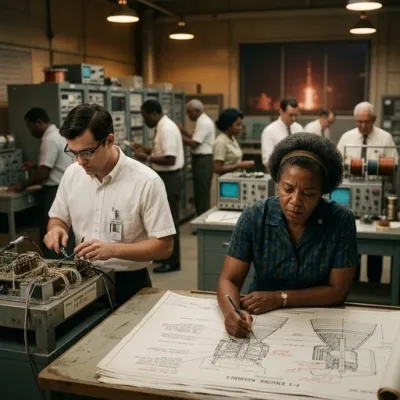
The Apollo program's triumphant Moon landings are often remembered through the astronauts who walked the lunar surface, yet *The Forgotten Engineers of the Apollo Program* argues that this achievement was built on the relentless, anonymous labor of hundreds of thousands of engineers, technicians, and support staff. The book traces the program's genesis from the NACA roots and the V-2 veterans through the frantic recruitment and organization of a massive workforce tasked with solving unprecedented problems. It details the monumental engineering feats required to create the Command Module—a robust lifeboat for the fiery return—and the Lunar Module, a fragile, weight-optimized spider designed solely for the vacuum of space. Central to these efforts was the development of the Saturn V's F-1 engines, where engineers tamed combustion instability to create the most powerful single-chamber rocket engine in history, and the Apollo Guidance Computer, a pioneering digital marvel that miniaturized real-time computing and established the foundations of modern software engineering.
The narrative emphasizes that success relied not just on individual components but on a philosophy of "engineering for failure" through radical redundancy, rigorous quality control, and exhaustive testing that simulated the lunar environment on Earth. The text highlights the critical, often overlooked roles of life support systems that sustained human biology in a void, communications networks that bridged the cosmic distance, and the global ground support infrastructure that tracked, fueled, and recovered the missions. The catastrophic Apollo 1 fire serves as a pivotal turning point, forcing a brutal, program-wide re-evaluation of materials, safety culture, and design philosophy that ultimately made subsequent missions safer. Later chapters explore the expansion of scientific capability through the Lunar Roving Vehicle and the ALSEP instrument packages, which transformed brief visits into geological expeditions, and the intricate recovery operations that safely returned crews and priceless samples.
Beyond the hardware, the book illuminates the human dimension of the enterprise: the mentorship chains passing hard-won intuition from NACA veterans to "young lions," the intense pressure and personal sacrifices of seven-day workweeks under a national deadline, and the ergonomic integration of astronauts into machines designed for human fallibility. It documents the explosion of patented innovations—from spacesuit joints and wire-mesh wheels to flame-resistant fabrics and cryogenic valves—that solved micro-problems collectively enabling the macro-goal. The emotional toll of the program is portrayed not as a side effect but as a fundamental component of the engineering culture, where the weight of human lives drove an obsession with perfection.
Ultimately, the book positions the Apollo engineers as the architects of the modern technological world. Their legacy extends far beyond the six landing sites, living on in the microelectronics revolution sparked by the AGC's integrated circuits, the real-time software paradigms that run today's avionics and smartphones, the reliability standards governing aerospace and medical manufacturing, and the deep space communications network enabling interplanetary exploration. By transforming the impossible into the repeatable, these unseen individuals normalized the extraordinary, proving that audacious visions are achieved not by solitary genius, but by the rigorous, collaborative, and sacrificial application of engineering discipline. Their names may be absent from history books, but their intellectual fingerprints are on every modern system that values precision, redundancy, and the relentless pursuit of the unknown.
What You'll Find Inside:
- The book reveals the untold stories of the engineers, scientists, and technicians whose work was essential to Apollo's success but who remained largely unrecognized in popular history
- It covers the full scope of Apollo engineering - from propulsion systems and guidance computers to life support, lunar surface exploration, and recovery operations
- The book emphasizes the human element: the pressure, dedication, sacrifices, and emotional toll experienced by those working behind the scenes on one of humanity's greatest endeavors
- It explains how lessons learned from failures (especially Apollo 1) led to engineering innovations in redundancy, reliability, and safety that continue to influence modern technology and space exploration
- It details the lasting legacy of Apollo engineering in today's technology, from microelectronics and software engineering to materials science and interdisciplinary collaboration approaches
Who's It For:
This book is ideal for space enthusiasts, engineering students and professionals, and anyone fascinated by the human stories behind technological achievements. Readers interested in the history of innovation, the collaborative nature of large-scale scientific endeavors, and the often-overlooked contributors to historic missions will find particular value in these pages. It will especially appeal to those who appreciate detailed technical explanations woven with personal narratives of dedication and perseverance.
Author:
Published By:
Date Published:
August 6, 2026
Type:
Nonfiction
Language:
English
Word Count:
44,622 words
Reading Time:
3 hours 7 minutes
Sample:
Order:
Order The Forgotten Engineers of the Apollo Program (Paperback) on MixCache.com:
Buy NowPrint copy is made to order and ships worldwide. Includes the ebook free, ready to read instantly.
$5 account credit for all new MixCache.com accounts, usable toward any ebook purchase!*