
Browse by Category
Fiction
- Action & Adventure
- African American
- Anthologies
- Children's Fiction
- Classics
- Comics & Graphic Novels
- Coming of Age
- Contemporary
- Cultural & Regional
- Drama
- Erotica
- Fantasy
- General
- Historical Fiction
- Horror
- Humor & Satire
- Literary Fiction
- Mystery, Thriller & Suspense
- Poetry
- Religious & Inspirational
- Romance
- Science Fiction
- Short Stories
- War & Military
- Westerns
- Women's Fiction
- Young Adult
Non-Fiction
- Antiques & Collectibles
- Arts & Photography
- Biographies & Memoirs
- Business & Money
- Children's Non-Fiction
-
Computers & Technology
- Artificial Intelligence
- Computer Science
- Cybersecurity & Cryptography
- Data Science & Analytics
- Databases & Big Data
- Game Development & Design
- General
- Hardware & DIY
- Mobile App Development
- Networking & Cloud Computing
- Operating Systems
- Programming
- Robotics
- Software
- Software Engineering
- User Experience (UX) & Design
- Web Development & Design
- Cooking, Food & Wine
- Crafts, Hobbies & Home
- Education & Teaching
- Engineering
- General
- Health, Fitness & Dieting
-
History
- African History
- African History - North Africa
- African History - Sub-Saharan Africa
- American History
- American History - 20th Century
- American History - Civil War
- American History - Colonial Period
- Ancient History
- Asian History
- Asian History - China
- Asian History - India
- Asian History - Japan
- Asian History - Southeast Asia
- European History
- European History - Ancient Greece
- European History - Ancient Rome
- European History - Medieval
- European History - Modern
- European History - Renaissance
- General
- Middle Eastern History
- Military History
- Military History - Aviation
- Military History - Naval
- Social & Cultural History
- World History
- Humor & Entertainment
- Industrial Technology
- Language Learning
- Law
- LGBTQ+ Non-Fiction
- Literary Criticism
- Medical Books
- Parenting & Relationships
- Philosophy
- Politics & Social Sciences
- Reference
- Religion & Spirituality
-
Science & Math
- Agricultural Sciences
- Astronomy & Space Science
- Behavioral Sciences
- Biological Sciences
- Botany & Plant Science
- Chemistry
- Earth Sciences
- Engineering - Chemical
- Engineering - Civil
- Engineering - Electrical
- Engineering - Mechanical
- Environment
- General
- Geology
- Mathematics
- Nature & Ecology
- Oceanography
- Paleontology
- Physics
- Statistics
- Self-Help
- Sports & Outdoors
- Study Aids
- Sustainability & Green Living
- Textbooks
- Transportation
- Travel
- True Crime
- Urban Planning & Development
- Veterinary Medicine
- Writing & Publishing
Jump to Section

Want unlimited access to all books published by MixCache.com (plus their audiobooks)? Try MixCache.com Total Access. Look for the MTA badge on book covers to identify included titles.
Access to infinite ebooks: Don't see the book you want? Suggest it and we'll create it (free!) for you from scratch with our powerful AI book writer. Then read it with MTA - besides profiting from any sales it makes!
The Forgotten Engineers of Ancient Rome
MTA
How Roman Innovations Shaped Modern Infrastructure
About this book:
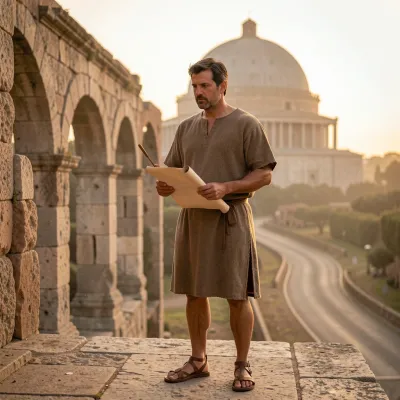
"The Forgotten Engineers of Ancient Rome" reveals how Roman engineers transformed pragmatic problem‑solving into the foundations of modern infrastructure. Beginning with early works like the Cloaca Maxima, the Aqua Appia, and the Via Appia, they established layered road construction, reliable water supply through gravity‑fed aqueducts, and the revolutionary use of pozzolana‑based concrete that enabled massive vaults, domes, and bridges. Their mastery of the arch, barrel and groin vaults, and the Pantheon’s unsupported concrete dome demonstrated a deep understanding of load distribution, material science, and large‑scale project management, while innovations in lifting devices, surveying tools, and timekeeping facilitated precise execution of monumental works.
Beyond grand monuments, Roman engineers integrated military and civilian expertise to build extensive harbor complexes, systematic urban grids with forums and public baths, sophisticated sanitation networks, and extensive mining and metallurgical operations that supplied the empire’s raw materials. Their engineering process—ranging from site reconnaissance and design to material selection, labor organization, quality control, and maintenance—was methodical and adaptable, allowing them to learn from failures such as bridge collapses or aqueduct leaks and continuously improve techniques. Economic analysis shows that state funding, private benefactors, and military labor combined to sustain these projects, which in turn stimulated trade, urbanization, and imperial cohesion.
The book traces the legacy of Roman engineering through the Byzantine preservation of aqueducts, walls, and domes; the medieval loss and gradual rediscovery of Roman techniques during the Carolingian, Romanesque, and Renaissance periods; and the eventual revival of hydraulic concrete, layered road building, and water management principles that underpin modern highways, bridges, dams, and urban utilities. Roman ideas of durability, utility, and systematic planning continue to shape contemporary architecture, from Neoclassical façades to reinforced concrete structures, and their emphasis on integrating infrastructure with the environment remains a model for sustainable development. In essence, the forgotten Roman engineers laid the enduring blueprint upon which much of today’s built environment rests.
What You'll Find Inside:
- The book details how Roman engineers designed and built gravity-fed aqueducts, using precise surveying and hydraulic concrete to supply cities with clean water for centuries.
- It explains the revolutionary structural principles of the arch, dome, and vault, exemplified by the Pantheon's massive concrete dome, which allowed unprecedented interior spaces.
- Roman road construction is examined, showcasing layered foundations, effective drainage, and straight alignments that became the model for modern highways.
- The development and widespread use of opus caementicium (Roman concrete) with pozzolana is highlighted as a durable, versatile material that enabled monumental structures and underwater works.
- The text explores Roman urban planning and sanitation, including grid layouts, public baths, and the Cloaca Maxima, illustrating early concepts of organized city living and public health.
Who's It For:
This book is ideal for history enthusiasts, engineering students, architects, and urban planners who want to understand how ancient Roman innovations laid the groundwork for modern infrastructure. It also appeals to general readers interested in the lasting impact of antiquity on today's built environment and the stories of the unsung engineers behind Rome's monumental achievements.
Author:
Published By:
Date Published:
August 4, 2026
Type:
Nonfiction
Language:
English
Word Count:
37,658 words
Reading Time:
2 hours 38 minutes
Sample:
Order:
Order The Forgotten Engineers of Ancient Rome (Hardcover) on MixCache.com:
Buy NowPrint copy is made to order and ships worldwide. Includes the ebook free, ready to read instantly.
$5 account credit for all new MixCache.com accounts, usable toward any ebook purchase!*


