Browse by Category
Fiction
- Action & Adventure
- African American
- Anthologies
- Children's Fiction
- Classics
- Comics & Graphic Novels
- Coming of Age
- Contemporary
- Cultural & Regional
- Drama
- Erotica
- Fantasy
- General
- Historical Fiction
- Horror
- Humor & Satire
- Literary Fiction
- Mystery, Thriller & Suspense
- Poetry
- Religious & Inspirational
- Romance
- Science Fiction
- Short Stories
- War & Military
- Westerns
- Women's Fiction
- Young Adult
Non-Fiction
- Antiques & Collectibles
- Arts & Photography
- Biographies & Memoirs
- Business & Money
- Children's Non-Fiction
-
Computers & Technology
- Artificial Intelligence
- Computer Science
- Cybersecurity & Cryptography
- Data Science & Analytics
- Databases & Big Data
- Game Development & Design
- General
- Hardware & DIY
- Mobile App Development
- Networking & Cloud Computing
- Operating Systems
- Programming
- Robotics
- Software
- Software Engineering
- User Experience (UX) & Design
- Web Development & Design
- Cooking, Food & Wine
- Crafts, Hobbies & Home
- Education & Teaching
- Engineering
- General
- Health, Fitness & Dieting
-
History
- African History
- African History - North Africa
- African History - Sub-Saharan Africa
- American History
- American History - 20th Century
- American History - Civil War
- American History - Colonial Period
- Ancient History
- Asian History
- Asian History - China
- Asian History - India
- Asian History - Japan
- Asian History - Southeast Asia
- European History
- European History - Ancient Greece
- European History - Ancient Rome
- European History - Medieval
- European History - Modern
- European History - Renaissance
- General
- Middle Eastern History
- Military History
- Military History - Aviation
- Military History - Naval
- Social & Cultural History
- World History
- Humor & Entertainment
- Industrial Technology
- Language Learning
- Law
- LGBTQ+ Non-Fiction
- Literary Criticism
- Medical Books
- Parenting & Relationships
- Philosophy
- Politics & Social Sciences
- Reference
- Religion & Spirituality
-
Science & Math
- Agricultural Sciences
- Astronomy & Space Science
- Behavioral Sciences
- Biological Sciences
- Botany & Plant Science
- Chemistry
- Earth Sciences
- Engineering - Chemical
- Engineering - Civil
- Engineering - Electrical
- Engineering - Mechanical
- Environment
- General
- Geology
- Mathematics
- Nature & Ecology
- Oceanography
- Paleontology
- Physics
- Statistics
- Self-Help
- Sports & Outdoors
- Study Aids
- Sustainability & Green Living
- Textbooks
- Transportation
- Travel
- True Crime
- Urban Planning & Development
- Veterinary Medicine
- Writing & Publishing
Jump to Section

Want unlimited access to all books published by MixCache.com (plus their audiobooks)? Try MixCache.com Total Access. Look for the MTA badge on book covers to identify included titles.
Access to infinite ebooks: Don't see the book you want? Suggest it and we'll create it (free!) for you from scratch with our powerful AI book writer. Then read it with MTA - besides profiting from any sales it makes!
Salt Caravans of the Sahara: A Trade History
MTA
How Desert Routes Shaped Global Economies
About this book:
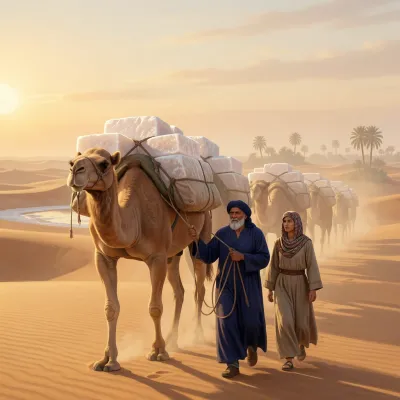
The Sahara’s salt, often called “white gold,” was far more than a seasoning; it was a vital necessity for survival, a powerful preservative, and a universally accepted currency that underpinned sophisticated commercial networks across Africa and beyond. Early human societies first sought salt for dietary and preservative needs, and localized barter laid the groundwork for trans‑Saharan trade. The geography of the desert—vast saline depressions like Taoudenni and Idjil, scattered oases, and rocky plateaus—dictated where salt could be extracted and how routes formed. Long before camels, early traders moved salt by human porter or donkey, but the introduction and widespread adoption of the dromedary camel in the first centuries CE revolutionized desert transport, enabling massive caravans to carry heavy loads across waterless expanses and dramatically increasing the volume and value of trade.
This camel‑fueled exchange of Saharan salt for West African gold became the economic engine of powerful empires. Ghana leveraged its intermediary position to tax the salt‑gold flow, Mali expanded control over both goldfields and salt mines, and Songhai further centralized power while directing the lucrative Taghaza mines. Further east, Kanem‑Bornu thrived on the Bilma salt trade with Tripoli and Cairo. Islamic expansion from the 7th century deepened these networks, bringing a common legal and linguistic framework, fostering intellectual centers like Timbuktu, and integrating the Sahara into a broader Mediterranean and Islamic world economy. Salt itself took on multiple roles: it functioned as currency, was essential in ritual and medicine, and, tragically, facilitated the trans‑Saharan slave trade, with enslaved people sometimes exchanged for salt or forced to work in salt mines. The Tuareg’s legendary Azalai caravans exemplified the skill, endurance, and cultural significance of desert traders who moved salt south and gold north, linking distant markets and spreading ideas, technologies, and faith.
By the early modern period, the old routes began to shift. Political fragmentation after the Moroccan invasion of Songhai, the rise of Ottoman priorities focused on the Mediterranean, and the growing competition from European maritime trade along the Atlantic coast eroded the Sahara’s centrality. Colonial powers in the 19th century redrew borders, imposed railways and roads, redirected trade toward coastal ports, and introduced new currencies and taxes that undermined traditional caravan economies. Indigenous resistance—armed revolts, route adaptation, smuggling, and cultural preservation—met these changes, but the advent of motorized transport in the 20th century ultimately supplanted the great camel caravans. Modern industrial mining now supplies global markets, yet the legacy of the Saharan salt trade endures in the cultural memory of desert communities, in the historic manuscripts of Timbuktu, and in the continued symbolic and practical value of salt. Environmental challenges like climate change and desertification threaten traditional practices, while the Sahara’s future is shaped by tourism, resource extraction, renewable energy projects, and geopolitical currents. Ultimately, the desert’s salt routes were crucial conduits that connected continents long before the age of oceangoing ships, shaping empires, spreading knowledge, and leaving an indelible mark on global history.
What You'll Find Inside:
- How salt functioned as 'white gold' and served as currency that powered West African empires like Ghana, Mali, and Songhai through the salt-gold exchange
- The revolutionary impact of camel domestication on Saharan trade, enabling massive caravans that connected distant civilizations across the desert
- Islamic expansion's role in transforming trade networks into culturally integrated systems that facilitated intellectual exchange, including Timbuktu's rise as a scholarly center
- How European colonialism and modern transportation disrupted centuries-old Saharan trade routes and traditional nomadic livelihoods
- The multifaceted significance of salt beyond economics - in ritual, medicine, cultural identity, and its connection to darker aspects like the trans-Saharan slave trade
Who's It For:
This book is ideal for history enthusiasts, particularly those interested in African economic history and trans-Saharan trade networks. It will appeal to students and scholars studying the rise and fall of West African empires, the cultural impact of Islamic expansion, and how geography shapes human civilization. Readers fascinated by commodities that drove historical change - like how salt influenced empires as much as gold - will find this comprehensive account especially valuable.
Author:
Published By:
Date Published:
August 3, 2026
Type:
Nonfiction
Language:
English
Word Count:
50,280 words
Reading Time:
3 hours 31 minutes
Sample:
Order:
Order Salt Caravans of the Sahara: A Trade History (Hardcover) on MixCache.com:
Buy NowPrint copy is made to order and ships worldwide. Includes the ebook free, ready to read instantly.
$5 account credit for all new MixCache.com accounts, usable toward any ebook purchase!*