Browse by Category
Fiction
- Action & Adventure
- African American
- Anthologies
- Children's Fiction
- Classics
- Comics & Graphic Novels
- Coming of Age
- Contemporary
- Cultural & Regional
- Drama
- Erotica
- Fantasy
- General
- Historical Fiction
- Horror
- Humor & Satire
- Literary Fiction
- Mystery, Thriller & Suspense
- Poetry
- Religious & Inspirational
- Romance
- Science Fiction
- Short Stories
- War & Military
- Westerns
- Women's Fiction
- Young Adult
Non-Fiction
- Antiques & Collectibles
- Arts & Photography
- Biographies & Memoirs
- Business & Money
- Children's Non-Fiction
-
Computers & Technology
- Artificial Intelligence
- Computer Science
- Cybersecurity & Cryptography
- Data Science & Analytics
- Databases & Big Data
- Game Development & Design
- General
- Hardware & DIY
- Mobile App Development
- Networking & Cloud Computing
- Operating Systems
- Programming
- Robotics
- Software
- Software Engineering
- User Experience (UX) & Design
- Web Development & Design
- Cooking, Food & Wine
- Crafts, Hobbies & Home
- Education & Teaching
- Engineering
- General
- Health, Fitness & Dieting
-
History
- African History
- African History - North Africa
- African History - Sub-Saharan Africa
- American History
- American History - 20th Century
- American History - Civil War
- American History - Colonial Period
- Ancient History
- Asian History
- Asian History - China
- Asian History - India
- Asian History - Japan
- Asian History - Southeast Asia
- European History
- European History - Ancient Greece
- European History - Ancient Rome
- European History - Medieval
- European History - Modern
- European History - Renaissance
- General
- Middle Eastern History
- Military History
- Military History - Aviation
- Military History - Naval
- Social & Cultural History
- World History
- Humor & Entertainment
- Industrial Technology
- Language Learning
- Law
- LGBTQ+ Non-Fiction
- Literary Criticism
- Medical Books
- Parenting & Relationships
- Philosophy
- Politics & Social Sciences
- Reference
- Religion & Spirituality
-
Science & Math
- Agricultural Sciences
- Astronomy & Space Science
- Behavioral Sciences
- Biological Sciences
- Botany & Plant Science
- Chemistry
- Earth Sciences
- Engineering - Chemical
- Engineering - Civil
- Engineering - Electrical
- Engineering - Mechanical
- Environment
- General
- Geology
- Mathematics
- Nature & Ecology
- Oceanography
- Paleontology
- Physics
- Statistics
- Self-Help
- Sports & Outdoors
- Study Aids
- Sustainability & Green Living
- Textbooks
- Transportation
- Travel
- True Crime
- Urban Planning & Development
- Veterinary Medicine
- Writing & Publishing
Jump to Section

Want unlimited access to all books published by MixCache.com (plus their audiobooks)? Try MixCache.com Total Access. Look for the MTA badge on book covers to identify included titles.
Access to infinite ebooks: Don't see the book you want? Suggest it and we'll create it (free!) for you from scratch with our powerful AI book writer. Then read it with MTA - besides profiting from any sales it makes!
The Hidden History of the Trans-Saharan Trade
MTA
Routes, Cultures, and Economies Across the Sahara
About this book:
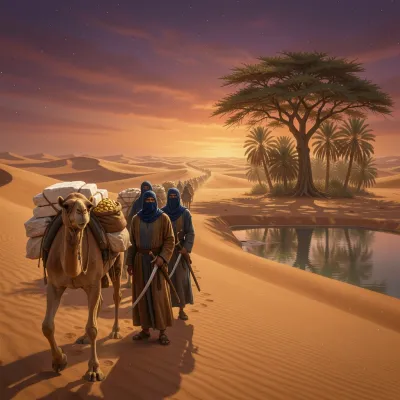
The Hidden History of the Trans-Saharan Trade reveals the Sahara Desert not as an impenetrable barrier, but as a dynamic bridge that facilitated centuries of profound economic, cultural, and intellectual exchange between North and Sub-Saharan Africa. The book traces how the introduction of the camel revolutionized desert travel, enabling the movement of core commodities—gold from West African fields, salt from desert mines like Taghaza, and tragically, enslaved people—which formed the economic backbone of vast trade networks. Berber groups, particularly the Sanhaja and Tuareg, emerged as indispensable masters of these routes, leveraging their deep ecological knowledge to organize caravans, control key oases, and act as intermediaries between Mediterranean markets and the gold-rich kingdoms of the south.
This trade catalyzed the rise and fall of powerful West African empires. Ghana initially thrived by taxing gold passing through its territory, setting a precedent for state control of trade. Mali reached its zenith under Mansa Musa, whose legendary pilgrimage showcased the empire's immense wealth and fueled the intellectual flowering of Timbuktu—a city transformed into a legendary center of Islamic scholarship and manuscript culture. Songhai later consolidated power, further securing routes and fostering cosmopolitan hubs like Gao and Djenné. Concurrently, the spread of Islam, facilitated by merchant caravans and scholarly exchange, created a shared religious and legal framework across the Sahara, evident in the distinctive mud-brick architecture of mosques, the spread of Arabic and Ajami scripts, and the flourishing of centers like Sankore University in Timbuktu.
The book details the gradual decline of these overland routes, beginning with the Moroccan destruction of Songhai in 1591 and accelerating with European maritime exploration that bypassed the Sahara for direct coastal access to gold and slaves. Colonialism then delivered the final blow, imposing arbitrary borders that fragmented nomadic territories, redirecting trade toward coastal ports, and undermining traditional caravan economies through infrastructure focused on extraction rather than trans-desert exchange. Yet, the legacy endures: in the widespread practice of Islam across the Sahel, the resilience of Timbuktu's manuscripts, the linguistic fusion of Arabic and indigenous languages, the continued (though diminished) salt trade like the Azalai caravans, and the enduring conception of the Sahara as a space of connection rather than isolation—a narrative the book reclaims as central to understanding Africa's interconnected global history.
What You'll Find Inside:
- How the camel's unique adaptations revolutionized desert travel, enabling the Trans-Saharan trade networks that connected North and Sub-Saharan Africa for over a millennium
- The pivotal role of gold, salt, and the tragic slave trade as core commodities that drove empires, shaped economies, and left enduring legacies across the Sahara
- How Berber masters of the desert created and managed sophisticated caravan networks, acting as essential intermediaries and cultural brokers between diverse societies
- The flourishing of Islamic scholarship and intellectual exchange that transformed cities like Timbuktu into renowned centers of learning, preserving tens of thousands of manuscripts
- The enduring cultural, linguistic, and economic legacies of Trans-Saharan trade that continue to influence contemporary Africa, challenging narratives of continental isolation
Who's It For:
This book is ideal for students, scholars, and general readers interested in African history, world history, and pre-modern globalization. It particularly benefits those seeking to understand Africa's central role in global trade networks before European dominance, the rise and fall of West African empires, and the profound cultural exchanges across the Sahara. Readers looking for a decolonized historical perspective that highlights African agency and intellectual achievements will find this work especially valuable.
Author:
Published By:
Date Published:
August 3, 2026
Type:
Nonfiction
Language:
English
Word Count:
41,043 words
Reading Time:
2 hours 52 minutes
Sample:
Order:
Order The Hidden History of the Trans-Saharan Trade (Hardcover) on MixCache.com:
Buy NowPrint copy is made to order and ships worldwide. Includes the ebook free, ready to read instantly.
$5 account credit for all new MixCache.com accounts, usable toward any ebook purchase!*