
Browse by Category
Fiction
- Action & Adventure
- African American
- Anthologies
- Children's Fiction
- Classics
- Comics & Graphic Novels
- Coming of Age
- Contemporary
- Cultural & Regional
- Drama
- Erotica
- Fantasy
- General
- Historical Fiction
- Horror
- Humor & Satire
- Literary Fiction
- Mystery, Thriller & Suspense
- Poetry
- Religious & Inspirational
- Romance
- Science Fiction
- Short Stories
- War & Military
- Westerns
- Women's Fiction
- Young Adult
Non-Fiction
- Antiques & Collectibles
- Arts & Photography
- Biographies & Memoirs
- Business & Money
- Children's Non-Fiction
-
Computers & Technology
- Artificial Intelligence
- Computer Science
- Cybersecurity & Cryptography
- Data Science & Analytics
- Databases & Big Data
- Game Development & Design
- General
- Hardware & DIY
- Mobile App Development
- Networking & Cloud Computing
- Operating Systems
- Programming
- Robotics
- Software
- Software Engineering
- User Experience (UX) & Design
- Web Development & Design
- Cooking, Food & Wine
- Crafts, Hobbies & Home
- Education & Teaching
- Engineering
- General
- Health, Fitness & Dieting
-
History
- African History
- African History - North Africa
- African History - Sub-Saharan Africa
- American History
- American History - 20th Century
- American History - Civil War
- American History - Colonial Period
- Ancient History
- Asian History
- Asian History - China
- Asian History - India
- Asian History - Japan
- Asian History - Southeast Asia
- European History
- European History - Ancient Greece
- European History - Ancient Rome
- European History - Medieval
- European History - Modern
- European History - Renaissance
- General
- Middle Eastern History
- Military History
- Military History - Aviation
- Military History - Naval
- Social & Cultural History
- World History
- Humor & Entertainment
- Industrial Technology
- Language Learning
- Law
- LGBTQ+ Non-Fiction
- Literary Criticism
- Medical Books
- Parenting & Relationships
- Philosophy
- Politics & Social Sciences
- Reference
- Religion & Spirituality
-
Science & Math
- Agricultural Sciences
- Astronomy & Space Science
- Behavioral Sciences
- Biological Sciences
- Botany & Plant Science
- Chemistry
- Earth Sciences
- Engineering - Chemical
- Engineering - Civil
- Engineering - Electrical
- Engineering - Mechanical
- Environment
- General
- Geology
- Mathematics
- Nature & Ecology
- Oceanography
- Paleontology
- Physics
- Statistics
- Self-Help
- Sports & Outdoors
- Study Aids
- Sustainability & Green Living
- Textbooks
- Transportation
- Travel
- True Crime
- Urban Planning & Development
- Veterinary Medicine
- Writing & Publishing
Jump to Section

Want unlimited access to all books published by MixCache.com (plus their audiobooks)? Try MixCache.com Total Access. Look for the MTA badge on book covers to identify included titles.
Access to infinite ebooks: Don't see the book you want? Suggest it and we'll create it (free!) for you from scratch with our powerful AI book writer. Then read it with MTA - besides profiting from any sales it makes!
Spices of the Silk Road: A Global Journey
MTA
How Trade Shaped Cuisine and Culture
About this book:
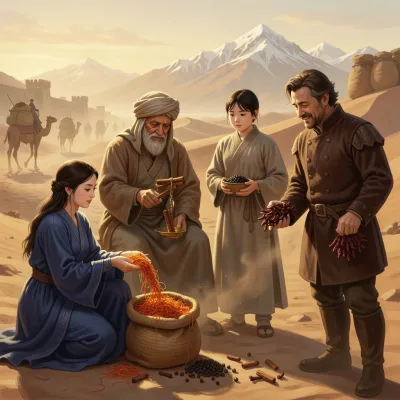
"Spices of the Silk Road: A Global Journey" traces the profound influence of spices from their earliest use in ancient civilizations to their role in shaping modern cuisine, medicine, economics, and culture. Beginning with archaeological evidence of spice use dating back tens of thousands of years, the book explores how early societies in Mesopotamia, Egypt, the Indus Valley, and China integrated aromatic plants into daily life, medicine, and ritual, laying the groundwork for the first trade networks. It then details the emergence of the Silk Road—both overland and maritime—highlighting the pivotal roles of Chinese envoys, Arab merchants, and later Italian city‑states like Venice in moving coveted commodities such as cinnamon, black pepper, cloves, nutmeg, and saffron across continents, fostering unprecedented cultural and technological exchange.
The narrative follows the individual sagas of key spices, illustrating how their unique origins and properties drove empires and exploration. Black pepper’s dominance as the “King of Spices” fueled Roman wealth and later Venetian monopolies, while the elusive cloves and nutmeg of the Spice Islands sparked brutal competition, leading to the rise of the Dutch and British East India Companies and the establishment of colonial monopolies backed by military force. The book also examines how the Ottoman Empire acted as a bridge for spice flow, how African cuisines absorbed and transformed imported aromatics, and how the Columbian Exchange introduced New World flavors like chili peppers, vanilla, and allspice that forever altered global palates. Throughout, it underscores the dual role of spices as culinary enhancers and medicinal agents, their integration into religious rites, and their power to spur innovation in blending practices such as Indian masalas and North African ras el hanout.
Finally, the work brings the story into the present, analyzing the modern spice trade’s challenges—price volatility, adulteration, climate change, and ethical sourcing—while noting continuities in production regions and the enduring cultural significance of spices in rituals, health, and gastronomy. It concludes by looking ahead to sustainable cultivation, biotechnological advances, and the ever‑expanding global palate, emphasizing that spices remain a living testament to humanity’s enduring desire for flavor, connection, and discovery.
What You'll Find Inside:
- The book traces how early civilizations in Mesopotamia, Egypt, the Indus Valley, and China first discovered and valued spices for flavor, medicine, and ritual, laying the foundation for long-distance trade.
- It explains the emergence of the Silk Road as a vast network of land and sea routes that connected East and West, enabling the exchange of spices like cinnamon, pepper, cloves, and saffron alongside ideas and technologies.
- Individual chapters detail the histories of key spices—black pepper as the 'King of Spices,' cloves and nutmeg from the Spice Islands, saffron as a luxury, and ginger/turmeric as medicinal staples—showing their impact on empires, economies, and cuisines.
- The work examines how the spice trade drove the Age of Exploration, prompted colonial competition, and shaped the rise and fall of trading empires such as the Venetian, Dutch, and British East India Companies.
- Finally, it discusses the modern spice trade, covering challenges like sustainability and adulteration, continuities in cultural rituals, and ongoing innovations that keep spices central to global cuisine and health.
Who's It For:
This book is ideal for readers interested in world history, food culture, and the economics of trade—including students, academics, food enthusiasts, and anyone curious about how everyday ingredients have shaped empires, exploration, and modern globalization. It offers a richly detailed yet accessible narrative that connects ancient trade routes to contemporary spice markets, making it valuable for both casual readers and those seeking deeper insight into the cultural significance of spices.
Author:
Published By:
Date Published:
August 2, 2026
Type:
Nonfiction
Language:
English
Word Count:
39,876 words
Reading Time:
2 hours 48 minutes
Sample:
MixCache.com Total Access
Get unlimited access to this book + all books published by MixCache.com for $11.99/month
Subscribe to MTAOr purchase this book individually below
Order:
Buy the Spices of the Silk Road: A Global Journey ebook on MixCache.com:
Buy Now
Full ebook will be available immediately
- read online or download as a PDF file.
$5 account credit for all new MixCache.com accounts, usable toward any ebook purchase!*


Ratings & Reviews
Ask Questions About This Book
Have a question about the content? Ask our AI assistant!
Start by asking a question about "Spices of the Silk Road: A Global Journey"
Example: "Does this book mention William Shakespeare?"
Thinking...