
Browse by Category
Fiction
- Action & Adventure
- African American
- Anthologies
- Children's Fiction
- Classics
- Comics & Graphic Novels
- Coming of Age
- Contemporary
- Cultural & Regional
- Drama
- Erotica
- Fantasy
- General
- Historical Fiction
- Horror
- Humor & Satire
- Literary Fiction
- Mystery, Thriller & Suspense
- Poetry
- Religious & Inspirational
- Romance
- Science Fiction
- Short Stories
- War & Military
- Westerns
- Women's Fiction
- Young Adult
Non-Fiction
- Antiques & Collectibles
- Arts & Photography
- Biographies & Memoirs
- Business & Money
- Children's Non-Fiction
-
Computers & Technology
- Artificial Intelligence
- Computer Science
- Cybersecurity & Cryptography
- Data Science & Analytics
- Databases & Big Data
- Game Development & Design
- General
- Hardware & DIY
- Mobile App Development
- Networking & Cloud Computing
- Operating Systems
- Programming
- Robotics
- Software
- Software Engineering
- User Experience (UX) & Design
- Web Development & Design
- Cooking, Food & Wine
- Crafts, Hobbies & Home
- Education & Teaching
- Engineering
- General
- Health, Fitness & Dieting
-
History
- African History
- African History - North Africa
- African History - Sub-Saharan Africa
- American History
- American History - 20th Century
- American History - Civil War
- American History - Colonial Period
- Ancient History
- Asian History
- Asian History - China
- Asian History - India
- Asian History - Japan
- Asian History - Southeast Asia
- European History
- European History - Ancient Greece
- European History - Ancient Rome
- European History - Medieval
- European History - Modern
- European History - Renaissance
- General
- Middle Eastern History
- Military History
- Military History - Aviation
- Military History - Naval
- Social & Cultural History
- World History
- Humor & Entertainment
- Industrial Technology
- Language Learning
- Law
- LGBTQ+ Non-Fiction
- Literary Criticism
- Medical Books
- Parenting & Relationships
- Philosophy
- Politics & Social Sciences
- Reference
- Religion & Spirituality
-
Science & Math
- Agricultural Sciences
- Astronomy & Space Science
- Behavioral Sciences
- Biological Sciences
- Botany & Plant Science
- Chemistry
- Earth Sciences
- Engineering - Chemical
- Engineering - Civil
- Engineering - Electrical
- Engineering - Mechanical
- Environment
- General
- Geology
- Mathematics
- Nature & Ecology
- Oceanography
- Paleontology
- Physics
- Statistics
- Self-Help
- Sports & Outdoors
- Study Aids
- Sustainability & Green Living
- Textbooks
- Transportation
- Travel
- True Crime
- Urban Planning & Development
- Veterinary Medicine
- Writing & Publishing
Jump to Section

Want unlimited access to all books published by MixCache.com (plus their audiobooks)? Try MixCache.com Total Access. Look for the MTA badge on book covers to identify included titles.
Access to infinite ebooks: Don't see the book you want? Suggest it and we'll create it (free!) for you from scratch with our powerful AI book writer. Then read it with MTA - besides profiting from any sales it makes!
The Science of Coral Reef Restoration
MTA
How Reefs Recover and Thrive
About this book:
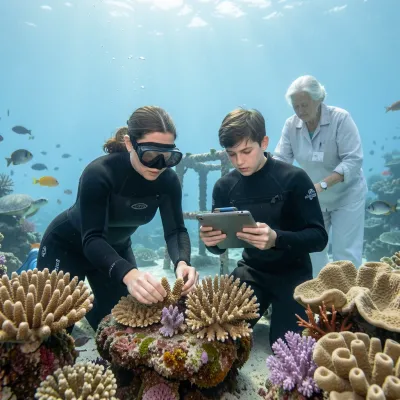
"The Science of Coral Reef Restoration: How Reefs Recover and Thrive" provides a comprehensive guide to restoring degraded coral reefs, beginning with an overview of reef biodiversity, ecosystem services, and the myriad threats they face—including climate change, ocean acidification, pollution, overfishing, disease, and physical damage. It delves into coral biology, explaining polyp structure, symbiotic relationships with zooxanthellae, reproductive strategies (both asexual fragmentation and sexual spawning), and growth requirements, laying the scientific foundation for restoration efforts. The book then outlines the principles of ecological restoration in marine contexts, emphasizing historical baselines, root‑cause mitigation, resilience, connectivity, adaptive management, stakeholder engagement, and the importance of restoring ecological functions rather than merely species.
Practical methodologies are detailed across subsequent chapters: site selection and assessment criteria; asexual coral propagation via fragmentation and nursery management (including mid‑water coral trees, bottom nurseries, and microfragmentation); sexual reproduction techniques involving larval rearing, settlement cues, and larval enhancement; substrate preparation and the use of artificial reef structures; outplanting methods for secure attachment and survivorship; genetic considerations to maintain diversity and avoid monocultures; herbivory and algal management through grazer protection and active interventions; community engagement and local participation as vital for long‑term success; monitoring and adaptive management frameworks using ecological and physical indicators; and metrics for measuring recovery such as coral cover, species richness, growth rates, recruitment, fish abundance, and structural complexity. The text also covers socioeconomic benefits (tourism, fisheries, coastal protection, cultural heritage), policy and governance tools (marine protected areas, national action plans, community‑based management), financing mechanisms (grants, blue bonds, debt‑for‑nature swaps, crowdfunding, impact investing), and global case studies illustrating successful projects in Florida, the Great Barrier Reef, Seychelles, Maldives, and Bonaire.
Addressing challenges, the book acknowledges the limits posed by climate change, scale mismatches, funding constraints, technical complexity, knowledge gaps, slow coral growth, persistent local stressors, disease outbreaks, genetic homogeneity risks, remote logistics, extreme weather, stakeholder conflicts, and ecosystem complexity. It highlights innovative technologies—underwater robotics (ROVs/AUVs), 3D‑printed biomimetic structures, AI‑driven image analysis and predictive modeling, sensor networks, sensor‑AI integration, advanced materials, bio‑acoustics, AR/VR training, and blockchain for provenance—to increase efficiency and scale. Scaling up strategies involve mass coral production facilities, larval enhancement, fleets of autonomous underwater vehicles, integrated algal and herbivore management, sustainable financing (blue bonds, public‑private partnerships), cohesive policy frameworks, capacity building, strategic site prioritization, reef‑mosaic/network approaches, genetic diversity management, and linking restoration with broader conservation (MPAs, fisheries management, pollution control, climate mitigation). The work concludes with a forward‑looking perspective on reef resilience, adaptation, refugia, assisted evolution, technological innovation, scaling up, integrated ridge‑to‑reef management, and the enduring hope that coordinated global action can secure vibrant, self‑sustaining reefs for future generations.
What You'll Find Inside:
- Coral reefs are biodiversity hotspots providing essential ecosystem services such as coastal protection, fisheries, tourism revenue, and potential medical compounds, making their restoration vital for both ecological and human well-being.
- The book details the full restoration workflow—from understanding coral biology and threats (bleaching, disease, overfishing, pollution) to practical techniques like asexual fragmentation, larval rearing, nursery management, substrate preparation, and outplanting.
- Genetic diversity and assisted evolution are emphasized as critical for long-term reef resilience, with strategies for sourcing diverse donor colonies, tracking genotypes, and integrating sexual reproduction to avoid monocultures.
- Successful restoration hinges on ecological principles such as addressing root causes, fostering connectivity, adaptive management, community engagement, and restoring functional groups like herbivores to control algal overgrowth.
- Monitoring, adaptive management, and measurable ecological indicators (coral cover, recruitment, fish abundance, structural complexity) are essential to evaluate success and guide iterative improvements in restoration projects.
Who's It For:
This book is ideal for marine biology students, reef restoration practitioners, environmental policymakers, and coastal conservation NGOs seeking a comprehensive, science‑based guide to coral reef recovery. It also benefits researchers and graduate students looking for detailed methodologies and case studies, as well as concerned citizens and community leaders who want to understand both the ecological challenges and the socioeconomic opportunities involved in reef restoration.
Author:
Published By:
Date Published:
August 2, 2026
Type:
Nonfiction
Language:
English
Word Count:
45,436 words
Reading Time:
3 hours 11 minutes
Sample:
MixCache.com Total Access
Get unlimited access to this book + all books published by MixCache.com for $11.99/month
Subscribe to MTAOr purchase this book individually below
Order:
Buy the The Science of Coral Reef Restoration ebook on MixCache.com:
Buy Now
Full ebook will be available immediately
- read online or download as a PDF file.
$5 account credit for all new MixCache.com accounts, usable toward any ebook purchase!*




Ratings & Reviews
Ask Questions About This Book
Have a question about the content? Ask our AI assistant!
Start by asking a question about "The Science of Coral Reef Restoration"
Example: "Does this book mention William Shakespeare?"
Thinking...