Browse by Category
Fiction
- Action & Adventure
- African American
- Anthologies
- Children's Fiction
- Classics
- Comics & Graphic Novels
- Coming of Age
- Contemporary
- Cultural & Regional
- Drama
- Erotica
- Fantasy
- General
- Historical Fiction
- Horror
- Humor & Satire
- Literary Fiction
- Mystery, Thriller & Suspense
- Poetry
- Religious & Inspirational
- Romance
- Science Fiction
- Short Stories
- War & Military
- Westerns
- Women's Fiction
- Young Adult
Non-Fiction
- Antiques & Collectibles
- Arts & Photography
- Biographies & Memoirs
- Business & Money
- Children's Non-Fiction
-
Computers & Technology
- Artificial Intelligence
- Computer Science
- Cybersecurity & Cryptography
- Data Science & Analytics
- Databases & Big Data
- Game Development & Design
- General
- Hardware & DIY
- Mobile App Development
- Networking & Cloud Computing
- Operating Systems
- Programming
- Robotics
- Software
- Software Engineering
- User Experience (UX) & Design
- Web Development & Design
- Cooking, Food & Wine
- Crafts, Hobbies & Home
- Education & Teaching
- Engineering
- General
- Health, Fitness & Dieting
-
History
- African History
- African History - North Africa
- African History - Sub-Saharan Africa
- American History
- American History - 20th Century
- American History - Civil War
- American History - Colonial Period
- Ancient History
- Asian History
- Asian History - China
- Asian History - India
- Asian History - Japan
- Asian History - Southeast Asia
- European History
- European History - Ancient Greece
- European History - Ancient Rome
- European History - Medieval
- European History - Modern
- European History - Renaissance
- General
- Middle Eastern History
- Military History
- Military History - Aviation
- Military History - Naval
- Social & Cultural History
- World History
- Humor & Entertainment
- Industrial Technology
- Language Learning
- Law
- LGBTQ+ Non-Fiction
- Literary Criticism
- Medical Books
- Parenting & Relationships
- Philosophy
- Politics & Social Sciences
- Reference
- Religion & Spirituality
-
Science & Math
- Agricultural Sciences
- Astronomy & Space Science
- Behavioral Sciences
- Biological Sciences
- Botany & Plant Science
- Chemistry
- Earth Sciences
- Engineering - Chemical
- Engineering - Civil
- Engineering - Electrical
- Engineering - Mechanical
- Environment
- General
- Geology
- Mathematics
- Nature & Ecology
- Oceanography
- Paleontology
- Physics
- Statistics
- Self-Help
- Sports & Outdoors
- Study Aids
- Sustainability & Green Living
- Textbooks
- Transportation
- Travel
- True Crime
- Urban Planning & Development
- Veterinary Medicine
- Writing & Publishing
Jump to Section

Want unlimited access to all books published by MixCache.com (plus their audiobooks)? Try MixCache.com Total Access. Look for the MTA badge on book covers to identify included titles.
Access to infinite ebooks: Don't see the book you want? Suggest it and we'll create it (free!) for you from scratch with our powerful AI book writer. Then read it with MTA - besides profiting from any sales it makes!
The Secret History of Seaweed Farming
MTA
How Coastal Communities Cultivated the Ocean
About this book:
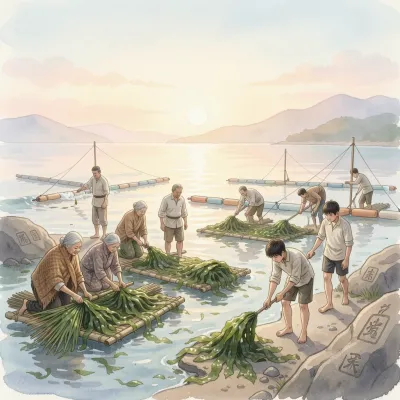
The Secret History of Seaweed Farming traces humanity's relationship with marine algae from ancient foraging practices to modern aquaculture innovations. Early coastal societies worldwide independently discovered seaweed's value for sustenance, medicine, and practical applications, with archaeological evidence showing its use dating back millennia. In East Asia, particularly Japan, Korea, and China, these interactions evolved into sophisticated cultivation techniques—from Japan's hibi method using bamboo branches to Korea's floating raft systems and China's substrate placement—transforming wild harvests into managed crops driven by culinary demands and population pressures.
The book details how scientific understanding and technological advancements revolutionized seaweed farming, particularly after World War II. Kathleen Drew-Baker's discovery of the Porphyra life cycle enabled reliable spore seeding, while synthetic materials and floating longline systems dramatically increased efficiency and scalability. The Industrial Revolution created new demands for seaweed-derived products like iodine, agar, and alginates, and the World Wars highlighted its strategic importance. These developments facilitated seaweed farming's global spread beyond Asia, with adaptations like the Philippines' tie-tie method for carrageenan-producing seaweeds and kelp cultivation initiatives in temperate waters worldwide.
Today, seaweed farming represents a multifaceted industry with significant economic, environmental, and innovative dimensions. It provides livelihoods for millions across coastal communities, particularly empowering women in developing nations, while offering crucial ecosystem services including carbon sequestration, nutrient remediation, and coastal protection. Modern applications have expanded far beyond food to include pharmaceuticals, cosmetics, bioplastics, animal feed supplements that reduce livestock methane emissions, and potential biofuel sources. The industry increasingly emphasizes sustainable practices through integrated multi-trophic aquaculture, certification programs, and blending traditional ecological knowledge with scientific innovation to address climate change challenges and realize the vision of productive, regenerative ocean gardens.
What You'll Find Inside:
- Discover how ancient Japanese, Korean, and Chinese coastal communities pioneered systematic seaweed cultivation, transforming wild harvests into sophisticated farming techniques over centuries.
- Trace the evolution from simple foraging to modern aquaculture through key innovations like nori nets, artificial spore seeding, and longline systems that enabled global expansion.
- Explore seaweed's dual legacy as both a culinary cornerstone (nori, gim, wakame) and vital industrial resource (iodine, alginates, carrageenan) throughout human history.
- Learn how seaweed farming provides critical ecosystem services including carbon sequestration, nutrient remediation, and coastal protection against climate change impacts.
- Understand the global spread of seaweed farming and its role as an economic engine empowering coastal communities through sustainable livelihoods and community resilience.
Who's It For:
This book is ideal for students, researchers, and professionals in aquaculture, marine biology, environmental science, and sustainable agriculture seeking a comprehensive understanding of seaweed cultivation's historical development and future potential. It will also appeal to policymakers and coastal community leaders interested in leveraging seaweed for economic development and climate resilience. General readers fascinated by food history, traditional ecological knowledge, or innovative climate solutions will find the narrative engaging and informative.
Author:
Published By:
Date Published:
August 2, 2026
Type:
Nonfiction
Language:
English
Word Count:
36,295 words
Reading Time:
2 hours 33 minutes
Sample:
Order:
Order The Secret History of Seaweed Farming (Paperback) on MixCache.com:
Buy NowPrint copy is made to order and ships worldwide. Includes the ebook free, ready to read instantly.
$5 account credit for all new MixCache.com accounts, usable toward any ebook purchase!*