
Browse by Category
Fiction
- Action & Adventure
- African American
- Anthologies
- Children's Fiction
- Classics
- Comics & Graphic Novels
- Coming of Age
- Contemporary
- Cultural & Regional
- Drama
- Erotica
- Fantasy
- General
- Historical Fiction
- Horror
- Humor & Satire
- Literary Fiction
- Mystery, Thriller & Suspense
- Poetry
- Religious & Inspirational
- Romance
- Science Fiction
- Short Stories
- War & Military
- Westerns
- Women's Fiction
- Young Adult
Non-Fiction
- Antiques & Collectibles
- Arts & Photography
- Biographies & Memoirs
- Business & Money
- Children's Non-Fiction
-
Computers & Technology
- Artificial Intelligence
- Computer Science
- Cybersecurity & Cryptography
- Data Science & Analytics
- Databases & Big Data
- Game Development & Design
- General
- Hardware & DIY
- Mobile App Development
- Networking & Cloud Computing
- Operating Systems
- Programming
- Robotics
- Software
- Software Engineering
- User Experience (UX) & Design
- Web Development & Design
- Cooking, Food & Wine
- Crafts, Hobbies & Home
- Education & Teaching
- Engineering
- General
- Health, Fitness & Dieting
-
History
- African History
- African History - North Africa
- African History - Sub-Saharan Africa
- American History
- American History - 20th Century
- American History - Civil War
- American History - Colonial Period
- Ancient History
- Asian History
- Asian History - China
- Asian History - India
- Asian History - Japan
- Asian History - Southeast Asia
- European History
- European History - Ancient Greece
- European History - Ancient Rome
- European History - Medieval
- European History - Modern
- European History - Renaissance
- General
- Middle Eastern History
- Military History
- Military History - Aviation
- Military History - Naval
- Social & Cultural History
- World History
- Humor & Entertainment
- Industrial Technology
- Language Learning
- Law
- LGBTQ+ Non-Fiction
- Literary Criticism
- Medical Books
- Parenting & Relationships
- Philosophy
- Politics & Social Sciences
- Reference
- Religion & Spirituality
-
Science & Math
- Agricultural Sciences
- Astronomy & Space Science
- Behavioral Sciences
- Biological Sciences
- Botany & Plant Science
- Chemistry
- Earth Sciences
- Engineering - Chemical
- Engineering - Civil
- Engineering - Electrical
- Engineering - Mechanical
- Environment
- General
- Geology
- Mathematics
- Nature & Ecology
- Oceanography
- Paleontology
- Physics
- Statistics
- Self-Help
- Sports & Outdoors
- Study Aids
- Sustainability & Green Living
- Textbooks
- Transportation
- Travel
- True Crime
- Urban Planning & Development
- Veterinary Medicine
- Writing & Publishing
Jump to Section

Want unlimited access to all books published by MixCache.com (plus their audiobooks)? Try MixCache.com Total Access. Look for the MTA badge on book covers to identify included titles.
Access to infinite ebooks: Don't see the book you want? Suggest it and we'll create it (free!) for you from scratch with our powerful AI book writer. Then read it with MTA - besides profiting from any sales it makes!
The Forgotten Recipes of Medieval Monasteries
MTA
Cooking and Culture in the Middle Ages
About this book:
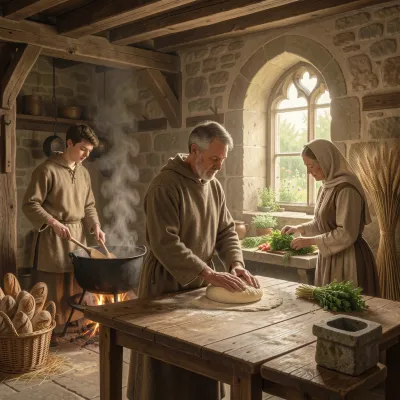
The Forgotten Recipes of Medieval Monasteries explores how the Benedictine ideal of ora et labora shaped every aspect of monastic food life, turning monasteries into self‑sufficient centers of agricultural innovation, culinary craft, and spiritual discipline. From the Rule of Saint Benedict’s directives on moderation and the prohibition of four‑footed meat to the daily rhythms of prayer, labor, and silent meals in the refectory, food was both sustenance and sacrament. Bread, produced in vast bakehouses using stone ovens, natural leaveners, and locally grown grains, formed the literal and symbolic staff of life, while the monastic kitchen—staffed by monks, conversi, and lay workers—relied on open‑hearth cauldrons, querns, and meticulous mise en place to feed the community.
Monastic estates became models of pre‑industrial food technology: extensive grain fields powered by watermills and windmills, orchards and herb gardens supplying vegetables, fruits, and medicinal plants, dairy herds yielding cheese and butter, apiaries providing honey and beeswax, and sophisticated fishponds ensuring a steady supply of aquatic protein. Preservation techniques—salting, smoking, drying, and fermentation—allowed monasteries to store surpluses for lean months and fasts, and their brewing and winemaking produced ale, wine, cider, and mead that were safer than water and contributed calories and communal spirit. Spices acquired through long‑distance trade, though used sparingly, added flavor, medicinal value, and prestige on feast days, while the monastic larder stored legumes, dried fruits, salted fish, and cured meats as essential staples.
The monastic diet oscillated between fasting and feasting, governed by liturgical calendars that limited meat, dairy, and eggs during Lent and Advent but allowed richer fare on saints’ days and solemnities. This cycle spurred culinary creativity, turning pottages of legumes and grains into nourishing meals, employing herbs for both flavor and healing, and using food as medicine in the infirmary. Food also permeated ritual: the Eucharist’s unleavened bread, blessed loaves, hospitality offered to pilgrims and guests, and festive meals reinforced communal bonds and Christian charity. Monasteries exerted considerable economic power through surplus grain, cheese, wine, ale, fish, and honey, becoming employers, creditors, and market influencers, while women—both cloistered nuns and lay laborers—were indispensable in gardens, dairies, kitchens, and breweries, transmitting practical knowledge across generations. Despite challenges from famines, plagues, and wars, monastic food systems demonstrated resilience through diversified production, advanced storage, and adaptive labor, leaving a lasting legacy in European bread‑making, cheese‑making, brewing, winemaking, herb use, and sustainable agriculture that continues to inspire modern interpretations of medieval monastic cuisine.
What You'll Find Inside:
- How monastic bread-making served as both spiritual sacrament (Eucharist) and economic foundation, shaping European grain cultivation, milling technology, and baking techniques for centuries
- The ingenious food preservation methods (salting, smoking, drying) developed by monastics to survive fasting seasons and famines, which became cornerstones of European cuisine and food security
- How monastic gardens functioned as living pharmacies and pantries, cultivating herbs for both medicinal remedies and culinary flavor that profoundly influenced broader European herbal traditions and healthcare
- The sophisticated monastic innovations in food technology - from watermills and windmills to specialized ovens, dairy processing, and brewing systems - that prefigured industrial food production in medieval Europe
- Monasteries as economic powerhouses through surplus food production, trade networks, and hospitality that integrated them into regional economies while spreading culinary practices, innovations, and dietary patterns beyond cloister walls
Who's It For:
This book will most benefit food historians, medieval scholars, culinary enthusiasts interested in historical gastronomy, and modern chefs seeking inspiration from traditional techniques. It is particularly valuable for readers studying the intersection of religion, agriculture, and food culture in medieval Europe, as well as anyone curious about how monastic innovations laid the groundwork for contemporary European cuisine and food traditions.
Author:
Published By:
Date Published:
August 1, 2026
Type:
Nonfiction
Language:
English
Word Count:
37,202 words
Reading Time:
2 hours 36 minutes
Sample:
MixCache.com Total Access
Get unlimited access to this book + all books published by MixCache.com for $11.99/month
Subscribe to MTAOr purchase this book individually below
Order:
Buy the The Forgotten Recipes of Medieval Monasteries ebook on MixCache.com:
Buy Now
Full ebook will be available immediately
- read online or download as a PDF file.
$5 account credit for all new MixCache.com accounts, usable toward any ebook purchase!*


Ratings & Reviews
Ask Questions About This Book
Have a question about the content? Ask our AI assistant!
Start by asking a question about "The Forgotten Recipes of Medieval Monasteries"
Example: "Does this book mention William Shakespeare?"
Thinking...