Browse by Category
Fiction
- Action & Adventure
- African American
- Anthologies
- Children's Fiction
- Classics
- Comics & Graphic Novels
- Coming of Age
- Contemporary
- Cultural & Regional
- Drama
- Erotica
- Fantasy
- General
- Historical Fiction
- Horror
- Humor & Satire
- Literary Fiction
- Mystery, Thriller & Suspense
- Poetry
- Religious & Inspirational
- Romance
- Science Fiction
- Short Stories
- War & Military
- Westerns
- Women's Fiction
- Young Adult
Non-Fiction
- Antiques & Collectibles
- Arts & Photography
- Biographies & Memoirs
- Business & Money
- Children's Non-Fiction
-
Computers & Technology
- Artificial Intelligence
- Computer Science
- Cybersecurity & Cryptography
- Data Science & Analytics
- Databases & Big Data
- Game Development & Design
- General
- Hardware & DIY
- Mobile App Development
- Networking & Cloud Computing
- Operating Systems
- Programming
- Robotics
- Software
- Software Engineering
- User Experience (UX) & Design
- Web Development & Design
- Cooking, Food & Wine
- Crafts, Hobbies & Home
- Education & Teaching
- Engineering
- General
- Health, Fitness & Dieting
-
History
- African History
- African History - North Africa
- African History - Sub-Saharan Africa
- American History
- American History - 20th Century
- American History - Civil War
- American History - Colonial Period
- Ancient History
- Asian History
- Asian History - China
- Asian History - India
- Asian History - Japan
- Asian History - Southeast Asia
- European History
- European History - Ancient Greece
- European History - Ancient Rome
- European History - Medieval
- European History - Modern
- European History - Renaissance
- General
- Middle Eastern History
- Military History
- Military History - Aviation
- Military History - Naval
- Social & Cultural History
- World History
- Humor & Entertainment
- Industrial Technology
- Language Learning
- Law
- LGBTQ+ Non-Fiction
- Literary Criticism
- Medical Books
- Parenting & Relationships
- Philosophy
- Politics & Social Sciences
- Reference
- Religion & Spirituality
-
Science & Math
- Agricultural Sciences
- Astronomy & Space Science
- Behavioral Sciences
- Biological Sciences
- Botany & Plant Science
- Chemistry
- Earth Sciences
- Engineering - Chemical
- Engineering - Civil
- Engineering - Electrical
- Engineering - Mechanical
- Environment
- General
- Geology
- Mathematics
- Nature & Ecology
- Oceanography
- Paleontology
- Physics
- Statistics
- Self-Help
- Sports & Outdoors
- Study Aids
- Sustainability & Green Living
- Textbooks
- Transportation
- Travel
- True Crime
- Urban Planning & Development
- Veterinary Medicine
- Writing & Publishing
Jump to Section

Want unlimited access to all books published by MixCache.com (plus their audiobooks)? Try MixCache.com Total Access. Look for the MTA badge on book covers to identify included titles.
Access to infinite ebooks: Don't see the book you want? Suggest it and we'll create it (free!) for you from scratch with our powerful AI book writer. Then read it with MTA - besides profiting from any sales it makes!
A History of Wi-Fi
MTA
The Story of the Wireless Technology
About this book:
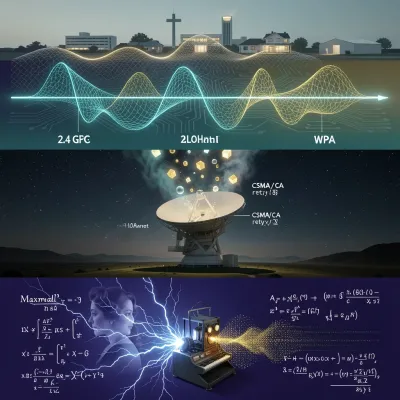
The book traces Wi‑Fi’s origins from the theoretical foundations of electromagnetism laid by Maxwell and Hertz, through early wireless experiments by Marconi, Fessenden, and Tesla, to the pivotal spread‑spectrum concept introduced by Hedy Lamarr and George Antheil. It details how ALOHAnet pioneered packet radio and the ALOHA protocol, setting the stage for medium access control, and how the IEEE 802 committee—particularly the 802.11 working group—standardized wireless LAN technology, culminating in the first 802.11 standard in 1997 that defined the 2.4 GHz ISM band, FHSS/DSSS PHY, and CSMA/CA MAC. Early adopters in warehouses, hospitals, and campuses grappled with cost, range, interference, and the weak WEP security, proving the technology’s niche viability despite its limitations.
The narrative then follows Wi‑Fi’s transition to the mainstream: the creation of the “Wi‑Fi” brand and the Wi‑Fi Alliance’s certification program resolved an identity crisis and built consumer trust; 802.11b’s 11 Mbps breakthrough sparked mass‑market adoption in homes and offices; the quest for speed produced the higher‑rate but incompatible 802.11a and the backward‑compatible 802.11g; security evolved from the broken WEP to WPA and then the robust WPA2; enterprise Wi‑Fi enabled mobility, VoWi‑Fi, location services, and BYOD, while the mobile revolution embedded Wi‑Fi in smartphones and tablets, driving demand for public hotspots. Subsequent chapters cover 802.11n’s MIMO and channel bonding, Wi‑Fi’s expanding role in the Internet of Things, 802.11ac’s gigabit speeds and MU‑MIMO, mesh systems for whole‑home coverage, Wi‑Fi Direct peer‑to‑peer connections, and early smart‑city applications.
The book concludes with the latest developments: 802.11ax (Wi‑Fi 6) introducing OFDMA, uplink MU‑MIMO, TWT, and BSS Coloring to alleviate congestion; Wi‑Fi 6E exploiting the newly opened 6 GHz band for wider channels and lower latency; and a look ahead to Wi‑Fi 7 (802.11be) with Multi‑Link Operation, 4096‑QAM, and preamble puncturing. Throughout, spectrum management remains a central challenge, prompting innovations like DFS, AFC, and future AI‑driven optimization. Finally, the work examines Wi‑Fi’s profound societal impact—bridging the digital divide, transforming work, education, entertainment, and smart homes—and projects its continuing evolution alongside cellular and IoT technologies in an ever‑more connected world.
What You'll Find Inside:
- The theoretical foundations of wireless communication, from Maxwell's equations to Hedy Lamarr's spread spectrum innovation
- How ALOHAnet's packet radio protocols pioneered the medium access control techniques essential for Wi-Fi
- The IEEE 802 committee's standardization journey that created interoperable Wi-Fi standards from 802.11 to Wi-Fi 7
- Wi-Fi's profound societal impact, enabling hotspots, enterprise mobility, IoT expansion, and smart city transformations
- The technological evolution from 1Mbps speeds to multi-gigabit Wi-Fi 6E/7 and security advancements from WEP to WPA3
Who's It For:
This book is ideal for technology enthusiasts seeking to understand Wi-Fi's inner workings, networking professionals looking for historical context, and general readers curious about how wireless technology reshapes modern society. It appeals to anyone interested in the intersection of innovation, engineering, and cultural change behind everyday connectivity.
Author:
Published By:
Date Published:
August 1, 2026
Type:
Nonfiction
Language:
English
Word Count:
40,510 words
Reading Time:
2 hours 50 minutes
Sample:
Order:
Order A History of Wi-Fi (Paperback) on MixCache.com:
Buy NowPrint copy is made to order and ships worldwide. Includes the ebook free, ready to read instantly.
$5 account credit for all new MixCache.com accounts, usable toward any ebook purchase!*