
Browse by Category
Fiction
- Action & Adventure
- African American
- Anthologies
- Children's Fiction
- Classics
- Comics & Graphic Novels
- Coming of Age
- Contemporary
- Cultural & Regional
- Drama
- Erotica
- Fantasy
- General
- Historical Fiction
- Horror
- Humor & Satire
- Literary Fiction
- Mystery, Thriller & Suspense
- Poetry
- Religious & Inspirational
- Romance
- Science Fiction
- Short Stories
- War & Military
- Westerns
- Women's Fiction
- Young Adult
Non-Fiction
- Antiques & Collectibles
- Arts & Photography
- Biographies & Memoirs
- Business & Money
- Children's Non-Fiction
-
Computers & Technology
- Artificial Intelligence
- Computer Science
- Cybersecurity & Cryptography
- Data Science & Analytics
- Databases & Big Data
- Game Development & Design
- General
- Hardware & DIY
- Mobile App Development
- Networking & Cloud Computing
- Operating Systems
- Programming
- Robotics
- Software
- Software Engineering
- User Experience (UX) & Design
- Web Development & Design
- Cooking, Food & Wine
- Crafts, Hobbies & Home
- Education & Teaching
- Engineering
- General
- Health, Fitness & Dieting
-
History
- African History
- African History - North Africa
- African History - Sub-Saharan Africa
- American History
- American History - 20th Century
- American History - Civil War
- American History - Colonial Period
- Ancient History
- Asian History
- Asian History - China
- Asian History - India
- Asian History - Japan
- Asian History - Southeast Asia
- European History
- European History - Ancient Greece
- European History - Ancient Rome
- European History - Medieval
- European History - Modern
- European History - Renaissance
- General
- Middle Eastern History
- Military History
- Military History - Aviation
- Military History - Naval
- Social & Cultural History
- World History
- Humor & Entertainment
- Industrial Technology
- Language Learning
- Law
- LGBTQ+ Non-Fiction
- Literary Criticism
- Medical Books
- Parenting & Relationships
- Philosophy
- Politics & Social Sciences
- Reference
- Religion & Spirituality
-
Science & Math
- Agricultural Sciences
- Astronomy & Space Science
- Behavioral Sciences
- Biological Sciences
- Botany & Plant Science
- Chemistry
- Earth Sciences
- Engineering - Chemical
- Engineering - Civil
- Engineering - Electrical
- Engineering - Mechanical
- Environment
- General
- Geology
- Mathematics
- Nature & Ecology
- Oceanography
- Paleontology
- Physics
- Statistics
- Self-Help
- Sports & Outdoors
- Study Aids
- Sustainability & Green Living
- Textbooks
- Transportation
- Travel
- True Crime
- Urban Planning & Development
- Veterinary Medicine
- Writing & Publishing
Jump to Section
MixCache.com Total Access
Unlimited reading and audiobooks for every book published by MixCache.com.
Included titles carry the MTA badge.
Learn more →
A History of Mercedes-Benz Group
MTA
The Story of a Global Company
About this book:
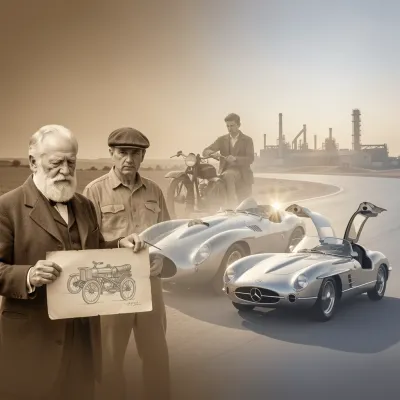
The Mercedes‑Benz Group traces its origins to the independent innovations of Karl Benz, who patented the first gasoline‑powered automobile in 1886, and Gottlieb Daimler and Wilhelm Maybach, who developed high‑speed engines and early motorcycles. Their parallel efforts culminated in the 1926 merger of Benz & Cie. and Daimler‑Motoren‑Gesellschaft, forming Daimler‑Benz AG and adopting the Mercedes‑Benz name. The new company quickly rose to prominence with supercharged S‑Series cars and the legendary Silver Arrow racers, establishing a reputation for performance, luxury, and engineering excellence.
During the 1930s and World War II, Mercedes‑Benz shifted to military production, utilizing forced labor and suffering extensive bombing damage. After the war, the company rebuilt from ruins, restarting with the modest 170 V and gradually returning to luxury with models such as the 300 SL “Gullwing” and the stately 300 “Adenauer.” The postwar “Wirtschaftswunder” fueled innovation, including Béla Barényi’s crumple‑zone safety concept, the introduction of fuel‑injection and disc brakes, and the launch of iconic flagship sedans like the W 124, W 140, and the opulent 600.
The 1970s oil crisis compelled Mercedes‑Benz to prioritize efficiency, expanding diesel passenger‑car offerings, improving aerodynamics, and adopting emissions controls. Subsequent decades saw the integration of digital technologies—electronic engine management, ABS, ESP, and eventually DRIVE PILOT Level 3 autonomous driving—while design evolved under Bruno Sacco’s “vertical affinity” philosophy and the company broadened its model range with the A‑, M‑, and SUV series. Global expansion established assembly plants in North America, South America, Asia, and Africa, and strategic moves such as the acquisition of Mitsubishi Fuso and the creation of the Smart brand diversified the portfolio, though the 1998 merger with Chrysler proved costly and was later unwound.
In the 21st century, Mercedes‑Benz launched the EQ sub‑brand to lead the electric revolution, introducing dedicated EV platforms (EVA) and models like the EQS and EQC, while AMG redefined high performance with hand‑built engines and later electric variants. The company also invested heavily in autonomous driving, manufacturing excellence (exemplified by Factory 56), sustainability initiatives (BlueEfficiency, carbon‑neutral factories), and extensive CSR programs. Facing fierce competition from traditional rivals, EV startups, and tech giants, Mercedes‑Benz now pursues a strategy centered on electrification, software‑centric vehicles, autonomous driving, and sustainable luxury, aiming to remain a global leader in mobility as it transitions to an all‑electric future.
What You'll Find Inside:
- The pioneering origins of Mercedes-Benz tracing back to Karl Benz's Patent-Motorwagen and Gottlieb Daimler's high-speed engine innovations that laid the foundation for the modern automobile.
- The pivotal 1926 merger of Daimler-Motoren-Gesellschaft and Benz & Cie. that created Daimler-Benz AG and established the iconic Mercedes-Benz brand name and three-pointed star emblem.
- The company's resilience through historical challenges including World Wars, economic depressions, and oil crises, demonstrating how Mercedes-Benz adapted its strategies while maintaining engineering excellence.
- Groundbreaking technological innovations from Béla Barényi's crumple zone safety revolution to the electric EQ sub-brand and autonomous DRIVE PILOT systems that have continually redefined automotive safety and mobility.
- Mercedes-Benz's global expansion strategy, manufacturing excellence exemplified by facilities like Factory 56, and vision for sustainable mobility that positions the company at the forefront of the 21st-century automotive transformation.
Who's It For:
This book is ideal for automotive enthusiasts seeking a deep understanding of one of the world's most iconic car manufacturers, business students and professionals studying corporate history and strategy, engineering professionals interested in automotive technological evolution, and general readers fascinated by how a company navigates over a century of technological, economic, and social transformations while maintaining its position as a global leader in luxury, innovation, and sustainability.
Table of Contents:
- Introduction
- Chapter 1 The Genesis of an Icon: Early Innovators and the Birth of the Automobile
- Chapter 2 Daimler and Benz: Parallel Paths to Automotive Excellence
- Chapter 3 The Merger: Forging a New Powerhouse in the Automotive World
- Chapter 4 The Roaring Twenties and the Silver Arrow Legacy
- Chapter 5 Navigating the Storm: Mercedes-Benz Through the World Wars
- Chapter 6 Post-War Reconstruction and the Dawn of Luxury
- Chapter 7 Innovation and Expansion: The Fifties and Sixties
- Chapter 8 The Safety Revolution and Engineering Prowess
- Chapter 9 Global Reach: Entering New Markets and Continents
- Chapter 10 The Oil Crisis and Adapting to Changing Times
- Chapter 11 Technological Advancements and the Digital Age
- Chapter 12 Mergers and Acquisitions: Expanding the Portfolio
- Chapter 13 Design Philosophy: Shaping the Aesthetic of Mercedes-Benz
- Chapter 14 Motorsport Dominance: From Track to Road
- Chapter 15 The Rise of AMG: Performance Redefined
- Chapter 16 Environmental Challenges and Sustainable Mobility Initiatives
- Chapter 17 The Electric Revolution: EQ and Beyond
- Chapter 18 Autonomous Driving and the Future of Mobility
- Chapter 19 Manufacturing Excellence and Global Production Networks
- Chapter 20 Marketing and Branding: Cultivating a Global Image
- Chapter 21 Leadership and Vision: The Architects of Mercedes-Benz Group
- Chapter 22 Corporate Social Responsibility and Community Engagement
- Chapter 23 Financial Performance and Economic Impact
- Chapter 24 Competitors and the Evolving Automotive Landscape
- Chapter 25 The Road Ahead: Mercedes-Benz Group in the 21st Century
Author:
Published By:
Date Published:
July 24, 2026
Type:
Nonfiction
Language:
English
Word Count:
46,261 words
Reading Time:
3 hours 14 minutes
Sample:
MixCache.com Total Access
Get unlimited access to this book + all books published by MixCache.com for $11.99/month
Subscribe to MTAOr purchase this book individually below
Order:
Buy the A History of Mercedes-Benz Group ebook on MixCache.com:
Buy Now
Full ebook will be available immediately
- read online or download as a PDF file.
$5 account credit for all new MixCache.com accounts, usable toward any ebook purchase!*




Ratings & Reviews
Ask Questions About This Book
Have a question about the content? Ask our AI assistant!
Start by asking a question about "A History of Mercedes-Benz Group"
Example: "Does this book mention William Shakespeare?"
Thinking...