
Browse by Category
Fiction
- Action & Adventure
- African American
- Anthologies
- Children's Fiction
- Classics
- Comics & Graphic Novels
- Coming of Age
- Contemporary
- Cultural & Regional
- Drama
- Erotica
- Fantasy
- General
- Historical Fiction
- Horror
- Humor & Satire
- Literary Fiction
- Mystery, Thriller & Suspense
- Poetry
- Religious & Inspirational
- Romance
- Science Fiction
- Short Stories
- War & Military
- Westerns
- Women's Fiction
- Young Adult
Non-Fiction
- Antiques & Collectibles
- Arts & Photography
- Biographies & Memoirs
- Business & Money
- Children's Non-Fiction
-
Computers & Technology
- Artificial Intelligence
- Computer Science
- Cybersecurity & Cryptography
- Data Science & Analytics
- Databases & Big Data
- Game Development & Design
- General
- Hardware & DIY
- Mobile App Development
- Networking & Cloud Computing
- Operating Systems
- Programming
- Robotics
- Software
- Software Engineering
- User Experience (UX) & Design
- Web Development & Design
- Cooking, Food & Wine
- Crafts, Hobbies & Home
- Education & Teaching
- Engineering
- General
- Health, Fitness & Dieting
-
History
- African History
- African History - North Africa
- African History - Sub-Saharan Africa
- American History
- American History - 20th Century
- American History - Civil War
- American History - Colonial Period
- Ancient History
- Asian History
- Asian History - China
- Asian History - India
- Asian History - Japan
- Asian History - Southeast Asia
- European History
- European History - Ancient Greece
- European History - Ancient Rome
- European History - Medieval
- European History - Modern
- European History - Renaissance
- General
- Middle Eastern History
- Military History
- Military History - Aviation
- Military History - Naval
- Social & Cultural History
- World History
- Humor & Entertainment
- Industrial Technology
- Language Learning
- Law
- LGBTQ+ Non-Fiction
- Literary Criticism
- Medical Books
- Parenting & Relationships
- Philosophy
- Politics & Social Sciences
- Reference
- Religion & Spirituality
-
Science & Math
- Agricultural Sciences
- Astronomy & Space Science
- Behavioral Sciences
- Biological Sciences
- Botany & Plant Science
- Chemistry
- Earth Sciences
- Engineering - Chemical
- Engineering - Civil
- Engineering - Electrical
- Engineering - Mechanical
- Environment
- General
- Geology
- Mathematics
- Nature & Ecology
- Oceanography
- Paleontology
- Physics
- Statistics
- Self-Help
- Sports & Outdoors
- Study Aids
- Sustainability & Green Living
- Textbooks
- Transportation
- Travel
- True Crime
- Urban Planning & Development
- Veterinary Medicine
- Writing & Publishing
Jump to Section
MixCache.com Total Access
Unlimited reading and audiobooks for every book published by MixCache.com.
Included titles carry the MTA badge.
Learn more →
A History of Mitsui & Co.
MTA
The Story of a Global Company
About this book:
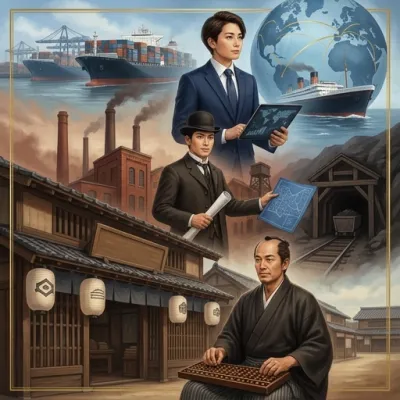
Mitsui & Co. traces its origins to 17th‑century merchant Takashi Mitsui, whose family transformed a modest dry‑goods store and money‑exchange house into a powerful zaibatsu through shrewd alliances with the Tokugawa shogunate, innovative cash‑based retail practices, and early diversification into mining and finance. The Meiji Restoration propelled Mitsui into Japan’s industrial ascent, as it helped found the nation’s first modern bank, acquired strategic assets such as the Miike Coal Mine, and expanded into shipbuilding, machinery, and overseas trade, establishing the Mitsui Bussan trading arm that would become the core of its global operations. During the Zaibatsu era the conglomerate deepened vertical integration across banking, trade, heavy industry, and resource development, maintaining close ties to the state while building a vast, self‑sufficient economic network.
World War II and the Allied Occupation dismantled the zaibatsu structure, forcing Mitsui’s subsidiaries into independent entities and stripping the family of direct control. Yet informal ties persisted, and through post‑war reconstruction—bolstered by Korean War procurements, the Mitsui Conference, and a gradual rebound of trade and investment—the company re‑emerged as Mitsui & Co., Ltd., revitalizing the sogo shosha (general trading company) model. This model emphasized diversified commodity trading, global logistics, risk management, and strategic upstream investment, enabling Mitsui to secure essential resources such as Australian iron ore, Middle Eastern LNG, and Southeast Asian raw materials while simultaneously developing infrastructure, power generation, chemicals, machinery, and food‑retail chains worldwide.
In the latter half of the 20th century Mitsui expanded its footprint across continents, pioneering resource projects in Australia, the Middle East, and Latin America, investing in petrochemicals, telecommunications, and digital technologies, and nurturing a sophisticated financial services arm that supported its trading and industrial activities. The company weathered oil crises, Japan’s bubble economy and Lost Decades, and later global financial shocks by leveraging its diversified portfolio, disciplined risk management, and long‑term capital orientation. Today Mitsui operates as a global sogo shosha with offices in over 60 countries, pursuing digital transformation, energy transition, wellness ecosystems, and sustainable infrastructure while maintaining a strong commitment to corporate governance, ESG principles, and social responsibility. Its enduring legacy lies in the ability to continuously adapt, innovate, and connect producers to consumers across industries and borders, shaping Japan’s modernization and influencing global commerce for over three centuries.
What You'll Find Inside:
- Mitsui's transformation from a 17th-century merchant house into a modern global trading company (sogo shosha)
- The company's pivotal role in Japan's Meiji Restoration, industrialization, and economic ascent
- Evolution and significance of the sogo shosha (general trading company) business model
- Mitsui's global expansion through resource development, infrastructure projects, and international partnerships
- The company's approach to corporate social responsibility, environmental sustainability, and long-term value creation
Who's It For:
This book is ideal for business students, historians, and professionals interested in corporate evolution, international trade, and Japanese economic development. It will particularly benefit those studying general trading companies, multinational corporations, and sustainable business practices. Readers seeking insights into how companies adapt across centuries while navigating economic crises, technological changes, and shifting global markets will find valuable lessons in Mitsui's enduring history.
Table of Contents:
- Introduction
- Chapter 1 The Origins of Mitsui: From Humble Beginnings to a Commercial Powerhouse
- Chapter 2 The Edo Period and the Mitsui Echigoya: Laying the Foundations of a Modern Business
- Chapter 3 The Meiji Restoration: Navigating a New Era of Change and Opportunity
- Chapter 4 Industrialization and Expansion: Mitsui's Role in Japan's Economic Ascent
- Chapter 5 Forging Global Connections: Early International Ventures and Trade Routes
- Chapter 6 The Zaibatsu Era: Growth, Influence, and Diversification
- Chapter 7 World Wars and Nationalization: Surviving Periods of Upheaval
- Chapter 8 Post-War Reconstruction: Rebuilding and Redefining the Company's Purpose
- Chapter 9 The Sogo Shosha Model: Evolution of a General Trading Company
- Chapter 10 Global Reach: Expanding Across Continents and Industries
- Chapter 11 Resource Development: Securing Essential Materials for a Growing World
- Chapter 12 Infrastructure and Urban Development: Building the Future
- Chapter 13 Information and Communications Technology: Embracing the Digital Age
- Chapter 14 Chemical and Energy Ventures: Powering Progress
- Chapter 15 Machinery and Shipbuilding: Innovation in Manufacturing
- Chapter 16 Food and Retail: Connecting Producers to Consumers
- Chapter 17 Financial Services and Investment: A Diverse Portfolio
- Chapter 18 Environmental Initiatives: Towards a Sustainable Future
- Chapter 19 Corporate Social Responsibility: Giving Back to the Global Community
- Chapter 20 Navigating Economic Crises: Resilience and Adaptability
- Chapter 21 Leadership and Governance: Shaping the Company's Direction
- Chapter 22 Innovation and Future Technologies: Pioneering New Frontiers
- Chapter 23 Mitsui's Global Network: A Web of Partnerships and Subsidiaries
- Chapter 24 Cultural Impact and Legacy: Beyond Business
- Chapter 25 Mitsui & Co. Today: A Global Leader in a Dynamic World
Author:
Published By:
Date Published:
July 21, 2026
Type:
Nonfiction
Language:
English
Word Count:
37,663 words
Reading Time:
2 hours 38 minutes
Sample:
Order:
Order A History of Mitsui & Co. (Paperback) on MixCache.com:
Buy NowPrint copy is made to order and ships worldwide. Includes the ebook free, ready to read instantly.
$5 account credit for all new MixCache.com accounts, usable toward any ebook purchase!*



 Includes Audiobook

