
Browse by Category
Fiction
- Action & Adventure
- African American
- Anthologies
- Children's Fiction
- Classics
- Comics & Graphic Novels
- Coming of Age
- Contemporary
- Cultural & Regional
- Drama
- Erotica
- Fantasy
- General
- Historical Fiction
- Horror
- Humor & Satire
- Literary Fiction
- Mystery, Thriller & Suspense
- Poetry
- Religious & Inspirational
- Romance
- Science Fiction
- Short Stories
- War & Military
- Westerns
- Women's Fiction
- Young Adult
Non-Fiction
- Antiques & Collectibles
- Arts & Photography
- Biographies & Memoirs
- Business & Money
- Children's Non-Fiction
-
Computers & Technology
- Artificial Intelligence
- Computer Science
- Cybersecurity & Cryptography
- Data Science & Analytics
- Databases & Big Data
- Game Development & Design
- General
- Hardware & DIY
- Mobile App Development
- Networking & Cloud Computing
- Operating Systems
- Programming
- Robotics
- Software
- Software Engineering
- User Experience (UX) & Design
- Web Development & Design
- Cooking, Food & Wine
- Crafts, Hobbies & Home
- Education & Teaching
- Engineering
- General
- Health, Fitness & Dieting
-
History
- African History
- African History - North Africa
- African History - Sub-Saharan Africa
- American History
- American History - 20th Century
- American History - Civil War
- American History - Colonial Period
- Ancient History
- Asian History
- Asian History - China
- Asian History - India
- Asian History - Japan
- Asian History - Southeast Asia
- European History
- European History - Ancient Greece
- European History - Ancient Rome
- European History - Medieval
- European History - Modern
- European History - Renaissance
- General
- Middle Eastern History
- Military History
- Military History - Aviation
- Military History - Naval
- Social & Cultural History
- World History
- Humor & Entertainment
- Industrial Technology
- Language Learning
- Law
- LGBTQ+ Non-Fiction
- Literary Criticism
- Medical Books
- Parenting & Relationships
- Philosophy
- Politics & Social Sciences
- Reference
- Religion & Spirituality
-
Science & Math
- Agricultural Sciences
- Astronomy & Space Science
- Behavioral Sciences
- Biological Sciences
- Botany & Plant Science
- Chemistry
- Earth Sciences
- Engineering - Chemical
- Engineering - Civil
- Engineering - Electrical
- Engineering - Mechanical
- Environment
- General
- Geology
- Mathematics
- Nature & Ecology
- Oceanography
- Paleontology
- Physics
- Statistics
- Self-Help
- Sports & Outdoors
- Study Aids
- Sustainability & Green Living
- Textbooks
- Transportation
- Travel
- True Crime
- Urban Planning & Development
- Veterinary Medicine
- Writing & Publishing
Jump to Section
MixCache.com Total Access
Unlimited reading and audiobooks for every book published by MixCache.com.
Included titles carry the MTA badge.
Learn more →
Education In Sri Lanka
MTA
A Comprehensive Overview from Early Childhood to Higher Education
About this book:
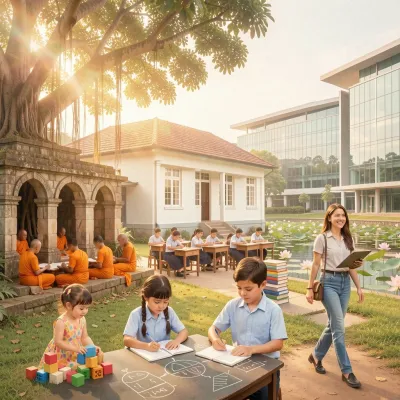
Educationin Sri Lanka traces its origins to ancient Buddhist monastic pirivenas, which provided a holistic blend of religious, linguistic, and practical knowledge, and later absorbed Hindu and indigenous learning traditions. Colonial rule by the Portuguese, Dutch, and British imposed Western-style schooling, missionary instruction, and a linguistic divide that privileged English and created an elite Anglophone class, while vernacular schools served the masses. Post‑independence reforms, spearheaded by the Free Education Scheme of 1945 and the Swabasha policy, eliminated tuition fees, expanded access, and replaced English with Sinhala and Tamil as media of instruction, laying the foundation for a national system aimed at equity and social cohesion.
The contemporary system spans early childhood education (predominantly private and community‑based), primary education (mother‑tongue based with English as a second language, activity‑based learning, and the high‑stakes Grade 5 Scholarship Examination), and secondary education divided into a junior cycle (broad general education) and a senior cycle focused on the G.C.E. Ordinary Level and Advanced Level examinations that determine university admission and vocational pathways. Technical and Vocational Education and Training (TVET) offers competency‑based, industry‑linked training through public authorities and private providers, while higher education is centered on state universities coordinated by the University Grants Commission, complemented by private institutions and foreign partnerships delivering internationally recognized qualifications. Teacher education flows via National Colleges of Education and university postgraduate diplomas, supported by continuous in‑service training, and language policy balances mother‑tongue instruction with compulsory English, alongside efforts for trilingualism and inclusive education for students with special needs. Persistent challenges include rural‑urban disparities in resources and teacher distribution, an examination‑oriented culture that encourages rote learning, gaps between curriculum outcomes and labor‑market demands, funding constraints, and the digital divide, all mediated by governance structures involving the Ministry of Education, Provincial Councils, the National Institute of Education, and various statutory bodies.
International collaborations with agencies such as UNESCO, UNICEF, the World Bank, and bilateral partners have contributed to curriculum reform, teacher training, infrastructure, and TVET modernization, while student and faculty exchanges foster global perspectives. Looking ahead, Sri Lankan education aims to deepen the integration of 21st‑century skills (critical thinking, creativity, communication, collaboration), expand equitable access to technology and digital learning, align curricula with emerging economic sectors, upgrade and prestige TVET, strengthen inclusive and special‑needs provisions, enhance English proficiency, promote environmental and peace education, and improve governance through decentralization and data‑driven decision‑making, all while maintaining the commitment to free public education as a cornerstone of national development.
What You'll Find Inside:
- Traces the historical development of Sri Lankan education from ancient Buddhist monastic schools (pirivenas) through colonial influences to post-independence reforms like the Free Education Scheme and Swabasha policy.
- Provides a comprehensive overview of all education levels – early childhood, primary, secondary (including detailed analysis of G.C.E. O/L and A/L examinations), technical/vocational training, and higher education institutions.
- Examines critical contemporary issues including language education policies (Sinhala, Tamil, English), special education needs and inclusive education, gender disparities, and rural-urban educational inequalities.
- Analyzes the structure and governance of the education system, covering Ministry of Education, Provincial Councils, National Institute of Education, Department of Examinations, and school types (National, Provincial, Pirivenas).
- Explores modern challenges and future directions, including technology integration, funding mechanisms while maintaining free education, TVET expansion, and preparations for 21st-century skills development.
Who's It For:
This book is intended for educators, policymakers, researchers, and students of comparative education seeking to understand Sri Lanka's education system. It also serves anyone with a specific interest in the dynamics of education in developing nations, particularly those analyzing how historical, cultural, and policy factors shape educational access and quality. The comprehensive nature makes it valuable for both newcomers to Sri Lankan education and specialists looking for detailed insights into specific sectors like TVET, higher education, or early childhood development.
Table of Contents:
- Introduction
- Chapter 1: Historical Roots of Sri Lankan Education
- Chapter 2: Traditional Educational Systems and Influences
- Chapter 3: The Impact of Colonialism on Education
- Chapter 4: Post-Independence Educational Reforms
- Chapter 5: Structure and Governance of the Sri Lankan Education System
- Chapter 6: Early Childhood Education: Foundations and Development
- Chapter 7: Primary Education: Curriculum and Pedagogy
- Chapter 8: Secondary Education: Junior and Senior Cycles
- Chapter 9: The G.C.E. Ordinary Level Examination
- Chapter 10: The G.C.E. Advanced Level Examination and University Entrance
- Chapter 11: Technical and Vocational Education and Training (TVET)
- Chapter 12: Higher Education: Universities and Institutes
- Chapter 13: Private Higher Education and Foreign Partnerships
- Chapter 14: Teacher Education and Professional Development
- Chapter 15: Language Education Policies and Practices
- Chapter 16: Special Education Needs and Inclusive Education
- Chapter 17: Education in Conflict-Affected Regions
- Chapter 18: Gender Disparities and Equity in Education
- Chapter 19: Rural-Urban Disparities in Educational Access and Quality
- Chapter 20: The Role of Technology in Education
- Chapter 21: Curriculum Development and Assessment Practices
- Chapter 22: Funding and Financing of Education in Sri Lanka
- Chapter 23: Challenges and Issues in the Education System
- Chapter 24: International Collaborations and Educational Exchange
- Chapter 25: Future Directions and Prospects for Sri Lankan Education
Author:
Published By:
Date Published:
July 5, 2026
Type:
Nonfiction
Language:
English
Word Count:
40,872 words
Reading Time:
2 hours 52 minutes
Sample:
Order:
Order Education In Sri Lanka (Paperback) on MixCache.com:
Buy NowPrint copy is made to order and ships worldwide. Includes the ebook free, ready to read instantly.
$5 account credit for all new MixCache.com accounts, usable toward any ebook purchase!*


