Browse by Category
Fiction
- Action & Adventure
- African American
- Anthologies
- Children's Fiction
- Classics
- Comics & Graphic Novels
- Coming of Age
- Contemporary
- Cultural & Regional
- Drama
- Erotica
- Fantasy
- General
- Historical Fiction
- Horror
- Humor & Satire
- Literary Fiction
- Mystery, Thriller & Suspense
- Poetry
- Religious & Inspirational
- Romance
- Science Fiction
- Short Stories
- War & Military
- Westerns
- Women's Fiction
- Young Adult
Non-Fiction
- Antiques & Collectibles
- Arts & Photography
- Biographies & Memoirs
- Business & Money
- Children's Non-Fiction
-
Computers & Technology
- Artificial Intelligence
- Computer Science
- Cybersecurity & Cryptography
- Data Science & Analytics
- Databases & Big Data
- Game Development & Design
- General
- Hardware & DIY
- Mobile App Development
- Networking & Cloud Computing
- Operating Systems
- Programming
- Robotics
- Software
- Software Engineering
- User Experience (UX) & Design
- Web Development & Design
- Cooking, Food & Wine
- Crafts, Hobbies & Home
- Education & Teaching
- Engineering
- General
- Health, Fitness & Dieting
-
History
- African History
- African History - North Africa
- African History - Sub-Saharan Africa
- American History
- American History - 20th Century
- American History - Civil War
- American History - Colonial Period
- Ancient History
- Asian History
- Asian History - China
- Asian History - India
- Asian History - Japan
- Asian History - Southeast Asia
- European History
- European History - Ancient Greece
- European History - Ancient Rome
- European History - Medieval
- European History - Modern
- European History - Renaissance
- General
- Middle Eastern History
- Military History
- Military History - Aviation
- Military History - Naval
- Social & Cultural History
- World History
- Humor & Entertainment
- Industrial Technology
- Language Learning
- Law
- LGBTQ+ Non-Fiction
- Literary Criticism
- Medical Books
- Parenting & Relationships
- Philosophy
- Politics & Social Sciences
- Reference
- Religion & Spirituality
-
Science & Math
- Agricultural Sciences
- Astronomy & Space Science
- Behavioral Sciences
- Biological Sciences
- Botany & Plant Science
- Chemistry
- Earth Sciences
- Engineering - Chemical
- Engineering - Civil
- Engineering - Electrical
- Engineering - Mechanical
- Environment
- General
- Geology
- Mathematics
- Nature & Ecology
- Oceanography
- Paleontology
- Physics
- Statistics
- Self-Help
- Sports & Outdoors
- Study Aids
- Sustainability & Green Living
- Textbooks
- Transportation
- Travel
- True Crime
- Urban Planning & Development
- Veterinary Medicine
- Writing & Publishing
Jump to Section
MixCache.com Total Access
Unlimited reading and audiobooks for every book published by MixCache.com.
Included titles carry the MTA badge.
Learn more →
Education In Paraguay
MTA
A Comprehensive Overview from Early Childhood to Higher Education
About this book:
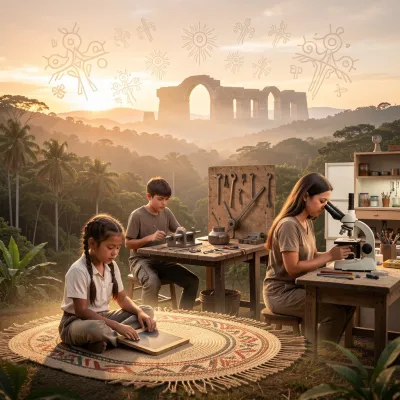
Education in Paraguay has evolved from indigenous oral traditions and the influential Jesuit Reductions through periods of isolation, war, dictatorship, and democratic reform, shaping a system that now strives to balance universal access with quality and relevance. The contemporary structure, overseen by the Ministry of Education and Sciences, progresses from non‑compulsory early childhood education through nine years of compulsory basic education (divided into three cycles) to a diversified three‑year secondary level offering scientific‑humanistic and technical bachilleratos, alongside parallel technical and vocational training pathways. Higher education has expanded rapidly since the 1990s, encompassing public and private universities and institutes, with quality assurance managed by the National Agency for Evaluation and Accreditation of Higher Education (ANEAES). Throughout these levels, the curriculum emphasizes bilingualism in Spanish and Guaraní, intercultural inclusion, and the gradual integration of 21st‑century skills, sustainable development, and technology, while ongoing reforms aim to improve teacher training, governance, and equitable resource allocation despite persistent challenges of funding, infrastructure, and regional disparities.
The system confronts significant socioeconomic, geographic, and cultural barriers that affect enrollment, retention, and learning outcomes, especially for rural, indigenous, low‑income, and disabled students. Initiatives such as the conditional cash‑transfer Tekoporã program, school feeding, targeted teacher incentives, infrastructure investments, and culturally relevant bilingual‑intercultural education seek to mitigate these inequities. Inclusive education policies promote the integration of students with special needs, while gender parity in enrollment has been achieved, though disparities persist in field‑of‑study choices and leadership representation. Technology integration, though hampered by the digital divide, is being advanced through solar‑powered classrooms, offline digital resources, and teacher‑training programs. Assessment mechanisms like the national ENACE exam and institutional evaluations provide data for policy, yet effective use of results remains limited by capacity and utilization challenges. International cooperation, NGOs, and public‑private partnerships contribute financial support, expertise, and innovative models, especially in TVET, indigenous education, and sustainable development.
Looking ahead, Paraguay’s educational future hinges on deepening competency‑based, interdisciplinary curricula that embed education for sustainable development, strengthening teacher preparation and professional development through technology‑enabled, data‑driven approaches, and expanding lifelong‑learning pathways that recognize formal, non‑formal, and informal learning. Continued efforts to improve equity—through targeted funding, community‑managed schools, indigenous teacher training, and inclusive practices—are essential to overcoming structural inefficiencies. Educational research and innovation are increasingly valued as bases for evidence‑based policy, while international collaboration focuses on South‑South exchange, joint research, and digital platforms to build a more resilient, globally engaged system. The case studies highlighted throughout the volume illustrate that context‑specific, cooperative, and sustained interventions can yield measurable gains in retention, achievement, and social inclusion, offering a roadmap for Paraguay to transform educational challenges into opportunities for national development.
What You'll Find Inside:
- Historical foundations of Paraguayan education, including the unique Jesuit Reductions experiment and its lasting impact on educational practices
- Comprehensive overview of the Paraguayan educational system structure from early childhood through higher education, with special attention to bilingual (Spanish-Guaraní) education
- Analysis of persistent challenges and innovative solutions in rural, indigenous, and inclusive education contexts
- Examination of educational policy, governance, funding, and teacher development challenges and reforms
- Case studies highlighting successful educational reforms and future prospects for Paraguay's education system
Who's It For:
This book is designed for policymakers, educators, researchers, and students seeking to understand Paraguay's educational landscape. It will particularly benefit those interested in Latin American educational development, bilingual education policies, and strategies for addressing equity challenges in diverse socioeconomic contexts. Anyone involved in educational reform, international cooperation, or studying the intersection of culture and education in developing nations will find valuable insights.
Table of Contents:
- Introduction
- Chapter 1: Historical Foundations of Paraguayan Education
- Chapter 2: The Structure of the Paraguayan Educational System
- Chapter 3: Early Childhood Education: Foundations and Challenges
- Chapter 4: Primary Education: Access, Equity, and Quality
- Chapter 5: Secondary Education: Pathways and Reforms
- Chapter 6: Technical and Vocational Education and Training (TVET)
- Chapter 7: Higher Education Landscape: Universities and Institutes
- Chapter 8: Curriculum Development and Educational Standards
- Chapter 9: Teacher Training and Professional Development
- Chapter 10: Educational Policy and Governance
- Chapter 11: Funding and Investment in Education
- Chapter 12: Rural Education: Specific Challenges and Initiatives
- Chapter 13: Indigenous Education and Bilingualism
- Chapter 14: Inclusive Education for Students with Special Needs
- Chapter 15: The Role of Technology in Education
- Chapter 16: Educational Assessment and Evaluation
- Chapter 17: International Cooperation and Educational Exchange
- Chapter 18: Non-Formal and Informal Education
- Chapter 19: Challenges in Educational Attainment and Retention
- Chapter 20: The Impact of Socioeconomic Factors on Education
- Chapter 21: Gender and Education in Paraguay
- Chapter 22: Education for Sustainable Development
- Chapter 23: Educational Research and Innovation
- Chapter 24: The Future of Education in Paraguay: Trends and Prospects
- Chapter 25: Case Studies in Educational Reform and Success
Author:
Published By:
Date Published:
July 2, 2026
Type:
Nonfiction
Language:
English
Word Count:
75,827 words
Reading Time:
5 hours 19 minutes
Sample:
Order:
Order Education In Paraguay (Paperback) on MixCache.com:
Buy NowPrint copy is made to order and ships worldwide. Includes the ebook free, ready to read instantly.
$5 account credit for all new MixCache.com accounts, usable toward any ebook purchase!*