Browse by Category
Fiction
- Action & Adventure
- African American
- Anthologies
- Children's Fiction
- Classics
- Comics & Graphic Novels
- Coming of Age
- Contemporary
- Cultural & Regional
- Drama
- Erotica
- Fantasy
- General
- Historical Fiction
- Horror
- Humor & Satire
- Literary Fiction
- Mystery, Thriller & Suspense
- Poetry
- Religious & Inspirational
- Romance
- Science Fiction
- Short Stories
- War & Military
- Westerns
- Women's Fiction
- Young Adult
Non-Fiction
- Antiques & Collectibles
- Arts & Photography
- Biographies & Memoirs
- Business & Money
- Children's Non-Fiction
-
Computers & Technology
- Artificial Intelligence
- Computer Science
- Cybersecurity & Cryptography
- Data Science & Analytics
- Databases & Big Data
- Game Development & Design
- General
- Hardware & DIY
- Mobile App Development
- Networking & Cloud Computing
- Operating Systems
- Programming
- Robotics
- Software
- Software Engineering
- User Experience (UX) & Design
- Web Development & Design
- Cooking, Food & Wine
- Crafts, Hobbies & Home
- Education & Teaching
- Engineering
- General
- Health, Fitness & Dieting
-
History
- African History
- African History - North Africa
- African History - Sub-Saharan Africa
- American History
- American History - 20th Century
- American History - Civil War
- American History - Colonial Period
- Ancient History
- Asian History
- Asian History - China
- Asian History - India
- Asian History - Japan
- Asian History - Southeast Asia
- European History
- European History - Ancient Greece
- European History - Ancient Rome
- European History - Medieval
- European History - Modern
- European History - Renaissance
- General
- Middle Eastern History
- Military History
- Military History - Aviation
- Military History - Naval
- Social & Cultural History
- World History
- Humor & Entertainment
- Industrial Technology
- Language Learning
- Law
- LGBTQ+ Non-Fiction
- Literary Criticism
- Medical Books
- Parenting & Relationships
- Philosophy
- Politics & Social Sciences
- Reference
- Religion & Spirituality
-
Science & Math
- Agricultural Sciences
- Astronomy & Space Science
- Behavioral Sciences
- Biological Sciences
- Botany & Plant Science
- Chemistry
- Earth Sciences
- Engineering - Chemical
- Engineering - Civil
- Engineering - Electrical
- Engineering - Mechanical
- Environment
- General
- Geology
- Mathematics
- Nature & Ecology
- Oceanography
- Paleontology
- Physics
- Statistics
- Self-Help
- Sports & Outdoors
- Study Aids
- Sustainability & Green Living
- Textbooks
- Transportation
- Travel
- True Crime
- Urban Planning & Development
- Veterinary Medicine
- Writing & Publishing
Jump to Section
MixCache.com Total Access
Unlimited reading and audiobooks for every book published by MixCache.com.
Included titles carry the MTA badge.
Learn more →
Education In Gambia
MTA
A Comprehensive Overview from Early Childhood to Higher Education
About this book:
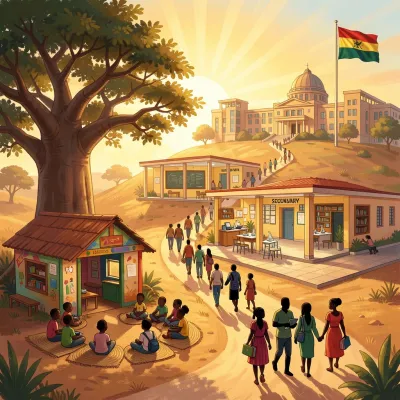
The Gambian education system has evolved from indigenous Islamic Quranic schools (Daras) and colonial missionary institutions to a structured national framework encompassing Early Childhood Care and Development (ECCD), nine years of Basic Education (Lower and Upper Basic), Senior Secondary Education, Technical and Vocational Education and Training (TVET), and Higher Education led by the University of The Gambia (established 1999). This progression reflects the nation's journey from fragmented, unequal systems toward a unified approach aimed at national development, with post-independence efforts focusing on expanding access, decolonizing curricula, and building local capacity.
Despite notable achievements in enrollment growth, the system faces persistent challenges including inadequate funding and resource shortages, dilapidated infrastructure, uneven teacher distribution and shortages (particularly in rural areas and critical subjects like STEM), low teacher morale, quality concerns, high repetition and dropout rates, gender disparities that worsen at higher education levels, a significant rural-urban divide in access to resources and technology, and difficulties in implementing inclusive education for students with special needs. These challenges are compounded by curriculum relevance issues, governance constraints, and over-reliance on external donor funding. However, strategic interventions have emerged, including policy reforms like the Language in Education Policy prioritizing mother-tongue instruction, expanded teacher training programs, community participation models, school feeding initiatives, girls' empowerment scholarships, and technology integration efforts such as solar-powered schools and radio-based learning.
Looking forward, The Gambia's education strategy emphasizes foundational literacy and numeracy, digital transformation with "offline-first" solutions, higher education expansion (including the University of Education transformation), TVET growth aligned with market needs, strengthened inclusive education practices, continued gender equity initiatives, deeper integration of Education for Sustainable Development, increased domestic financing, and data-driven decision-making. Innovative community-led practices—such as School Banks, peer mentorship, school gardens, and locally relevant learning materials—demonstrate adaptive resilience. Through sustained commitment to equity, quality, and relevance, the system aims to transform learning outcomes and empower all citizens to contribute to a prosperous, sustainable future, as illustrated by successful case studies in literacy, TVET, inclusion, infrastructure, and adult education across diverse regions.
What You'll Find Inside:
- Historical evolution of Gambian education from pre-colonial traditions to modern institutions, including the establishment of the University of The Gambia in 1999.
- Comprehensive analysis of the education system structure, covering Early Childhood Care and Development (ECCD), Basic Education, Senior Secondary, Technical and Vocational Education and Training (TVET), and Higher Education.
- Examination of persistent challenges such as funding constraints, teacher shortages, infrastructure gaps, and gender disparities, alongside innovative strategies to overcome them.
- Insights into curriculum development, teacher training, and pedagogical innovations aimed at improving quality and relevance across all educational levels.
- Future outlook highlighting digital transformation, inclusive education initiatives, and strategic plans for sustainable development and workforce preparation.
Who's It For:
This book is essential for educators, policymakers, and researchers engaged in education policy and development in The Gambia and other West African nations. It offers valuable insights for international development practitioners and NGOs working on educational reform, particularly in developing contexts. Readers interested in understanding the intersection of education, governance, and socio-economic development in The Gambia will find comprehensive analysis and evidence-based strategies. It also serves as a critical resource for stakeholders involved in teacher training, curriculum design, and inclusive education initiatives.
Table of Contents:
- Introduction
- Chapter 1: Historical Foundations of Gambian Education
- Chapter 2: The Structure of the Gambian Education System
- Chapter 3: Early Childhood Care and Development (ECCD) Policies and Practices
- Chapter 4: Access and Equity in Early Childhood Education
- Chapter 5: Primary Education: Curriculum and Pedagogy
- Chapter 6: Challenges and Achievements in Primary School Enrollment
- Chapter 7: Secondary Education: Junior and Senior Cycles
- Chapter 8: Technical and Vocational Education and Training (TVET) Landscape
- Chapter 9: Higher Education Institutions and Programs
- Chapter 10: Quality Assurance in Gambian Education
- Chapter 11: Teacher Training and Professional Development
- Chapter 12: Curriculum Development and Reform Initiatives
- Chapter 13: The Role of Government in Education Policy and Funding
- Chapter 14: Non-Governmental Organizations (NGOs) and International Aid in Education
- Chapter 15: Community Participation in Education
- Chapter 16: Inclusive Education for Students with Special Needs
- Chapter 17: Gender Disparities and Empowerment in Education
- Chapter 18: Education in Rural vs. Urban Areas
- Chapter 19: The Impact of Technology on Gambian Education
- Chapter 20: Literacy and Adult Education Programs
- Chapter 21: Education for Sustainable Development in The Gambia
- Chapter 22: Challenges Facing the Gambian Education System
- Chapter 23: Innovations and Best Practices in Gambian Schools
- Chapter 24: The Future Outlook for Education in The Gambia
- Chapter 25: Case Studies of Successful Educational Initiatives
Author:
Published By:
Date Published:
June 26, 2026
Type:
Nonfiction
Language:
English
Word Count:
42,174 words
Reading Time:
2 hours 57 minutes
Sample:
Order:
Order Education In Gambia (Paperback) on MixCache.com:
Buy NowPrint copy is made to order and ships worldwide. Includes the ebook free, ready to read instantly.
$5 account credit for all new MixCache.com accounts, usable toward any ebook purchase!*