
Browse by Category
Fiction
- Action & Adventure
- African American
- Anthologies
- Children's Fiction
- Classics
- Comics & Graphic Novels
- Coming of Age
- Contemporary
- Cultural & Regional
- Drama
- Erotica
- Fantasy
- General
- Historical Fiction
- Horror
- Humor & Satire
- Literary Fiction
- Mystery, Thriller & Suspense
- Poetry
- Religious & Inspirational
- Romance
- Science Fiction
- Short Stories
- War & Military
- Westerns
- Women's Fiction
- Young Adult
Non-Fiction
- Antiques & Collectibles
- Arts & Photography
- Biographies & Memoirs
- Business & Money
- Children's Non-Fiction
-
Computers & Technology
- Artificial Intelligence
- Computer Science
- Cybersecurity & Cryptography
- Data Science & Analytics
- Databases & Big Data
- Game Development & Design
- General
- Hardware & DIY
- Mobile App Development
- Networking & Cloud Computing
- Operating Systems
- Programming
- Robotics
- Software
- Software Engineering
- User Experience (UX) & Design
- Web Development & Design
- Cooking, Food & Wine
- Crafts, Hobbies & Home
- Education & Teaching
- Engineering
- General
- Health, Fitness & Dieting
-
History
- African History
- African History - North Africa
- African History - Sub-Saharan Africa
- American History
- American History - 20th Century
- American History - Civil War
- American History - Colonial Period
- Ancient History
- Asian History
- Asian History - China
- Asian History - India
- Asian History - Japan
- Asian History - Southeast Asia
- European History
- European History - Ancient Greece
- European History - Ancient Rome
- European History - Medieval
- European History - Modern
- European History - Renaissance
- General
- Middle Eastern History
- Military History
- Military History - Aviation
- Military History - Naval
- Social & Cultural History
- World History
- Humor & Entertainment
- Industrial Technology
- Language Learning
- Law
- LGBTQ+ Non-Fiction
- Literary Criticism
- Medical Books
- Parenting & Relationships
- Philosophy
- Politics & Social Sciences
- Reference
- Religion & Spirituality
-
Science & Math
- Agricultural Sciences
- Astronomy & Space Science
- Behavioral Sciences
- Biological Sciences
- Botany & Plant Science
- Chemistry
- Earth Sciences
- Engineering - Chemical
- Engineering - Civil
- Engineering - Electrical
- Engineering - Mechanical
- Environment
- General
- Geology
- Mathematics
- Nature & Ecology
- Oceanography
- Paleontology
- Physics
- Statistics
- Self-Help
- Sports & Outdoors
- Study Aids
- Sustainability & Green Living
- Textbooks
- Transportation
- Travel
- True Crime
- Urban Planning & Development
- Veterinary Medicine
- Writing & Publishing
Jump to Section

Want unlimited access to all books published by MixCache.com (plus their audiobooks)? Try MixCache.com Total Access. Look for the MTA badge on book covers to identify included titles.
Access to infinite ebooks: Don't see the book you want? Suggest it and we'll create it (free!) for you from scratch with our powerful AI book writer. Then read it with MTA - besides profiting from any sales it makes!
Education In Egypt
MTA
A Comprehensive Overview from Early Childhood to Higher Education
About this book:
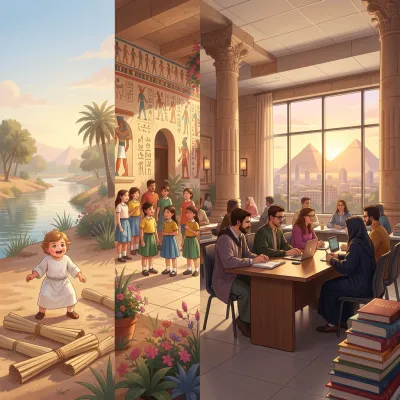
Education in Egypt traces its origins from ancient "Houses of Life" and scribal training through Hellenistic, Roman, Islamic, and Ottoman influences, evolving into a dual system under Muhammad Ali Pasha that blended traditional religious schools with secular, European‑inspired institutions. The contemporary structure, overseen by the Ministry of Education and Technical Education for pre‑university levels and the Ministry of Higher Education and Scientific Research for post‑secondary education, comprises compulsory nine‑year basic education (six years primary, three years preparatory), followed by three‑year secondary education split between general academic streams (scientific, literary, mathematical) and Technical and Vocational Education and Training (TVET). A parallel Al‑Azhar system provides an Islamic‑integrated curriculum from primary through university, while private national and international schools offer alternative curricula and facilities, often catering to expatriates and affluent Egyptian families seeking global qualifications.
Higher education encompasses a large network of tuition‑free public universities, rapidly expanding private universities, and specialized institutes that award diplomas and degrees in technical, commercial, health, and artistic fields. Quality assurance is driven by the National Authority for Quality Assurance and Accreditation of Education (NAQAAE), which sets benchmarks, evaluates institutions, and grants accreditation, while international accreditations further enhance global recognition. Continuous curriculum reform—exemplified by the "Education 2.0" initiative—shifts focus from rote memorization to critical thinking, problem‑solving, creativity, and digital literacy across all levels, supported by extensive teacher training programs, technology integration (tablets, interactive whiteboards, the Egyptian Knowledge Bank, and e‑learning platforms), and efforts to align instruction with labor market needs. Funding relies heavily on government allocations for public institutions, supplemented by household expenditures on private tutoring and fees, private sector investments, and international aid, with ongoing debates about equity, resource distribution, and sustainable financing models.
Persistent challenges include illiteracy, dropout rates—especially at preparatory and secondary transitions—and socio‑economic disparities that affect access, quality, and outcomes between urban and rural areas, rich and poor families, and girls and boys in certain regions. Inclusive education policies aim to integrate students with special needs through resource rooms, individualized plans, teacher training, and accessible infrastructure, while gender parity has improved markedly in enrollment but still faces biases in STEM fields, vocational tracking, and leadership representation. Bridging the education‑labor‑market gap emphasizes reforming TVET, strengthening internships and apprenticeships, embedding soft and digital skills, fostering entrepreneurship, and improving career guidance. International cooperation—through bilateral ties, multilateral organizations, and South‑South partnerships—supports curriculum development, teacher training, TVET modernization, higher‑education internationalization, and financial assistance. Looking ahead, Egypt Vision 2030 and continued Education 2.0 reforms aim to build an equitable, high‑quality, technology‑enhanced system that prepares youth for a knowledge‑based economy, expands TVET as a respected pathway, deepens quality‑assurance mechanisms, and leverages international partnerships to foster innovation and global competitiveness.
What You'll Find Inside:
- The historical evolution of Egyptian education from ancient 'Houses of Life' and Al-Azhar's founding to modern reforms under Muhammad Ali and Nasser, revealing how political and cultural shifts shaped today's system.
- The complex structure of Egypt's educational system, including pre-university stages (primary, preparatory, secondary), general and technical/vocational tracks, and the parallel Al-Azhar religious education pathway.
- The expanding landscape of higher education, covering public and private universities, specialized institutes, quality assurance through NAQAAE, and the growing role of internationalization and digital transformation.
- Persistent challenges such as overcrowded classrooms, teacher quality and retention, illiteracy, high drop-out rates, rural-urban disparities, and the socio-economic factors that deeply influence educational access and outcomes.
- Ongoing reform initiatives like Education 2.0, curriculum modernization, technology integration, inclusive education for students with special needs, and future policy directions aligned with Egypt Vision 2030.
Who's It For:
This book is ideal for policymakers, educators, researchers, and international development professionals seeking a comprehensive understanding of Egypt’s educational system. It also serves students and scholars of comparative education, Middle Eastern studies, or those interested in how historical, socio-economic, and political factors shape national education reforms in developing countries.
Author:
Published By:
Date Published:
June 24, 2026
Type:
Nonfiction
Language:
English
Word Count:
43,629 words
Reading Time:
3 hours 3 minutes
Sample:
MixCache.com Total Access
Get unlimited access to this book + all books published by MixCache.com for $11.99/month
Subscribe to MTAOr purchase this book individually below
Order:
Buy the Education In Egypt ebook on MixCache.com:
Buy Now
Full ebook will be available immediately
- read online or download as a PDF file.
$5 account credit for all new MixCache.com accounts, usable toward any ebook purchase!*




Ratings & Reviews
Ask Questions About This Book
Have a question about the content? Ask our AI assistant!
Start by asking a question about "Education In Egypt"
Example: "Does this book mention William Shakespeare?"
Thinking...