Browse by Category
Fiction
- Action & Adventure
- African American
- Anthologies
- Children's Fiction
- Classics
- Comics & Graphic Novels
- Coming of Age
- Contemporary
- Cultural & Regional
- Drama
- Erotica
- Fantasy
- General
- Historical Fiction
- Horror
- Humor & Satire
- Literary Fiction
- Mystery, Thriller & Suspense
- Poetry
- Religious & Inspirational
- Romance
- Science Fiction
- Short Stories
- War & Military
- Westerns
- Women's Fiction
- Young Adult
Non-Fiction
- Antiques & Collectibles
- Arts & Photography
- Biographies & Memoirs
- Business & Money
- Children's Non-Fiction
-
Computers & Technology
- Artificial Intelligence
- Computer Science
- Cybersecurity & Cryptography
- Data Science & Analytics
- Databases & Big Data
- Game Development & Design
- General
- Hardware & DIY
- Mobile App Development
- Networking & Cloud Computing
- Operating Systems
- Programming
- Robotics
- Software
- Software Engineering
- User Experience (UX) & Design
- Web Development & Design
- Cooking, Food & Wine
- Crafts, Hobbies & Home
- Education & Teaching
- Engineering
- General
- Health, Fitness & Dieting
-
History
- African History
- African History - North Africa
- African History - Sub-Saharan Africa
- American History
- American History - 20th Century
- American History - Civil War
- American History - Colonial Period
- Ancient History
- Asian History
- Asian History - China
- Asian History - India
- Asian History - Japan
- Asian History - Southeast Asia
- European History
- European History - Ancient Greece
- European History - Ancient Rome
- European History - Medieval
- European History - Modern
- European History - Renaissance
- General
- Middle Eastern History
- Military History
- Military History - Aviation
- Military History - Naval
- Social & Cultural History
- World History
- Humor & Entertainment
- Industrial Technology
- Language Learning
- Law
- LGBTQ+ Non-Fiction
- Literary Criticism
- Medical Books
- Parenting & Relationships
- Philosophy
- Politics & Social Sciences
- Reference
- Religion & Spirituality
-
Science & Math
- Agricultural Sciences
- Astronomy & Space Science
- Behavioral Sciences
- Biological Sciences
- Botany & Plant Science
- Chemistry
- Earth Sciences
- Engineering - Chemical
- Engineering - Civil
- Engineering - Electrical
- Engineering - Mechanical
- Environment
- General
- Geology
- Mathematics
- Nature & Ecology
- Oceanography
- Paleontology
- Physics
- Statistics
- Self-Help
- Sports & Outdoors
- Study Aids
- Sustainability & Green Living
- Textbooks
- Transportation
- Travel
- True Crime
- Urban Planning & Development
- Veterinary Medicine
- Writing & Publishing
Jump to Section

Want unlimited access to all books published by MixCache.com (plus their audiobooks)? Try MixCache.com Total Access. Look for the MTA badge on book covers to identify included titles.
Access to infinite ebooks: Don't see the book you want? Suggest it and we'll create it (free!) for you from scratch with our powerful AI book writer. Then read it with MTA - besides profiting from any sales it makes!
Education In The Czech Republic
MTA
A Comprehensive Overview from Early Childhood to Higher Education
About this book:
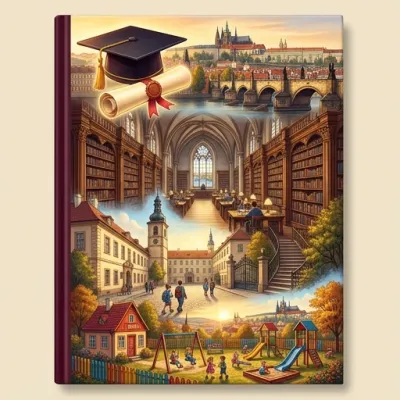
Education in the Czech Republic is a historically rich and systematically structured system that spans from early childhood through higher education, deeply influenced by its evolving political and social landscape. The historical context traces back to medieval monastic schools and the founding of Charles University in 1348, with significant transformations occurring during the Hussite movement, the Austro-Hungarian Empire, and post-1989 democratic reforms. The current structure is governed by the Ministry of Education, Youth and Sports (MŠMT), supported by regional and municipal authorities, and follows international frameworks like the Bologna Process. Early childhood education emphasizes inclusivity and mandatory pre-primary schooling, while primary and lower secondary education focuses on foundational skills and curriculum flexibility. The transition to upper secondary education offers distinct pathways: academically oriented gymnasia preparing students for the Maturita examination and higher education, and vocationally focused schools and apprenticeships emphasizing practical skills. Teacher training is rigorous, involving pedagogical specializations and continuous professional development, with significant attention to inclusivity and support for special needs and minority communities, especially Roma children.
Funding mechanisms blend state, regional, and municipal contributions, supplemented by European Union structural funds and private investments, ensuring infrastructure and resource access. Higher education features comprehensive universities and vocational schools, accredited by the National Accreditation Bureau for Higher Education (NAÚ), offering bachelor's, master's, and doctoral programs. Internationalization is a priority, with active participation in Erasmus+ and global partnerships, alongside lifelong learning opportunities for adults. Despite these strengths, the Czech system faces challenges such as ensuring equitable resource allocation, addressing teacher shortages, integrating digital technologies, and overcoming social disparities, particularly for marginalized groups. Ongoing reforms aim to balance academic rigor with practical skills, enhance teacher support, and adapt to demographic and technological changes. Future trends emphasize digital transformation, personalized learning, and lifelong education, ensuring the system remains responsive to global demands while fostering inclusivity and adaptability. This evolving approach positions Czech education to meet the complexities of a modern, interconnected world.
What You'll Find Inside:
- Explore the historical evolution of Czech education, from its earliest monastic foundations to the significant societal shifts following the Velvet Revolution and subsequent reintegration into the European educational landscape.
- Understand the intricate governance and multi-layered structure of the Czech educational system, detailing the roles of the Ministry of Education, regional authorities, and municipal councils from early childhood through higher education.
- Examine the diverse pathways available to students, including the distinct roles and advantages of general academic tracks (Gymnázia) and specialized vocational schools, culminating in the pivotal Maturita examination.
- Discover how the Czech system addresses inclusivity and equity, with dedicated chapters on special needs education, supporting minority and Roma children, and the ongoing challenges in achieving full integration.
- Gain insights into critical contemporary issues such as teacher training, professional development, the impact of EU policies, funding mechanisms, and future trends like digital transformation and lifelong learning.
Who's It For:
This comprehensive guide is specifically designed for educators seeking a deep understanding of a European system, policymakers interested in educational reforms and comparisons, and researchers studying international education. It is also invaluable for students considering studying or teaching in the Czech Republic, as well as expatriate families navigating the local educational landscape and wanting to understand the structure, values, and challenges of the Czech system.
Author:
Published By:
Date Published:
June 23, 2026
Type:
Nonfiction
Language:
English
Word Count:
45,081 words
Reading Time:
3 hours 9 minutes
Sample:
Order:
Order Education In The Czech Republic (Hardcover) on MixCache.com:
Buy NowPrint copy is made to order and ships worldwide. Includes the ebook free, ready to read instantly.
$5 account credit for all new MixCache.com accounts, usable toward any ebook purchase!*