Browse by Category
Fiction
- Action & Adventure
- African American
- Anthologies
- Children's Fiction
- Classics
- Comics & Graphic Novels
- Coming of Age
- Contemporary
- Cultural & Regional
- Drama
- Erotica
- Family Life
- Fantasy
- General
- Historical Fiction
- Horror
- Humor & Satire
- Literary Fiction
- Mystery, Thriller & Suspense
- Poetry
- Religious & Inspirational
- Romance
- Science Fiction
- Short Stories
- War & Military
- Westerns
- Women's Fiction
- Young Adult
Non-Fiction
- Antiques & Collectibles
- Arts & Photography
- Biographies & Memoirs
- Business & Money
- Children's Non-Fiction
-
Computers & Technology
- Artificial Intelligence
- Computer Science
- Cybersecurity & Cryptography
- Data Science & Analytics
- Databases & Big Data
- Game Development & Design
- General
- Hardware & DIY
- Mobile App Development
- Networking & Cloud Computing
- Operating Systems
- Programming
- Robotics
- Software
- Software Engineering
- User Experience (UX) & Design
- Web Development & Design
- Cooking, Food & Wine
- Crafts, Hobbies & Home
- Education & Teaching
- Engineering
- General
- Health, Fitness & Dieting
-
History
- African History
- African History - North Africa
- African History - Sub-Saharan Africa
- American History
- American History - 20th Century
- American History - Civil War
- American History - Colonial Period
- Ancient History
- Asian History
- Asian History - China
- Asian History - India
- Asian History - Japan
- Asian History - Southeast Asia
- European History
- European History - Ancient Greece
- European History - Ancient Rome
- European History - Medieval
- European History - Modern
- European History - Renaissance
- General
- Middle Eastern History
- Military History
- Military History - Aviation
- Military History - Naval
- Social & Cultural History
- World History
- Humor & Entertainment
- Industrial Technology
- Language Learning
- Law
- LGBTQ+ Non-Fiction
- Literary Criticism
- Medical Books
- Parenting & Relationships
- Philosophy
- Politics & Social Sciences
- Reference
- Religion & Spirituality
-
Science & Math
- Agricultural Sciences
- Astronomy & Space Science
- Behavioral Sciences
- Biological Sciences
- Botany & Plant Science
- Chemistry
- Earth Sciences
- Engineering - Chemical
- Engineering - Civil
- Engineering - Electrical
- Engineering - Mechanical
- Environment
- General
- Geology
- Mathematics
- Nature & Ecology
- Oceanography
- Paleontology
- Physics
- Statistics
- Self-Help
- Sports & Outdoors
- Study Aids
- Sustainability & Green Living
- Textbooks
- Transportation
- Travel
- True Crime
- Urban Planning & Development
- Veterinary Medicine
- Writing & Publishing
Jump to Section
MixCache.com Total Access
Unlimited reading and audiobooks for every book published by MixCache.com.
Included titles carry the MTA badge.
Learn more →
Education In Botswana
MTA
A Comprehensive Overview from Early Childhood to Higher Education
About this book:
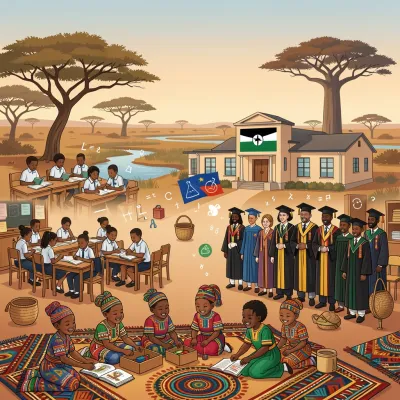
Botswana's education system has undergone a profound transformation since independence in 1966, evolving from a limited colonial-era structure into a comprehensive, state-funded national system. Heavily reliant on diamond revenues, the government has prioritized education as the cornerstone of its human capital development, achieving remarkable strides in expanding access to primary and secondary schooling. The governance of the system is split between the Ministry of Basic Education and the Ministry of Tertiary Education, Research, Science and Technology, overseeing a structure that transitions from early childhood programs through to technical training and university-level studies.
Despite significant progress in enrollment and accessibility, the system faces a complex array of challenges related to quality and equity. There are persistent rural-urban disparities in infrastructure and teacher distribution, with remote schools often lacking the resources and experienced staff found in urban centers. Additionally, Botswana has struggled with aligning its curriculum, particularly at the secondary and technical levels, to the demands of a diversifying economy, leading to a mismatch between graduate output and labor market needs. The impact of the HIV/AIDS epidemic also placed immense strain on the system by increasing teacher mortality and student orphanhood.
In response to these hurdles, Botswana has engaged in continuous policy reform and strategic investment. Recent initiatives focus on strengthening technical and vocational education (TVET), advancing digital literacy, and promoting inclusive education for learners with special needs. By emphasizing lifelong learning, data-driven policymaking, and the integration of indigenous knowledge, the nation aims to build a more resilient and responsive education system. Ultimately, Botswana envisions a future where education empowers every citizen to thrive in a globalized, knowledge-based society while remaining culturally grounded.
What You'll Find Inside:
- Trace Botswana's educational evolution from indigenous traditions and missionary schools to post-independence expansion fueled by diamond revenues, highlighting key reforms like the 1977 National Commission on Education and the 1994 Revised National Policy on Education.
- Examine the dual ministerial structure (Ministry of Basic Education and Ministry of Tertiary Education, Research, Science and Technology) governing the 7-3-2 education system, including decentralized implementation through regional offices and school-level governance mechanisms.
- Explore curriculum development across all levels, emphasizing the shift toward competency-based learning, the critical role of teacher education and professional development, and assessment systems like PSLE, JCE, and BGCSE.
- Analyze persistent equity challenges including rural-urban disparities, gender dynamics in subject participation, inclusive education for learners with special needs, and the systemic impact of HIV/AIDS on teacher supply and student attendance.
- Discover the vision for a knowledge-based economy through technology integration, lifelong learning initiatives, public-private partnerships, and evidence-based policy making driven by educational research and data analytics.
Who's It For:
This book is essential reading for policymakers, education administrators, teachers, researchers, and development practitioners seeking a comprehensive understanding of Botswana's education system. It provides valuable insights for anyone interested in educational development in African contexts, particularly those focused on policy analysis, reform initiatives, and the interplay between education and national development.
Table of Contents:
- Introduction
- Chapter 1: Historical Development of Education in Botswana
- Chapter 2: The Structure and Governance of Botswana's Education System
- Chapter 3: Early Childhood Education: Policies, Provision, and Challenges
- Chapter 4: Primary Education: Curriculum, Access, and Quality
- Chapter 5: Secondary Education: Pathways, Reforms, and Outcomes
- Chapter 6: Technical and Vocational Education and Training (TVET) in Botswana
- Chapter 7: Higher Education Landscape: Universities and Colleges
- Chapter 8: Curriculum Development and Implementation Across Educational Levels
- Chapter 9: Teacher Education and Professional Development
- Chapter 10: Assessment, Examinations, and Certification
- Chapter 11: Inclusive Education: Addressing Special Educational Needs
- Chapter 12: Gender and Education in Botswana
- Chapter 13: Language Policy and Medium of Instruction
- Chapter 14: The Role of Technology in Education
- Chapter 15: Education Financing and Expenditure
- Chapter 16: Public-Private Partnerships in Education
- Chapter 17: Education and Employment: Bridging the Skills Gap
- Chapter 18: The Impact of HIV/AIDS on the Education System
- Chapter 19: Rural-Urban Disparities in Educational Access and Quality
- Chapter 20: International Cooperation and Influence on Botswana's Education
- Chapter 21: Challenges and Opportunities in Educational Reform
- Chapter 22: Lifelong Learning and Adult Education Initiatives
- Chapter 23: The Role of Culture and Indigenous Knowledge in Education
- Chapter 24: Educational Research and Data for Policy Making
- Chapter 25: Future Directions and Vision for Education in Botswana
Author:
Published By:
Date Published:
June 21, 2026
Type:
Nonfiction
Language:
English
Word Count:
43,548 words
Reading Time:
3 hours 3 minutes
Sample:
Order:
Order Education In Botswana (Hardcover) on MixCache.com:
Buy NowPrint copy is made to order and ships worldwide. Includes the ebook free, ready to read instantly.
$5 account credit for all new MixCache.com accounts, usable toward any ebook purchase!*