Browse by Category
Fiction
- Action & Adventure
- African American
- Anthologies
- Children's Fiction
- Classics
- Comics & Graphic Novels
- Coming of Age
- Contemporary
- Cultural & Regional
- Drama
- Erotica
- Fantasy
- General
- Historical Fiction
- Horror
- Humor & Satire
- Literary Fiction
- Mystery, Thriller & Suspense
- Poetry
- Religious & Inspirational
- Romance
- Science Fiction
- Short Stories
- War & Military
- Westerns
- Women's Fiction
- Young Adult
Non-Fiction
- Antiques & Collectibles
- Arts & Photography
- Biographies & Memoirs
- Business & Money
- Children's Non-Fiction
-
Computers & Technology
- Artificial Intelligence
- Computer Science
- Cybersecurity & Cryptography
- Data Science & Analytics
- Databases & Big Data
- Game Development & Design
- General
- Hardware & DIY
- Mobile App Development
- Networking & Cloud Computing
- Operating Systems
- Programming
- Robotics
- Software
- Software Engineering
- User Experience (UX) & Design
- Web Development & Design
- Cooking, Food & Wine
- Crafts, Hobbies & Home
- Education & Teaching
- Engineering
- General
- Health, Fitness & Dieting
-
History
- African History
- African History - North Africa
- African History - Sub-Saharan Africa
- American History
- American History - 20th Century
- American History - Civil War
- American History - Colonial Period
- Ancient History
- Asian History
- Asian History - China
- Asian History - India
- Asian History - Japan
- Asian History - Southeast Asia
- European History
- European History - Ancient Greece
- European History - Ancient Rome
- European History - Medieval
- European History - Modern
- European History - Renaissance
- General
- Middle Eastern History
- Military History
- Military History - Aviation
- Military History - Naval
- Social & Cultural History
- World History
- Humor & Entertainment
- Industrial Technology
- Language Learning
- Law
- LGBTQ+ Non-Fiction
- Literary Criticism
- Medical Books
- Parenting & Relationships
- Philosophy
- Politics & Social Sciences
- Reference
- Religion & Spirituality
-
Science & Math
- Agricultural Sciences
- Astronomy & Space Science
- Behavioral Sciences
- Biological Sciences
- Botany & Plant Science
- Chemistry
- Earth Sciences
- Engineering - Chemical
- Engineering - Civil
- Engineering - Electrical
- Engineering - Mechanical
- Environment
- General
- Geology
- Mathematics
- Nature & Ecology
- Oceanography
- Paleontology
- Physics
- Statistics
- Self-Help
- Sports & Outdoors
- Study Aids
- Sustainability & Green Living
- Textbooks
- Transportation
- Travel
- True Crime
- Urban Planning & Development
- Veterinary Medicine
- Writing & Publishing
Jump to Section

Want unlimited access to all books published by MixCache.com (plus their audiobooks)? Try MixCache.com Total Access. Look for the MTA badge on book covers to identify included titles.
Access to infinite ebooks: Don't see the book you want? Suggest it and we'll create it (free!) for you from scratch with our powerful AI book writer. Then read it with MTA - besides profiting from any sales it makes!
Education In Colombia
MTA
A Comprehensive Overview from Early Childhood to Higher Education
About this book:
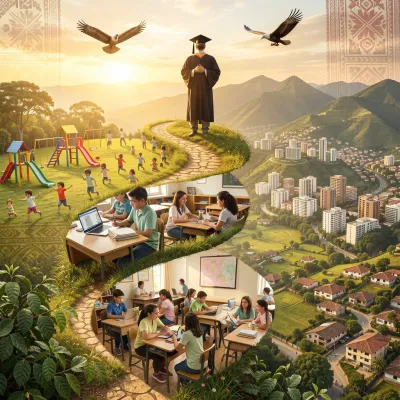
Education in Colombia has evolved from informal indigenous knowledge transmission through a colonial system dominated by the Catholic Church to a modern, legally mandated framework established by the 1991 Constitution and subsequent laws such as the General Education Law (115/1994) and the Higher Education Law (30/1992). The system is structured into Early Childhood Education, Basic Education (primary and secondary basic), Middle Education (academic and technical tracks), and Higher Education (universities, technological, and technical professional institutions). Governance is centralized through the Ministry of National Education (MEN) but decentralized to departmental and municipal secretariats, with a mixed public‑private provision that coexists across all levels, supported by the General System of Participations (SGP) for public funding and supplemented by private tuition, ICETEX loans, and international cooperation.
Each level faces persistent challenges of access, equity, and quality. Early childhood programs, led by the ICBF and MEN, strive for holistic development but grapple with rural‑urban disparities, socioeconomic barriers, and the need for culturally relevant intercultural bilingual education for indigenous and Afro‑Colombian communities. Primary education emphasizes foundational literacy and numeracy through active, competency‑based pedagogies, yet struggles with infrastructure deficits, teacher retention in remote areas, and the impact of violence and poverty. Secondary education diversifies into academic and technical pathways, with the Saber 11° exam serving as the gateway to higher education; TVET, epitomized by SENA, provides industry‑linked, hands‑on training that enhances employability. Higher education has expanded dramatically, featuring a dual public‑private system, robust research output, and internationalization efforts, while quality assurance is enforced via prior mandatory registration (registro calificado) and voluntary accreditation by the National Accreditation Council (CNA). Financing relies heavily on SGP transfers, private household expenditure, and targeted programs like Generación E to support vulnerable students, with ongoing debates over equity and adequacy of resources.
Looking forward, Colombian education policy prioritizes strengthening quality and equity through data‑driven decision‑making, curriculum reform that integrates 21st‑century skills (critical thinking, creativity, digital literacy, entrepreneurship), and expanded use of educational technology to bridge the digital divide. Teacher development focuses on continuous, personalized professional development and incentives for rural and conflict‑affected areas. Inclusive education, peace and citizenship education, and robust linkages between academia, industry, and NGOs are emphasized to promote social cohesion, employability, and innovation. Case studies such as the “De Cero a Siempre” integrated early childhood model, “Maestros por Colombia,” SENA’s TVET impact, Universidad del Valle’s social‑impact research, Medellín’s Campus Nova innovation hub, and the “Todos a Aprender” program illustrate successful strategies that have improved learning outcomes, retention, and socioeconomic mobility, offering scalable pathways for a more equitable and prosperous future.
What You'll Find Inside:
- Explore the historical evolution of Colombia's education system from indigenous foundations through colonial influences to modern reforms.
- Examine the structure, governance, and quality assurance mechanisms shaping Colombia's diverse educational landscape.
- Analyze specialized approaches in early childhood education, technical/vocational training, and inclusive education for marginalized communities.
- Investigate challenges and innovations in rural, bilingual, and peace-oriented education within conflict-affected regions.
- Review Colombia's internationalization efforts, research contributions, and policies linking education to employability and lifelong learning.
Who's It For:
This book is essential for policymakers, educators, researchers, and students seeking comprehensive insights into Colombia's education system. International development professionals, NGOs, and stakeholders interested in comparative education or Latin American educational models will also benefit from its detailed analysis and case studies.
Author:
Published By:
Date Published:
June 20, 2026
Type:
Nonfiction
Language:
English
Word Count:
99,514 words
Reading Time:
6 hours 58 minutes
Sample:
Order:
Order Education In Colombia (Paperback) on MixCache.com:
Buy NowPrint copy is made to order and ships worldwide. Includes the ebook free, ready to read instantly.
$5 account credit for all new MixCache.com accounts, usable toward any ebook purchase!*