Browse by Category
Fiction
- Action & Adventure
- African American
- Anthologies
- Children's Fiction
- Classics
- Comics & Graphic Novels
- Coming of Age
- Contemporary
- Cultural & Regional
- Drama
- Erotica
- Fantasy
- General
- Historical Fiction
- Horror
- Humor & Satire
- Literary Fiction
- Mystery, Thriller & Suspense
- Poetry
- Religious & Inspirational
- Romance
- Science Fiction
- Short Stories
- War & Military
- Westerns
- Women's Fiction
- Young Adult
Non-Fiction
- Antiques & Collectibles
- Arts & Photography
- Biographies & Memoirs
- Business & Money
- Children's Non-Fiction
-
Computers & Technology
- Artificial Intelligence
- Computer Science
- Cybersecurity & Cryptography
- Data Science & Analytics
- Databases & Big Data
- Game Development & Design
- General
- Hardware & DIY
- Mobile App Development
- Networking & Cloud Computing
- Operating Systems
- Programming
- Robotics
- Software
- Software Engineering
- User Experience (UX) & Design
- Web Development & Design
- Cooking, Food & Wine
- Crafts, Hobbies & Home
- Education & Teaching
- Engineering
- General
- Health, Fitness & Dieting
-
History
- African History
- African History - North Africa
- African History - Sub-Saharan Africa
- American History
- American History - 20th Century
- American History - Civil War
- American History - Colonial Period
- Ancient History
- Asian History
- Asian History - China
- Asian History - India
- Asian History - Japan
- Asian History - Southeast Asia
- European History
- European History - Ancient Greece
- European History - Ancient Rome
- European History - Medieval
- European History - Modern
- European History - Renaissance
- General
- Middle Eastern History
- Military History
- Military History - Aviation
- Military History - Naval
- Social & Cultural History
- World History
- Humor & Entertainment
- Industrial Technology
- Language Learning
- Law
- LGBTQ+ Non-Fiction
- Literary Criticism
- Medical Books
- Parenting & Relationships
- Philosophy
- Politics & Social Sciences
- Reference
- Religion & Spirituality
-
Science & Math
- Agricultural Sciences
- Astronomy & Space Science
- Behavioral Sciences
- Biological Sciences
- Botany & Plant Science
- Chemistry
- Earth Sciences
- Engineering - Chemical
- Engineering - Civil
- Engineering - Electrical
- Engineering - Mechanical
- Environment
- General
- Geology
- Mathematics
- Nature & Ecology
- Oceanography
- Paleontology
- Physics
- Statistics
- Self-Help
- Sports & Outdoors
- Study Aids
- Sustainability & Green Living
- Textbooks
- Transportation
- Travel
- True Crime
- Urban Planning & Development
- Veterinary Medicine
- Writing & Publishing
Jump to Section

Want unlimited access to all books published by MixCache.com (plus their audiobooks)? Try MixCache.com Total Access. Look for the MTA badge on book covers to identify included titles.
Access to infinite ebooks: Don't see the book you want? Suggest it and we'll create it (free!) for you from scratch with our powerful AI book writer. Then read it with MTA - besides profiting from any sales it makes!
Education In Brunei
MTA
A Comprehensive Overview from Early Childhood to Higher Education
About this book:
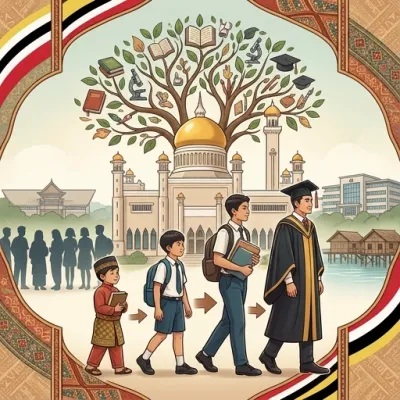
Education in Brunei Darussalam is a comprehensive system designed to cultivate a knowledgeable, skilled, and ethically grounded populace in alignment with the national vision Wawasan Brunei 2035. Guided by the principles of Melayu Islam Beraja (MIB), the system integrates Islamic values, cultural identity, and bilingual instruction (Malay and English) to prepare students for both national development and global competitiveness. Structured as a "7-3-2-2" framework (primary, lower secondary, upper secondary, pre-university or vocational training), education is free and compulsory from preschool through secondary levels, supported by strategic reforms such as the National Education System for the 21st Century (SPN21). SPN21 emphasizes student-centered learning, critical thinking, and multiple educational pathways, reflecting Brunei’s commitment to holistic development and economic diversification.
The system spans early childhood, primary, secondary, technical and vocational education and training (TVET), and higher education. Early childhood education focuses on foundational skills and cultural values, while primary and secondary education emphasize core subjects, ICT integration, and co-curricular activities to foster leadership and creativity. TVET, managed by the Institute of Brunei Technical Education (IBTE), provides industry-aligned training to support economic diversification. Higher education institutions like Universiti Brunei Darussalam (UBD), Universiti Teknologi Brunei (UTB), and Universiti Islam Sultan Sharif Ali (UNISSA) prioritize research, innovation, and specialized programs in technology, Islamic studies, and sustainable development. The curriculum balances traditional Islamic education with modern pedagogies, ensuring students develop both moral and technical competencies.
Challenges include maintaining equitable access, addressing skill gaps for workforce demands, and adapting to technological and pedagogical shifts. Efforts to enhance teacher training, integrate digital tools, and promote lifelong learning aim to overcome these barriers. The system also prioritizes inclusivity through policies supporting special education needs and bilingual education, while fostering international collaboration through partnerships and scholarships. Future directions focus on leveraging AI, AR, and adaptive technologies, refining competency-based curricula, and strengthening global academic ties to meet evolving economic and societal needs.
Ultimately, Brunei’s education system serves as a cornerstone of national advancement, nurturing individuals capable of contributing to a knowledge-based economy while preserving cultural and religious heritage. Through continuous reform and strategic investment, it seeks to realize Wawasan Brunei 2035’s goals of a prosperous, sustainable, and globally engaged nation.
What You'll Find Inside:
- A comprehensive historical overview tracing Brunei's education from informal Islamic and indigenous roots through colonial influences to post‑independence reforms and the Wawasan Brunei 2035 vision.
- Detailed description of the Bruneian education system's structure, governance, and key policies such as the Bilingual Education Policy, SPN21, and the Inclusive Education Policy.
- Insights into curriculum development across all levels, including early childhood, primary, secondary, technical/vocational (IBTE), and higher education pathways, with emphasis on 21st‑century skills and holistic development.
- Analysis of critical support systems: teacher education and professional development, assessment and evaluation practices, ICT integration, language and Islamic education, and co‑curricular activities.
- Discussion of challenges, opportunities, and future directions, covering equity, funding, research, internationalization, sustainable development, and the role of education in national development.
Who's It For:
This book is intended for educators, policymakers, researchers, and students of comparative education who seek a deep understanding of Brunei's educational landscape. It will also benefit anyone interested in Southeast Asian education systems, national development strategies, or the interplay of culture, language, and policy in shaping schooling.
Author:
Published By:
Date Published:
June 19, 2026
Type:
Nonfiction
Language:
English
Word Count:
39,367 words
Reading Time:
2 hours 45 minutes
Sample:
Order:
Order Education In Brunei (Hardcover) on MixCache.com:
Buy NowPrint copy is made to order and ships worldwide. Includes the ebook free, ready to read instantly.
$5 account credit for all new MixCache.com accounts, usable toward any ebook purchase!*