
Browse by Category
Fiction
- Action & Adventure
- African American
- Anthologies
- Children's Fiction
- Classics
- Comics & Graphic Novels
- Coming of Age
- Contemporary
- Cultural & Regional
- Drama
- Erotica
- Fantasy
- General
- Historical Fiction
- Horror
- Humor & Satire
- Literary Fiction
- Mystery, Thriller & Suspense
- Poetry
- Religious & Inspirational
- Romance
- Science Fiction
- Short Stories
- War & Military
- Westerns
- Women's Fiction
- Young Adult
Non-Fiction
- Antiques & Collectibles
- Arts & Photography
- Biographies & Memoirs
- Business & Money
- Children's Non-Fiction
-
Computers & Technology
- Artificial Intelligence
- Computer Science
- Cybersecurity & Cryptography
- Data Science & Analytics
- Databases & Big Data
- Game Development & Design
- General
- Hardware & DIY
- Mobile App Development
- Networking & Cloud Computing
- Operating Systems
- Programming
- Robotics
- Software
- Software Engineering
- User Experience (UX) & Design
- Web Development & Design
- Cooking, Food & Wine
- Crafts, Hobbies & Home
- Education & Teaching
- Engineering
- General
- Health, Fitness & Dieting
-
History
- African History
- African History - North Africa
- African History - Sub-Saharan Africa
- American History
- American History - 20th Century
- American History - Civil War
- American History - Colonial Period
- Ancient History
- Asian History
- Asian History - China
- Asian History - India
- Asian History - Japan
- Asian History - Southeast Asia
- European History
- European History - Ancient Greece
- European History - Ancient Rome
- European History - Medieval
- European History - Modern
- European History - Renaissance
- General
- Middle Eastern History
- Military History
- Military History - Aviation
- Military History - Naval
- Social & Cultural History
- World History
- Humor & Entertainment
- Industrial Technology
- Language Learning
- Law
- LGBTQ+ Non-Fiction
- Literary Criticism
- Medical Books
- Parenting & Relationships
- Philosophy
- Politics & Social Sciences
- Reference
- Religion & Spirituality
-
Science & Math
- Agricultural Sciences
- Astronomy & Space Science
- Behavioral Sciences
- Biological Sciences
- Botany & Plant Science
- Chemistry
- Earth Sciences
- Engineering - Chemical
- Engineering - Civil
- Engineering - Electrical
- Engineering - Mechanical
- Environment
- General
- Geology
- Mathematics
- Nature & Ecology
- Oceanography
- Paleontology
- Physics
- Statistics
- Self-Help
- Sports & Outdoors
- Study Aids
- Sustainability & Green Living
- Textbooks
- Transportation
- Travel
- True Crime
- Urban Planning & Development
- Veterinary Medicine
- Writing & Publishing
Jump to Section

Want unlimited access to all books published by MixCache.com (plus their audiobooks)? Try MixCache.com Total Access. Look for the MTA badge on book covers to identify included titles.
Access to infinite ebooks: Don't see the book you want? Suggest it and we'll create it (free!) for you from scratch with our powerful AI book writer. Then read it with MTA - besides profiting from any sales it makes!
Education In Argentina
MTA
A Comprehensive Overview from Early Childhood to Higher Education
About this book:
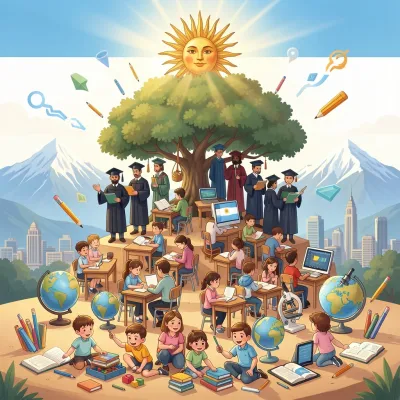
Education in Argentina is a historically rich and structurally complex system that spans from early childhood to higher education, shaped by foundational laws like the 1884 Law 1420 and the 2006 National Education Law 26.206. The country's educational framework emphasizes universal access, encompassing Early Childhood Education (ages 45 days to five years), Primary Education (six to seven years), Secondary Education (five to six years with common and diversified cycles), and Higher Education, including both public and private universities alongside technical and vocational institutions. Key historical figures like Sarmiento and the 1918 University Reform of Córdoba established enduring principles of secular, public education and university autonomy, while the federal system divides responsibility between national and provincial governments, influencing resource allocation and quality variations. Public education dominates as the primary vehicle for social mobility, though private institutions contribute to a diverse educational landscape, with ongoing debates about equity and quality.
Despite its strengths, Argentina faces significant challenges in delivering equitable and high-quality education, particularly given the profound impact of socioeconomic factors on student outcomes. Poverty, parental education, and geographic location create disparities, with rural and underserved urban communities struggling against resource limitations, teacher shortages, and infrastructure deficits. The system has made strides in inclusive education, integrating students with disabilities and expanding Bilingual and Intercultural Education (EBI) for indigenous communities, yet attitudinal and infrastructural barriers persist. Technology integration, spurred by programs like Conectar Igualdad, has bridged some gaps but revealed ongoing digital divides, especially for students without home internet access. Teacher training through *Institutos de Formación Docente* (IFDs) remains critical, though quality and support vary widely, impacting pedagogical effectiveness across regions and school levels.
Looking forward, Argentina’s educational future hinges on embracing 21st-century competencies, deepening digital transformation for personalized learning, and addressing funding and retention issues exacerbated by economic volatility. Strategic priorities include refining curricula to foster critical thinking, creativity, and socio-emotional skills, accompanied by robust professional development for educators to adapt to flexible, technology-enhanced teaching methods. Efforts to strengthen research, innovate within higher education, and expand international partnerships aim to position Argentina as a regional leader, while sustained investments in teacher salaries and school infrastructure are essential to bridge equity gaps and retain talent. By focusing on inclusive practices, intercultural respect, and adaptive governance, Argentina seeks to cultivate an educational ecosystem that empowers all learners to meet evolving societal and global demands, reinforcing education’s role as a catalyst for national development.
What You'll Find Inside:
- The book traces the historical evolution of Argentine education from colonial religious instruction through Sarmiento's 19th‑century reforms to modern inclusive policies and the 2006 National Education Law.
- It outlines the system’s structure—early childhood, primary, secondary (basic and oriented cycles), TVET, and higher education—highlighting compulsory education, provincial autonomy, and the public‑private mix.
- A central theme is equity and inclusion, detailing policies for inclusive education, bilingual/intercultural programs for indigenous peoples, and initiatives to bridge rural‑urban disparities.
- The role of technology is examined, especially nationwide digital inclusion efforts like Conectar Igualdad, and how ICT integration is reshaping pedagogy across all levels.
- The work analyzes persistent challenges—socioeconomic impacts on outcomes, funding volatility, teacher training needs—and explores future directions such as 21st‑century competencies, personalized learning, and sustainable financing.
Who's It For:
Education In Argentina is designed for educators, school administrators, policymakers, and government officials involved in shaping or implementing educational policy in Argentina. It also serves researchers and students of Latin American studies, comparative education, and development who need a detailed reference on the country’s educational landscape. Additionally, the book is valuable for NGOs, international development agencies, and anyone interested in the interplay between education, socioeconomic factors, and national development in Argentina.
Author:
Published By:
Date Published:
June 19, 2026
Type:
Nonfiction
Language:
English
Word Count:
49,321 words
Reading Time:
3 hours 27 minutes
Sample:
MixCache.com Total Access
Get unlimited access to this book + all books published by MixCache.com for $11.99/month
Subscribe to MTAOr purchase this book individually below
Order:
Buy the Education In Argentina ebook on MixCache.com:
Buy Now
Full ebook will be available immediately
- read online or download as a PDF file.
$5 account credit for all new MixCache.com accounts, usable toward any ebook purchase!*




Ratings & Reviews
Ask Questions About This Book
Have a question about the content? Ask our AI assistant!
Start by asking a question about "Education In Argentina"
Example: "Does this book mention William Shakespeare?"
Thinking...