Browse by Category
Fiction
- Action & Adventure
- African American
- Anthologies
- Children's Fiction
- Classics
- Comics & Graphic Novels
- Coming of Age
- Contemporary
- Cultural & Regional
- Drama
- Erotica
- Fantasy
- General
- Historical Fiction
- Horror
- Humor & Satire
- Literary Fiction
- Mystery, Thriller & Suspense
- Poetry
- Religious & Inspirational
- Romance
- Science Fiction
- Short Stories
- War & Military
- Westerns
- Women's Fiction
- Young Adult
Non-Fiction
- Antiques & Collectibles
- Arts & Photography
- Biographies & Memoirs
- Business & Money
- Children's Non-Fiction
-
Computers & Technology
- Artificial Intelligence
- Computer Science
- Cybersecurity & Cryptography
- Data Science & Analytics
- Databases & Big Data
- Game Development & Design
- General
- Hardware & DIY
- Mobile App Development
- Networking & Cloud Computing
- Operating Systems
- Programming
- Robotics
- Software
- Software Engineering
- User Experience (UX) & Design
- Web Development & Design
- Cooking, Food & Wine
- Crafts, Hobbies & Home
- Education & Teaching
- Engineering
- General
- Health, Fitness & Dieting
-
History
- African History
- African History - North Africa
- African History - Sub-Saharan Africa
- American History
- American History - 20th Century
- American History - Civil War
- American History - Colonial Period
- Ancient History
- Asian History
- Asian History - China
- Asian History - India
- Asian History - Japan
- Asian History - Southeast Asia
- European History
- European History - Ancient Greece
- European History - Ancient Rome
- European History - Medieval
- European History - Modern
- European History - Renaissance
- General
- Middle Eastern History
- Military History
- Military History - Aviation
- Military History - Naval
- Social & Cultural History
- World History
- Humor & Entertainment
- Industrial Technology
- Language Learning
- Law
- LGBTQ+ Non-Fiction
- Literary Criticism
- Medical Books
- Parenting & Relationships
- Philosophy
- Politics & Social Sciences
- Reference
- Religion & Spirituality
-
Science & Math
- Agricultural Sciences
- Astronomy & Space Science
- Behavioral Sciences
- Biological Sciences
- Botany & Plant Science
- Chemistry
- Earth Sciences
- Engineering - Chemical
- Engineering - Civil
- Engineering - Electrical
- Engineering - Mechanical
- Environment
- General
- Geology
- Mathematics
- Nature & Ecology
- Oceanography
- Paleontology
- Physics
- Statistics
- Self-Help
- Sports & Outdoors
- Study Aids
- Sustainability & Green Living
- Textbooks
- Transportation
- Travel
- True Crime
- Urban Planning & Development
- Veterinary Medicine
- Writing & Publishing
Jump to Section

Want unlimited access to all books published by MixCache.com (plus their audiobooks)? Try MixCache.com Total Access. Look for the MTA badge on book covers to identify included titles.
Access to infinite ebooks: Don't see the book you want? Suggest it and we'll create it (free!) for you from scratch with our powerful AI book writer. Then read it with MTA - besides profiting from any sales it makes!
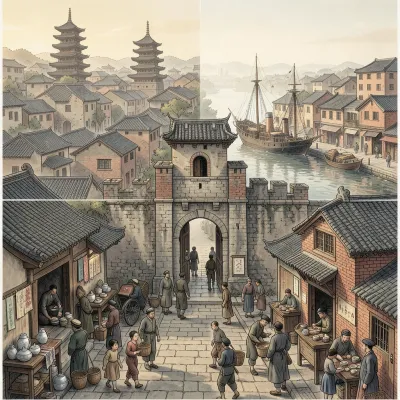
Touring the Past: Walking Histories of China's Provincial Cities
MTA
Microhistories of streets, neighborhoods, and provincial urban memory — one province per chapter
About this book:

The book "Touring the Past: Walking Histories of China's Provincial Cities" offers a distinctive exploration of China's urban heritage through the lens of microhistory, focusing on provincial cities often overlooked in favor of megacities. Organized by province, each chapter presents a walking route that combines architectural observation with archival research, inviting readers to engage deeply with local neighborhoods, streets, and landmarks. The author emphasizes how provincial cities serve as repositories of layered histories, where guild halls, temples, markets, and residential spaces encode the interplay of commerce, migration, faith, and political change. The methodology blends physical exploration with historical narratives, using "reading stations"—facades, monuments, or everyday objects—as entry points into broader social, economic, and cultural processes, transforming mundane urban elements into windows onto transformative histories.
Key themes include the examination of trade and cultural exchange, evident in locales like Quanzhou’s maritime heritage and Harbin’s diaspora-influenced architecture. The book also highlights the role of ethnic and religious communities, such as the Hui Muslims in cities like Xi’an and Hohhot, and the multicultural legacy of colonial-era planning in Dalian and Qingdao. Each chapter underscores the tension between preservation and modernization, illustrating how cities like Suzhou and Jingdezhen balance heritage conservation with contemporary needs. The text addresses ethical considerations in urban tourism, advocating mindful observation and respect for residents, while acknowledging the complexities of curating history amid displacement and development.
Through detailed accounts of revitalized spaces—from Lanzhou’s riverbanks to Kunming’s repurposed factories—the author reveals how provincial cities adapt their pasts to present realities. The narrative consistently ties local stories to transnational connections, such as the Silk Road influence in Xi’an or the Grand Canal’s economic legacy in Hangzhou. The book concludes by emphasizing that these microhistories are not isolated but part of interconnected networks, urging readers to see in each street or courtyard a reflection of broader historical forces. Ultimately, it presents urban memory as a living, evolving entity, shaped by both grand events and the quiet persistence of daily life.
What You'll Find Inside:
- Walking tours of 25 provincial cities that reveal how local streets embody national histories of trade, migration, and cultural exchange
- Microhistorical approach combining on-foot exploration with archival research at designated 'reading stations' along each route
- Examination of architectural heritage and preservation challenges, showing how cities negotiate between historical authenticity and modern development
- Exploration of diverse urban landscapes including Hui Muslim quarters, colonial architecture, ethnic minority communities, and industrial heritage sites
- Practical travel guidance with route details, timing suggestions, and ethical considerations for respectful exploration of living neighborhoods
Who's It For:
This book is ideal for culturally curious travelers seeking deeper engagement with China's provincial cities beyond typical tourist itineraries, as well as urban historians, anthropology students, and preservationists interested in microhistorical methods. It will particularly benefit readers who want to understand how everyday urban spaces reflect broader historical processes of commerce, faith, and cultural fusion, and who appreciate practical guidance for exploring living historical neighborhoods with respect and awareness.
Author:
Published By:
Date Published:
June 15, 2026
Type:
Nonfiction
Language:
English
Word Count:
48,715 words
Reading Time:
3 hours 25 minutes
Sample:
Order:
Order Touring the Past: Walking Histories of China's Provincial Cities (Paperback) on MixCache.com:
Buy NowPrint copy is made to order and ships worldwide. Includes the ebook free, ready to read instantly.
$5 account credit for all new MixCache.com accounts, usable toward any ebook purchase!*