Browse by Category
Fiction
- Action & Adventure
- African American
- Anthologies
- Children's Fiction
- Classics
- Comics & Graphic Novels
- Coming of Age
- Contemporary
- Cultural & Regional
- Drama
- Erotica
- Fantasy
- General
- Historical Fiction
- Horror
- Humor & Satire
- Literary Fiction
- Mystery, Thriller & Suspense
- Poetry
- Religious & Inspirational
- Romance
- Science Fiction
- Short Stories
- War & Military
- Westerns
- Women's Fiction
- Young Adult
Non-Fiction
- Antiques & Collectibles
- Arts & Photography
- Biographies & Memoirs
- Business & Money
- Children's Non-Fiction
-
Computers & Technology
- Artificial Intelligence
- Computer Science
- Cybersecurity & Cryptography
- Data Science & Analytics
- Databases & Big Data
- Game Development & Design
- General
- Hardware & DIY
- Mobile App Development
- Networking & Cloud Computing
- Operating Systems
- Programming
- Robotics
- Software
- Software Engineering
- User Experience (UX) & Design
- Web Development & Design
- Cooking, Food & Wine
- Crafts, Hobbies & Home
- Education & Teaching
- Engineering
- General
- Health, Fitness & Dieting
-
History
- African History
- African History - North Africa
- African History - Sub-Saharan Africa
- American History
- American History - 20th Century
- American History - Civil War
- American History - Colonial Period
- Ancient History
- Asian History
- Asian History - China
- Asian History - India
- Asian History - Japan
- Asian History - Southeast Asia
- European History
- European History - Ancient Greece
- European History - Ancient Rome
- European History - Medieval
- European History - Modern
- European History - Renaissance
- General
- Middle Eastern History
- Military History
- Military History - Aviation
- Military History - Naval
- Social & Cultural History
- World History
- Humor & Entertainment
- Industrial Technology
- Language Learning
- Law
- LGBTQ+ Non-Fiction
- Literary Criticism
- Medical Books
- Parenting & Relationships
- Philosophy
- Politics & Social Sciences
- Reference
- Religion & Spirituality
-
Science & Math
- Agricultural Sciences
- Astronomy & Space Science
- Behavioral Sciences
- Biological Sciences
- Botany & Plant Science
- Chemistry
- Earth Sciences
- Engineering - Chemical
- Engineering - Civil
- Engineering - Electrical
- Engineering - Mechanical
- Environment
- General
- Geology
- Mathematics
- Nature & Ecology
- Oceanography
- Paleontology
- Physics
- Statistics
- Self-Help
- Sports & Outdoors
- Study Aids
- Sustainability & Green Living
- Textbooks
- Transportation
- Travel
- True Crime
- Urban Planning & Development
- Veterinary Medicine
- Writing & Publishing
Jump to Section

Want unlimited access to all books published by MixCache.com (plus their audiobooks)? Try MixCache.com Total Access. Look for the MTA badge on book covers to identify included titles.
Access to infinite ebooks: Don't see the book you want? Suggest it and we'll create it (free!) for you from scratch with our powerful AI book writer. Then read it with MTA - besides profiting from any sales it makes!
Frontiers and Borders: Military and Diplomatic Histories of China's Provinces
MTA
Borderlands, defense, and provincial identities told one province at a time
About this book:
**Summary of Frontiers and Borders: Military and Diplomatic Histories of China's Provinces**
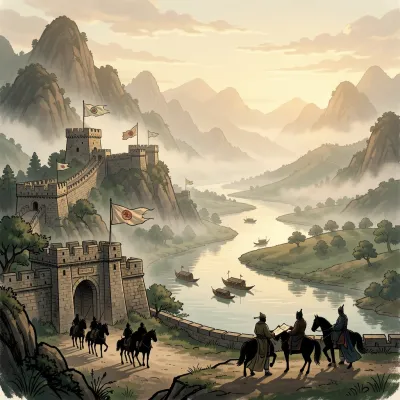
"Frontiers and Borders" offers a distinctive provincial perspective on the military and diplomatic history of China, tracing how geography, local institutions, and cross-border dynamics shaped each region's identity and contributed to national strategy. The book examines twenty-five provinces, from Xinjiang's desert oases to Guangdong's maritime frontiers, emphasizing how terrain—whether mountains, rivers, deserts, or coastlines—dictated defense strategies and diplomatic approaches. Each chapter explores how military installations, trade routes, and ethnic interactions forged distinct provincial identities that influenced central policies. The analysis challenges monolithic views of Chinese security, instead highlighting a "layered, provincial practice of security" that adapted to local conditions, demonstrating how institutions learned to work with geography to project power and maintain stability.
The study integrates campaign narratives with infrastructural history, treating forts, passes, railways, and telegraph lines as strategic actors that enabled or constrained military choices. It underscores the inseparability of military history from diplomacy, showing how borderlands were meeting grounds for treaties, local bargains, and external power struggles. The book also emphasizes the role of middle-level officials, local militias, religious institutions, and ethnic communities in shaping security landscapes, revealing that provincial problem-solving often preceded and influenced central national strategy. By comparing these provincial cases, the work demonstrates a pattern where local officials crafted frontier solutions, which central authorities ratified, facing periodic tests from neighboring powers and evolving technologies.
The concluding argument reframes continuity and change in China’s borderlands, arguing that certain corridors and strategic points (like the Hexi Corridor, Shanhai Pass, or the South China Sea approaches) recurred as constants despite evolving military technologies. The book contends that successful border stabilization emerged not from uniform policy but from adaptive provincial practices, suggesting that institutions capable of working with geography achieved greater security at lower cost with higher legitimacy. Ultimately, "Frontiers and Borders" repositions China’s historical borders as dynamic spaces of negotiation and adaptation, where provincial experiences cumulatively forged a resilient yet flexible national security framework.
What You'll Find Inside:
- Geographic constraints shaping provincial military strategies from oases to mountain passes
- Integration of military history and diplomacy in China's frontier negotiations
- Provincial-center power dynamics in borderland governance and resource allocation
- Infrastructure as strategic actor: forts, rivers, and roads enabling military operations
- Enduring strategic corridors across dynasties despite technological evolution
Who's It For:
This book serves readers of military history and foreign policy interested in China's provincial borderlands. It benefits scholars and students examining how local dynamics shaped national security strategies throughout Chinese history. The provincial lens reveals geography's role in institutional adaptation for security projection.
Author:
Published By:
Date Published:
June 13, 2026
Type:
Nonfiction
Language:
English
Word Count:
75,052 words
Reading Time:
5 hours 15 minutes
Sample:
Order:
Order Frontiers and Borders: Military and Diplomatic Histories of China's Provinces (Paperback) on MixCache.com:
Buy NowPrint copy is made to order and ships worldwide. Includes the ebook free, ready to read instantly.
$5 account credit for all new MixCache.com accounts, usable toward any ebook purchase!*