
Browse by Category
Fiction
- Action & Adventure
- African American
- Anthologies
- Children's Fiction
- Classics
- Comics & Graphic Novels
- Coming of Age
- Contemporary
- Cultural & Regional
- Drama
- Erotica
- Fantasy
- General
- Historical Fiction
- Horror
- Humor & Satire
- Literary Fiction
- Mystery, Thriller & Suspense
- Poetry
- Religious & Inspirational
- Romance
- Science Fiction
- Short Stories
- War & Military
- Westerns
- Women's Fiction
- Young Adult
Non-Fiction
- Antiques & Collectibles
- Arts & Photography
- Biographies & Memoirs
- Business & Money
- Children's Non-Fiction
-
Computers & Technology
- Artificial Intelligence
- Computer Science
- Cybersecurity & Cryptography
- Data Science & Analytics
- Databases & Big Data
- Game Development & Design
- General
- Hardware & DIY
- Mobile App Development
- Networking & Cloud Computing
- Operating Systems
- Programming
- Robotics
- Software
- Software Engineering
- User Experience (UX) & Design
- Web Development & Design
- Cooking, Food & Wine
- Crafts, Hobbies & Home
- Education & Teaching
- Engineering
- General
- Health, Fitness & Dieting
-
History
- African History
- African History - North Africa
- African History - Sub-Saharan Africa
- American History
- American History - 20th Century
- American History - Civil War
- American History - Colonial Period
- Ancient History
- Asian History
- Asian History - China
- Asian History - India
- Asian History - Japan
- Asian History - Southeast Asia
- European History
- European History - Ancient Greece
- European History - Ancient Rome
- European History - Medieval
- European History - Modern
- European History - Renaissance
- General
- Middle Eastern History
- Military History
- Military History - Aviation
- Military History - Naval
- Social & Cultural History
- World History
- Humor & Entertainment
- Industrial Technology
- Language Learning
- Law
- LGBTQ+ Non-Fiction
- Literary Criticism
- Medical Books
- Parenting & Relationships
- Philosophy
- Politics & Social Sciences
- Reference
- Religion & Spirituality
-
Science & Math
- Agricultural Sciences
- Astronomy & Space Science
- Behavioral Sciences
- Biological Sciences
- Botany & Plant Science
- Chemistry
- Earth Sciences
- Engineering - Chemical
- Engineering - Civil
- Engineering - Electrical
- Engineering - Mechanical
- Environment
- General
- Geology
- Mathematics
- Nature & Ecology
- Oceanography
- Paleontology
- Physics
- Statistics
- Self-Help
- Sports & Outdoors
- Study Aids
- Sustainability & Green Living
- Textbooks
- Transportation
- Travel
- True Crime
- Urban Planning & Development
- Veterinary Medicine
- Writing & Publishing
Jump to Section

Want unlimited access to all books published by MixCache.com (plus their audiobooks)? Try MixCache.com Total Access. Look for the MTA badge on book covers to identify included titles.
Access to infinite ebooks: Don't see the book you want? Suggest it and we'll create it (free!) for you from scratch with our powerful AI book writer. Then read it with MTA - besides profiting from any sales it makes!
Ports and Coasts: Maritime Histories of China's Coastal Provinces
MTA
Trade, piracy, and seafaring cultures along provincial coastlines — one province per chapter
About this book:
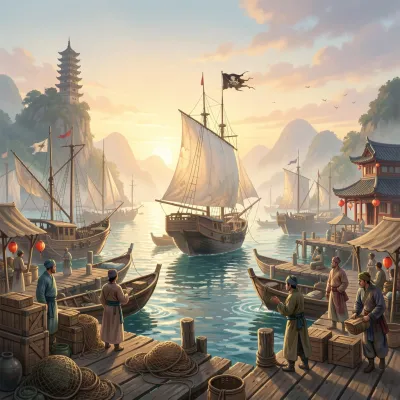
*Ports and Coasts: Maritime Histories of China's Coastal Provinces* presents a comprehensive exploration of China's maritime heritage through the lens of its coastal provinces, municipalities, and special administrative regions. Rather than treating the coastline as a peripheral boundary, the book positions it as a dynamic frontier that has shaped economies, cultures, and identities across millennia. Organized province by province—from Liaoning in the northeast to Hainan in the south, and including Hong Kong, Macao, and Taiwan—the work traces how geography, trade, foreign encounters, and state policy converged to create distinctive yet interconnected maritime histories. Each chapter examines specific ports and coastal zones, revealing how local communities adapted to monsoons, estuarine shifts, and imperial decrees while engaging with global networks of commerce, migration, and conflict.
Central to the narrative is the transformative role of trade and seafaring cultures. Coastal markets moved grain, salt, tea, seafood, ceramics, coal, and manufactured goods through intricate lattices of cabotage routes and blue-water passages. Merchant guilds, shipping partnerships, and diasporic networks—particularly from Fujian and Guangdong—wove local harbors into global systems, carrying capital, customs, and faiths across oceans. The book details how piracy and smuggling flourished alongside legitimate commerce, especially during periods of restrictive maritime bans, and how provincial authorities oscillated between suppression and accommodation. Seafaring communities developed rich traditions of pilotage, boat-building, and ritual practice, recording knowledge of currents, reefs, and storms in pilot books, songs, and seasonal calendars dedicated to deities like Mazu.
Imperial rivalries and colonial encounters profoundly reshaped many of these shores. Foreign powers sought coaling stations, consulates, and concessions, creating new legal geographies that divided waterfronts into zones with different customs, courts, and police. Cities such as Qingdao, Dalian, Tianjin, Shanghai, and Hong Kong became laboratories for urban modernity, while others specialized in repair, bunkering, or regional cabotage. War and revolution militarized straits and islands, redirected shipping, and displaced waterfront communities, only for peacetime reconstruction to launch new industrial and logistical booms. The late twentieth and early twenty-first centuries brought another transformation: special economic zones, bonded areas, and port-industrial complexes scaled up provincial ambitions, with containers stacked at deep-water terminals and petrochemical crackers feeding export manufacturing.
The book also addresses the environmental and social consequences of rapid development. Coastal erosion, land reclamation, depleted fisheries, and industrial pollution have provoked new regimes of conservation, marine zoning, and disaster preparedness. Labor movements, educational institutions, and technological innovation—from automated container terminals to offshore wind farms—reflect ongoing efforts to balance competitiveness with sustainability. Drawing on port gazetteers, customs ledgers, nautical charts, shipwreck archaeology, clan genealogies, and oral histories, the work reconstructs how policy, practice, and place intersected across centuries. Ultimately, it argues that ports and coasts are not simply edges of the land but engines of history, shaping the provinces that face the sea and offering a comparative framework for understanding China's enduring relationship with the ocean.
What You'll Find Inside:
- Provincial-by-provincial chronicles of China's coastlines, detailing each region's unique maritime evolution from ancient ports to modern hubs.
- Analysis of trade networks, piracy, and seafaring cultures that shaped local economies and cultural identities across dynasties.
- Examination of foreign imperial rivalries, treaty ports, and colonial concessions that transformed coastal cities into global gateways.
- Discussion of modern developments including containerization, special economic zones, Belt and Road Initiative, and industrial shifts.
- Assessment of environmental challenges, sustainability initiatives, and the ongoing balance between economic growth and ecological preservation.
Who's It For:
This book is ideal for students and researchers of Chinese history, maritime studies, and economic development, as well as professionals in port management, logistics, and international trade seeking a deep understanding of China's coastal transformation. It also appeals to policymakers and environmental planners interested in the historical context of contemporary coastal challenges.
Author:
Published By:
Date Published:
June 13, 2026
Type:
Nonfiction
Language:
English
Word Count:
53,589 words
Reading Time:
3 hours 45 minutes
Sample:
MixCache.com Total Access
Get unlimited access to this book + all books published by MixCache.com for $11.99/month
Subscribe to MTAOr purchase this book individually below
Order:
Buy the Ports and Coasts: Maritime Histories of China's Coastal Provinces ebook on MixCache.com:
Buy Now
Full ebook will be available immediately
- read online or download as a PDF file.
$5 account credit for all new MixCache.com accounts, usable toward any ebook purchase!*





Ratings & Reviews
Ask Questions About This Book
Have a question about the content? Ask our AI assistant!
Start by asking a question about "Ports and Coasts: Maritime Histories of China's Coastal Provinces"
Example: "Does this book mention William Shakespeare?"
Thinking...