
Browse by Category
Fiction
- Action & Adventure
- African American
- Anthologies
- Children's Fiction
- Classics
- Comics & Graphic Novels
- Coming of Age
- Contemporary
- Cultural & Regional
- Drama
- Erotica
- Fantasy
- General
- Historical Fiction
- Horror
- Humor & Satire
- Literary Fiction
- Mystery, Thriller & Suspense
- Poetry
- Religious & Inspirational
- Romance
- Science Fiction
- Short Stories
- War & Military
- Westerns
- Women's Fiction
- Young Adult
Non-Fiction
- Antiques & Collectibles
- Arts & Photography
- Biographies & Memoirs
- Business & Money
- Children's Non-Fiction
-
Computers & Technology
- Artificial Intelligence
- Computer Science
- Cybersecurity & Cryptography
- Data Science & Analytics
- Databases & Big Data
- Game Development & Design
- General
- Hardware & DIY
- Mobile App Development
- Networking & Cloud Computing
- Operating Systems
- Programming
- Robotics
- Software
- Software Engineering
- User Experience (UX) & Design
- Web Development & Design
- Cooking, Food & Wine
- Crafts, Hobbies & Home
- Education & Teaching
- Engineering
- General
- Health, Fitness & Dieting
-
History
- African History
- African History - North Africa
- African History - Sub-Saharan Africa
- American History
- American History - 20th Century
- American History - Civil War
- American History - Colonial Period
- Ancient History
- Asian History
- Asian History - China
- Asian History - India
- Asian History - Japan
- Asian History - Southeast Asia
- European History
- European History - Ancient Greece
- European History - Ancient Rome
- European History - Medieval
- European History - Modern
- European History - Renaissance
- General
- Middle Eastern History
- Military History
- Military History - Aviation
- Military History - Naval
- Social & Cultural History
- World History
- Humor & Entertainment
- Industrial Technology
- Language Learning
- Law
- LGBTQ+ Non-Fiction
- Literary Criticism
- Medical Books
- Parenting & Relationships
- Philosophy
- Politics & Social Sciences
- Reference
- Religion & Spirituality
-
Science & Math
- Agricultural Sciences
- Astronomy & Space Science
- Behavioral Sciences
- Biological Sciences
- Botany & Plant Science
- Chemistry
- Earth Sciences
- Engineering - Chemical
- Engineering - Civil
- Engineering - Electrical
- Engineering - Mechanical
- Environment
- General
- Geology
- Mathematics
- Nature & Ecology
- Oceanography
- Paleontology
- Physics
- Statistics
- Self-Help
- Sports & Outdoors
- Study Aids
- Sustainability & Green Living
- Textbooks
- Transportation
- Travel
- True Crime
- Urban Planning & Development
- Veterinary Medicine
- Writing & Publishing
Jump to Section

Want unlimited access to all books published by MixCache.com (plus their audiobooks)? Try MixCache.com Total Access. Look for the MTA badge on book covers to identify included titles.
Access to infinite ebooks: Don't see the book you want? Suggest it and we'll create it (free!) for you from scratch with our powerful AI book writer. Then read it with MTA - besides profiting from any sales it makes!
Crossroads of Empires: Belgrade’s Strategic History and Urban Resilience
MTA
Serbia’s capital at the intersection of Ottoman, Austro-Hungarian, and Yugoslav histories
About this book:
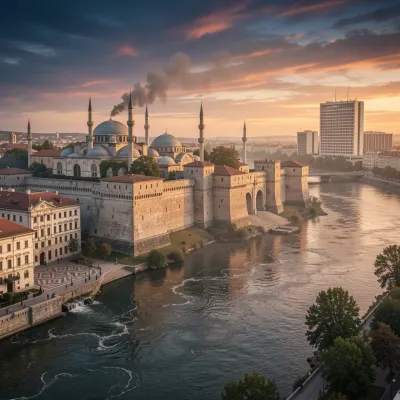
Belgrade’s history is fundamentally shaped by its position at the confluence of the Sava and Danube rivers, a strategic crossroads that has repeatedly attracted empires seeking to control trade, movement, and military advantage in the Balkans. From the Roman castrum of Singidunum through medieval contests between Hungarians, Byzantines, and Bulgars, the city’s rocky ridge provided a natural fortress that successive powers—Ottoman, Habsburg, and later Serbian—continually fortified and contested. This layered history of siege and reconstruction, detailed from the 1521 Ottoman conquest through the Long Turkish War, the Great Turkish War, and the Serbian uprisings of 1804–1830, forged a urban culture of pragmatism and resilience, where inhabitants rebuilt after each catastrophe, adapted infrastructure to riverine realities, and nurtured a dual civic life split between the Ottoman garrison in Kalemegdan and the Serbian town below.
The 19th century marked Belgrade’s transition from an imperial frontier outpost to a modern national capital, as Serbian autonomy secured in 1830 spurred systematic urban planning, public works, and railway integration that reoriented the city toward European connectivity. The interwar period saw rapid demographic growth, state‑building in the Kingdom of Yugoslavia, and a vibrant liberal culture, while World War II brought occupation, devastation, and a socialist reconstruction that emphasized collective housing, industrialization, and civil defense—most visibly in the creation of New Belgrade and a network of hardened bunkers. The Tito era transformed Belgrade into the federal capital of a non‑aligned Yugoslavia, blending monumental architecture with extensive shelter systems designed to protect the populace from aerial and nuclear threats.
The late 20th and early 21st centuries tested Belgrade’s resilience anew: international sanctions isolated the city through the 1990s, the 1999 NATO bombing crippled infrastructure yet sparked adaptive civilian responses, and post‑Milošević transition unleashed privatization, informal economies, and contentious waterfront developments like Belgrade Waterfront. Simultaneously, the city has grappled with climate‑change‑induced floods and heatwaves, managed refugee flows along the Balkan Route, and sought to reassert itself as a regional hub within pan‑European corridors. Throughout, the book argues that resilience is not a slogan but a measurable capacity rooted in institutions, data, community preparedness, and the enduring geographic logic that has turned exposure into capability for over two millennia.
What You'll Find Inside:
- Belgrade's strategic location at the confluence of the Sava and Danube rivers has made it a contested frontier city for empires—from Romans and Ottomans to Habsburgs and Yugoslavs—shaping its fortifications, urban form, and cycles of siege and reconstruction over two millennia.
- The city's resilience is rooted in layered institutions, infrastructure, and community practices forged through repeated conflicts, occupations, and disasters, including NATO bombing in 1999, which tested civil defense systems developed during the socialist era.
- Kalemegdan Fortress stands as a palimpsest of military architecture reflecting Roman, medieval, Ottoman, and Habsburg engineering traditions, later transformed from a defensive stronghold into a public park symbolizing peace and collective memory.
- Post-socialist transition brought privatization, informal economies, and controversial megaprojects like Belgrade Waterfront, sparking debates over transparency, displacement, heritage, and the balance between global capital and local identity.
- Contemporary challenges—including climate-driven flood and heat risks, migration flows, EU integration aspirations, and contested historical memory—are reshaping Belgrade's urban governance around data-driven planning, green infrastructure, and inclusive resilience strategies.
Who's It For:
This book is intended for students and practitioners of Balkan history, military geography, and urban resilience. It will appeal particularly to those interested in how cities on geopolitical fault lines develop adaptive capacities over centuries, as well as urban planners, historians, and policymakers examining the interplay between fortifications, infrastructure, memory, and metropolitan development in contested regions.
Author:
Published By:
Date Published:
June 12, 2026
Type:
Nonfiction
Language:
English
Word Count:
52,230 words
Reading Time:
3 hours 39 minutes
Sample:
MixCache.com Total Access
Get unlimited access to this book + all books published by MixCache.com for $11.99/month
Subscribe to MTAOr purchase this book individually below
Order:
Buy the Crossroads of Empires: Belgrade’s Strategic History and Urban Resilience ebook on MixCache.com:
Buy Now
Full ebook will be available immediately
- read online or download as a PDF file.
$5 account credit for all new MixCache.com accounts, usable toward any ebook purchase!*




Ratings & Reviews
Ask Questions About This Book
Have a question about the content? Ask our AI assistant!
Start by asking a question about "Crossroads of Empires: Belgrade’s Strategic History and Urban Resilience"
Example: "Does this book mention William Shakespeare?"
Thinking...