
Browse by Category
Fiction
- Action & Adventure
- African American
- Anthologies
- Children's Fiction
- Classics
- Comics & Graphic Novels
- Coming of Age
- Contemporary
- Cultural & Regional
- Drama
- Erotica
- Fantasy
- General
- Historical Fiction
- Horror
- Humor & Satire
- Literary Fiction
- Mystery, Thriller & Suspense
- Poetry
- Religious & Inspirational
- Romance
- Science Fiction
- Short Stories
- War & Military
- Westerns
- Women's Fiction
- Young Adult
Non-Fiction
- Antiques & Collectibles
- Arts & Photography
- Biographies & Memoirs
- Business & Money
- Children's Non-Fiction
-
Computers & Technology
- Artificial Intelligence
- Computer Science
- Cybersecurity & Cryptography
- Data Science & Analytics
- Databases & Big Data
- Game Development & Design
- General
- Hardware & DIY
- Mobile App Development
- Networking & Cloud Computing
- Operating Systems
- Programming
- Robotics
- Software
- Software Engineering
- User Experience (UX) & Design
- Web Development & Design
- Cooking, Food & Wine
- Crafts, Hobbies & Home
- Education & Teaching
- Engineering
- General
- Health, Fitness & Dieting
-
History
- African History
- African History - North Africa
- African History - Sub-Saharan Africa
- American History
- American History - 20th Century
- American History - Civil War
- American History - Colonial Period
- Ancient History
- Asian History
- Asian History - China
- Asian History - India
- Asian History - Japan
- Asian History - Southeast Asia
- European History
- European History - Ancient Greece
- European History - Ancient Rome
- European History - Medieval
- European History - Modern
- European History - Renaissance
- General
- Middle Eastern History
- Military History
- Military History - Aviation
- Military History - Naval
- Social & Cultural History
- World History
- Humor & Entertainment
- Industrial Technology
- Language Learning
- Law
- LGBTQ+ Non-Fiction
- Literary Criticism
- Medical Books
- Parenting & Relationships
- Philosophy
- Politics & Social Sciences
- Reference
- Religion & Spirituality
-
Science & Math
- Agricultural Sciences
- Astronomy & Space Science
- Behavioral Sciences
- Biological Sciences
- Botany & Plant Science
- Chemistry
- Earth Sciences
- Engineering - Chemical
- Engineering - Civil
- Engineering - Electrical
- Engineering - Mechanical
- Environment
- General
- Geology
- Mathematics
- Nature & Ecology
- Oceanography
- Paleontology
- Physics
- Statistics
- Self-Help
- Sports & Outdoors
- Study Aids
- Sustainability & Green Living
- Textbooks
- Transportation
- Travel
- True Crime
- Urban Planning & Development
- Veterinary Medicine
- Writing & Publishing
Jump to Section

Want unlimited access to all books published by MixCache.com (plus their audiobooks)? Try MixCache.com Total Access. Look for the MTA badge on book covers to identify included titles.
Access to infinite ebooks: Don't see the book you want? Suggest it and we'll create it (free!) for you from scratch with our powerful AI book writer. Then read it with MTA - besides profiting from any sales it makes!
Literary Dublin: Writers, Pubs, and the Urban Stories of Ireland’s Capital
MTA
A cultural history linking Dublin’s streets to its legendary writers and literary scenes
About this book:
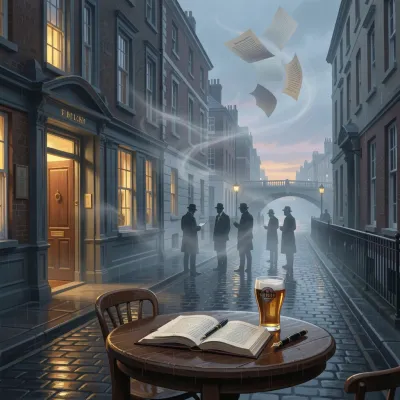
*Literary Dublin* presents Dublin as a city that can be read like a text: its streets, bridges, pubs, theatres, print shops, universities, and rivers are not merely backdrops for literature but active forces that shape it. The book argues that Dublin’s literary history is inseparable from urban history, tracing how writers have turned the city’s physical and social spaces into scenes of memory, conflict, identity, and imagination. Rather than offering a simple chronology of famous authors, it maps the networks that made literature possible: salons and pub conversations, publishing houses and printers, censorship boards, theatres, periodicals, campuses, markets, and walking routes.
The book begins with the city’s literary topography and gives central attention to James Joyce, whose Dublin is treated as an extraordinarily detailed street atlas of everyday life, especially in *Ulysses*. Samuel Beckett appears as a contrasting figure, one whose work abstracts Dublin into edges, margins, silence, and existential waiting. W.B. Yeats, the Celtic Revival, and the Abbey Theatre are shown as crucial to Dublin’s emergence as a national cultural capital, while Oscar Wilde and George Bernard Shaw represent the cosmopolitan Dubliner whose wit and social critique were forged locally but performed globally. The chapters on pubs, print culture, and little magazines emphasize that Dublin’s literature was produced not only in books but also in conversation, debate, performance, and argument.
A major aim of the book is to broaden the canon. It foregrounds women writers from Maria Edgeworth and Lady Gregory to Edna O’Brien, Eavan Boland, Anne Enright, Emma Donoghue, Nuala O’Faolain, and newer voices, showing how they reimagined the domestic, suburban, and political city. It also turns to working-class Dublin, from O’Casey’s tenements and Joyce’s North Wall to Roddy Doyle’s Northside fiction, arguing that poverty, labour, docks, housing, and vernacular speech are central to the city’s literary identity. The Liffey, the Northside/Southside divide, Trinity and UCD, the Easter Rising, language politics, Patrick Kavanagh’s Grand Canal, post-O’Casey drama, and Dublin’s oral traditions all reveal how literature records the city’s social divisions and transformations.
The final chapters bring the story into contemporary Dublin, examining migration, Temple Bar and Docklands regeneration, crime fiction, and the “Celtic Tiger” hangover as evidence of a city constantly rewriting itself. New migrant voices, multicultural spaces, noir narratives, and stories of economic boom and bust complicate older images of literary Dublin. The book closes by inviting readers to walk the city as *flâneurs*, following routes through Joyce, Yeats, O’Casey, Kavanagh, Wilde, Beckett, and others, while also reflecting on how digital maps and literary tourism reshape access to Dublin’s heritage. Its central claim is that literature does not simply describe Dublin; it helps build the city’s meaning, memory, and identity.
What You'll Find Inside:
- Explore Dublin's literary geography through the lens of its streets, bridges, and iconic locations, showing how physical spaces shape storytelling and cultural identity.
- Discover how writers like James Joyce, Samuel Beckett, and W.B. Yeats used Dublin as both a setting and a method to reflect social, political, and psychological themes in their works.
- Examine the role of social institutions—including pubs, theatres, and publishing houses—in fostering Dublin's literary culture and influencing the circulation of ideas and texts.
- Analyze how Dublin's working-class, women's, and migrant voices have diversified its literary narrative, challenging traditional perspectives and highlighting marginalized experiences.
- Investigate the ethical and economic impacts of literary tourism and digital technologies on Dublin's urban identity, questioning how heritage preservation and modernization intersect.
Who's It For:
This book is ideal for readers interested in the intersection of literature, urban studies, and cultural history—particularly those fascinated by Dublin's unique role as a literary capital. Students, academics, and general audiences drawn to the works of Joyce, Yeats, and Beckett will find rich context and fresh perspectives. It also appeals to travelers and literary tourists seeking to understand how cities shape storytelling and cultural identity.
Author:
Published By:
Date Published:
June 11, 2026
Type:
Nonfiction
Language:
English
Word Count:
57,623 words
Reading Time:
4 hours 2 minutes
Sample:
MixCache.com Total Access
Get unlimited access to this book + all books published by MixCache.com for $11.99/month
Subscribe to MTAOr purchase this book individually below
Order:
Buy the Literary Dublin: Writers, Pubs, and the Urban Stories of Ireland’s Capital ebook on MixCache.com:
Buy Now
Full ebook will be available immediately
- read online or download as a PDF file.
$5 account credit for all new MixCache.com accounts, usable toward any ebook purchase!*



Ratings & Reviews
Ask Questions About This Book
Have a question about the content? Ask our AI assistant!
Start by asking a question about "Literary Dublin: Writers, Pubs, and the Urban Stories of Ireland’s Capital"
Example: "Does this book mention William Shakespeare?"
Thinking...