Browse by Category
Fiction
- Action & Adventure
- African American
- Anthologies
- Children's Fiction
- Classics
- Comics & Graphic Novels
- Coming of Age
- Contemporary
- Cultural & Regional
- Drama
- Erotica
- Fantasy
- General
- Historical Fiction
- Horror
- Humor & Satire
- Literary Fiction
- Mystery, Thriller & Suspense
- Poetry
- Religious & Inspirational
- Romance
- Science Fiction
- Short Stories
- War & Military
- Westerns
- Women's Fiction
- Young Adult
Non-Fiction
- Antiques & Collectibles
- Arts & Photography
- Biographies & Memoirs
- Business & Money
- Children's Non-Fiction
-
Computers & Technology
- Artificial Intelligence
- Computer Science
- Cybersecurity & Cryptography
- Data Science & Analytics
- Databases & Big Data
- Game Development & Design
- General
- Hardware & DIY
- Mobile App Development
- Networking & Cloud Computing
- Operating Systems
- Programming
- Robotics
- Software
- Software Engineering
- User Experience (UX) & Design
- Web Development & Design
- Cooking, Food & Wine
- Crafts, Hobbies & Home
- Education & Teaching
- Engineering
- General
- Health, Fitness & Dieting
-
History
- African History
- African History - North Africa
- African History - Sub-Saharan Africa
- American History
- American History - 20th Century
- American History - Civil War
- American History - Colonial Period
- Ancient History
- Asian History
- Asian History - China
- Asian History - India
- Asian History - Japan
- Asian History - Southeast Asia
- European History
- European History - Ancient Greece
- European History - Ancient Rome
- European History - Medieval
- European History - Modern
- European History - Renaissance
- General
- Middle Eastern History
- Military History
- Military History - Aviation
- Military History - Naval
- Social & Cultural History
- World History
- Humor & Entertainment
- Industrial Technology
- Language Learning
- Law
- LGBTQ+ Non-Fiction
- Literary Criticism
- Medical Books
- Parenting & Relationships
- Philosophy
- Politics & Social Sciences
- Reference
- Religion & Spirituality
-
Science & Math
- Agricultural Sciences
- Astronomy & Space Science
- Behavioral Sciences
- Biological Sciences
- Botany & Plant Science
- Chemistry
- Earth Sciences
- Engineering - Chemical
- Engineering - Civil
- Engineering - Electrical
- Engineering - Mechanical
- Environment
- General
- Geology
- Mathematics
- Nature & Ecology
- Oceanography
- Paleontology
- Physics
- Statistics
- Self-Help
- Sports & Outdoors
- Study Aids
- Sustainability & Green Living
- Textbooks
- Transportation
- Travel
- True Crime
- Urban Planning & Development
- Veterinary Medicine
- Writing & Publishing
Jump to Section

Want unlimited access to all books published by MixCache.com (plus their audiobooks)? Try MixCache.com Total Access. Look for the MTA badge on book covers to identify included titles.
Access to infinite ebooks: Don't see the book you want? Suggest it and we'll create it (free!) for you from scratch with our powerful AI book writer. Then read it with MTA - besides profiting from any sales it makes!
Athens Reborn: From Classical Polis to Modern Capital
MTA
How ancient heritage and modern democracy coexist in Athens’ urban story
About this book:
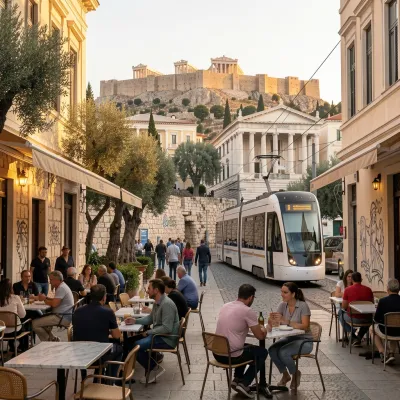
Athens Reborn: From Classical Polis to Modern Capital explores the multifaceted urban evolution of Athens, tracing how the city has continuously transformed itself across millennia while maintaining a dialogue between its ancient heritage and modern realities. Beginning with the classical polis, the book examines how the Acropolis and Agora served as foundational spaces for democracy and civic life, then follows successive historical layers—Hellenistic, Roman, Byzantine, Frankish, and Ottoman—each imposing new structures, religious practices, and urban forms. These periods are shown to have shaped Athens’s topography and social fabric, creating a palimpsest of architectural and cultural influences that underpin its identity.
The narrative shifts to the modern era, focusing on the pivotal moment of the 1821 Revolution and Athens’s designation as the capital of the newly independent Greek state. The Bavarian regency’s neoclassical urban plans aimed to forge a modern capital rooted in its ancient legacy, though these ideals often clashed with the rapid, unplanned growth from refugee influxes, industrialization, and the *polykatoikia* housing boom. The city’s struggles with urban density, infrastructure, and the tension between heritage representation and everyday life are central themes, particularly evident in the mid-20th-century reconstruction efforts and the Olympic-led modernization projects of 2004, which brought both grandeur and lasting economic and infrastructural challenges.
In the late 20th and early 21st centuries, Athens confronts new complexities: the proliferation of Airbnb reshaping residential neighborhoods, the environmental threats of climate change and wildfires, and the paradox of overtourism commodifying its cultural sites. The book highlights grassroots movements, adaptive reuse initiatives, and infrastructural innovations like the Metro’s integration of archaeological findings, illustrating how the city navigates the delicate balance between preservation and progress. Public spaces emerge as contested yet vital arenas for political expression, cultural creativity, and communal identity, reflecting Athens’s role as a democratic laboratory.
The final chapters situate Athens within global networks, emphasizing its diaspora connections, diplomatic influence, and cultural diplomacy—particularly through campaigns for the return of the Parthenon Marbles and its position in the European Union. By weaving through its tumultuous past and speculative future, the book presents Athens not as a static relic but as a living metropolis grappling with questions of equity, sustainability, and the enduring legacy of democracy, offering insights into how cities worldwide might integrate heritage with modernity while fostering inclusive, resilient futures.
What You'll Find Inside:
- Explores how Athens's continuous urban renewal intertwines its classical heritage with modern democratic ideals, shaping the city's evolving identity.
- Examines the interplay between public spaces like the Agora and Acropolis, analyzing their roles in fostering civic engagement and cultural memory.
- Analyzes the impact of the 1922 refugee crisis on Athens's urban fabric, leading to rapid reconstruction and the emergence of distinct residential neighborhoods.
- Investigates the challenges of modern infrastructure projects, such as the Athens Metro, which balance urban development with archaeological preservation.
- Highlights contemporary issues like overtourism, climate resilience, and adaptive reuse, reflecting Athens's struggle to harmonize growth with historical preservation.
Who's It For:
This book is ideal for scholars, urban planners, and students interested in the intersection of history, urban development, and cultural identity. It also appeals to readers seeking a comprehensive understanding of how a city like Athens navigates the balance between preserving ancient heritage and addressing modern challenges such as tourism, climate change, and social equity. Perfect for those studying Mediterranean history, urban studies, or heritage management.
Author:
Published By:
Date Published:
June 10, 2026
Type:
Nonfiction
Language:
English
Word Count:
56,096 words
Reading Time:
3 hours 56 minutes
Sample:
Order:
Order Athens Reborn: From Classical Polis to Modern Capital (Paperback) on MixCache.com:
Buy NowPrint copy is made to order and ships worldwide. Includes the ebook free, ready to read instantly.
$5 account credit for all new MixCache.com accounts, usable toward any ebook purchase!*