Browse by Category
Fiction
- Action & Adventure
- African American
- Anthologies
- Children's Fiction
- Classics
- Comics & Graphic Novels
- Coming of Age
- Contemporary
- Cultural & Regional
- Drama
- Erotica
- Fantasy
- General
- Historical Fiction
- Horror
- Humor & Satire
- Literary Fiction
- Mystery, Thriller & Suspense
- Poetry
- Religious & Inspirational
- Romance
- Science Fiction
- Short Stories
- War & Military
- Westerns
- Women's Fiction
- Young Adult
Non-Fiction
- Antiques & Collectibles
- Arts & Photography
- Biographies & Memoirs
- Business & Money
- Children's Non-Fiction
-
Computers & Technology
- Artificial Intelligence
- Computer Science
- Cybersecurity & Cryptography
- Data Science & Analytics
- Databases & Big Data
- Game Development & Design
- General
- Hardware & DIY
- Mobile App Development
- Networking & Cloud Computing
- Operating Systems
- Programming
- Robotics
- Software
- Software Engineering
- User Experience (UX) & Design
- Web Development & Design
- Cooking, Food & Wine
- Crafts, Hobbies & Home
- Education & Teaching
- Engineering
- General
- Health, Fitness & Dieting
-
History
- African History
- African History - North Africa
- African History - Sub-Saharan Africa
- American History
- American History - 20th Century
- American History - Civil War
- American History - Colonial Period
- Ancient History
- Asian History
- Asian History - China
- Asian History - India
- Asian History - Japan
- Asian History - Southeast Asia
- European History
- European History - Ancient Greece
- European History - Ancient Rome
- European History - Medieval
- European History - Modern
- European History - Renaissance
- General
- Middle Eastern History
- Military History
- Military History - Aviation
- Military History - Naval
- Social & Cultural History
- World History
- Humor & Entertainment
- Industrial Technology
- Language Learning
- Law
- LGBTQ+ Non-Fiction
- Literary Criticism
- Medical Books
- Parenting & Relationships
- Philosophy
- Politics & Social Sciences
- Reference
- Religion & Spirituality
-
Science & Math
- Agricultural Sciences
- Astronomy & Space Science
- Behavioral Sciences
- Biological Sciences
- Botany & Plant Science
- Chemistry
- Earth Sciences
- Engineering - Chemical
- Engineering - Civil
- Engineering - Electrical
- Engineering - Mechanical
- Environment
- General
- Geology
- Mathematics
- Nature & Ecology
- Oceanography
- Paleontology
- Physics
- Statistics
- Self-Help
- Sports & Outdoors
- Study Aids
- Sustainability & Green Living
- Textbooks
- Transportation
- Travel
- True Crime
- Urban Planning & Development
- Veterinary Medicine
- Writing & Publishing
Jump to Section
MixCache.com Total Access
Unlimited reading and audiobooks for every book published by MixCache.com.
Included titles carry the MTA badge.
Learn more →
Volcanic City: Reykjavik’s Settlement, Fisheries, and Modern Reinvention
MTA
How geology, isolation, and global culture shaped Iceland’s capital
About this book:
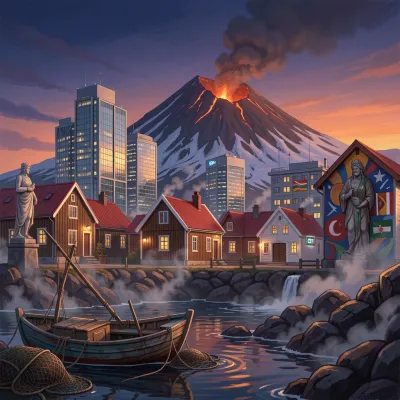
Reykjavik’s origins lie in its volcanic setting, where early Norse settlers chose the sheltered, geothermally active bay for its steam, fish, and anchorage, constructing turf and stone dwellings that harnessed local heat and withstand the harsh North Atlantic climate. The settlement’s early economy blended subsistence fishing with farming, relying on the bay’s sheltered waters and the fertility of volcanic soils, while Danish trade monopolies later funneled Iceland’s dried cod through Copenhagen, constraining local profit but reinforcing Reykjavik’s role as an administrative hub and fostering a culture of self‑reliance and cooperative resource management.
The 19th‑century liberalization of fishing sparked an industrial boom, introducing steam trawlers, large‑scale salting, and a growing wage‑labor workforce that transformed Reykjavik into Iceland’s economic capital. World War II brought a massive Allied presence, modern infrastructure, and a surge in prosperity that accelerated the push for full independence in 1944. Securing sovereignty over fisheries through the Cod Wars expanded Iceland’s exclusive economic zone to 200 nautical miles, cementing the city’s diplomatic confidence. Concurrently, Reykjavik pioneered a district‑heating network that tapped subterranean geothermal water, eliminating coal smoke, lowering household costs, and shaping urban layout around insulated pipelines; this clean‑energy transition became a cornerstone of the city’s identity and a model for sustainable urbanism.
In recent decades Reykjavik has pivoted from a fishing port to a diversified economy driven by creative industries, technology startups, and tourism, leveraging its cultural scene, natural beauty, and highly educated populace while grappling with tourism‑induced housing pressures, environmental strains, and seasonal fluctuations. The city continues to live with geological hazards through robust building codes, advanced monitoring, and public communication, manages water, waste, and wind resources with pragmatic, locally attuned solutions, and promotes walkability, cycling, and electric mobility amid basaltic terrain and harsh weather. Governance balances municipal autonomy with national oversight, reflected in the city’s response to the 2008 financial crisis—where it let banks fail, imposed capital controls, and prioritized household debt relief—and its active role in Arctic diplomacy, climate advocacy, and equitable integration of migrants. Reykjavik’s experience offers island capitals a playbook: harness indigenous resources for energy, invest in connective infrastructure, treat volatility as a planning factor, convert cultural distinctiveness into civic infrastructure, and build adaptive, inclusive systems that turn geographic constraints into sources of resilience and reinvention.
What You'll Find Inside:
- Reykjavik's geothermal district heating system turned a coal-dependent town into a global leader in renewable energy, demonstrating how local geological resources can be harnessed for public benefit.
- The city's economy evolved from subsistence fishing to industrial fisheries, then diversified into creative industries and tourism, showing how isolation can be overcome through adaptive economic reinvention.
- Geographic isolation fostered self-reliance and pragmatic problem‑solving, while openness to global culture—via trade, migration, and cultural exchange—provided the ideas and capital needed for innovation.
- Living with volcanic eruptions, earthquakes, and climate hazards shaped Reykjavik's approach to risk, resulting in stringent building codes, proactive monitoring, and a culture of preparedness that treats volatility as a planning parameter.
- Reykjavik's experience offers a playbook for other island capitals: leverage indigenous resources, invest in connective infrastructure, assert sovereignty over vital assets, adopt Nordic‑style welfare systems, and manage economic and environmental volatility through flexible governance.
Who's It For:
This book is ideal for urban planners, policymakers, and scholars interested in sustainable development, especially those working in island or remote city contexts. It will also appeal to students of environmental history, Nordic welfare models, and cultural economics who want to see how geology, isolation, and global engagement shape a capital's evolution. Practitioners seeking concrete lessons on energy transition, fisheries management, creative economy growth, and hazard resilience will find actionable insights grounded in Reykjavik's real‑world experience.
Table of Contents:
- Introduction
- Chapter 1 Fire and Ice: The Making of a Volcanic City
- Chapter 2 From Ingolfur’s Hearth to Harbor: Norse Settlement at Reykjavik
- Chapter 3 Turf, Timber, and Tephra: Building in a Harsh Landscape
- Chapter 4 The Bay and the Banks: Early Fisheries and Subsistence
- Chapter 5 Monopoly and Margins: Danish Trade and Isolation
- Chapter 6 Steam in the Earth: Early Encounters with Geothermal Heat
- Chapter 7 Boats, Salt, and Cod: The Industrialization of Fishing
- Chapter 8 War and Boomtown: Reykjavik in a Time of Global Conflict
- Chapter 9 Republic on the Edge: Independence and Urban Identity
- Chapter 10 The Cod Wars and Sovereignty at Sea
- Chapter 11 Pipes Beneath the Streets: District Heating and Energy Transitions
- Chapter 12 Planning with Basalt: Streets, Housing, and Sprawl
- Chapter 13 Welfare, Education, and the Nordic City Model
- Chapter 14 Culture as Infrastructure: Music, Literature, and Media
- Chapter 15 The Creative Turn: From Fishing Port to Startup Scene
- Chapter 16 Tourism Tide: Benefits, Strains, and Policy Responses
- Chapter 17 Earthquakes, Eruptions, and Risk: Living with Hazards
- Chapter 18 Water, Waste, and Wind: Environmental Services in a Northern Capital
- Chapter 19 Mobility in the North: Buses, Bikes, and Walkability
- Chapter 20 Architecture After Lava: Preservation and Modernism
- Chapter 21 Governance on an Island: City, State, and Regional Coordination
- Chapter 22 Finance in a Small Market: Booms, Busts, and Lessons of 2008
- Chapter 23 Diplomacy and the Arctic: Reykjavik on the Global Stage
- Chapter 24 Equity, Migration, and Belonging in a Changing City
- Chapter 25 Playbook for Island Capitals: Policy Lessons and Transferability
Author:
Published By:
Date Published:
June 10, 2026
Type:
Nonfiction
Language:
English
Word Count:
60,525 words
Reading Time:
4 hours 14 minutes
Sample:
Order:
Order Volcanic City: Reykjavik’s Settlement, Fisheries, and Modern Reinvention (Hardcover) on MixCache.com:
Buy NowPrint copy is made to order and ships worldwide. Includes the ebook free, ready to read instantly.
$5 account credit for all new MixCache.com accounts, usable toward any ebook purchase!*