
Browse by Category
Fiction
- Action & Adventure
- African American
- Anthologies
- Children's Fiction
- Classics
- Comics & Graphic Novels
- Coming of Age
- Contemporary
- Cultural & Regional
- Drama
- Erotica
- Fantasy
- General
- Historical Fiction
- Horror
- Humor & Satire
- Literary Fiction
- Mystery, Thriller & Suspense
- Poetry
- Religious & Inspirational
- Romance
- Science Fiction
- Short Stories
- War & Military
- Westerns
- Women's Fiction
- Young Adult
Non-Fiction
- Antiques & Collectibles
- Arts & Photography
- Biographies & Memoirs
- Business & Money
- Children's Non-Fiction
-
Computers & Technology
- Artificial Intelligence
- Computer Science
- Cybersecurity & Cryptography
- Data Science & Analytics
- Databases & Big Data
- Game Development & Design
- General
- Hardware & DIY
- Mobile App Development
- Networking & Cloud Computing
- Operating Systems
- Programming
- Robotics
- Software
- Software Engineering
- User Experience (UX) & Design
- Web Development & Design
- Cooking, Food & Wine
- Crafts, Hobbies & Home
- Education & Teaching
- Engineering
- General
- Health, Fitness & Dieting
-
History
- African History
- African History - North Africa
- African History - Sub-Saharan Africa
- American History
- American History - 20th Century
- American History - Civil War
- American History - Colonial Period
- Ancient History
- Asian History
- Asian History - China
- Asian History - India
- Asian History - Japan
- Asian History - Southeast Asia
- European History
- European History - Ancient Greece
- European History - Ancient Rome
- European History - Medieval
- European History - Modern
- European History - Renaissance
- General
- Middle Eastern History
- Military History
- Military History - Aviation
- Military History - Naval
- Social & Cultural History
- World History
- Humor & Entertainment
- Industrial Technology
- Language Learning
- Law
- LGBTQ+ Non-Fiction
- Literary Criticism
- Medical Books
- Parenting & Relationships
- Philosophy
- Politics & Social Sciences
- Reference
- Religion & Spirituality
-
Science & Math
- Agricultural Sciences
- Astronomy & Space Science
- Behavioral Sciences
- Biological Sciences
- Botany & Plant Science
- Chemistry
- Earth Sciences
- Engineering - Chemical
- Engineering - Civil
- Engineering - Electrical
- Engineering - Mechanical
- Environment
- General
- Geology
- Mathematics
- Nature & Ecology
- Oceanography
- Paleontology
- Physics
- Statistics
- Self-Help
- Sports & Outdoors
- Study Aids
- Sustainability & Green Living
- Textbooks
- Transportation
- Travel
- True Crime
- Urban Planning & Development
- Veterinary Medicine
- Writing & Publishing
Jump to Section

Want unlimited access to all books published by MixCache.com (plus their audiobooks)? Try MixCache.com Total Access. Look for the MTA badge on book covers to identify included titles.
Access to infinite ebooks: Don't see the book you want? Suggest it and we'll create it (free!) for you from scratch with our powerful AI book writer. Then read it with MTA - besides profiting from any sales it makes!
Sea and City: Lisbon and the Age of Discovery
MTA
Maritime exploration, trade networks, and urban resilience in Lisbon
About this book:
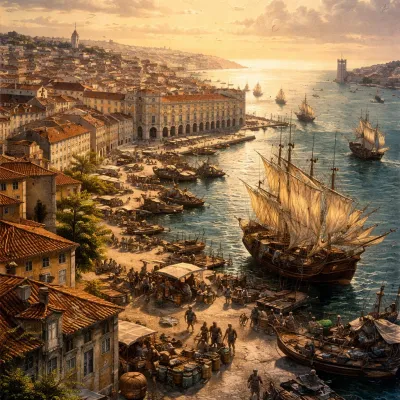
Lisbon’s transformation into a maritime capital began with the Tagus River’s sheltered estuary, which attracted ancient traders and later became the foundation for a powerful port under Christian rule. By the late Middle Ages, royal initiatives such as the Casa de Contratação and harbor‑deepening projects turned the river into a conduit for overseas commerce. The Ribeira das Naus shipyard turned timber into ocean‑going vessels, while navigational advances—mariner’s astrolabes, quadrants, ephemerides, and increasingly accurate nautical charts—enabled Portuguese sailors to venture beyond coastal pilotage. These technical and institutional developments were centralized in the Casa da Índia, which managed customs, finance, storage, and diplomatic correspondence, turning the waterfront into a bureaucratic and financial hub that directed the flow of Asian spices, African gold, and American sugar into royal coffers.
Lisbon’s wealth radiated through interconnected global circuits. The spice routes linked the city to Goa, Malacca, and Macau, bringing pepper, cinnamon, and porcelain that reshaped European tastes and funded monumental architecture like the Jerónimos Monastery. Simultaneously, the Atlantic circuit tied Lisbon to Brazil’s sugar plantations and the slave trade, creating a brutal but lucrative triangle of goods, enslaved Africans, and European manufactures. African forts and archipelagos supplied gold, ivory, and labor, while competition from the Dutch and English East India Companies eroded Portuguese monopolies, prompting the development of marine insurance, credit instruments, and convoy systems to manage risk. Piracy and privateering further strained the empire, forcing Lisbon to fortify its ports and adapt its naval fleet.
The 1755 earthquake, tsunami, and fires devastated Lisbon, killing tens of thousands and destroying the Ribeira das Naus, customs houses, and royal archives. Under the Marquis of Pombal, the city was rebuilt with a rational grid, standardized building codes, and the pioneering “Pombaline cage” anti‑seismic framework, creating a resilient Baixa that combined Enlightenment order with practical disaster mitigation. Reconstruction was financed largely by Brazilian gold, reaffirming the Atlantic connection as Lisbon’s economic lifeline. In the nineteenth century, steamships, railways, and land reclamation modernized the port, integrating maritime and industrial activity along the Tagus. The twentieth century saw Lisbon evolve from an imperial entrepôt to an Atlantic hub within the European Union, hosting Expo ’98 and continually negotiating its colonial legacy, demographic shifts, and globalization through adaptive urban planning and a enduring spirit of resilience.
What You'll Find Inside:
- Lisbon's transformation from a riverside settlement to a global maritime capital through strategic use of the Tagus River's natural harbor and imperial ambition
- The development of navigational instruments, shipbuilding techniques at Ribeira das Naus, and scientific knowledge that enabled Portuguese oceanic exploration
- Lisbon's role as the hub of interconnected global trade networks spanning the Indian Ocean (spice routes), Atlantic (sugar and slavery), and African coasts
- The 1755 earthquake as a catalyst for innovative urban reconstruction under Pombal, introducing seismic-resistant design and modern risk management principles
- The social fabric of Lisbon's waterfront communities, including labor systems, migration patterns, and cultural exchange that shaped the city's identity
Who's It For:
This book is ideal for history students, scholars of maritime and urban studies, and general readers interested in the Age of Discovery and its lasting impacts. It will particularly benefit those studying Portuguese history, globalization, trade networks, or urban resilience, offering a comprehensive analysis of how Lisbon's relationship with the sea shaped its development from medieval times through modernization. Readers interested in the interconnectedness of exploration, commerce, disaster recovery, and social change will find valuable insights in this detailed port city narrative.
Author:
Published By:
Date Published:
June 8, 2026
Type:
Nonfiction
Language:
English
Word Count:
48,009 words
Reading Time:
3 hours 22 minutes
Sample:
MixCache.com Total Access
Get unlimited access to this book + all books published by MixCache.com for $11.99/month
Subscribe to MTAOr purchase this book individually below
Order:
Buy the Sea and City: Lisbon and the Age of Discovery ebook on MixCache.com:
Buy Now
Full ebook will be available immediately
- read online or download as a PDF file.
$5 account credit for all new MixCache.com accounts, usable toward any ebook purchase!*





Ratings & Reviews
Ask Questions About This Book
Have a question about the content? Ask our AI assistant!
Start by asking a question about "Sea and City: Lisbon and the Age of Discovery"
Example: "Does this book mention William Shakespeare?"
Thinking...