
Browse by Category
Fiction
- Action & Adventure
- African American
- Anthologies
- Children's Fiction
- Classics
- Comics & Graphic Novels
- Coming of Age
- Contemporary
- Cultural & Regional
- Drama
- Erotica
- Fantasy
- General
- Historical Fiction
- Horror
- Humor & Satire
- Literary Fiction
- Mystery, Thriller & Suspense
- Poetry
- Religious & Inspirational
- Romance
- Science Fiction
- Short Stories
- War & Military
- Westerns
- Women's Fiction
- Young Adult
Non-Fiction
- Antiques & Collectibles
- Arts & Photography
- Biographies & Memoirs
- Business & Money
- Children's Non-Fiction
-
Computers & Technology
- Artificial Intelligence
- Computer Science
- Cybersecurity & Cryptography
- Data Science & Analytics
- Databases & Big Data
- Game Development & Design
- General
- Hardware & DIY
- Mobile App Development
- Networking & Cloud Computing
- Operating Systems
- Programming
- Robotics
- Software
- Software Engineering
- User Experience (UX) & Design
- Web Development & Design
- Cooking, Food & Wine
- Crafts, Hobbies & Home
- Education & Teaching
- Engineering
- General
- Health, Fitness & Dieting
-
History
- African History
- African History - North Africa
- African History - Sub-Saharan Africa
- American History
- American History - 20th Century
- American History - Civil War
- American History - Colonial Period
- Ancient History
- Asian History
- Asian History - China
- Asian History - India
- Asian History - Japan
- Asian History - Southeast Asia
- European History
- European History - Ancient Greece
- European History - Ancient Rome
- European History - Medieval
- European History - Modern
- European History - Renaissance
- General
- Middle Eastern History
- Military History
- Military History - Aviation
- Military History - Naval
- Social & Cultural History
- World History
- Humor & Entertainment
- Industrial Technology
- Language Learning
- Law
- LGBTQ+ Non-Fiction
- Literary Criticism
- Medical Books
- Parenting & Relationships
- Philosophy
- Politics & Social Sciences
- Reference
- Religion & Spirituality
-
Science & Math
- Agricultural Sciences
- Astronomy & Space Science
- Behavioral Sciences
- Biological Sciences
- Botany & Plant Science
- Chemistry
- Earth Sciences
- Engineering - Chemical
- Engineering - Civil
- Engineering - Electrical
- Engineering - Mechanical
- Environment
- General
- Geology
- Mathematics
- Nature & Ecology
- Oceanography
- Paleontology
- Physics
- Statistics
- Self-Help
- Sports & Outdoors
- Study Aids
- Sustainability & Green Living
- Textbooks
- Transportation
- Travel
- True Crime
- Urban Planning & Development
- Veterinary Medicine
- Writing & Publishing
Jump to Section
MixCache.com Total Access
Unlimited reading and audiobooks for every book published by MixCache.com.
Included titles carry the MTA badge.
Learn more →
The Idea to Launch Blueprint
MTA
How to validate startup ideas and move from concept to first paying customers
About this book:
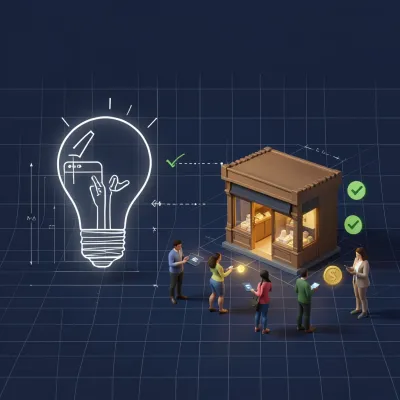
The Idea to Launch Blueprint provides a systematic, evidence‑based process for turning a startup concept into a product that customers will pay for. It begins by framing the raw idea as testable hypotheses about the target customer, their problem, and the proposed solution, then uses rigorous customer discovery to validate or refine those assumptions. Through problem‑space mapping, Jobs‑To‑Be‑Done analysis, and behavior‑driven personas, founders develop a deep, nuanced understanding of the customer’s pains and desired outcomes. This foundation informs a clear Unique Value Proposition and a thorough competitive and alternatives analysis that highlights where the solution can truly differentiate itself.
Validation is accelerated through low‑cost, high‑learning experiments: smoke tests (often landing pages) measure demand, concierge trials deliver the full value manually to uncover workflow nuances, and no‑code prototyping tests core interactions before any code is written. Insights from these steps shape a tightly scoped Minimum Viable Product focused on must‑have features that solve the customer’s primary job. Founders then run willingness‑to‑pay and pre‑sales experiments to confirm pricing viability, build the MVP with pragmatic tech choices and quality bars, and design activation and onboarding flows that guide users to their first “aha!” moment. Early traction is pursued by identifying and experimenting with the most effective acquisition channels—search, social ads, community building, content, and partnerships—while continuously refining messaging and offers.
Growth and sustainability are driven by iterative learning loops. Founders use A/B testing to optimize specific elements and cohort analysis to understand long‑term user behavior, anchoring decisions to a One Metric That Matters or North Star Metric that reflects core value delivery. Feedback loops combine quantitative data and qualitative insights to decide whether to iterate, kill, or pivot. Early revenue models—free trials, freemium, or direct paid—are tuned to convert engaged users into paying customers, supported by social proof, case studies, and testimonials. Launch readiness checklists, dry runs, and a day‑of playbook ensure a smooth debut, while post‑launch recovery focuses on stabilizing performance, deepening user understanding, and iterating based on real‑world usage. Finally, the book addresses financial runway, funding options, and next steps in product, team, and market expansion to turn initial traction into enduring, scalable growth.
What You'll Find Inside:
- Learn to frame your startup idea as testable hypotheses about customer, problem, and solution to de-risk assumptions early.
- Master customer discovery techniques to find and interview early users without bias, uncovering real pains, workarounds, and willingness to pay.
- Design and run fast, low‑cost experiments such as smoke tests and concierge trials to validate demand before writing code.
- Build a minimum viable product focused on core value, using no‑code tools and pragmatic tech choices to launch quickly and learn from real users.
- Establish metrics‑driven growth loops, including A/B testing, cohort analysis, and feedback mechanisms, to iterate toward product‑market fit and early revenue.
Who's It For:
This book is for first-time founders, solo builders, and small teams who want an evidence‑based, step‑by‑step system to validate startup ideas and acquire their first paying customers. It also serves product leaders inside larger companies who need to de‑risk new concepts before investing significant resources. Readers should bring curiosity, discipline, and a readiness to let data—not assumptions—guide their decisions.
Table of Contents:
- Introduction
- Chapter 1 From Spark to Hypothesis: Framing the Idea
- Chapter 2 Choosing a Customer Worth Serving
- Chapter 3 Mapping the Problem Space
- Chapter 4 Customer Discovery: Finding and Recruiting Early Users
- Chapter 5 Interview Mastery: Extracting Insight Without Leading
- Chapter 6 Jobs-To-Be-Done and Personas That Predict Behavior
- Chapter 7 Unique Value Proposition and Differentiation
- Chapter 8 Competitive and Alternatives Analysis
- Chapter 9 Designing Fast Experiments: Smoke Tests and Concierge Trials
- Chapter 10 Landing Pages That Measure Demand
- Chapter 11 Prototyping Without Code: Tools and Tactics
- Chapter 12 Minimum Viable Product Scope and Prioritization
- Chapter 13 Pricing, Willingness to Pay, and Pre-Sales
- Chapter 14 Building the MVP: Tech Choices and Quality Bars
- Chapter 15 Activation and Onboarding for Early Users
- Chapter 16 Traction Channels 101: Where Your Customers Actually Are
- Chapter 17 Content, Communities, and Partnerships That Compound
- Chapter 18 Running A/B Tests and Cohort Analysis
- Chapter 19 Metrics That Matter: OMTM, North Star, and Learning Loops
- Chapter 20 Feedback Loops: Iteration, Kill, or Pivot
- Chapter 21 Early Revenue: Trials, Freemium, and First Paying Customers
- Chapter 22 Social Proof, Case Studies, and Testimonials
- Chapter 23 Launch Readiness: Checklists, Timelines, and Dry Runs
- Chapter 24 The Launch: Day-Of Playbook and Post-Launch Recovery
- Chapter 25 Funding, Runway, and Next Steps After Traction
Author:
Published By:
Date Published:
June 2, 2026
Type:
Nonfiction
Language:
English
Word Count:
52,160 words
Reading Time:
3 hours 39 minutes
Sample:
Order:
Order The Idea to Launch Blueprint (Paperback) on MixCache.com:
Buy NowPrint copy is made to order and ships worldwide. Includes the ebook free, ready to read instantly.
$5 account credit for all new MixCache.com accounts, usable toward any ebook purchase!*


