Browse by Category
Fiction
- Action & Adventure
- African American
- Anthologies
- Children's Fiction
- Classics
- Comics & Graphic Novels
- Coming of Age
- Contemporary
- Cultural & Regional
- Drama
- Erotica
- Fantasy
- General
- Historical Fiction
- Horror
- Humor & Satire
- Literary Fiction
- Mystery, Thriller & Suspense
- Poetry
- Religious & Inspirational
- Romance
- Science Fiction
- Short Stories
- War & Military
- Westerns
- Women's Fiction
- Young Adult
Non-Fiction
- Antiques & Collectibles
- Arts & Photography
- Biographies & Memoirs
- Business & Money
- Children's Non-Fiction
-
Computers & Technology
- Artificial Intelligence
- Computer Science
- Cybersecurity & Cryptography
- Data Science & Analytics
- Databases & Big Data
- Game Development & Design
- General
- Hardware & DIY
- Mobile App Development
- Networking & Cloud Computing
- Operating Systems
- Programming
- Robotics
- Software
- Software Engineering
- User Experience (UX) & Design
- Web Development & Design
- Cooking, Food & Wine
- Crafts, Hobbies & Home
- Education & Teaching
- Engineering
- General
- Health, Fitness & Dieting
-
History
- African History
- African History - North Africa
- African History - Sub-Saharan Africa
- American History
- American History - 20th Century
- American History - Civil War
- American History - Colonial Period
- Ancient History
- Asian History
- Asian History - China
- Asian History - India
- Asian History - Japan
- Asian History - Southeast Asia
- European History
- European History - Ancient Greece
- European History - Ancient Rome
- European History - Medieval
- European History - Modern
- European History - Renaissance
- General
- Middle Eastern History
- Military History
- Military History - Aviation
- Military History - Naval
- Social & Cultural History
- World History
- Humor & Entertainment
- Industrial Technology
- Language Learning
- Law
- LGBTQ+ Non-Fiction
- Literary Criticism
- Medical Books
- Parenting & Relationships
- Philosophy
- Politics & Social Sciences
- Reference
- Religion & Spirituality
-
Science & Math
- Agricultural Sciences
- Astronomy & Space Science
- Behavioral Sciences
- Biological Sciences
- Botany & Plant Science
- Chemistry
- Earth Sciences
- Engineering - Chemical
- Engineering - Civil
- Engineering - Electrical
- Engineering - Mechanical
- Environment
- General
- Geology
- Mathematics
- Nature & Ecology
- Oceanography
- Paleontology
- Physics
- Statistics
- Self-Help
- Sports & Outdoors
- Study Aids
- Sustainability & Green Living
- Textbooks
- Transportation
- Travel
- True Crime
- Urban Planning & Development
- Veterinary Medicine
- Writing & Publishing
Jump to Section
MixCache.com Total Access
Unlimited reading and audiobooks for every book published by MixCache.com.
Included titles carry the MTA badge.
Learn more →
The Russian Far East
A Portrait of Russia's Pacific Frontier
About this book:
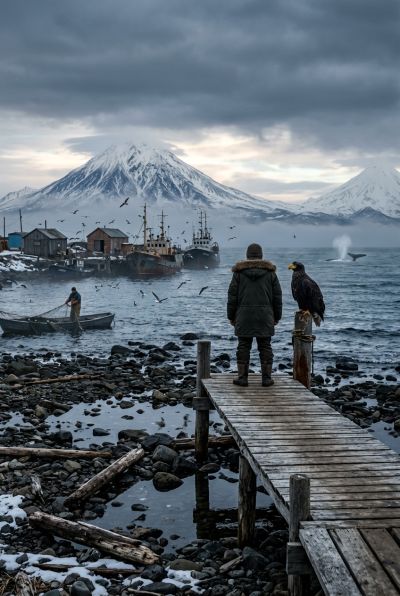
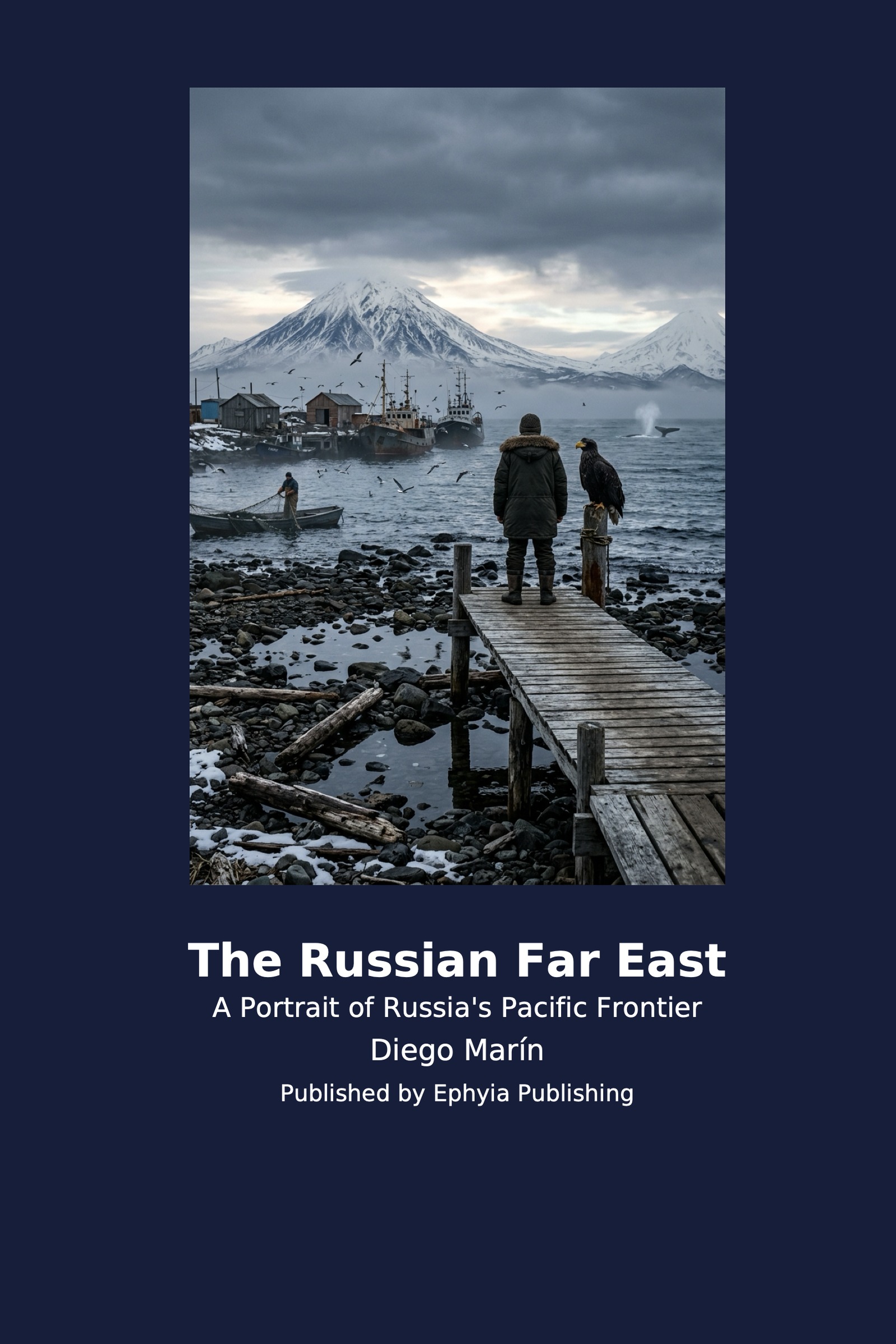
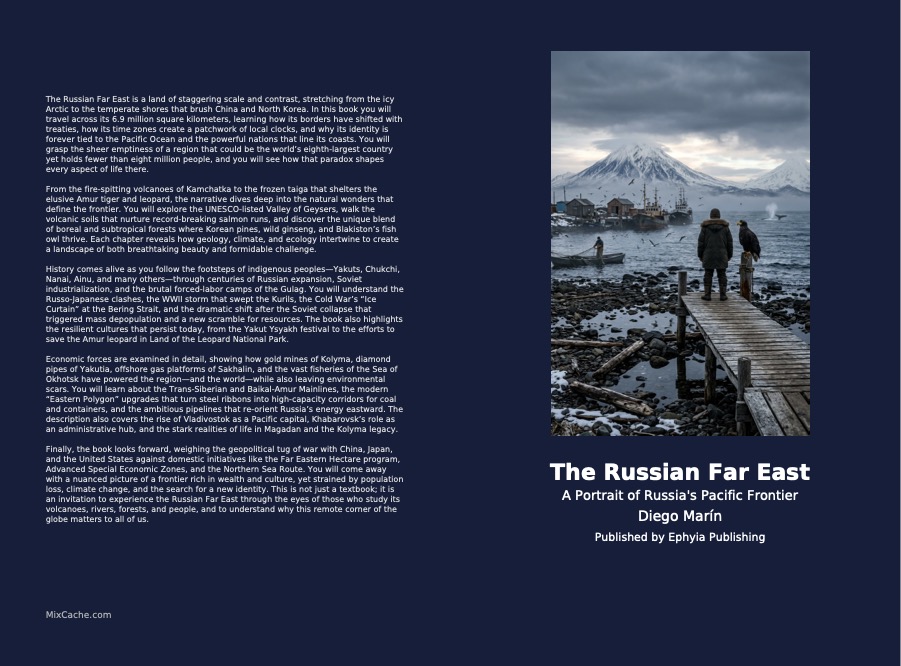
The Russian Far East is a land of staggering scale and contrast, stretching from the icy Arctic to the temperate shores that brush China and North Korea. In this book you will travel across its 6.9 million square kilometers, learning how its borders have shifted with treaties, how its time zones create a patchwork of local clocks, and why its identity is forever tied to the Pacific Ocean and the powerful nations that line its coasts. You will grasp the sheer emptiness of a region that could be the world’s eighth‑largest country yet holds fewer than eight million people, and you will see how that paradox shapes every aspect of life there.
From the fire‑spitting volcanoes of Kamchatka to the frozen taiga that shelters the elusive Amur tiger and leopard, the narrative dives deep into the natural wonders that define the frontier. You will explore the UNESCO‑listed Valley of Geysers, walk the volcanic soils that nurture record‑breaking salmon runs, and discover the unique blend of boreal and subtropical forests where Korean pines, wild ginseng, and Blakiston’s fish owl thrive. Each chapter reveals how geology, climate, and ecology intertwine to create a landscape of both breathtaking beauty and formidable challenge.
History comes alive as you follow the footsteps of indigenous peoples—Yakuts, Chukchi, Nanai, Ainu, and many others—through centuries of Russian expansion, Soviet industrialization, and the brutal forced‑labor camps of the Gulag. You will understand the Russo‑Japanese clashes, the WWII storm that swept the Kurils, the Cold War’s “Ice Curtain” at the Bering Strait, and the dramatic shift after the Soviet collapse that triggered mass depopulation and a new scramble for resources. The book also highlights the resilient cultures that persist today, from the Yakut Ysyakh festival to the efforts to save the Amur leopard in Land of the Leopard National Park.
Economic forces are examined in detail, showing how gold mines of Kolyma, diamond pipes of Yakutia, offshore gas platforms of Sakhalin, and the vast fisheries of the Sea of Okhotsk have powered the region—and the world—while also leaving environmental scars. You will learn about the Trans‑Siberian and Baikal‑Amur Mainlines, the modern “Eastern Polygon” upgrades that turn steel ribbons into high‑capacity corridors for coal and containers, and the ambitious pipelines that re‑orient Russia’s energy eastward. The description also covers the rise of Vladivostok as a Pacific capital, Khabarovsk’s role as an administrative hub, and the stark realities of life in Magadan and the Kolyma legacy.
Finally, the book looks forward, weighing the geopolitical tug of war with China, Japan, and the United States against domestic initiatives like the Far Eastern Hectare program, Advanced Special Economic Zones, and the Northern Sea Route. You will come away with a nuanced picture of a frontier rich in wealth and culture, yet strained by population loss, climate change, and the search for a new identity. This is not just a textbook; it is an invitation to experience the Russian Far East through the eyes of those who study its volcanoes, rivers, forests, and people, and to understand why this remote corner of the globe matters to all of us.
What You'll Find Inside:
- The Russian Far East's immense geography and strategic position as Russia's Pacific gateway, spanning over 6.9 million square kilometers with multiple time zones and borders with China, North Korea, and maritime proximity to Japan and the US.
- The region's extraordinary natural diversity, from volcanic landscapes in Kamchatka and ancient taiga forests to endangered species like the Amur tiger and leopard, and unique ecosystems supporting remarkable biodiversity.
- The complex history of indigenous cultures and Russian expansion, detailing original inhabitants like the Yakuts and Chukchi, Cossack arrival in the 17th century, and centuries of conflict with neighboring China and Japan.
- The Soviet legacy of industrialization built through the Gulag system, particularly in gold mining and infrastructure projects like the Kolyma Highway ('Road of Bones') and cities such as Magadan and Komsomolsk-on-Amur.
- Contemporary challenges of depopulation and economic transformation post-Soviet collapse, alongside geopolitical dynamics shaping the region's future with China, Japan, and the US through energy pipelines and strategic initiatives.
Who's It For:
This comprehensive portrait of Russia's Pacific Frontier is ideal for students and scholars of Russian studies, geography, and international relations, as well as general readers interested in Eurasian history, indigenous cultures, and environmental challenges. The book will particularly benefit those seeking to understand the region's complex geopolitical dynamics, its vast natural resources, and the ongoing struggle between development and conservation in one of the world's most remote and strategically significant territories.
Table of Contents:
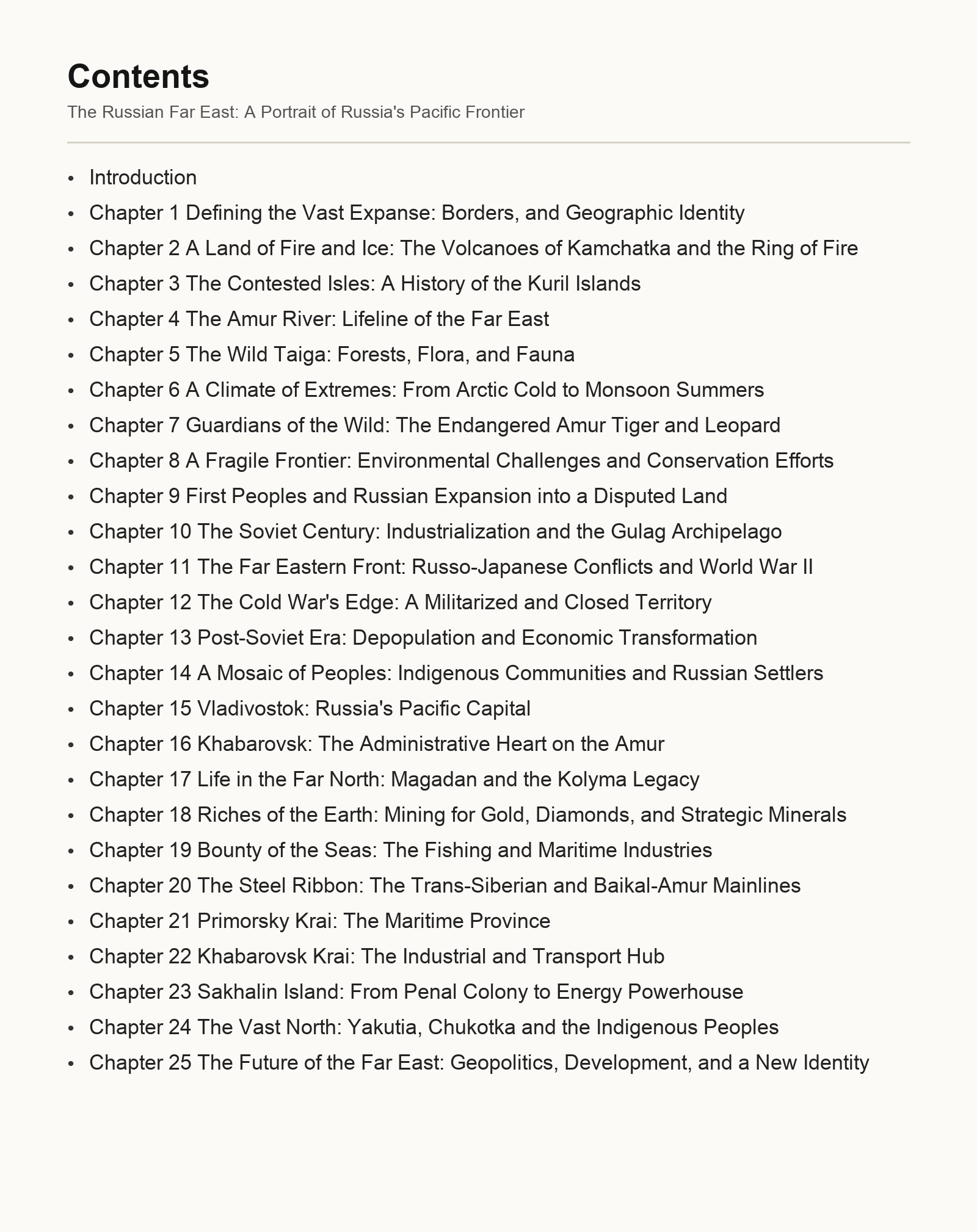
- Introduction
- Chapter 1 Defining the Vast Expanse: Borders, and Geographic Identity
- Chapter 2 A Land of Fire and Ice: The Volcanoes of Kamchatka and the Ring of Fire
- Chapter 3 The Contested Isles: A History of the Kuril Islands
- Chapter 4 The Amur River: Lifeline of the Far East.
- Chapter 5 The Wild Taiga: Forests, Flora, and Fauna.
- Chapter 6 A Climate of Extremes: From Arctic Cold to Monsoon Summers.
- Chapter 7 Guardians of the Wild: The Endangered Amur Tiger and Leopard.
- Chapter 8 A Fragile Frontier: Environmental Challenges and Conservation Efforts.
- Chapter 9 First Peoples and Russian Expansion into a Disputed Land.
- Chapter 10 The Soviet Century: Industrialization and the Gulag Archipelago.
- Chapter 11 The Far Eastern Front: Russo-Japanese Conflicts and World War II.
- Chapter 12 The Cold War's Edge: A Militarized and Closed Territory.
- Chapter 13 Post-Soviet Era: Depopulation and Economic Transformation.
- Chapter 14 A Mosaic of Peoples: Indigenous Communities and Russian Settlers.
- Chapter 15 Vladivostok: Russia's Pacific Capital.
- Chapter 16 Khabarovsk: The Administrative Heart on the Amur.
- Chapter 17 Life in the Far North: Magadan and the Kolyma Legacy.
- Chapter 18 Riches of the Earth: Mining for Gold, Diamonds, and Strategic Minerals.
- Chapter 19 Bounty of the Seas: The Fishing and Maritime Industries
- Chapter 20 The Steel Ribbon: The Trans-Siberian and Baikal-Amur Mainlines.
- Chapter 21 Primorsky Krai: The Maritime Province.
- Chapter 22 Khabarovsk Krai: The Industrial and Transport Hub.
- Chapter 23 Sakhalin Island: From Penal Colony to Energy Powerhouse.
- Chapter 24 The Vast North: Yakutia, Chukotka and the Indigenous Peoples.
- Chapter 25 The Future of the Far East: Geopolitics, Development, and a New Identity.
Author:
Published By:
Date Published:
May 28, 2026
Type:
Nonfiction
Language:
English
Also Available In:
Word Count:
40,605 words
Reading Time:
2 hours 51 minutes
Sample:
Order:
Order The Russian Far East (Hardcover) on MixCache.com:
Buy NowPrint copy is made to order and ships worldwide. Includes the ebook free, ready to read instantly.
$5 account credit for all new MixCache.com accounts, usable toward any ebook purchase!*