
Browse by Category
Fiction
- Action & Adventure
- African American
- Anthologies
- Children's Fiction
- Classics
- Comics & Graphic Novels
- Coming of Age
- Contemporary
- Cultural & Regional
- Drama
- Erotica
- Family Life
- Fantasy
- General
- Historical Fiction
- Horror
- Humor & Satire
- Literary Fiction
- Mystery, Thriller & Suspense
- Poetry
- Religious & Inspirational
- Romance
- Science Fiction
- Short Stories
- War & Military
- Westerns
- Women's Fiction
- Young Adult
Non-Fiction
- Antiques & Collectibles
- Arts & Photography
- Biographies & Memoirs
- Business & Money
- Children's Non-Fiction
-
Computers & Technology
- Artificial Intelligence
- Computer Science
- Cybersecurity & Cryptography
- Data Science & Analytics
- Databases & Big Data
- Game Development & Design
- General
- Hardware & DIY
- Mobile App Development
- Networking & Cloud Computing
- Operating Systems
- Programming
- Robotics
- Software
- Software Engineering
- User Experience (UX) & Design
- Web Development & Design
- Cooking, Food & Wine
- Crafts, Hobbies & Home
- Education & Teaching
- Engineering
- General
- Health, Fitness & Dieting
-
History
- African History
- African History - North Africa
- African History - Sub-Saharan Africa
- American History
- American History - 20th Century
- American History - Civil War
- American History - Colonial Period
- Ancient History
- Asian History
- Asian History - China
- Asian History - India
- Asian History - Japan
- Asian History - Southeast Asia
- European History
- European History - Ancient Greece
- European History - Ancient Rome
- European History - Medieval
- European History - Modern
- European History - Renaissance
- General
- Middle Eastern History
- Military History
- Military History - Aviation
- Military History - Naval
- Social & Cultural History
- World History
- Humor & Entertainment
- Industrial Technology
- Language Learning
- Law
- LGBTQ+ Non-Fiction
- Literary Criticism
- Medical Books
- Parenting & Relationships
- Philosophy
- Politics & Social Sciences
- Reference
- Religion & Spirituality
-
Science & Math
- Agricultural Sciences
- Astronomy & Space Science
- Behavioral Sciences
- Biological Sciences
- Botany & Plant Science
- Chemistry
- Earth Sciences
- Engineering - Chemical
- Engineering - Civil
- Engineering - Electrical
- Engineering - Mechanical
- Environment
- General
- Geology
- Mathematics
- Nature & Ecology
- Oceanography
- Paleontology
- Physics
- Statistics
- Self-Help
- Sports & Outdoors
- Study Aids
- Sustainability & Green Living
- Textbooks
- Transportation
- Travel
- True Crime
- Urban Planning & Development
- Veterinary Medicine
- Writing & Publishing
Jump to Section
MixCache.com Total Access
Unlimited reading and audiobooks for every book published by MixCache.com.
Included titles carry the MTA badge.
Learn more →A History of Lebanon
About this book:


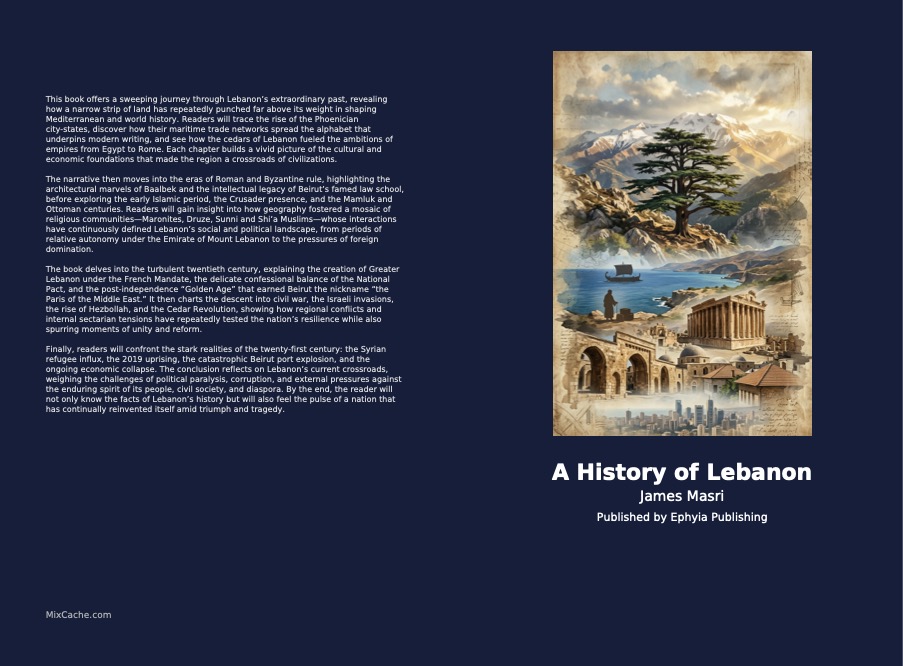
This book offers a sweeping journey through Lebanon’s extraordinary past, revealing how a narrow strip of land has repeatedly punched far above its weight in shaping Mediterranean and world history. Readers will trace the rise of the Phoenician city‑states, discover how their maritime trade networks spread the alphabet that underpins modern writing, and see how the cedars of Lebanon fueled the ambitions of empires from Egypt to Rome. Each chapter builds a vivid picture of the cultural and economic foundations that made the region a crossroads of civilizations.
The narrative then moves into the eras of Roman and Byzantine rule, highlighting the architectural marvels of Baalbek and the intellectual legacy of Beirut’s famed law school, before exploring the early Islamic period, the Crusader presence, and the Mamluk and Ottoman centuries. Readers will gain insight into how geography fostered a mosaic of religious communities—Maronites, Druze, Sunni and Shi’a Muslims—whose interactions have continuously defined Lebanon’s social and political landscape, from periods of relative autonomy under the Emirate of Mount Lebanon to the pressures of foreign domination.
The book delves into the turbulent twentieth century, explaining the creation of Greater Lebanon under the French Mandate, the delicate confessional balance of the National Pact, and the post‑independence “Golden Age” that earned Beirut the nickname “the Paris of the Middle East.” It then charts the descent into civil war, the Israeli invasions, the rise of Hezbollah, and the Cedar Revolution, showing how regional conflicts and internal sectarian tensions have repeatedly tested the nation’s resilience while also spurring moments of unity and reform.
Finally, readers will confront the stark realities of the twenty‑first century: the Syrian refugee influx, the 2019 uprising, the catastrophic Beirut port explosion, and the ongoing economic collapse. The conclusion reflects on Lebanon’s current crossroads, weighing the challenges of political paralysis, corruption, and external pressures against the enduring spirit of its people, civil society, and diaspora. By the end, the reader will not only know the facts of Lebanon’s history but will also feel the pulse of a nation that has continually reinvented itself amid triumph and tragedy.
What You'll Find Inside:
- The book traces Lebanon's history from ancient Phoenician city-states that pioneered the alphabet and Mediterranean trade to modern times, revealing how geography has consistently shaped the nation's destiny.
- It examines Lebanon's unique sectarian composition and how religious diversity has both enriched the culture and fueled conflicts throughout history, from the 1860 civil war to the 1975-1990 Lebanese Civil War.
- The work details Lebanon's experience with foreign domination and mandate systems, including Ottoman rule, French Mandate creation of Greater Lebanon, and subsequent Syrian and Israeli interventions that challenged sovereignty.
- It covers Lebanon's 'Golden Age' as the 'Switzerland of the East' and its subsequent descent into civil war, followed by reconstruction efforts under Rafic Hariri and recurring cycles of crisis and hope.
- The book concludes with analysis of Lebanon's current challenges including economic collapse, political paralysis, the Beirut Port Explosion, and the struggle for sovereignty amid regional tensions involving Hezbollah and Israeli conflicts.
Who's It For:
This book is ideal for students of Middle Eastern history, international relations, and political science seeking a comprehensive understanding of Lebanon's complex past. It will also benefit journalists, policymakers, and professionals working in the region who need historical context for current events, as well as general readers interested in how small nations navigate sectarian divisions, foreign intervention, and economic crises. Anyone wishing to understand the roots of Lebanon's ongoing struggles with governance, identity, and regional conflicts will find valuable insights in this detailed historical narrative.
Introduction
To understand Lebanon is to embrace a paradox. It is a nation nestled on a narrow strip of the eastern Mediterranean, a sliver of land that has played a role in human history vastly disproportionate to its size. This is a country whose very geography has dictated its destiny, with a mountainous spine offering refuge and fostering diversity, and a sun-drenched coast beckoning traders and conquerors alike. Its story is one of breathtaking cultural achievements and devastating conflicts, of legendary prosperity and heart-wrenching collapse. It is a place where ancient ruins stand sentinel over bustling city streets, and where the echoes of history reverberate in the daily lives of its people. To delve into the history of Lebanon is to embark on a journey through the annals of civilization itself, a story of resilience in the face of seemingly insurmountable odds.
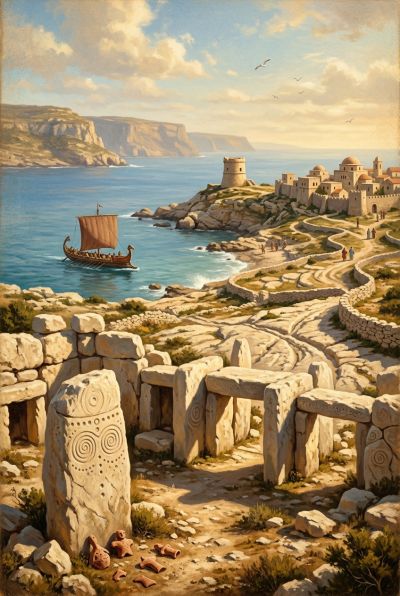
Human presence in this region dates back thousands of years, with early settlements emerging along the coast well before the dawn of recorded history. Archaeologists have unearthed evidence of prehistoric communities who fished the Mediterranean waters and built rudimentary homes on its shores, laying the very first foundations of what would become a cradle of civilization. These early inhabitants were the precursors to the Canaanites, a Semitic people who established a network of coastal city-states around 4000 BC.
Enjoying it? The full book includes every chapter.
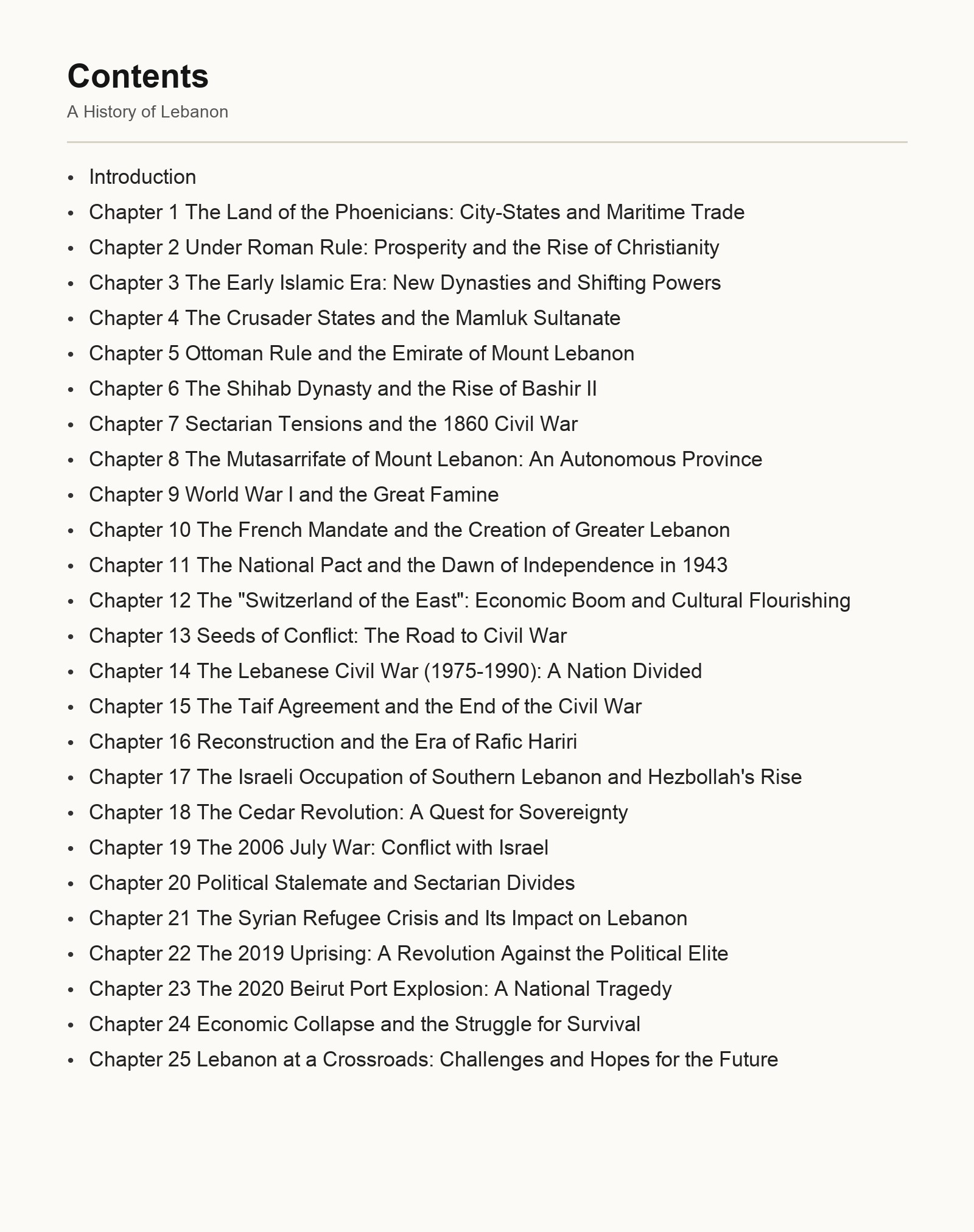
Table of Contents:
- Introduction Free
- Chapter 1 The Land of the Phoenicians: City-States and Maritime Trade Free
- Chapter 2 Under Roman Rule: Prosperity and the Rise of Christianity
- Chapter 3 The Early Islamic Era: New Dynasties and Shifting Powers
- Chapter 4 The Crusader States and the Mamluk Sultanate
- Chapter 5 Ottoman Rule and the Emirate of Mount Lebanon
- Chapter 6 The Shihab Dynasty and the Rise of Bashir II
- Chapter 7 Sectarian Tensions and the 1860 Civil War
- Chapter 8 The Mutasarrifate of Mount Lebanon: An Autonomous Province
- Chapter 9 World War I and the Great Famine
- Chapter 10 The French Mandate and the Creation of Greater Lebanon
- Chapter 11 The National Pact and the Dawn of Independence in 1943
- Chapter 12 The "Switzerland of the East": Economic Boom and Cultural Flourishing
- Chapter 13 Seeds of Conflict: The Road to Civil War
- Chapter 14 The Lebanese Civil War (1975-1990): A Nation Divided
- Chapter 15 The Taif Agreement and the End of the Civil War
- Chapter 16 Reconstruction and the Era of Rafic Hariri
- Chapter 17 The Israeli Occupation of Southern Lebanon and Hezbollah's Rise
- Chapter 18 The Cedar Revolution: A Quest for Sovereignty
- Chapter 19 The 2006 July War: Conflict with Israel
- Chapter 20 Political Stalemate and Sectarian Divides
- Chapter 21 The Syrian Refugee Crisis and Its Impact on Lebanon
- Chapter 22 The 2019 Uprising: A Revolution Against the Political Elite
- Chapter 23 The 2020 Beirut Port Explosion: A National Tragedy
- Chapter 24 Economic Collapse and the Struggle for Survival
- Chapter 25 Lebanon at a Crossroads: Challenges and Hopes for the Future
Included when you buy the full book.
Author:
Published By:
Date Published:
May 28, 2026
Type:
Nonfiction
Language:
English
Also Available In:
Word Count:
48,810 words
Reading Time:
3 hours 25 minutes
Sample:
Order:
Buy the A History of Lebanon ebook on MixCache.com:
Buy NowIncludes every chapter. Not sure yet? Read the opening free.
The full ebook will be available immediately to read instantly on any device.
$5 account credit for all new MixCache.com accounts, usable toward any ebook purchase!*





Ratings & Reviews
Ask Questions About This Book
Have a question about the content? Ask our AI assistant!
Start by asking a question about "A History of Lebanon"
Example: "Does this book mention William Shakespeare?"
Thinking...