Browse by Category
Fiction
- Action & Adventure
- African American
- Anthologies
- Children's Fiction
- Classics
- Comics & Graphic Novels
- Coming of Age
- Contemporary
- Cultural & Regional
- Drama
- Erotica
- Fantasy
- General
- Historical Fiction
- Horror
- Humor & Satire
- Literary Fiction
- Mystery, Thriller & Suspense
- Poetry
- Religious & Inspirational
- Romance
- Science Fiction
- Short Stories
- War & Military
- Westerns
- Women's Fiction
- Young Adult
Non-Fiction
- Antiques & Collectibles
- Arts & Photography
- Biographies & Memoirs
- Business & Money
- Children's Non-Fiction
-
Computers & Technology
- Artificial Intelligence
- Computer Science
- Cybersecurity & Cryptography
- Data Science & Analytics
- Databases & Big Data
- Game Development & Design
- General
- Hardware & DIY
- Mobile App Development
- Networking & Cloud Computing
- Operating Systems
- Programming
- Robotics
- Software
- Software Engineering
- User Experience (UX) & Design
- Web Development & Design
- Cooking, Food & Wine
- Crafts, Hobbies & Home
- Education & Teaching
- Engineering
- General
- Health, Fitness & Dieting
-
History
- African History
- African History - North Africa
- African History - Sub-Saharan Africa
- American History
- American History - 20th Century
- American History - Civil War
- American History - Colonial Period
- Ancient History
- Asian History
- Asian History - China
- Asian History - India
- Asian History - Japan
- Asian History - Southeast Asia
- European History
- European History - Ancient Greece
- European History - Ancient Rome
- European History - Medieval
- European History - Modern
- European History - Renaissance
- General
- Middle Eastern History
- Military History
- Military History - Aviation
- Military History - Naval
- Social & Cultural History
- World History
- Humor & Entertainment
- Industrial Technology
- Language Learning
- Law
- LGBTQ+ Non-Fiction
- Literary Criticism
- Medical Books
- Parenting & Relationships
- Philosophy
- Politics & Social Sciences
- Reference
- Religion & Spirituality
-
Science & Math
- Agricultural Sciences
- Astronomy & Space Science
- Behavioral Sciences
- Biological Sciences
- Botany & Plant Science
- Chemistry
- Earth Sciences
- Engineering - Chemical
- Engineering - Civil
- Engineering - Electrical
- Engineering - Mechanical
- Environment
- General
- Geology
- Mathematics
- Nature & Ecology
- Oceanography
- Paleontology
- Physics
- Statistics
- Self-Help
- Sports & Outdoors
- Study Aids
- Sustainability & Green Living
- Textbooks
- Transportation
- Travel
- True Crime
- Urban Planning & Development
- Veterinary Medicine
- Writing & Publishing
Jump to Section
MixCache.com Total Access
Unlimited reading and audiobooks for every book published by MixCache.com.
Included titles carry the MTA badge.
Learn more →
Colonizing the Solar System
An exploration of the possibilities for humanity
About this book:
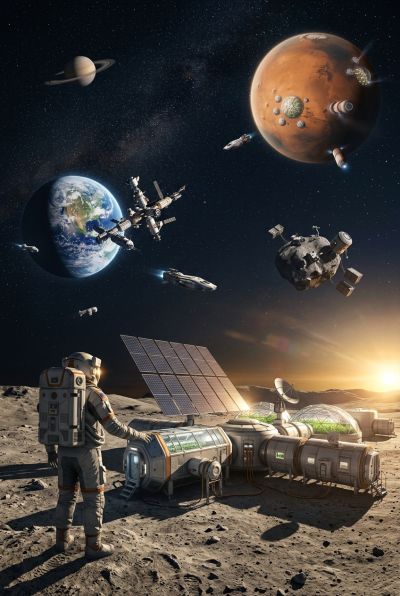
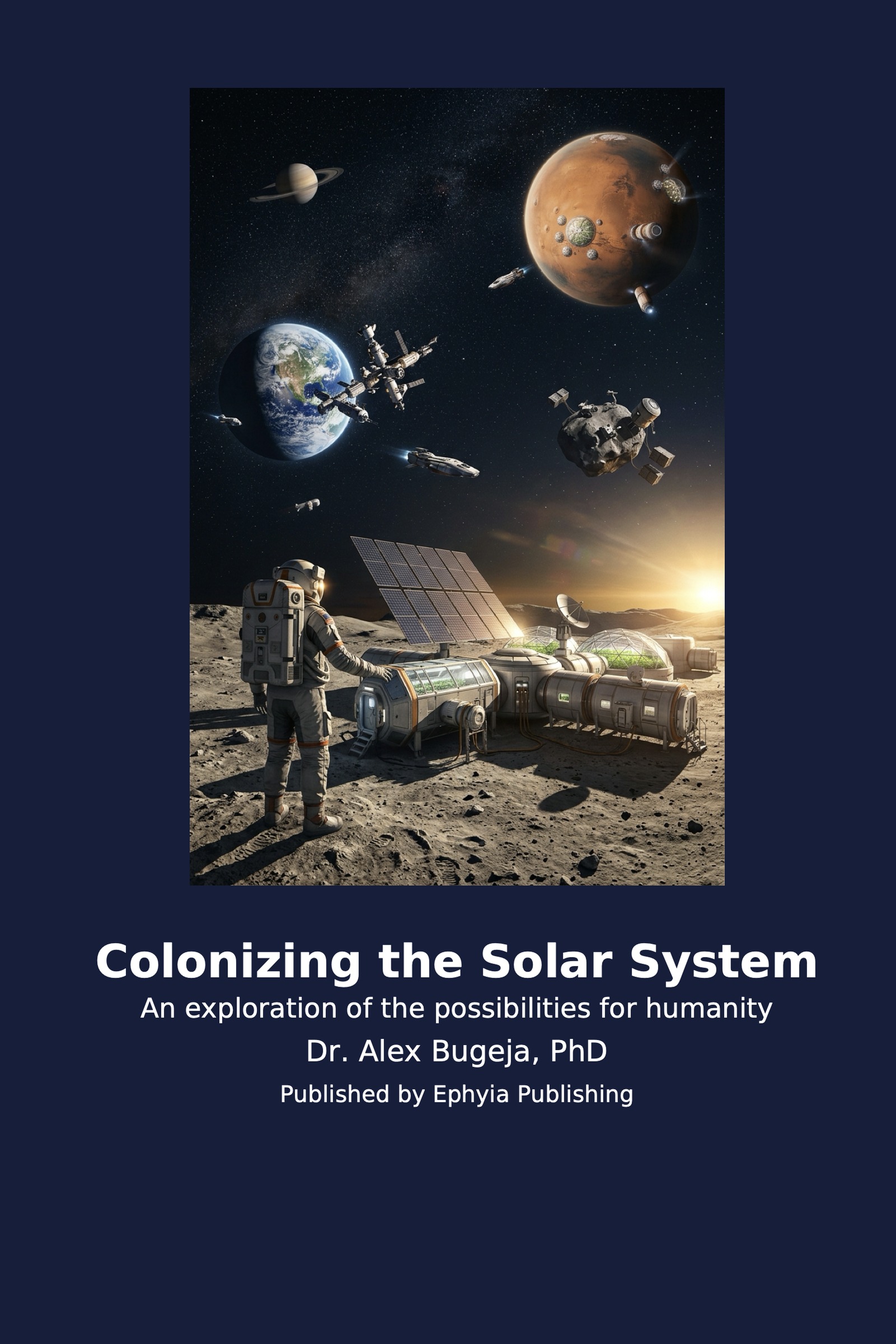
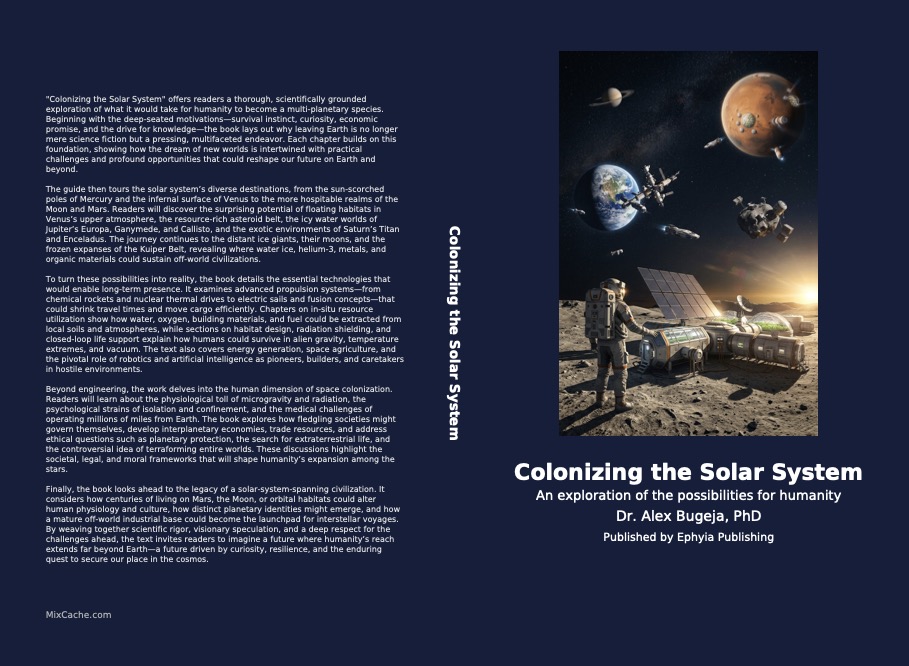
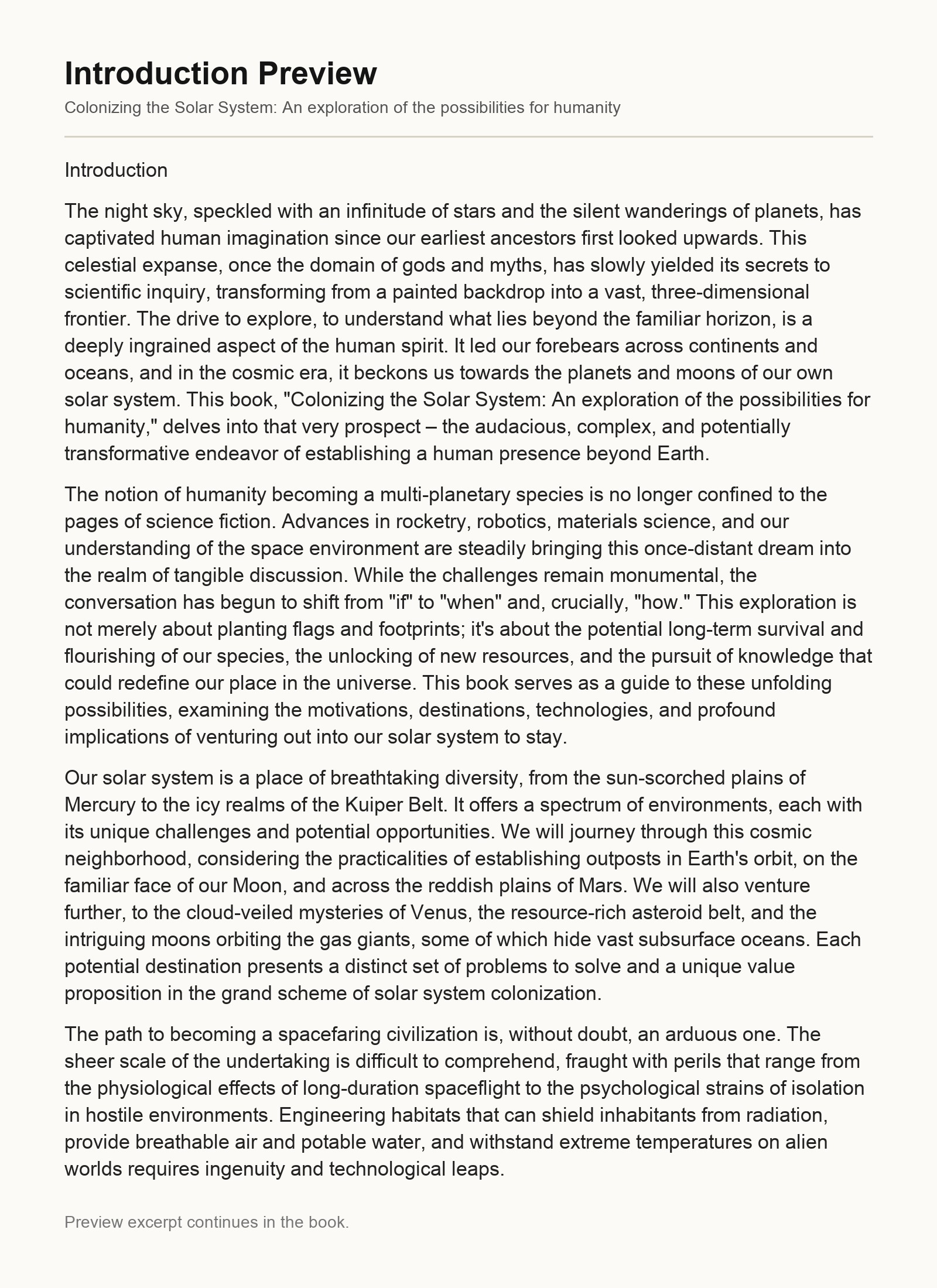
"Colonizing the Solar System" offers readers a thorough, scientifically grounded exploration of what it would take for humanity to become a multi‑planetary species. Beginning with the deep‑seated motivations—survival instinct, curiosity, economic promise, and the drive for knowledge—the book lays out why leaving Earth is no longer mere science fiction but a pressing, multifaceted endeavor. Each chapter builds on this foundation, showing how the dream of new worlds is intertwined with practical challenges and profound opportunities that could reshape our future on Earth and beyond.
The guide then tours the solar system’s diverse destinations, from the sun‑scorched poles of Mercury and the infernal surface of Venus to the more hospitable realms of the Moon and Mars. Readers will discover the surprising potential of floating habitats in Venus’s upper atmosphere, the resource‑rich asteroid belt, the icy water worlds of Jupiter’s Europa, Ganymede, and Callisto, and the exotic environments of Saturn’s Titan and Enceladus. The journey continues to the distant ice giants, their moons, and the frozen expanses of the Kuiper Belt, revealing where water ice, helium‑3, metals, and organic materials could sustain off‑world civilizations.
To turn these possibilities into reality, the book details the essential technologies that would enable long‑term presence. It examines advanced propulsion systems—from chemical rockets and nuclear thermal drives to electric sails and fusion concepts—that could shrink travel times and move cargo efficiently. Chapters on in‑situ resource utilization show how water, oxygen, building materials, and fuel could be extracted from local soils and atmospheres, while sections on habitat design, radiation shielding, and closed‑loop life support explain how humans could survive in alien gravity, temperature extremes, and vacuum. The text also covers energy generation, space agriculture, and the pivotal role of robotics and artificial intelligence as pioneers, builders, and caretakers in hostile environments.
Beyond engineering, the work delves into the human dimension of space colonization. Readers will learn about the physiological toll of microgravity and radiation, the psychological strains of isolation and confinement, and the medical challenges of operating millions of miles from Earth. The book explores how fledgling societies might govern themselves, develop interplanetary economies, trade resources, and address ethical questions such as planetary protection, the search for extraterrestrial life, and the controversial idea of terraforming entire worlds. These discussions highlight the societal, legal, and moral frameworks that will shape humanity’s expansion among the stars.
Finally, the book looks ahead to the legacy of a solar‑system‑spanning civilization. It considers how centuries of living on Mars, the Moon, or orbital habitats could alter human physiology and culture, how distinct planetary identities might emerge, and how a mature off‑world industrial base could become the launchpad for interstellar voyages. By weaving together scientific rigor, visionary speculation, and a deep respect for the challenges ahead, the text invites readers to imagine a future where humanity’s reach extends far beyond Earth—a future driven by curiosity, resilience, and the enduring quest to secure our place in the cosmos.
What You'll Find Inside:
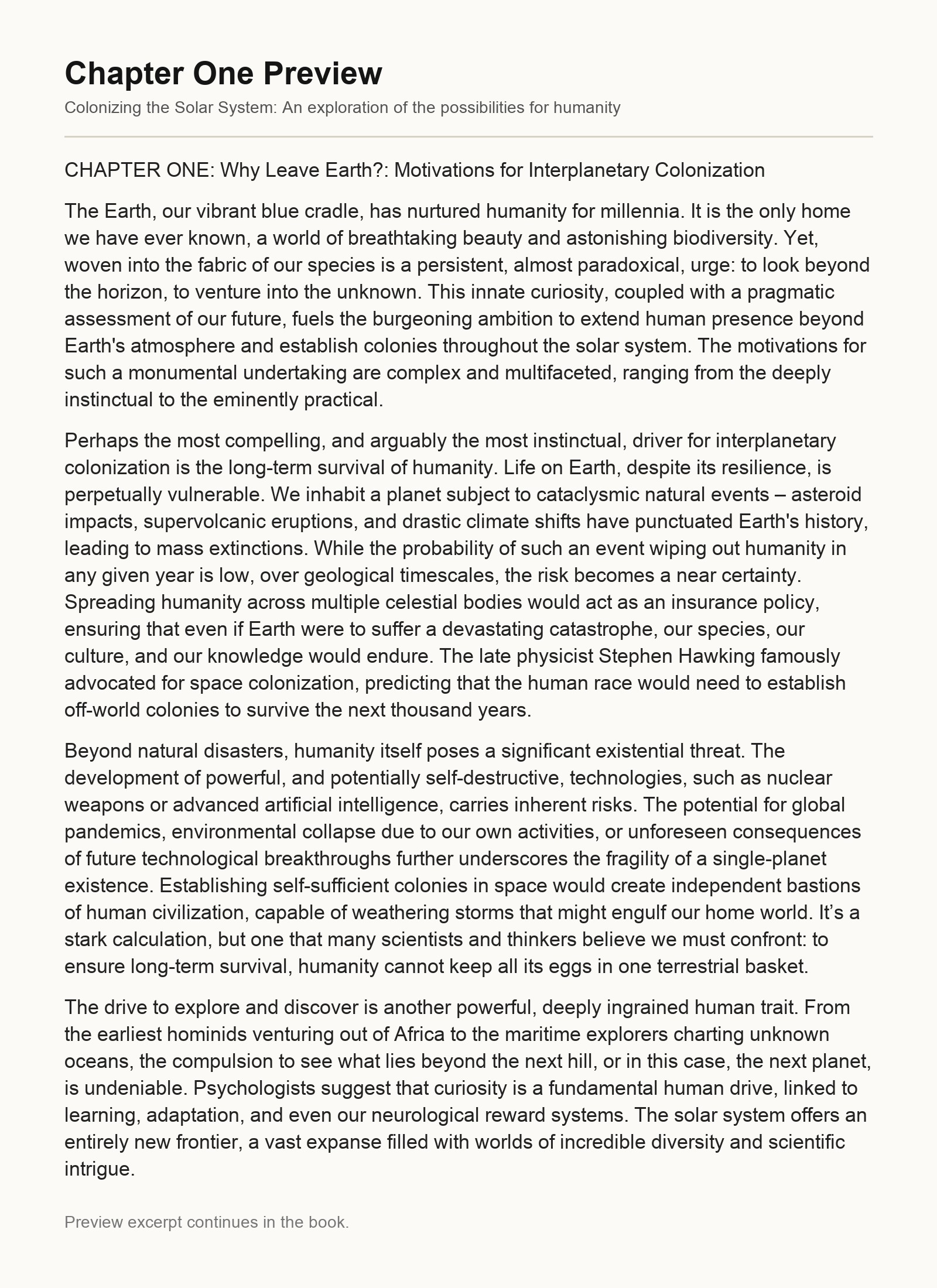
- The book explores humanity's motivations for becoming a multi-planetary species, including species survival, scientific discovery, economic opportunities, and the drive for exploration.
- It provides a comprehensive survey of potential colonization destinations throughout the solar system - from Earth orbit and the Moon to Mars, Venus, asteroid belt, Jovian and Saturnian moons, and even the Kuiper Belt.
- Key technologies enabling space colonization are examined in detail, including propulsion systems, in-situ resource utilization (ISRU), habitat construction, life support systems, and space agriculture.
- The physiological and psychological challenges of long-duration spaceflight and alien environment habitation are thoroughly analyzed, covering radiation effects, low-gravity impacts, and isolation stresses.
- Ethical considerations surrounding space colonization are addressed, including planetary protection protocols, the implications of discovering extraterrestrial life, and the controversies of terraforming.
Who's It For:
This book is ideal for space enthusiasts, aerospace engineering students, and professionals in related fields who seek a comprehensive yet accessible exploration of interplanetary colonization. It will particularly benefit readers interested in both the technical challenges and broader societal implications of becoming a multi-planetary species, offering scientific depth while remaining approachable for educated non-specialists. Anyone curious about humanity's future in space, from the motivations behind colonization to the practicalities of building extraterrestrial communities, will find valuable insights within these pages.
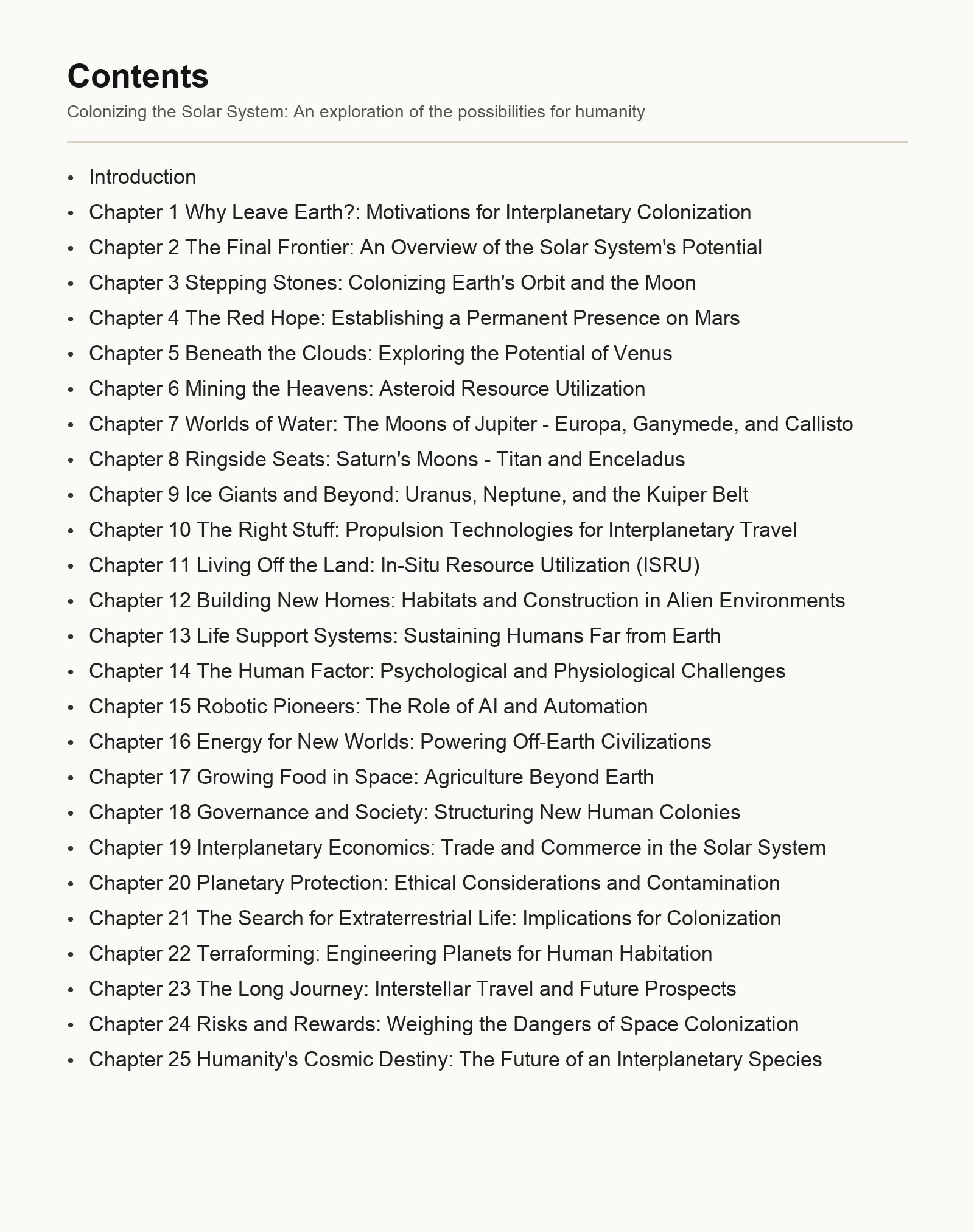
Table of Contents:
- Introduction
- Chapter 1 Why Leave Earth?: Motivations for Interplanetary Colonization
- Chapter 2 The Final Frontier: An Overview of the Solar System's Potential
- Chapter 3 Stepping Stones: Colonizing Earth's Orbit and the Moon
- Chapter 4 The Red Hope: Establishing a Permanent Presence on Mars
- Chapter 5 Beneath the Clouds: Exploring the Potential of Venus
- Chapter 6 Mining the Heavens: Asteroid Resource Utilization
- Chapter 7 Worlds of Water: The Moons of Jupiter - Europa, Ganymede, and Callisto
- Chapter 8 Ringside Seats: Saturn's Moons - Titan and Enceladus
- Chapter 9 Ice Giants and Beyond: Uranus, Neptune, and the Kuiper Belt
- Chapter 10 The Right Stuff: Propulsion Technologies for Interplanetary Travel
- Chapter 11 Living Off the Land: In-Situ Resource Utilization (ISRU)
- Chapter 12 Building New Homes: Habitats and Construction in Alien Environments
- Chapter 13 Life Support Systems: Sustaining Humans Far from Earth
- Chapter 14 The Human Factor: Psychological and Physiological Challenges
- Chapter 15 Robotic Pioneers: The Role of AI and Automation
- Chapter 16 Energy for New Worlds: Powering Off-Earth Civilizations
- Chapter 17 Growing Food in Space: Agriculture Beyond Earth
- Chapter 18 Governance and Society: Structuring New Human Colonies
- Chapter 19 Interplanetary Economics: Trade and Commerce in the Solar System
- Chapter 20 Planetary Protection: Ethical Considerations and Contamination
- Chapter 21 The Search for Extraterrestrial Life: Implications for Colonization
- Chapter 22 Terraforming: Engineering Planets for Human Habitation
- Chapter 23 The Long Journey: Interstellar Travel and Future Prospects
- Chapter 24 Risks and Rewards: Weighing the Dangers of Space Colonization
- Chapter 25 Humanity's Cosmic Destiny: The Future of an Interplanetary Species
Author:
Published By:
Date Published:
May 27, 2026
Type:
Nonfiction
Language:
English
Also Available In:
Word Count:
57,296 words
Reading Time:
4 hours 1 minutes
Sample:
Order:
Order Colonizing the Solar System (Paperback) on MixCache.com:
Buy NowPrint copy is made to order and ships worldwide. Includes the ebook free, ready to read instantly.
$5 account credit for all new MixCache.com accounts, usable toward any ebook purchase!*