Browse by Category
Fiction
- Action & Adventure
- African American
- Anthologies
- Children's Fiction
- Classics
- Comics & Graphic Novels
- Coming of Age
- Contemporary
- Cultural & Regional
- Drama
- Erotica
- Fantasy
- General
- Historical Fiction
- Horror
- Humor & Satire
- Literary Fiction
- Mystery, Thriller & Suspense
- Poetry
- Religious & Inspirational
- Romance
- Science Fiction
- Short Stories
- War & Military
- Westerns
- Women's Fiction
- Young Adult
Non-Fiction
- Antiques & Collectibles
- Arts & Photography
- Biographies & Memoirs
- Business & Money
- Children's Non-Fiction
-
Computers & Technology
- Artificial Intelligence
- Computer Science
- Cybersecurity & Cryptography
- Data Science & Analytics
- Databases & Big Data
- Game Development & Design
- General
- Hardware & DIY
- Mobile App Development
- Networking & Cloud Computing
- Operating Systems
- Programming
- Robotics
- Software
- Software Engineering
- User Experience (UX) & Design
- Web Development & Design
- Cooking, Food & Wine
- Crafts, Hobbies & Home
- Education & Teaching
- Engineering
- General
- Health, Fitness & Dieting
-
History
- African History
- African History - North Africa
- African History - Sub-Saharan Africa
- American History
- American History - 20th Century
- American History - Civil War
- American History - Colonial Period
- Ancient History
- Asian History
- Asian History - China
- Asian History - India
- Asian History - Japan
- Asian History - Southeast Asia
- European History
- European History - Ancient Greece
- European History - Ancient Rome
- European History - Medieval
- European History - Modern
- European History - Renaissance
- General
- Middle Eastern History
- Military History
- Military History - Aviation
- Military History - Naval
- Social & Cultural History
- World History
- Humor & Entertainment
- Industrial Technology
- Language Learning
- Law
- LGBTQ+ Non-Fiction
- Literary Criticism
- Medical Books
- Parenting & Relationships
- Philosophy
- Politics & Social Sciences
- Reference
- Religion & Spirituality
-
Science & Math
- Agricultural Sciences
- Astronomy & Space Science
- Behavioral Sciences
- Biological Sciences
- Botany & Plant Science
- Chemistry
- Earth Sciences
- Engineering - Chemical
- Engineering - Civil
- Engineering - Electrical
- Engineering - Mechanical
- Environment
- General
- Geology
- Mathematics
- Nature & Ecology
- Oceanography
- Paleontology
- Physics
- Statistics
- Self-Help
- Sports & Outdoors
- Study Aids
- Sustainability & Green Living
- Textbooks
- Transportation
- Travel
- True Crime
- Urban Planning & Development
- Veterinary Medicine
- Writing & Publishing
Jump to Section
MixCache.com Total Access
Unlimited reading and audiobooks for every book published by MixCache.com.
Included titles carry the MTA badge.
Learn more →A History of Kuwait
About this book:


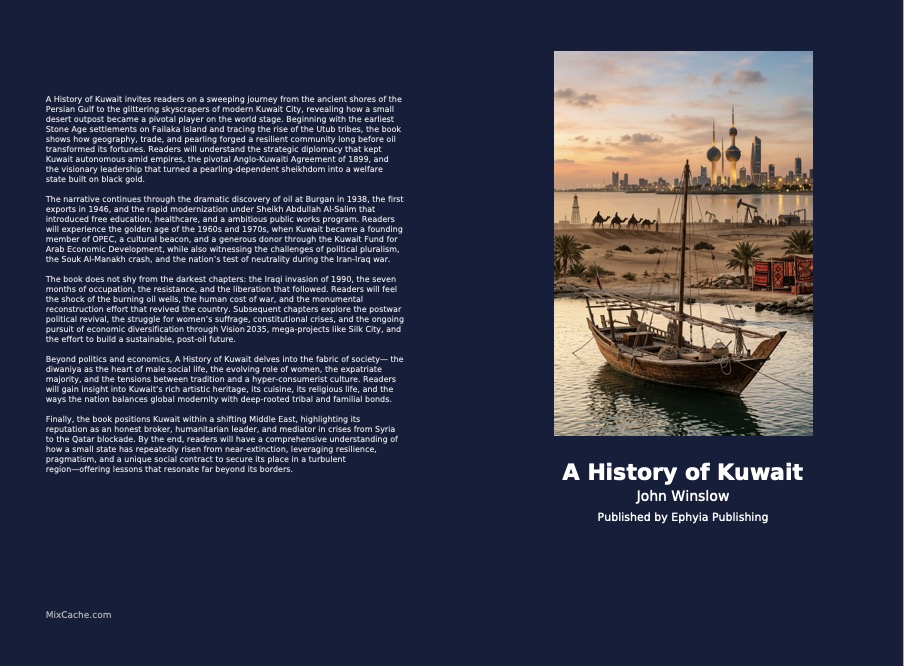
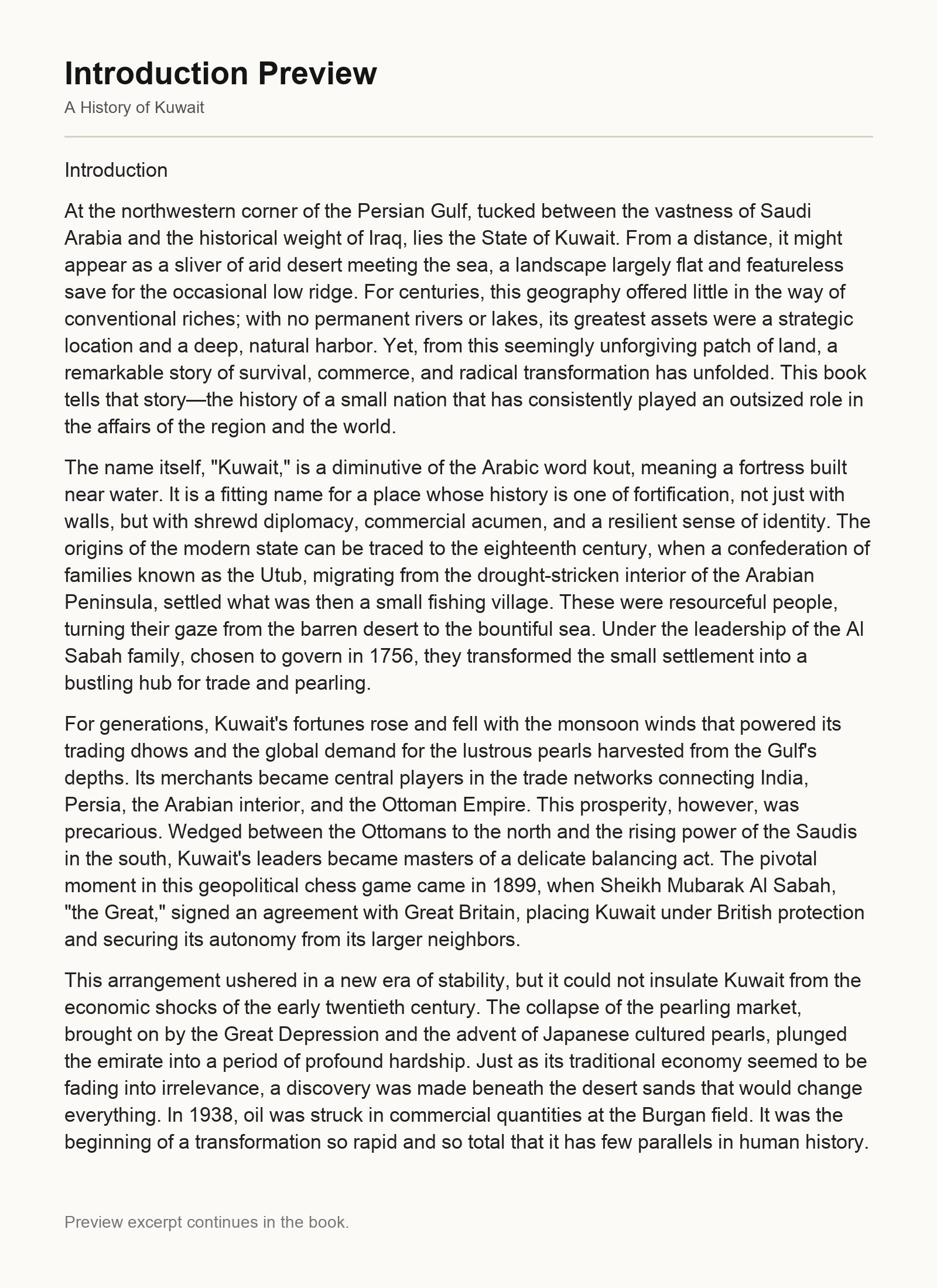
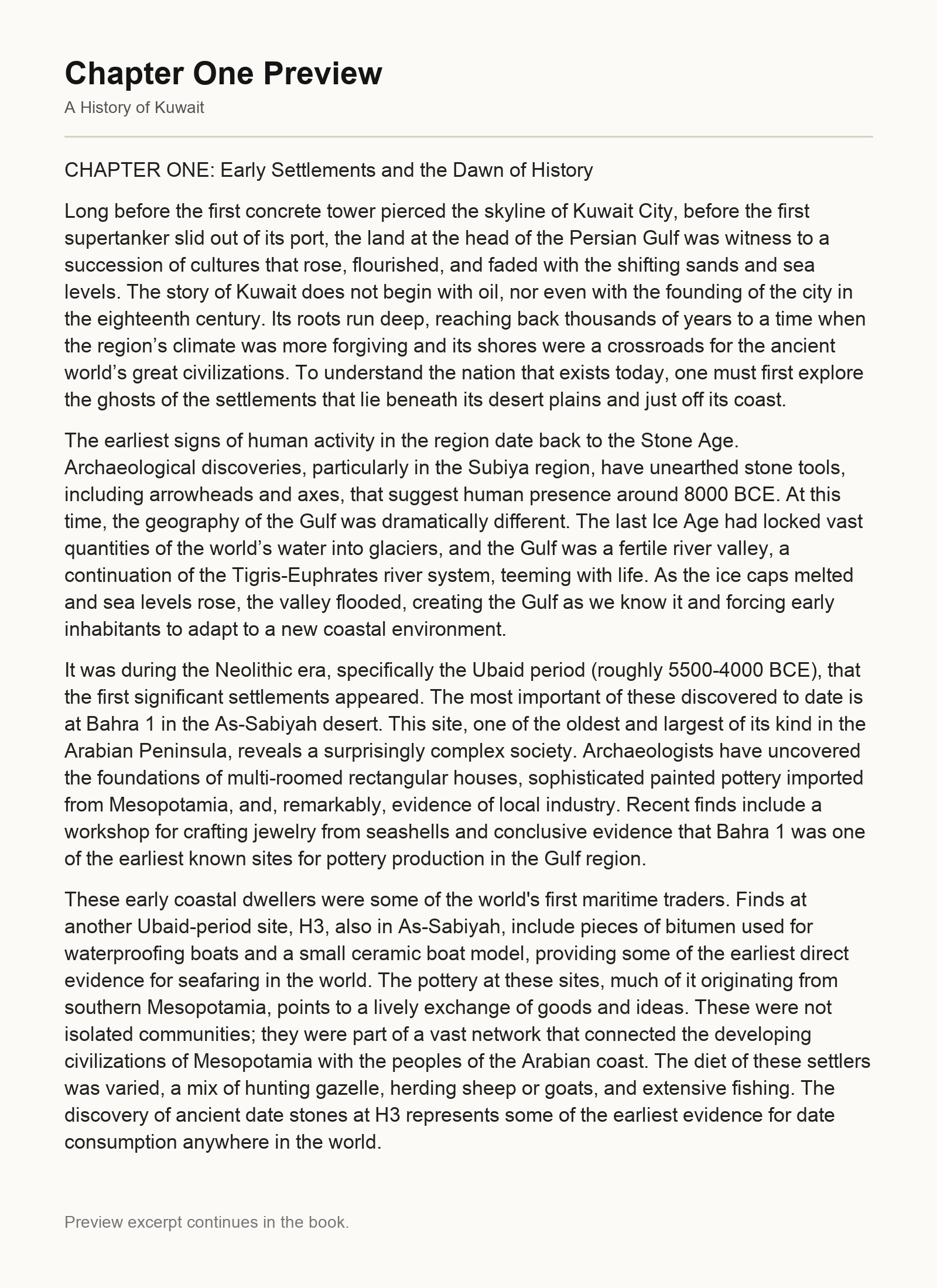
A History of Kuwait invites readers on a sweeping journey from the ancient shores of the Persian Gulf to the glittering skyscrapers of modern Kuwait City, revealing how a small desert outpost became a pivotal player on the world stage. Beginning with the earliest Stone Age settlements on Failaka Island and tracing the rise of the Utub tribes, the book shows how geography, trade, and pearling forged a resilient community long before oil transformed its fortunes. Readers will understand the strategic diplomacy that kept Kuwait autonomous amid empires, the pivotal Anglo‑Kuwaiti Agreement of 1899, and the visionary leadership that turned a pearling‑dependent sheikhdom into a welfare state built on black gold.
The narrative continues through the dramatic discovery of oil at Burgan in 1938, the first exports in 1946, and the rapid modernization under Sheikh Abdullah Al‑Salim that introduced free education, healthcare, and a ambitious public works program. Readers will experience the golden age of the 1960s and 1970s, when Kuwait became a founding member of OPEC, a cultural beacon, and a generous donor through the Kuwait Fund for Arab Economic Development, while also witnessing the challenges of political pluralism, the Souk Al‑Manakh crash, and the nation’s test of neutrality during the Iran‑Iraq war.
The book does not shy from the darkest chapters: the Iraqi invasion of 1990, the seven months of occupation, the resistance, and the liberation that followed. Readers will feel the shock of the burning oil wells, the human cost of war, and the monumental reconstruction effort that revived the country. Subsequent chapters explore the postwar political revival, the struggle for women’s suffrage, constitutional crises, and the ongoing pursuit of economic diversification through Vision 2035, mega‑projects like Silk City, and the effort to build a sustainable, post‑oil future.
Beyond politics and economics, A History of Kuwait delves into the fabric of society— the diwaniya as the heart of male social life, the evolving role of women, the expatriate majority, and the tensions between tradition and a hyper‑consumerist culture. Readers will gain insight into Kuwait’s rich artistic heritage, its cuisine, its religious life, and the ways the nation balances global modernity with deep‑rooted tribal and familial bonds.
Finally, the book positions Kuwait within a shifting Middle East, highlighting its reputation as an honest broker, humanitarian leader, and mediator in crises from Syria to the Qatar blockade. By the end, readers will have a comprehensive understanding of how a small state has repeatedly risen from near‑extinction, leveraging resilience, pragmatism, and a unique social contract to secure its place in a turbulent region—offering lessons that resonate far beyond its borders.
What You'll Find Inside:
- The book traces Kuwait’s origins from ancient Dilmun and Greek settlements to the 18th‑century Utub migration and the establishment of Al Sabah rule, highlighting how pearling and trade built the early economy.
- It details the 1938 discovery of the Burgan oil field, the post‑WWII oil exports, and how the resulting wealth funded a comprehensive welfare state, modern infrastructure, and a sovereign wealth fund.
- The narrative covers Kuwait’s path to independence in 1961, the adoption of a constitution and parliament, and the ensuing democratic experiments punctuated by periods of autocracy and political gridlock.
- It examines the 1990 Iraqi invasion, seven months of occupation, the Gulf War liberation, and the massive reconstruction effort that followed, including the extinguishing of over 700 oil wells.
- The final chapters discuss contemporary challenges: economic diversification under Vision 2035, the rentier economy’s social tensions, and Kuwait’s evolving role as a diplomatic mediator in a volatile Middle East.
Who's It For:
This book is ideal for students, academics, and general readers interested in Middle Eastern history, Gulf studies, and nation‑building processes. It will particularly benefit those seeking to understand how a small, arid territory transformed into a wealthy, oil‑driven state, navigated regional conflicts, and continues to balance tradition with modernization in its political and societal development.
Table of Contents:
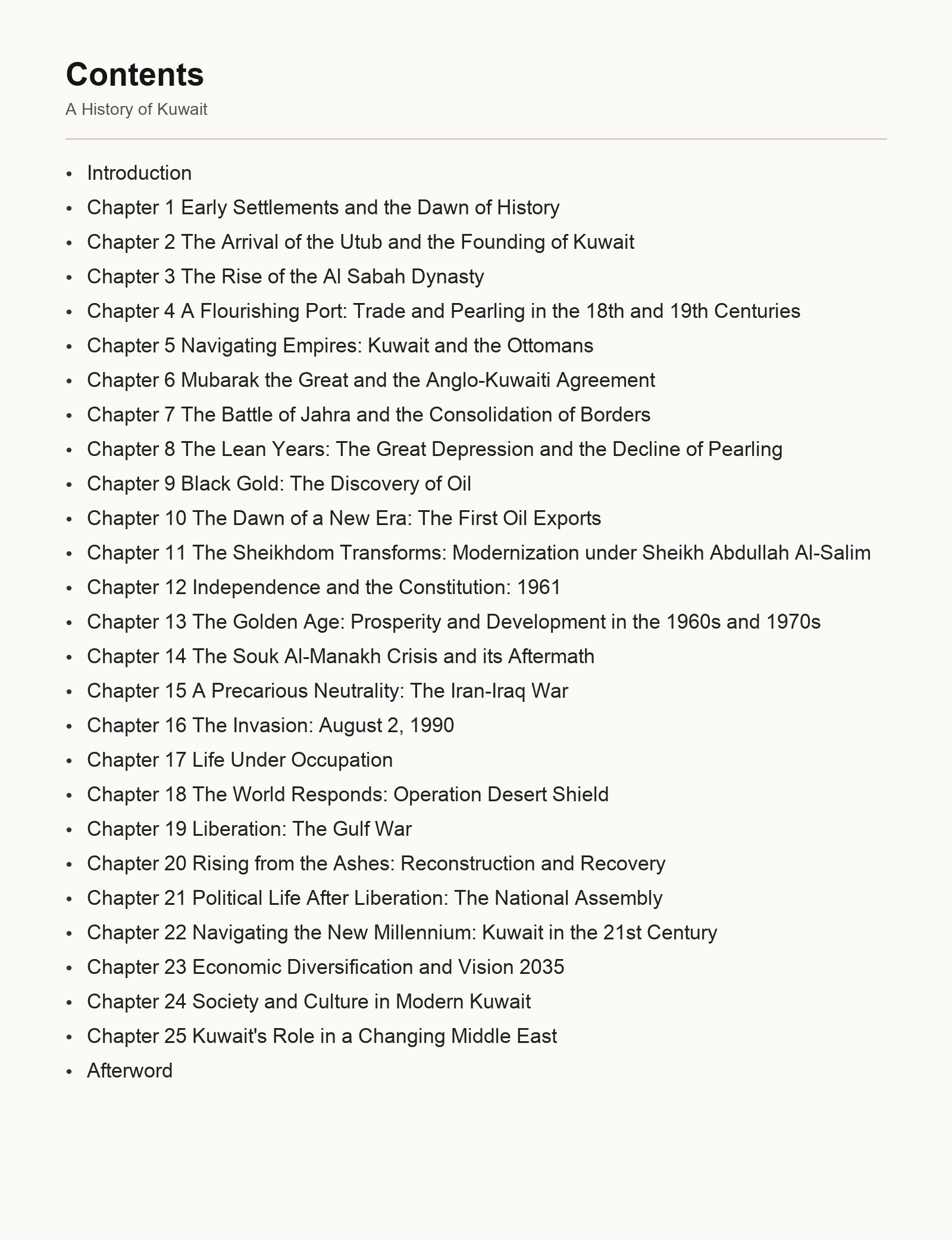
- Introduction
- Chapter 1 Early Settlements and the Dawn of History
- Chapter 2 The Arrival of the Utub and the Founding of Kuwait
- Chapter 3 The Rise of the Al Sabah Dynasty
- Chapter 4 A Flourishing Port: Trade and Pearling in the 18th and 19th Centuries
- Chapter 5 Navigating Empires: Kuwait and the Ottomans
- Chapter 6 Mubarak the Great and the Anglo-Kuwaiti Agreement
- Chapter 7 The Battle of Jahra and the Consolidation of Borders
- Chapter 8 The Lean Years: The Great Depression and the Decline of Pearling
- Chapter 9 Black Gold: The Discovery of Oil
- Chapter 10 The Dawn of a New Era: The First Oil Exports
- Chapter 11 The Sheikhdom Transforms: Modernization under Sheikh Abdullah Al-Salim
- Chapter 12 Independence and the Constitution: 1961
- Chapter 13 The Golden Age: Prosperity and Development in the 1960s and 1970s
- Chapter 14 The Souk Al-Manakh Crisis and its Aftermath
- Chapter 15 A Precarious Neutrality: The Iran-Iraq War
- Chapter 16 The Invasion: August 2, 1990
- Chapter 17 Life Under Occupation
- Chapter 18 The World Responds: Operation Desert Shield
- Chapter 19 Liberation: The Gulf War
- Chapter 20 Rising from the Ashes: Reconstruction and Recovery
- Chapter 21 Political Life After Liberation: The National Assembly
- Chapter 22 Navigating the New Millennium: Kuwait in the 21st Century
- Chapter 23 Economic Diversification and Vision 2035
- Chapter 24 Society and Culture in Modern Kuwait
- Chapter 25 Kuwait's Role in a Changing Middle East
- Afterword
Author:
Published By:
Date Published:
May 25, 2026
Type:
Nonfiction
Language:
English
Word Count:
49,048 words
Reading Time:
3 hours 26 minutes
Sample:
Order:
Order A History of Kuwait (Paperback) on MixCache.com:
Buy NowPrint copy is made to order and ships worldwide. Includes the ebook free, ready to read instantly.
$5 account credit for all new MixCache.com accounts, usable toward any ebook purchase!*