
Browse by Category
Fiction
- Action & Adventure
- African American
- Anthologies
- Children's Fiction
- Classics
- Comics & Graphic Novels
- Coming of Age
- Contemporary
- Cultural & Regional
- Drama
- Erotica
- Fantasy
- General
- Historical Fiction
- Horror
- Humor & Satire
- Literary Fiction
- Mystery, Thriller & Suspense
- Poetry
- Religious & Inspirational
- Romance
- Science Fiction
- Short Stories
- War & Military
- Westerns
- Women's Fiction
- Young Adult
Non-Fiction
- Antiques & Collectibles
- Arts & Photography
- Biographies & Memoirs
- Business & Money
- Children's Non-Fiction
-
Computers & Technology
- Artificial Intelligence
- Computer Science
- Cybersecurity & Cryptography
- Data Science & Analytics
- Databases & Big Data
- Game Development & Design
- General
- Hardware & DIY
- Mobile App Development
- Networking & Cloud Computing
- Operating Systems
- Programming
- Robotics
- Software
- Software Engineering
- User Experience (UX) & Design
- Web Development & Design
- Cooking, Food & Wine
- Crafts, Hobbies & Home
- Education & Teaching
- Engineering
- General
- Health, Fitness & Dieting
-
History
- African History
- African History - North Africa
- African History - Sub-Saharan Africa
- American History
- American History - 20th Century
- American History - Civil War
- American History - Colonial Period
- Ancient History
- Asian History
- Asian History - China
- Asian History - India
- Asian History - Japan
- Asian History - Southeast Asia
- European History
- European History - Ancient Greece
- European History - Ancient Rome
- European History - Medieval
- European History - Modern
- European History - Renaissance
- General
- Middle Eastern History
- Military History
- Military History - Aviation
- Military History - Naval
- Social & Cultural History
- World History
- Humor & Entertainment
- Industrial Technology
- Language Learning
- Law
- LGBTQ+ Non-Fiction
- Literary Criticism
- Medical Books
- Parenting & Relationships
- Philosophy
- Politics & Social Sciences
- Reference
- Religion & Spirituality
-
Science & Math
- Agricultural Sciences
- Astronomy & Space Science
- Behavioral Sciences
- Biological Sciences
- Botany & Plant Science
- Chemistry
- Earth Sciences
- Engineering - Chemical
- Engineering - Civil
- Engineering - Electrical
- Engineering - Mechanical
- Environment
- General
- Geology
- Mathematics
- Nature & Ecology
- Oceanography
- Paleontology
- Physics
- Statistics
- Self-Help
- Sports & Outdoors
- Study Aids
- Sustainability & Green Living
- Textbooks
- Transportation
- Travel
- True Crime
- Urban Planning & Development
- Veterinary Medicine
- Writing & Publishing
Jump to Section
MixCache.com Total Access
Unlimited reading and audiobooks for every book published by MixCache.com.
Included titles carry the MTA badge.
Learn more →A History of Poverty
About this book:


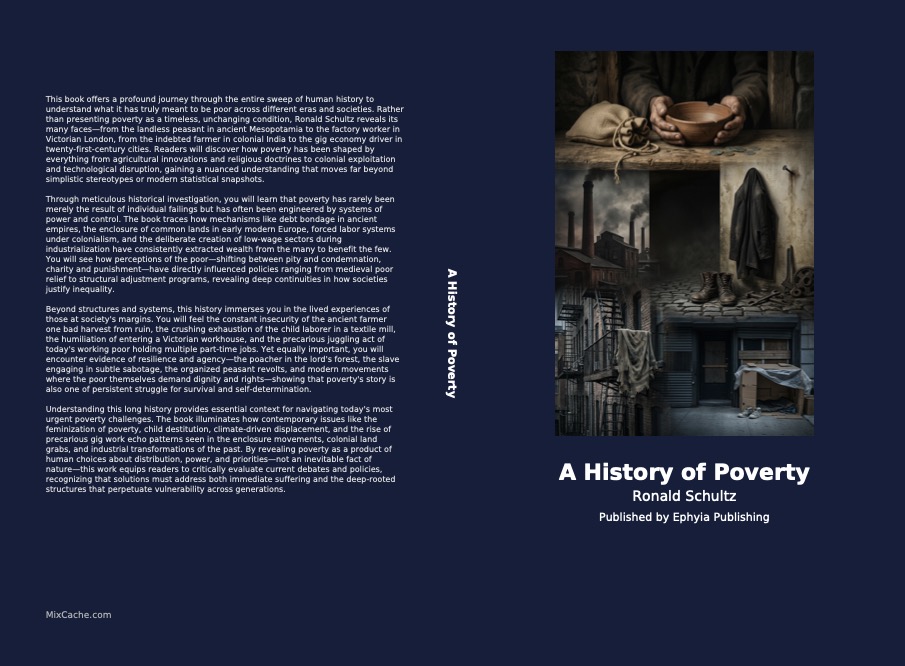
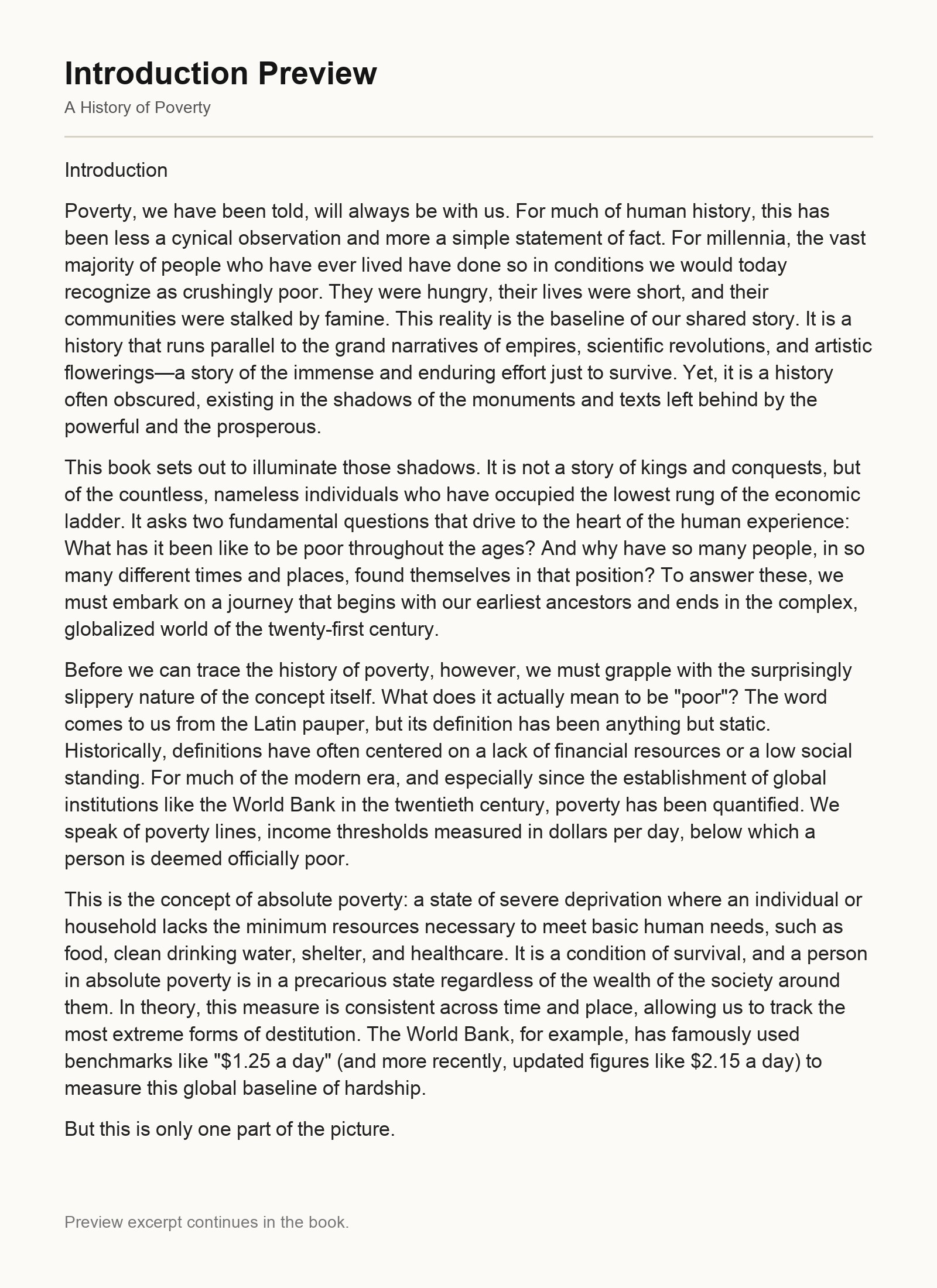
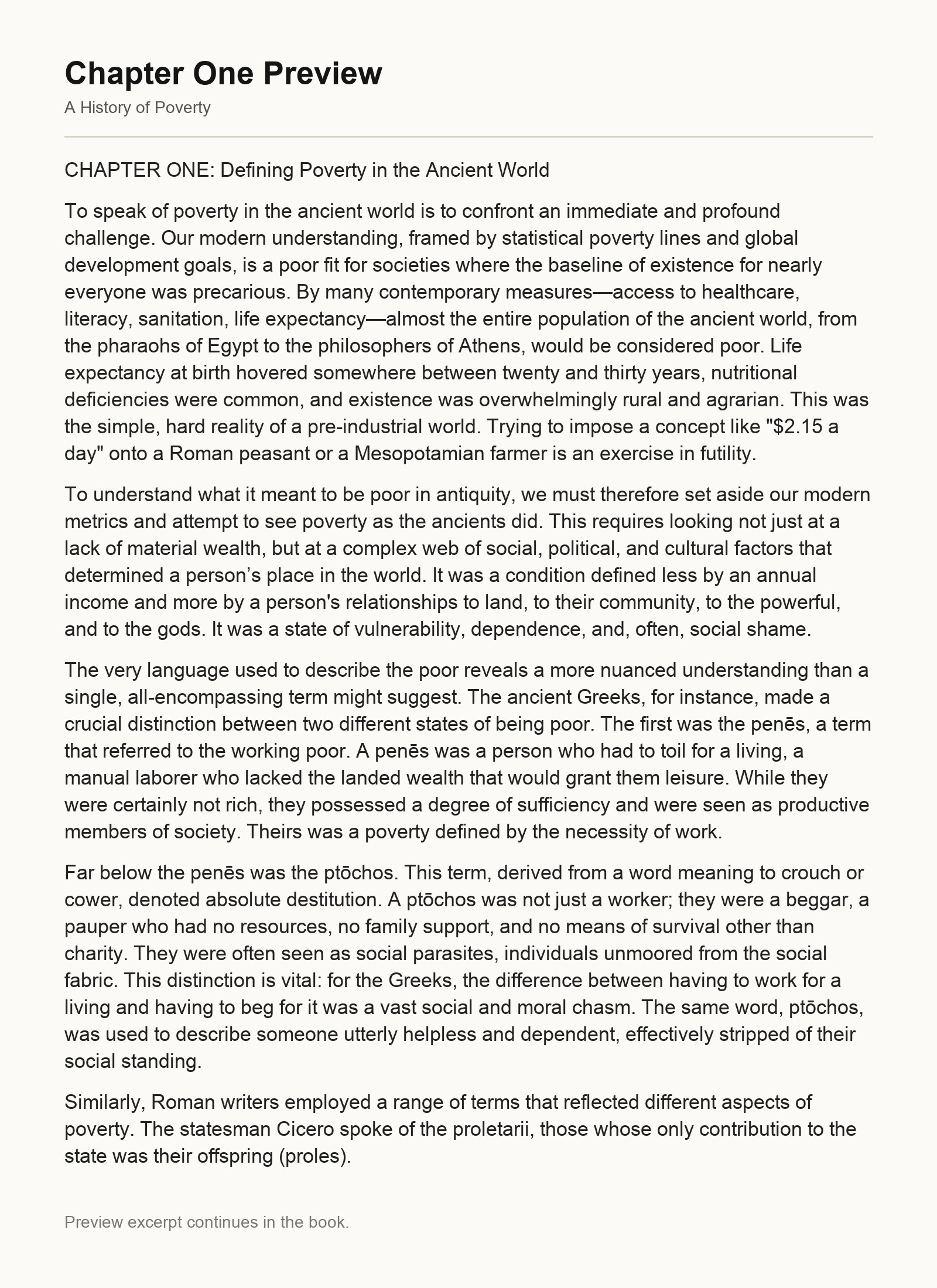
This book offers a profound journey through the entire sweep of human history to understand what it has truly meant to be poor across different eras and societies. Rather than presenting poverty as a timeless, unchanging condition, Ronald Schultz reveals its many faces—from the landless peasant in ancient Mesopotamia to the factory worker in Victorian London, from the indebted farmer in colonial India to the gig economy driver in twenty-first-century cities. Readers will discover how poverty has been shaped by everything from agricultural innovations and religious doctrines to colonial exploitation and technological disruption, gaining a nuanced understanding that moves far beyond simplistic stereotypes or modern statistical snapshots.
Through meticulous historical investigation, you will learn that poverty has rarely been merely the result of individual failings but has often been engineered by systems of power and control. The book traces how mechanisms like debt bondage in ancient empires, the enclosure of common lands in early modern Europe, forced labor systems under colonialism, and the deliberate creation of low-wage sectors during industrialization have consistently extracted wealth from the many to benefit the few. You will see how perceptions of the poor—shifting between pity and condemnation, charity and punishment—have directly influenced policies ranging from medieval poor relief to structural adjustment programs, revealing deep continuities in how societies justify inequality.
Beyond structures and systems, this history immerses you in the lived experiences of those at society's margins. You will feel the constant insecurity of the ancient farmer one bad harvest from ruin, the crushing exhaustion of the child laborer in a textile mill, the humiliation of entering a Victorian workhouse, and the precarious juggling act of today's working poor holding multiple part-time jobs. Yet equally important, you will encounter evidence of resilience and agency—the poacher in the lord's forest, the slave engaging in subtle sabotage, the organized peasant revolts, and modern movements where the poor themselves demand dignity and rights—showing that poverty's story is also one of persistent struggle for survival and self-determination.
Understanding this long history provides essential context for navigating today's most urgent poverty challenges. The book illuminates how contemporary issues like the feminization of poverty, child destitution, climate-driven displacement, and the rise of precarious gig work echo patterns seen in the enclosure movements, colonial land grabs, and industrial transformations of the past. By revealing poverty as a product of human choices about distribution, power, and priorities—not an inevitable fact of nature—this work equips readers to critically evaluate current debates and policies, recognizing that solutions must address both immediate suffering and the deep-rooted structures that perpetuate vulnerability across generations.
What You'll Find Inside:
- The historical evolution of poverty concepts from absolute deprivation in ancient societies to modern multidimensional measures that consider health, education, and living standards
- How the agricultural revolution and land ownership systems created the foundational inequalities that led to systemic poverty and the emergence of landless laboring classes
- The recurring role of debt, bondage, and exploitative labor systems as mechanisms for creating and perpetuating poverty across different historical eras and civilizations
- How colonialism, imperialism, and globalization structured global economic disparities by extracting wealth from peripheral regions to benefit imperial cores
- Contemporary approaches to measuring poverty and the ongoing struggle to develop effective anti-poverty policies that address both structural causes and lived experiences of the poor
Who's It For:
This book is essential reading for students and scholars of history, economics, sociology, and development studies who seek to understand poverty's deep historical roots. It will also benefit policymakers, NGO workers, and social justice advocates looking for historical context to inform contemporary poverty alleviation strategies. General readers interested in the origins of today's economic inequalities and the human experience of poverty across time will find this comprehensive analysis both enlightening and relevant.
Table of Contents:
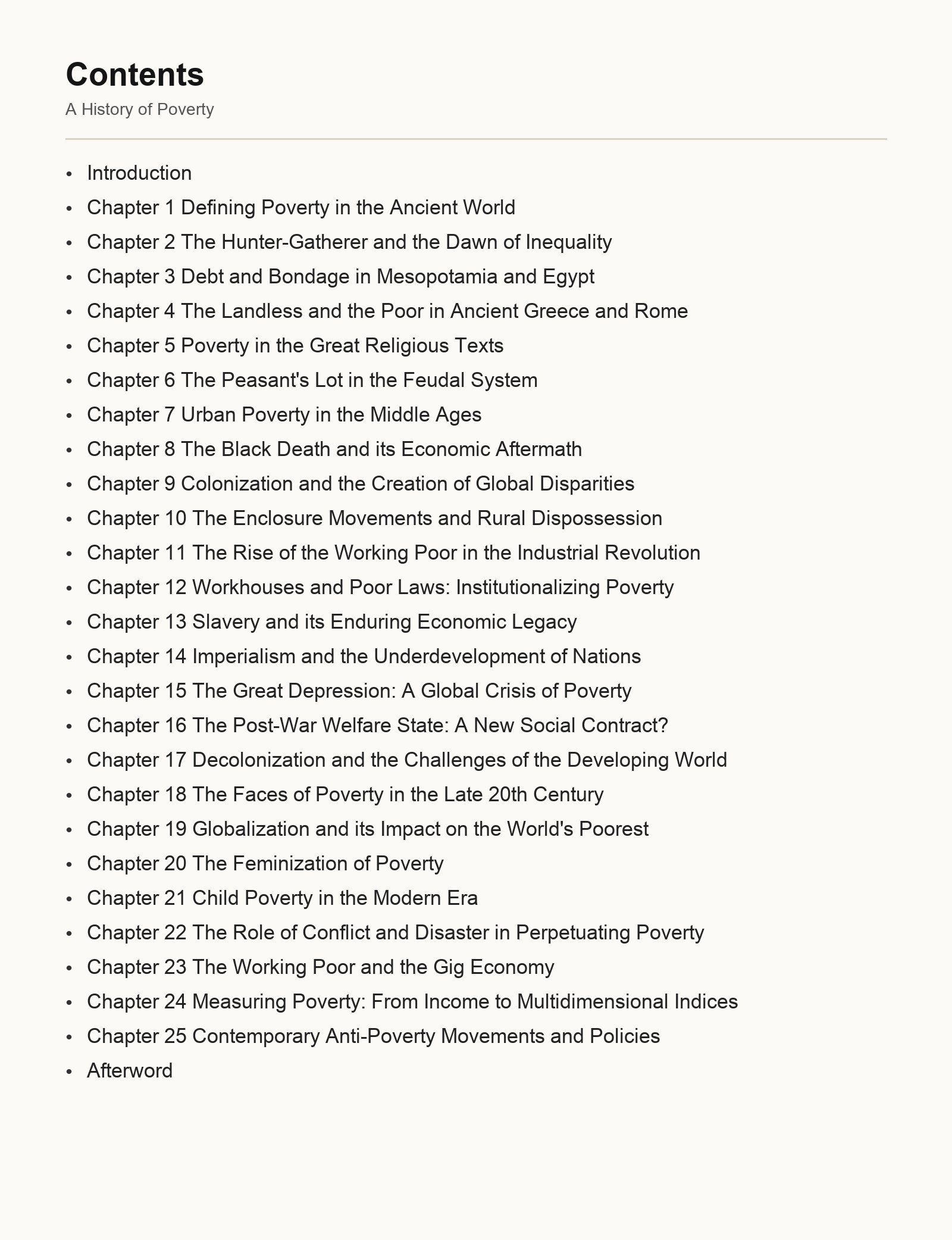
- Introduction
- Chapter 1 Defining Poverty in the Ancient World
- Chapter 2 The Hunter-Gatherer and the Dawn of Inequality
- Chapter 3 Debt and Bondage in Mesopotamia and Egypt
- Chapter 4 The Landless and the Poor in Ancient Greece and Rome
- Chapter 5 Poverty in the Great Religious Texts
- Chapter 6 The Peasant's Lot in the Feudal System
- Chapter 7 Urban Poverty in the Middle Ages
- Chapter 8 The Black Death and its Economic Aftermath
- Chapter 9 Colonization and the Creation of Global Disparities
- Chapter 10 The Enclosure Movements and Rural Dispossession
- Chapter 11 The Rise of the Working Poor in the Industrial Revolution
- Chapter 12 Workhouses and Poor Laws: Institutionalizing Poverty
- Chapter 13 Slavery and its Enduring Economic Legacy
- Chapter 14 Imperialism and the Underdevelopment of Nations
- Chapter 15 The Great Depression: A Global Crisis of Poverty
- Chapter 16 The Post-War Welfare State: A New Social Contract?
- Chapter 17 Decolonization and the Challenges of the Developing World
- Chapter 18 The Faces of Poverty in the Late 20th Century
- Chapter 19 Globalization and its Impact on the World's Poorest
- Chapter 20 The Feminization of Poverty
- Chapter 21 Child Poverty in the Modern Era
- Chapter 22 The Role of Conflict and Disaster in Perpetuating Poverty
- Chapter 23 The Working Poor and the Gig Economy
- Chapter 24 Measuring Poverty: From Income to Multidimensional Indices
- Chapter 25 Contemporary Anti-Poverty Movements and Policies
- Afterword
Author:
Published By:
Date Published:
May 25, 2026
Type:
Nonfiction
Language:
English
Also Available In:
Spanish, French, Italian, Portuguese
Word Count:
54,251 words
Reading Time:
3 hours 48 minutes
Sample:
Order:
Buy the A History of Poverty ebook on MixCache.com:
Buy NowThe full ebook will be available immediately to read instantly on any device.
$5 account credit for all new MixCache.com accounts, usable toward any ebook purchase!*




Ratings & Reviews
Ask Questions About This Book
Have a question about the content? Ask our AI assistant!
Start by asking a question about "A History of Poverty"
Example: "Does this book mention William Shakespeare?"
Thinking...