
Browse by Category
Fiction
- Action & Adventure
- African American
- Anthologies
- Children's Fiction
- Classics
- Comics & Graphic Novels
- Coming of Age
- Contemporary
- Cultural & Regional
- Drama
- Erotica
- Fantasy
- General
- Historical Fiction
- Horror
- Humor & Satire
- Literary Fiction
- Mystery, Thriller & Suspense
- Poetry
- Religious & Inspirational
- Romance
- Science Fiction
- Short Stories
- War & Military
- Westerns
- Women's Fiction
- Young Adult
Non-Fiction
- Antiques & Collectibles
- Arts & Photography
- Biographies & Memoirs
- Business & Money
- Children's Non-Fiction
-
Computers & Technology
- Artificial Intelligence
- Computer Science
- Cybersecurity & Cryptography
- Data Science & Analytics
- Databases & Big Data
- Game Development & Design
- General
- Hardware & DIY
- Mobile App Development
- Networking & Cloud Computing
- Operating Systems
- Programming
- Robotics
- Software
- Software Engineering
- User Experience (UX) & Design
- Web Development & Design
- Cooking, Food & Wine
- Crafts, Hobbies & Home
- Education & Teaching
- Engineering
- General
- Health, Fitness & Dieting
-
History
- African History
- African History - North Africa
- African History - Sub-Saharan Africa
- American History
- American History - 20th Century
- American History - Civil War
- American History - Colonial Period
- Ancient History
- Asian History
- Asian History - China
- Asian History - India
- Asian History - Japan
- Asian History - Southeast Asia
- European History
- European History - Ancient Greece
- European History - Ancient Rome
- European History - Medieval
- European History - Modern
- European History - Renaissance
- General
- Middle Eastern History
- Military History
- Military History - Aviation
- Military History - Naval
- Social & Cultural History
- World History
- Humor & Entertainment
- Industrial Technology
- Language Learning
- Law
- LGBTQ+ Non-Fiction
- Literary Criticism
- Medical Books
- Parenting & Relationships
- Philosophy
- Politics & Social Sciences
- Reference
- Religion & Spirituality
-
Science & Math
- Agricultural Sciences
- Astronomy & Space Science
- Behavioral Sciences
- Biological Sciences
- Botany & Plant Science
- Chemistry
- Earth Sciences
- Engineering - Chemical
- Engineering - Civil
- Engineering - Electrical
- Engineering - Mechanical
- Environment
- General
- Geology
- Mathematics
- Nature & Ecology
- Oceanography
- Paleontology
- Physics
- Statistics
- Self-Help
- Sports & Outdoors
- Study Aids
- Sustainability & Green Living
- Textbooks
- Transportation
- Travel
- True Crime
- Urban Planning & Development
- Veterinary Medicine
- Writing & Publishing
Jump to Section
MixCache.com Total Access
Unlimited reading and audiobooks for every book published by MixCache.com.
Included titles carry the MTA badge.
Learn more →A History of Social Media
About this book:

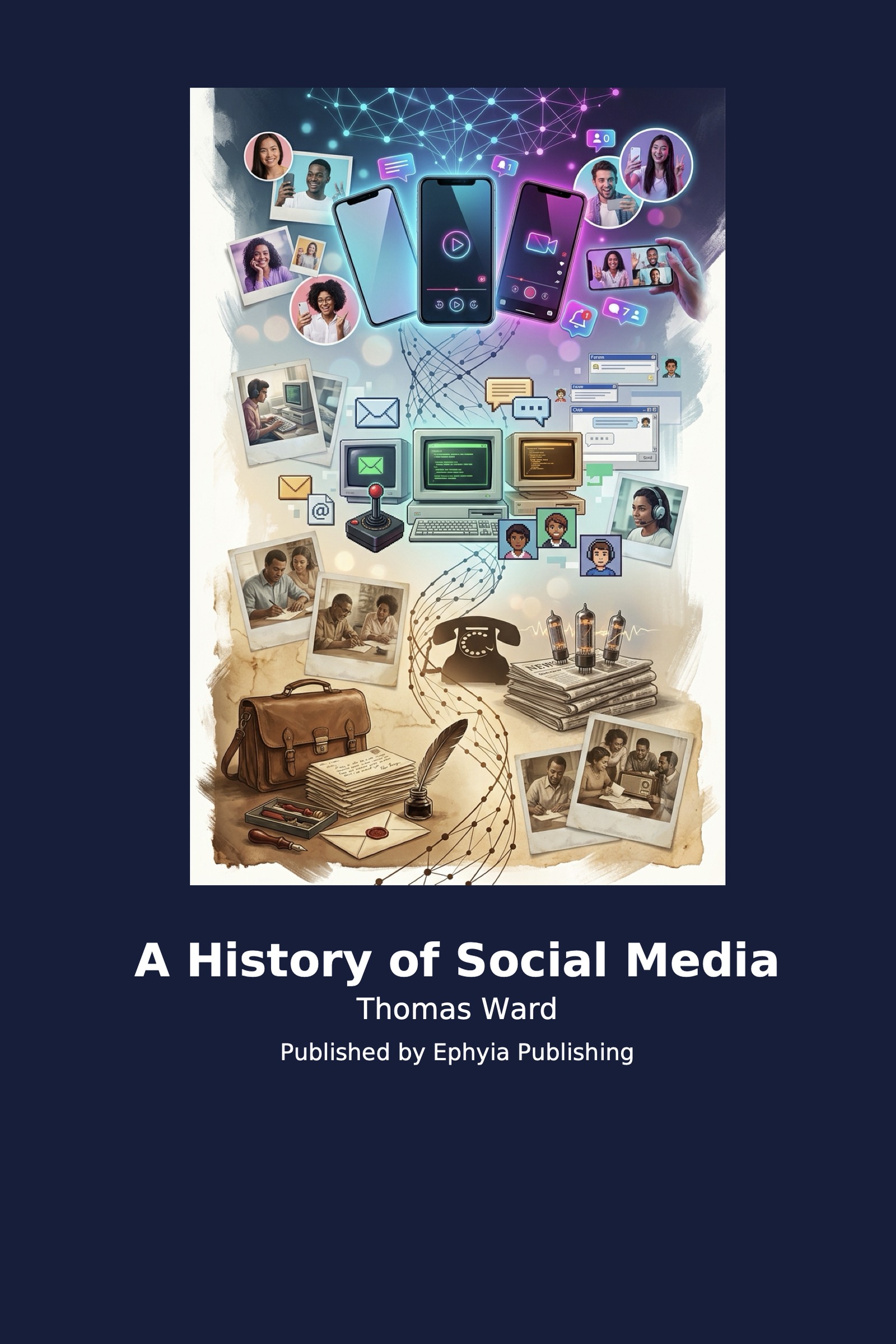
A History of Social Media takes readers on a comprehensive journey from the earliest analog gatherings in coffeehouses and salons to the cutting‑edge algorithms and immersive worlds shaping today’s digital experience. By tracing the evolution of communication—from handwritten letters and bulletin board systems to the rise of SixDegrees, Friendster, MySpace, and Facebook—you’ll discover how each innovation built upon the last to transform the way we connect, share, and perceive ourselves online.
The book delves into the cultural phenomena that defined each era: the customization frenzy of MySpace, the real‑time pulse of Twitter and the power of the hashtag, the visual storytelling of Instagram and Pinterest, the fleeting authenticity of Snapchat, and the video‑first revolution of YouTube and TikTok. You’ll learn how platforms like LinkedIn professionalized networking, how niche communities found their tribes on Twitch, Goodreads, and Nextdoor, and how messaging apps created a private side of social life that now rivals public feeds in importance.
Beyond the timelines and feature lists, the work examines the profound societal impacts of these tools. Chapters on politics reveal how social media has mobilized movements from Obama’s campaign to the Arab Spring and Black Lives Matter, while sections on misinformation, polarization, and mental health unpack the darker side of constant connectivity. The privacy paradox and data surveillance are explored in depth, showing how user information became the currency of the attention economy and the foundation of surveillance capitalism.
Readers will also gain insight into the business and regulatory battles that shaped the industry: the platform wars that saw Facebook acquire Instagram and WhatsApp, the rise of TikTok’s algorithmic tsunami, and the ongoing antitrust scrutiny of tech giants. The creator economy is laid bare, illustrating how influencers, streamers, and digital entrepreneurs turned passion into profession and reshaped advertising, entertainment, and commerce.
Finally, the book looks ahead to the future of social connection, weighing the promises and perils of the metaverse, augmented reality, AI‑generated content, and decentralized Web3 visions. By the end, you’ll not only understand how we arrived at today’s hyper‑connected world but also be equipped to think critically about where these technologies might lead us next—and what it means to be human in an age where every interaction can leave a digital trace.
What You'll Find Inside:
- The evolution from analog to digital social networks: How coffeehouses, salons, and early bulletin board systems laid the groundwork for modern social media platforms.
- The algorithmic revolution: How Facebook's News Feed and similar algorithms transformed social media from chronological feeds to personalized content curation, fundamentally changing how we consume information.
- The rise of visual and ephemeral content: From Instagram's photo-focused platform to Snapchat's disappearing messages and TikTok's short-form video, showing how visual communication reshaped social interaction.
- Social media's dual impact on society: How these platforms have enabled global movements and political mobilization while also amplifying misinformation, polarization, and mental health challenges.
- The business and cultural transformations: The emergence of the influencer economy, creator economy, platform wars, and ongoing debates about privacy, data surveillance, and the future of social media in the metaverse and beyond.
Who's It For:
This book is ideal for students and researchers in media studies, communications, sociology, or history who seek a comprehensive understanding of social media's development. It will also benefit professionals in marketing, tech, and policy-making roles who need to grasp the societal implications and business dynamics of social platforms. General readers interested in how the apps they use daily have shaped modern culture, politics, and human behavior will find this narrative both informative and engaging.
Table of Contents:
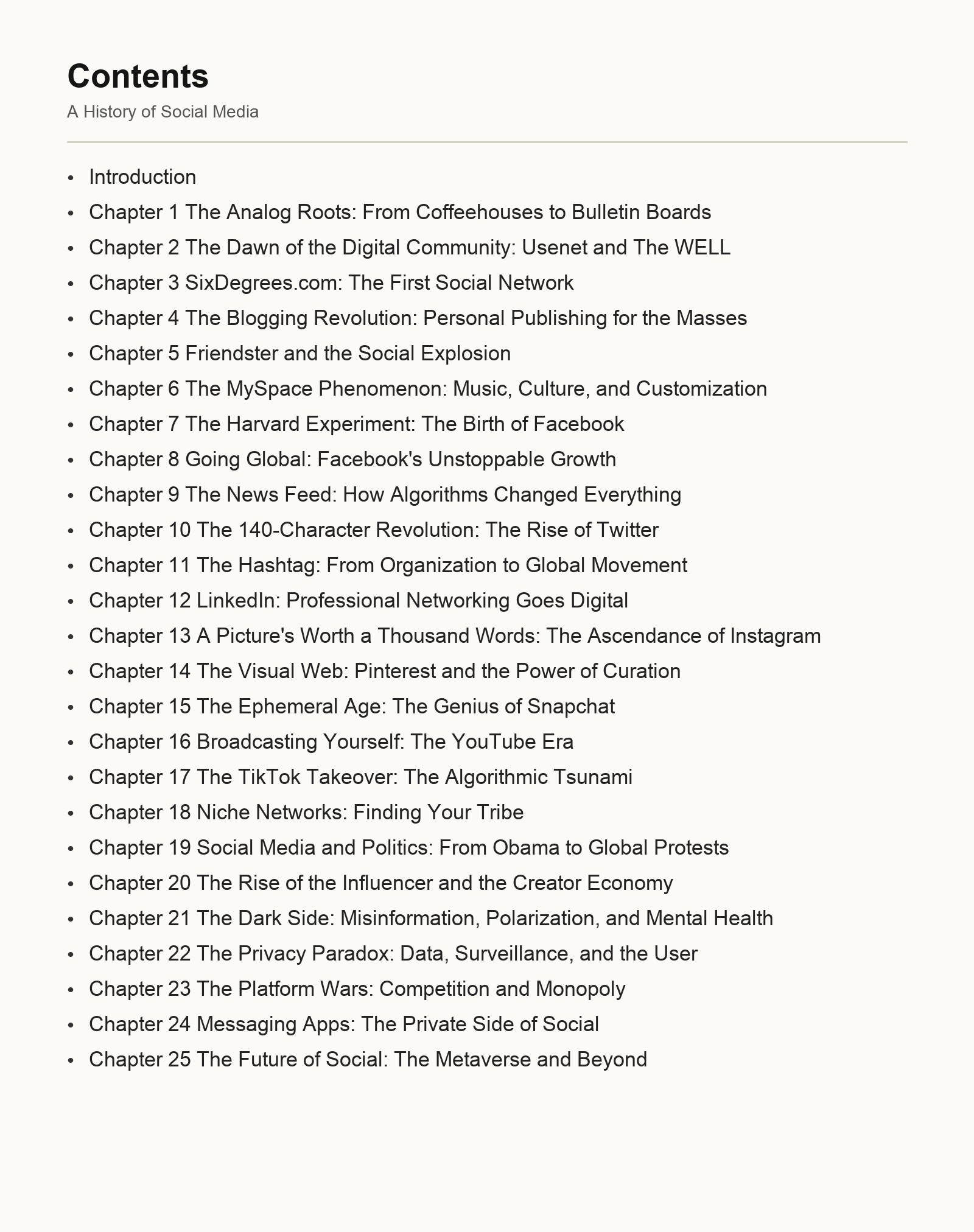
- Introduction
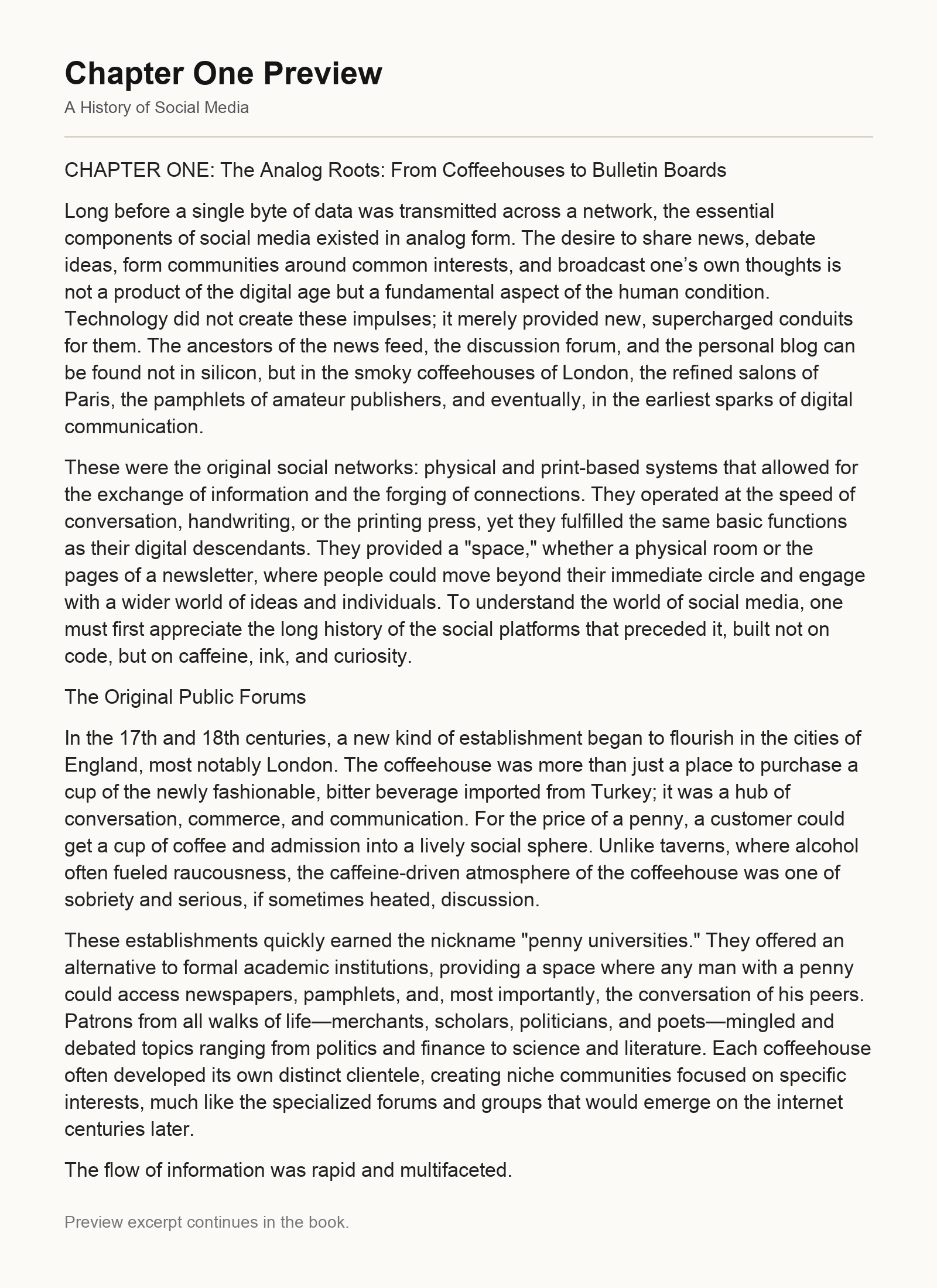
- Chapter 1 The Analog Roots: From Coffeehouses to Bulletin Boards
- Chapter 2 The Dawn of the Digital Community: Usenet and The WELL
- Chapter 3 SixDegrees.com: The First Social Network
- Chapter 4 The Blogging Revolution: Personal Publishing for the Masses
- Chapter 5 Friendster and the Social Explosion
- Chapter 6 The MySpace Phenomenon: Music, Culture, and Customization
- Chapter 7 The Harvard Experiment: The Birth of Facebook
- Chapter 8 Going Global: Facebook's Unstoppable Growth
- Chapter 9 The News Feed: How Algorithms Changed Everything
- Chapter 10 The 140-Character Revolution: The Rise of Twitter
- Chapter 11 The Hashtag: From Organization to Global Movement
- Chapter 12 LinkedIn: Professional Networking Goes Digital
- Chapter 13 A Picture's Worth a Thousand Words: The Ascendance of Instagram
- Chapter 14 The Visual Web: Pinterest and the Power of Curation
- Chapter 15 The Ephemeral Age: The Genius of Snapchat
- Chapter 16 Broadcasting Yourself: The YouTube Era
- Chapter 17 The TikTok Takeover: The Algorithmic Tsunami
- Chapter 18 Niche Networks: Finding Your Tribe
- Chapter 19 Social Media and Politics: From Obama to Global Protests
- Chapter 20 The Rise of the Influencer and the Creator Economy
- Chapter 21 The Dark Side: Misinformation, Polarization, and Mental Health
- Chapter 22 The Privacy Paradox: Data, Surveillance, and the User
- Chapter 23 The Platform Wars: Competition and Monopoly
- Chapter 24 Messaging Apps: The Private Side of Social
- Chapter 25 The Future of Social: The Metaverse and Beyond
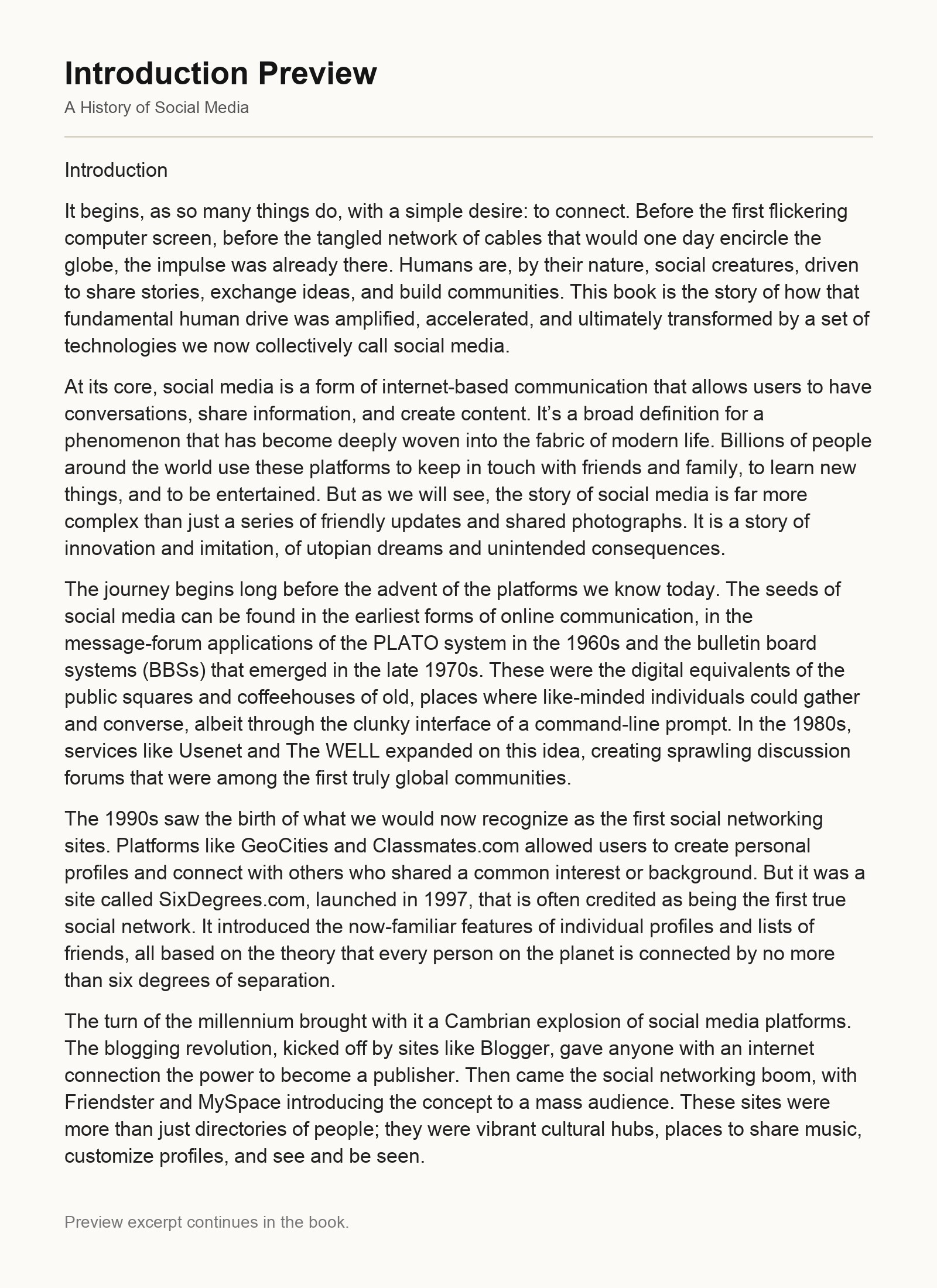
It begins, as so many things do, with a simple desire: to connect. Before the first flickering computer screen, before the tangled network of cables that would one day encircle the globe, the impulse was already there. Humans are, by their nature, social creatures, driven to share stories, exchange ideas, and build communities. This book is the story of how that fundamental human drive was amplified, accelerated, and ultimately transformed by a set of technologies we now collectively call social media.
At its core, social media is a form of internet-based communication that allows users to have conversations, share information, and create content. It’s a broad definition for a phenomenon that has become deeply woven into the fabric of modern life. Billions of people around the world use these platforms to keep in touch with friends and family, to learn new things, and to be entertained. But as we will see, the story of social media is far more complex than just a series of friendly updates and shared photographs. It is a story of innovation and imitation, of utopian dreams and unintended consequences.
The journey begins long before the advent of the platforms we know today. The seeds of social media can be found in the earliest forms of online communication, in the message-forum applications of the PLATO system in the 1960s and the bulletin board systems (BBSs) that emerged in the late 1970s. These were the digital equivalents of the public squares and coffeehouses of old, places where like-minded individuals could gather and converse, albeit through the clunky interface of a command-line prompt. In the 1980s, services like Usenet and The WELL expanded on this idea, creating sprawling discussion forums that were among the first truly global communities.
The 1990s saw the birth of what we would now recognize as the first social networking sites. Platforms like GeoCities and Classmates.com allowed users to create personal profiles and connect with others who shared a common interest or background. But it was a site called SixDegrees.com, launched in 1997, that is often credited as being the first true social network. It introduced the now-familiar features of individual profiles and lists of friends, all based on the theory that every person on the planet is connected by no more than six degrees of separation.
The turn of the millennium brought with it a Cambrian explosion of social media platforms. The blogging revolution, kicked off by sites like Blogger, gave anyone with an internet connection the power to become a publisher. Then came the social networking boom, with Friendster and MySpace introducing the concept to a mass audience. These sites were more than just directories of people; they were vibrant cultural hubs, places to share music, customize profiles, and see and be seen.
Of course, no history of social media would be complete without a thorough examination of Facebook. What began as a campus-specific directory at Harvard University in 2004 would go on to become a global behemoth, connecting billions of people and fundamentally reshaping the internet in its image. We will trace its meteoric rise, from its exclusive beginnings to its current status as one of the most powerful companies in the world. We will also delve into the innovations that cemented its dominance, most notably the introduction of the News Feed, an algorithmic firehose of content that would forever change the way we consume information.
But the story of social media is not the story of a single platform. The 2000s and 2010s saw the emergence of a diverse ecosystem of services, each with its own unique culture and purpose. Twitter, with its 140-character limit, became the world’s real-time news ticker and a powerful tool for citizen journalism and social movements. LinkedIn professionalized the social network, creating a space for career development and industry connections. The rise of the smartphone, in turn, fueled the visual web, with platforms like Instagram and Pinterest making it easier than ever to share our lives through images. Snapchat introduced the concept of ephemeral messaging, a fleeting and playful form of communication that captured the imagination of a younger generation. And then there was YouTube, a platform that democratized video, giving rise to a new generation of creators and forever changing the landscape of entertainment. More recently, the algorithmic sophistication of TikTok has created a new paradigm for content discovery, one that has been both celebrated for its creativity and scrutinized for its potential societal impacts.
As social media has grown in scale and influence, so too has its impact on the world. These platforms have become integral to political discourse, from the election of presidents to the organization of global protests. They have given rise to the influencer and the creator economy, new career paths that were unimaginable just a few decades ago. But the rise of social media has not been without its dark side. We will explore the challenges of misinformation and polarization, the mental health implications of a constantly connected world, and the ongoing debate over privacy in an age of data surveillance. We will also examine the competitive landscape of the platform wars, the private side of social interaction on messaging apps, and what the future may hold, from the much-hyped metaverse to technologies yet to be invented.
This book is not just a chronological account of websites and apps. It is an exploration of how technology and human nature have co-evolved, each shaping and being shaped by the other. It is a story with no clear heroes or villains, but rather a complex cast of characters—innovators, entrepreneurs, users, and regulators—all grappling with the profound changes that social media has wrought. And it is a story that is still being written, with each new post, each new platform, and each new connection adding another chapter to this ever-unfolding history.
Author:
Published By:
Date Published:
May 24, 2026
Type:
Nonfiction
Language:
English
Also Available In:
Word Count:
45,539 words
Reading Time:
3 hours 11 minutes
Sample:
Order:
Buy the A History of Social Media ebook on MixCache.com:
Buy NowThe full ebook will be available immediately to read instantly on any device.
$5 account credit for all new MixCache.com accounts, usable toward any ebook purchase!*





 Includes Audiobook
Ratings & Reviews
Ask Questions About This Book
Have a question about the content? Ask our AI assistant!
Start by asking a question about "A History of Social Media"
Example: "Does this book mention William Shakespeare?"
Thinking...