Browse by Category
Fiction
- Action & Adventure
- African American
- Anthologies
- Children's Fiction
- Classics
- Comics & Graphic Novels
- Coming of Age
- Contemporary
- Cultural & Regional
- Drama
- Erotica
- Fantasy
- General
- Historical Fiction
- Horror
- Humor & Satire
- Literary Fiction
- Mystery, Thriller & Suspense
- Poetry
- Religious & Inspirational
- Romance
- Science Fiction
- Short Stories
- War & Military
- Westerns
- Women's Fiction
- Young Adult
Non-Fiction
- Antiques & Collectibles
- Arts & Photography
- Biographies & Memoirs
- Business & Money
- Children's Non-Fiction
-
Computers & Technology
- Artificial Intelligence
- Computer Science
- Cybersecurity & Cryptography
- Data Science & Analytics
- Databases & Big Data
- Game Development & Design
- General
- Hardware & DIY
- Mobile App Development
- Networking & Cloud Computing
- Operating Systems
- Programming
- Robotics
- Software
- Software Engineering
- User Experience (UX) & Design
- Web Development & Design
- Cooking, Food & Wine
- Crafts, Hobbies & Home
- Education & Teaching
- Engineering
- General
- Health, Fitness & Dieting
-
History
- African History
- African History - North Africa
- African History - Sub-Saharan Africa
- American History
- American History - 20th Century
- American History - Civil War
- American History - Colonial Period
- Ancient History
- Asian History
- Asian History - China
- Asian History - India
- Asian History - Japan
- Asian History - Southeast Asia
- European History
- European History - Ancient Greece
- European History - Ancient Rome
- European History - Medieval
- European History - Modern
- European History - Renaissance
- General
- Middle Eastern History
- Military History
- Military History - Aviation
- Military History - Naval
- Social & Cultural History
- World History
- Humor & Entertainment
- Industrial Technology
- Language Learning
- Law
- LGBTQ+ Non-Fiction
- Literary Criticism
- Medical Books
- Parenting & Relationships
- Philosophy
- Politics & Social Sciences
- Reference
- Religion & Spirituality
-
Science & Math
- Agricultural Sciences
- Astronomy & Space Science
- Behavioral Sciences
- Biological Sciences
- Botany & Plant Science
- Chemistry
- Earth Sciences
- Engineering - Chemical
- Engineering - Civil
- Engineering - Electrical
- Engineering - Mechanical
- Environment
- General
- Geology
- Mathematics
- Nature & Ecology
- Oceanography
- Paleontology
- Physics
- Statistics
- Self-Help
- Sports & Outdoors
- Study Aids
- Sustainability & Green Living
- Textbooks
- Transportation
- Travel
- True Crime
- Urban Planning & Development
- Veterinary Medicine
- Writing & Publishing
Jump to Section
MixCache.com Total Access
Unlimited reading and audiobooks for every book published by MixCache.com.
Included titles carry the MTA badge.
Learn more →A History of Uruguay
About this book:


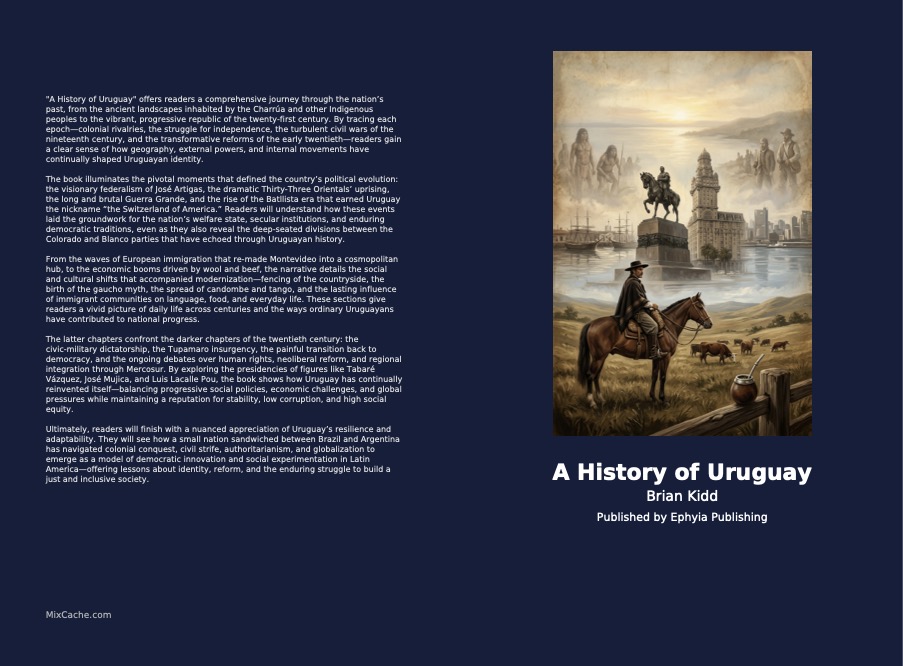
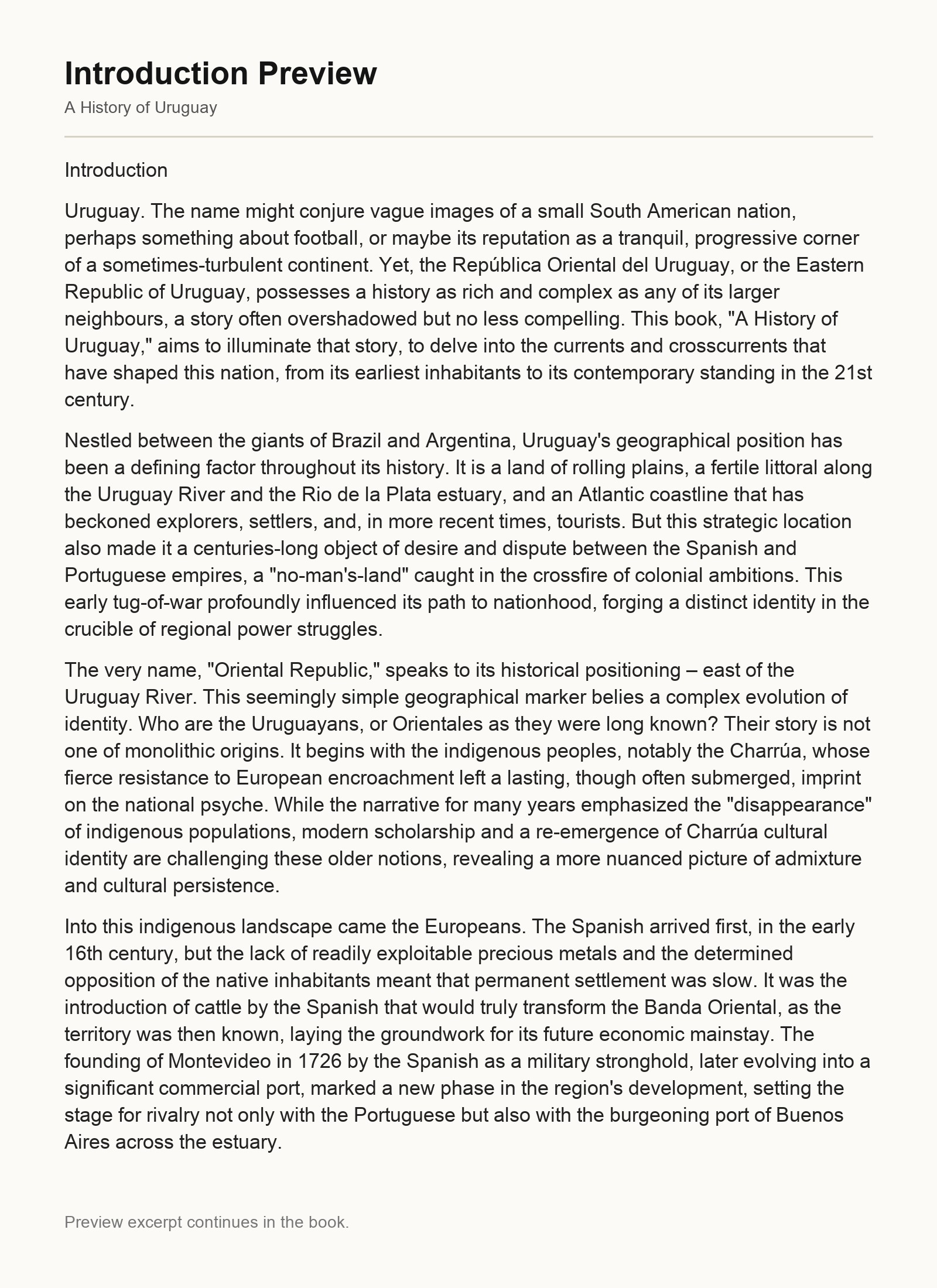
"A History of Uruguay" offers readers a comprehensive journey through the nation’s past, from the ancient landscapes inhabited by the Charrúa and other Indigenous peoples to the vibrant, progressive republic of the twenty‑first century. By tracing each epoch—colonial rivalries, the struggle for independence, the turbulent civil wars of the nineteenth century, and the transformative reforms of the early twentieth—readers gain a clear sense of how geography, external powers, and internal movements have continually shaped Uruguayan identity.
The book illuminates the pivotal moments that defined the country’s political evolution: the visionary federalism of José Artigas, the dramatic Thirty‑Three Orientals’ uprising, the long and brutal Guerra Grande, and the rise of the Batllista era that earned Uruguay the nickname “the Switzerland of America.” Readers will understand how these events laid the groundwork for the nation’s welfare state, secular institutions, and enduring democratic traditions, even as they also reveal the deep‑seated divisions between the Colorado and Blanco parties that have echoed through Uruguayan history.
From the waves of European immigration that re‑made Montevideo into a cosmopolitan hub, to the economic booms driven by wool and beef, the narrative details the social and cultural shifts that accompanied modernization—fencing of the countryside, the birth of the gaucho myth, the spread of candombe and tango, and the lasting influence of immigrant communities on language, food, and everyday life. These sections give readers a vivid picture of daily life across centuries and the ways ordinary Uruguayans have contributed to national progress.
The latter chapters confront the darker chapters of the twentieth century: the civic‑military dictatorship, the Tupamaro insurgency, the painful transition back to democracy, and the ongoing debates over human rights, neoliberal reform, and regional integration through Mercosur. By exploring the presidencies of figures like Tabaré Vázquez, José Mujica, and Luis Lacalle Pou, the book shows how Uruguay has continually reinvented itself—balancing progressive social policies, economic challenges, and global pressures while maintaining a reputation for stability, low corruption, and high social equity.
Ultimately, readers will finish with a nuanced appreciation of Uruguay’s resilience and adaptability. They will see how a small nation sandwiched between Brazil and Argentina has navigated colonial conquest, civil strife, authoritarianism, and globalization to emerge as a model of democratic innovation and social experimentation in Latin America—offering lessons about identity, reform, and the enduring struggle to build a just and inclusive society.
What You'll Find Inside:
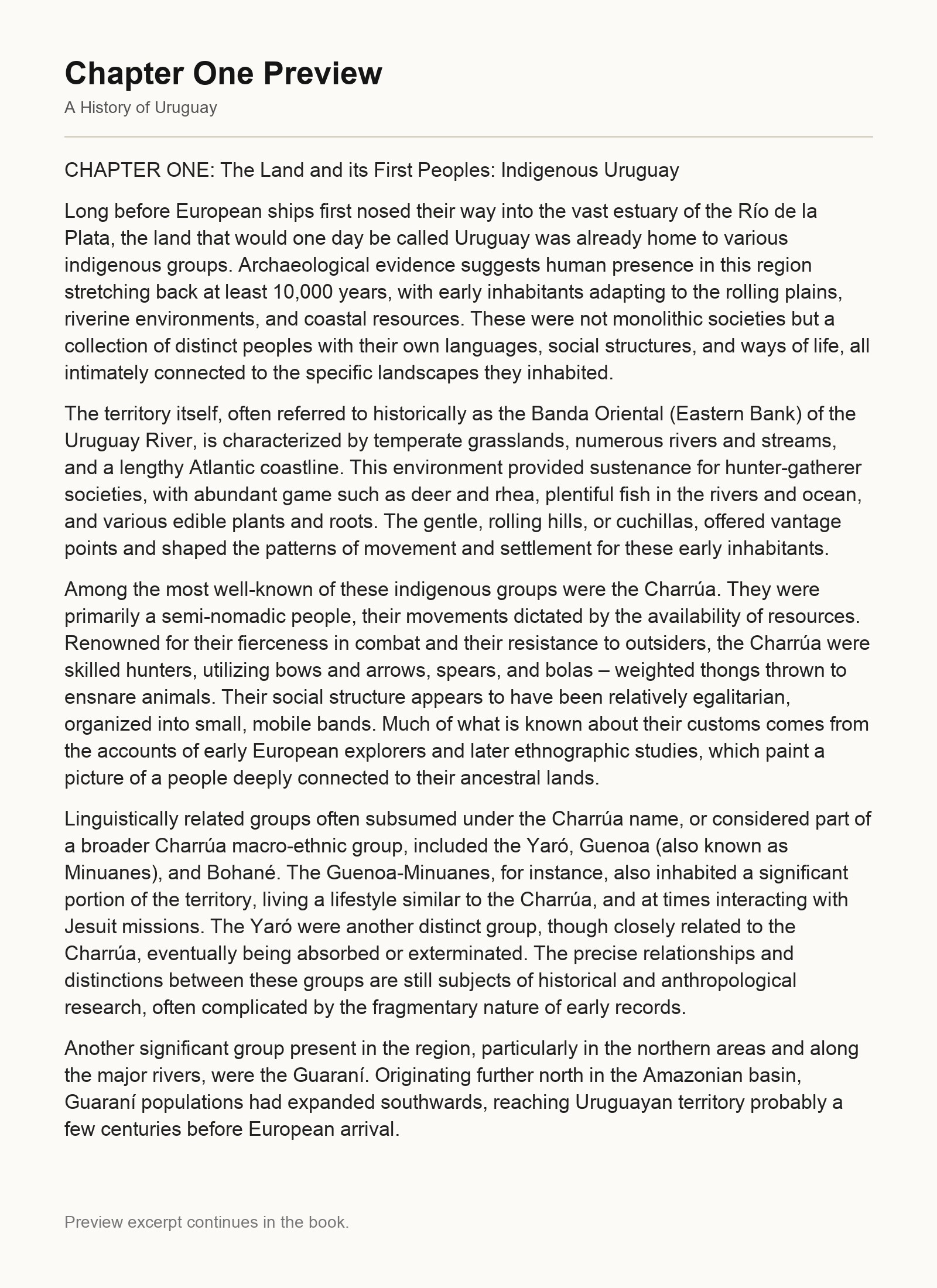
- Explores Uruguay's indigenous roots, detailing the Charrúa and other native groups' resistance, cultural persistence, and lasting influence on national identity despite historical narratives of disappearance.
- Chronicles the complex independence struggle featuring José Artigas's federalist ideals, the Thirty-Three Orientals' daring expedition, and Uruguay's emergence as an independent buffer state between Brazil and Argentina.
- Examines the early 20th-century Batllista era that implemented groundbreaking social reforms (women's suffrage, secularization, welfare state) earning Uruguay the 'Switzerland of America' moniker.
- Analyzes the 1973-1985 civic-military dictatorship's repression and Uruguay's peaceful transition to democracy through popular mobilization and the pivotal 1980 constitutional plebiscite.
- Traces Uruguay's 21st-century progressive trajectory under Frente Amplio governments, including marijuana legalization, same-sex marriage, and innovative social policies amid economic challenges.
Who's It For:
This comprehensive history is ideal for students, scholars, and general readers interested in Latin American studies, particularly those seeking to understand Uruguay's unique path of democratic development, social innovation, and resilience. It will benefit readers studying comparative politics, democratization processes, or the interplay between indigenous heritage and nation-building in the Americas. The book serves as both an accessible introduction to Uruguayan history and a detailed resource for researchers examining how small nations navigate regional power dynamics while maintaining progressive social policies.
Table of Contents:
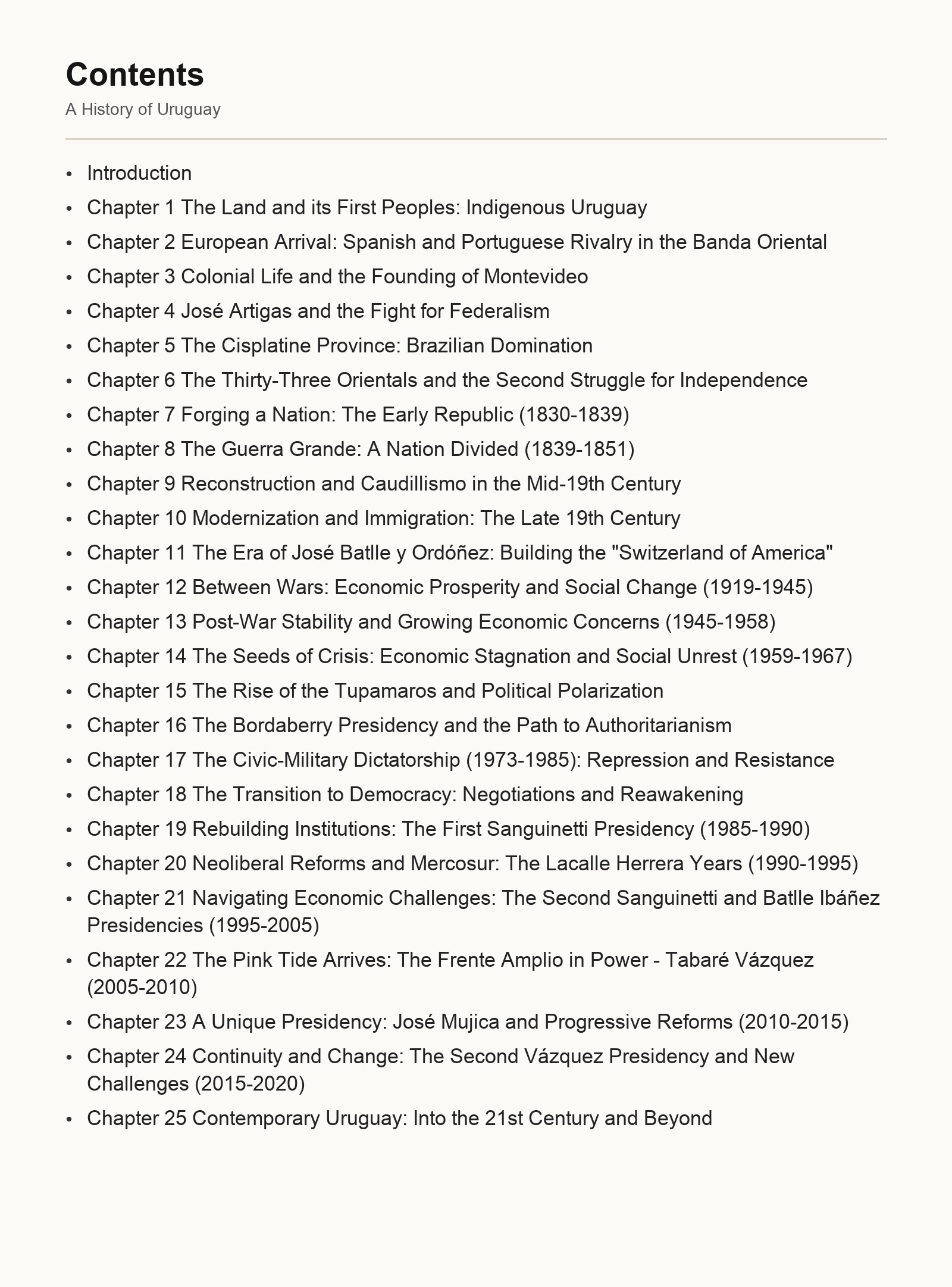
- Introduction
- Chapter 1 The Land and its First Peoples: Indigenous Uruguay
- Chapter 2 European Arrival: Spanish and Portuguese Rivalry in the Banda Oriental
- Chapter 3 Colonial Life and the Founding of Montevideo
- Chapter 4 José Artigas and the Fight for Federalism
- Chapter 5 The Cisplatine Province: Brazilian Domination
- Chapter 6 The Thirty-Three Orientals and the Second Struggle for Independence
- Chapter 7 Forging a Nation: The Early Republic (1830-1839)
- Chapter 8 The Guerra Grande: A Nation Divided (1839-1851)
- Chapter 9 Reconstruction and Caudillismo in the Mid-19th Century
- Chapter 10 Modernization and Immigration: The Late 19th Century
- Chapter 11 The Era of José Batlle y Ordóñez: Building the "Switzerland of America"
- Chapter 12 Between Wars: Economic Prosperity and Social Change (1919-1945)
- Chapter 13 Post-War Stability and Growing Economic Concerns (1945-1958)
- Chapter 14 The Seeds of Crisis: Economic Stagnation and Social Unrest (1959-1967)
- Chapter 15 The Rise of the Tupamaros and Political Polarization
- Chapter 16 The Bordaberry Presidency and the Path to Authoritarianism
- Chapter 17 The Civic-Military Dictatorship (1973-1985): Repression and Resistance
- Chapter 18 The Transition to Democracy: Negotiations and Reawakening
- Chapter 19 Rebuilding Institutions: The First Sanguinetti Presidency (1985-1990)
- Chapter 20 Neoliberal Reforms and Mercosur: The Lacalle Herrera Years (1990-1995)
- Chapter 21 Navigating Economic Challenges: The Second Sanguinetti and Batlle Ibáñez Presidencies (1995-2005)
- Chapter 22 The Pink Tide Arrives: The Frente Amplio in Power - Tabaré Vázquez (2005-2010)
- Chapter 23 A Unique Presidency: José Mujica and Progressive Reforms (2010-2015)
- Chapter 24 Continuity and Change: The Second Vázquez Presidency and New Challenges (2015-2020)
- Chapter 25 Contemporary Uruguay: Into the 21st Century and Beyond
Author:
Published By:
Date Published:
May 24, 2026
Type:
Nonfiction
Language:
English
Also Available In:
Word Count:
43,686 words
Reading Time:
3 hours 4 minutes
Sample:
Order:
Order A History of Uruguay (Hardcover) on MixCache.com:
Buy NowPrint copy is made to order and ships worldwide. Includes the ebook free, ready to read instantly.
$5 account credit for all new MixCache.com accounts, usable toward any ebook purchase!*