
Browse by Category
Fiction
- Action & Adventure
- African American
- Anthologies
- Children's Fiction
- Classics
- Comics & Graphic Novels
- Coming of Age
- Contemporary
- Cultural & Regional
- Drama
- Erotica
- Fantasy
- General
- Historical Fiction
- Horror
- Humor & Satire
- Literary Fiction
- Mystery, Thriller & Suspense
- Poetry
- Religious & Inspirational
- Romance
- Science Fiction
- Short Stories
- War & Military
- Westerns
- Women's Fiction
- Young Adult
Non-Fiction
- Antiques & Collectibles
- Arts & Photography
- Biographies & Memoirs
- Business & Money
- Children's Non-Fiction
-
Computers & Technology
- Artificial Intelligence
- Computer Science
- Cybersecurity & Cryptography
- Data Science & Analytics
- Databases & Big Data
- Game Development & Design
- General
- Hardware & DIY
- Mobile App Development
- Networking & Cloud Computing
- Operating Systems
- Programming
- Robotics
- Software
- Software Engineering
- User Experience (UX) & Design
- Web Development & Design
- Cooking, Food & Wine
- Crafts, Hobbies & Home
- Education & Teaching
- Engineering
- General
- Health, Fitness & Dieting
-
History
- African History
- African History - North Africa
- African History - Sub-Saharan Africa
- American History
- American History - 20th Century
- American History - Civil War
- American History - Colonial Period
- Ancient History
- Asian History
- Asian History - China
- Asian History - India
- Asian History - Japan
- Asian History - Southeast Asia
- European History
- European History - Ancient Greece
- European History - Ancient Rome
- European History - Medieval
- European History - Modern
- European History - Renaissance
- General
- Middle Eastern History
- Military History
- Military History - Aviation
- Military History - Naval
- Social & Cultural History
- World History
- Humor & Entertainment
- Industrial Technology
- Language Learning
- Law
- LGBTQ+ Non-Fiction
- Literary Criticism
- Medical Books
- Parenting & Relationships
- Philosophy
- Politics & Social Sciences
- Reference
- Religion & Spirituality
-
Science & Math
- Agricultural Sciences
- Astronomy & Space Science
- Behavioral Sciences
- Biological Sciences
- Botany & Plant Science
- Chemistry
- Earth Sciences
- Engineering - Chemical
- Engineering - Civil
- Engineering - Electrical
- Engineering - Mechanical
- Environment
- General
- Geology
- Mathematics
- Nature & Ecology
- Oceanography
- Paleontology
- Physics
- Statistics
- Self-Help
- Sports & Outdoors
- Study Aids
- Sustainability & Green Living
- Textbooks
- Transportation
- Travel
- True Crime
- Urban Planning & Development
- Veterinary Medicine
- Writing & Publishing
Jump to Section
MixCache.com Total Access
Unlimited reading and audiobooks for every book published by MixCache.com.
Included titles carry the MTA badge.
Learn more →GITMO
About this book:

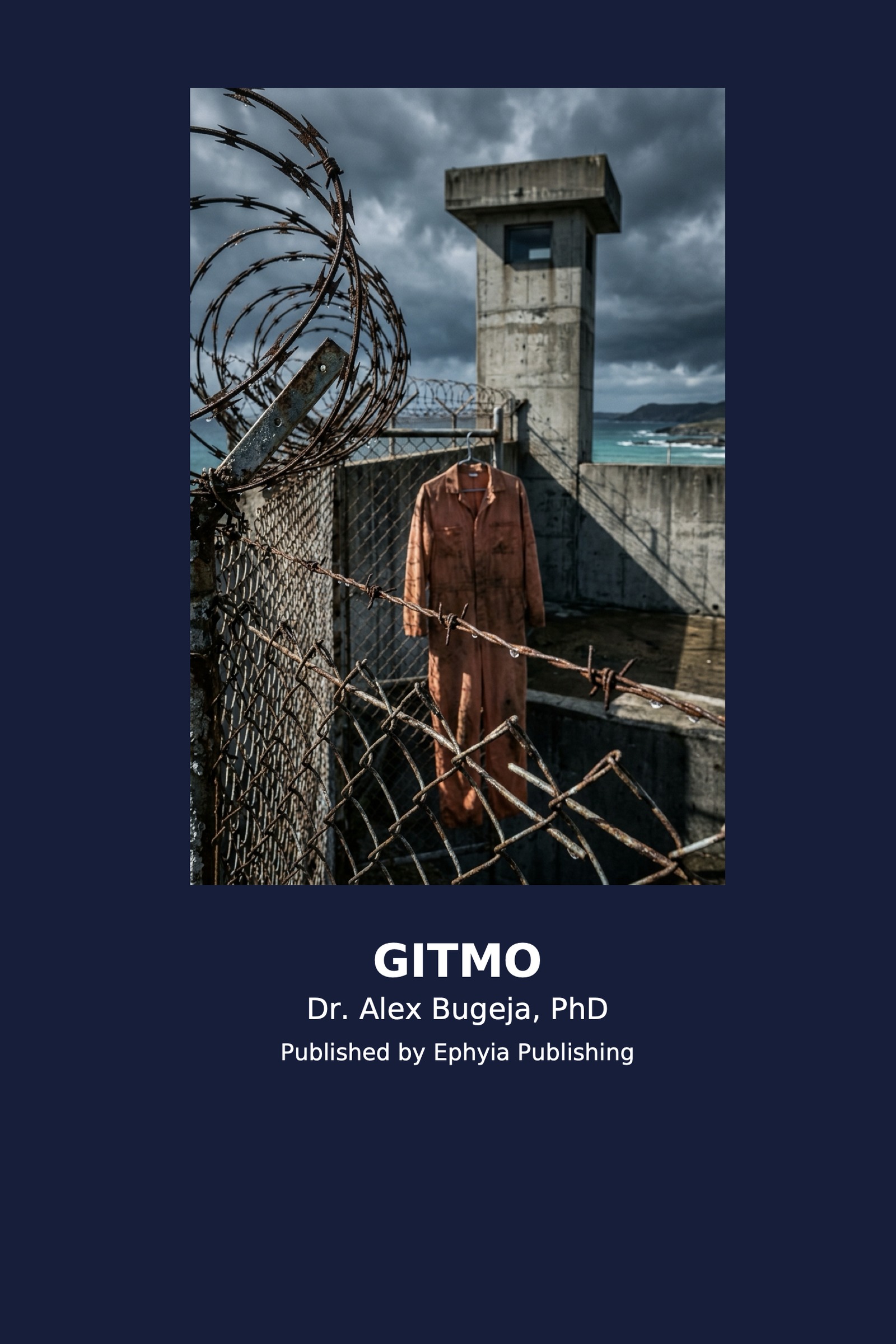
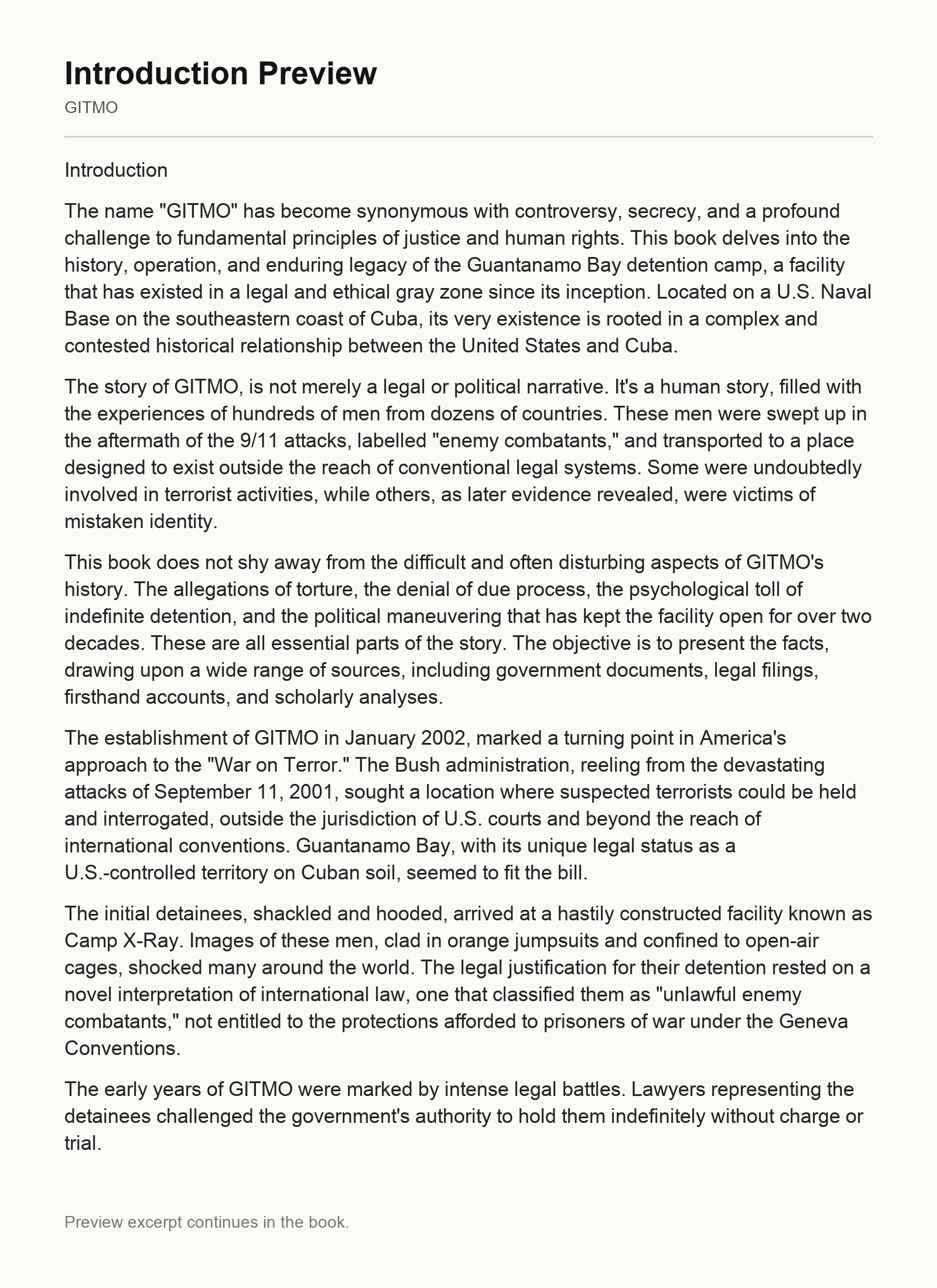
This book offers a comprehensive journey through the origins, operations, and lasting impact of the Guantanamo Bay detention camp, from its early strategic importance in Caribbean geopolitics to its role as a flashpoint in the post‑9/11 War on Terror. Readers will trace how a naval lease dating back to 1903 evolved into a controversial prison camp, exploring the legal justifications, political decisions, and military constructions that shaped its existence.
Through detailed chapters, the work examines the pivotal moments that defined GITMO’s trajectory: the establishment of Camp X‑Ray, the institutionalization of Camp Delta, the secretive high‑value detainee facility known as Camp 7, and the contested legal battles over habeas corpus that reached the Supreme Court in cases such as Rasul v. Bush, Hamdan v. Rumsfeld, and Boumediene v. Bush. Readers will gain insight into how each ruling redefined the balance between executive power, judicial review, and individual rights.
The narrative goes beyond legal documents to reveal the human experience inside the fence lines. Readers will learn about daily routines, interrogation techniques, hunger strikes, force‑feeding, medical care, and the psychological toll of indefinite detention, drawing on firsthand accounts from detainees, guards, medical personnel, and legal advocates. Personal stories like those of the Tipton Three and the allegations surrounding Camp No illuminate the real‑world consequences of policy decisions.
By presenting a wide array of sources—government memos, declassified records, international reports, and scholarly studies such as the Denbeaux analyses—the book enables readers to assess competing claims about the detainees’ threat levels, the effectiveness of enhanced interrogation techniques, and the financial and diplomatic costs of keeping the facility open. It also situates GITMO within broader cultural depictions and ongoing debates about national security versus human rights.
Ultimately, readers will come away with a nuanced understanding of why Guantanamo Bay remains a potent symbol of legal and ethical controversy, how its legacy continues to influence U.S. law and international relations, and what the prospects for closure or continued operation mean for America’s commitment to the rule of law in an era of enduring security challenges. The description equips anyone interested in history, law, politics, or human rights with the factual foundation to form an informed perspective on one of the most divisive chapters of contemporary American history.
What You'll Find Inside:
- The book traces GITMO's origins from the post-9/11 decision to detain 'unlawful enemy combatants' outside U.S. courts, highlighting the legal and policy choices that created a legal black hole.
- It details the evolution of detention facilities from the makeshift Camp X-Ray to the institutionalized Camp Delta and secretive sites like Camp 7, showing how infrastructure reflected shifting policies.
- The narrative covers landmark Supreme Court cases (Rasul, Hamdan, Boumediene) that affirmed detainees' habeas corpus rights while leaving procedural questions unresolved, shaping years of litigation.
- Allegations of torture, abuse, force-feeding of hunger strikers, and contested detainee deaths (including the 'Camp No' allegations) are examined through declassified documents, survivor accounts, and official investigations.
- Despite promises from multiple administrations to close GITMO, political opposition, legal complexities, and the challenge of resettling detainees have kept the camp open, leaving a lasting legacy on U.S. law, ethics, and international standing.
Who's It For:
This book is suited for students, scholars, and professionals in law, political science, international relations, and human rights who seek a comprehensive, fact‑based account of Guantanamo Bay's history and legacy. It will also benefit policymakers and advocates interested in the legal and ethical dimensions of counterterrorism detention, as well as general readers wanting to understand how GITMO has shaped U.S. domestic and foreign policy since 2001.
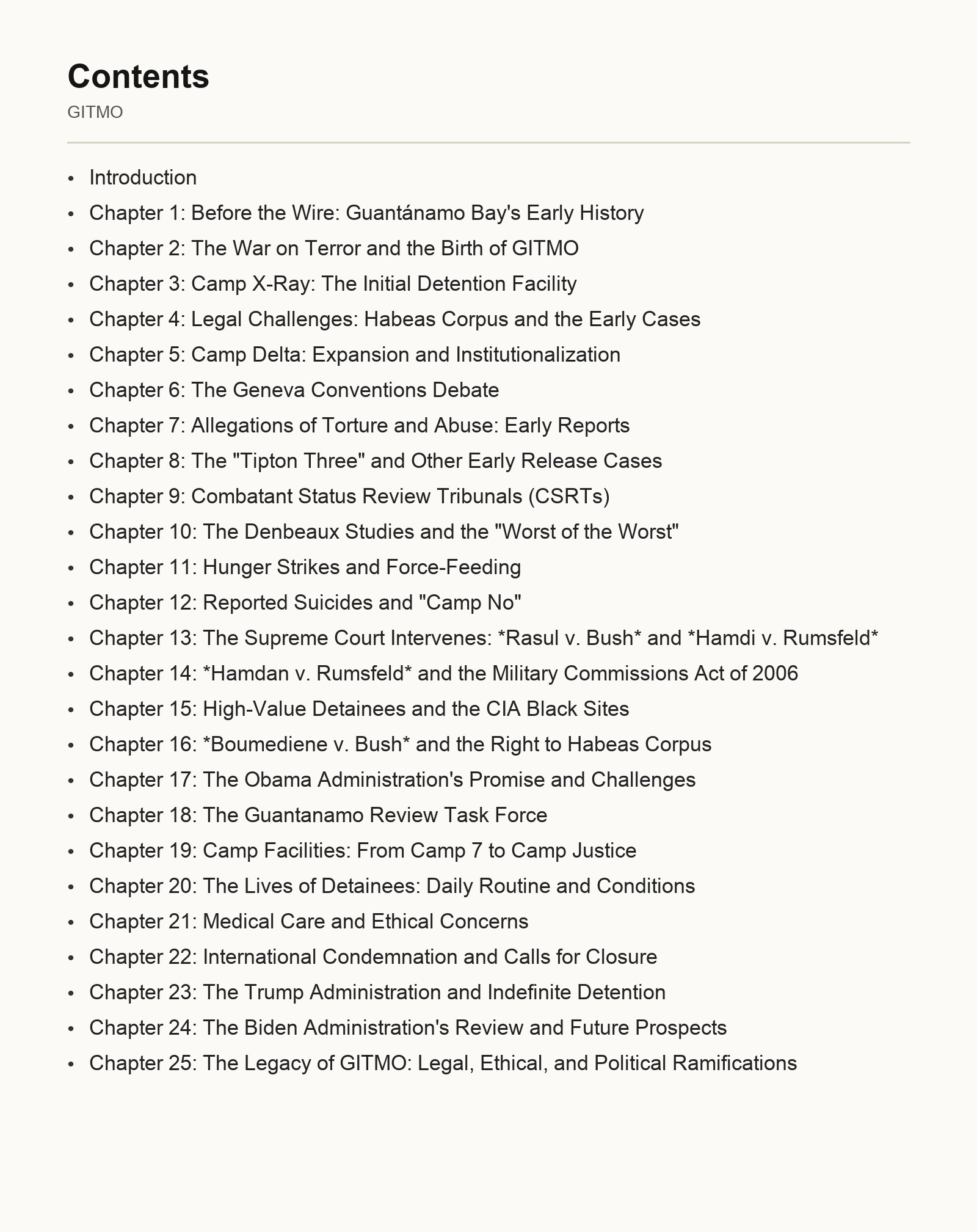
Table of Contents:
-
Introduction
-
Chapter 1: Before the Wire: Guantánamo Bay's Early History
-
Chapter 2: The War on Terror and the Birth of GITMO
-
Chapter 3: Camp X-Ray: The Initial Detention Facility
-
Chapter 4: Legal Challenges: Habeas Corpus and the Early Cases
-
Chapter 5: Camp Delta: Expansion and Institutionalization
-
Chapter 6: The Geneva Conventions Debate
-
Chapter 7: Allegations of Torture and Abuse: Early Reports
-
Chapter 8: The "Tipton Three" and Other Early Release Cases
-
Chapter 9: Combatant Status Review Tribunals (CSRTs)
-
Chapter 10: The Denbeaux Studies and the "Worst of the Worst"
-
Chapter 11: Hunger Strikes and Force-Feeding
-
Chapter 12: Reported Suicides and "Camp No"
-
Chapter 13: The Supreme Court Intervenes: Rasul v. Bush and Hamdi v. Rumsfeld
-
Chapter 14: Hamdan v. Rumsfeld and the Military Commissions Act of 2006
-
Chapter 15: High-Value Detainees and the CIA Black Sites
-
Chapter 16: Boumediene v. Bush and the Right to Habeas Corpus
-
Chapter 17: The Obama Administration's Promise and Challenges
-
Chapter 18: The Guantanamo Review Task Force
-
Chapter 19: Camp Facilities: From Camp 7 to Camp Justice
-
Chapter 20: The Lives of Detainees: Daily Routine and Conditions
-
Chapter 21: Medical Care and Ethical Concerns
-
Chapter 22: International Condemnation and Calls for Closure
-
Chapter 23: The Trump Administration and Indefinite Detention
-
Chapter 24: The Biden Administration's Review and Future Prospects
-
Chapter 25: The Legacy of GITMO: Legal, Ethical, and Political Ramifications
Author:
Published By:
Date Published:
May 23, 2026
Type:
Nonfiction
Language:
English
Also Available In:
Word Count:
43,323 words
Reading Time:
3 hours 2 minutes
Sample:
Order:
Buy the GITMO ebook on MixCache.com:
Buy NowThe full ebook will be available immediately to read instantly on any device.
$5 account credit for all new MixCache.com accounts, usable toward any ebook purchase!*






Ratings & Reviews
Ask Questions About This Book
Have a question about the content? Ask our AI assistant!
Start by asking a question about "GITMO"
Example: "Does this book mention William Shakespeare?"
Thinking...