
Browse by Category
Fiction
- Action & Adventure
- African American
- Anthologies
- Children's Fiction
- Classics
- Comics & Graphic Novels
- Coming of Age
- Contemporary
- Cultural & Regional
- Drama
- Erotica
- Fantasy
- General
- Historical Fiction
- Horror
- Humor & Satire
- Literary Fiction
- Mystery, Thriller & Suspense
- Poetry
- Religious & Inspirational
- Romance
- Science Fiction
- Short Stories
- War & Military
- Westerns
- Women's Fiction
- Young Adult
Non-Fiction
- Antiques & Collectibles
- Arts & Photography
- Biographies & Memoirs
- Business & Money
- Children's Non-Fiction
-
Computers & Technology
- Artificial Intelligence
- Computer Science
- Cybersecurity & Cryptography
- Data Science & Analytics
- Databases & Big Data
- Game Development & Design
- General
- Hardware & DIY
- Mobile App Development
- Networking & Cloud Computing
- Operating Systems
- Programming
- Robotics
- Software
- Software Engineering
- User Experience (UX) & Design
- Web Development & Design
- Cooking, Food & Wine
- Crafts, Hobbies & Home
- Education & Teaching
- Engineering
- General
- Health, Fitness & Dieting
-
History
- African History
- African History - North Africa
- African History - Sub-Saharan Africa
- American History
- American History - 20th Century
- American History - Civil War
- American History - Colonial Period
- Ancient History
- Asian History
- Asian History - China
- Asian History - India
- Asian History - Japan
- Asian History - Southeast Asia
- European History
- European History - Ancient Greece
- European History - Ancient Rome
- European History - Medieval
- European History - Modern
- European History - Renaissance
- General
- Middle Eastern History
- Military History
- Military History - Aviation
- Military History - Naval
- Social & Cultural History
- World History
- Humor & Entertainment
- Industrial Technology
- Language Learning
- Law
- LGBTQ+ Non-Fiction
- Literary Criticism
- Medical Books
- Parenting & Relationships
- Philosophy
- Politics & Social Sciences
- Reference
- Religion & Spirituality
-
Science & Math
- Agricultural Sciences
- Astronomy & Space Science
- Behavioral Sciences
- Biological Sciences
- Botany & Plant Science
- Chemistry
- Earth Sciences
- Engineering - Chemical
- Engineering - Civil
- Engineering - Electrical
- Engineering - Mechanical
- Environment
- General
- Geology
- Mathematics
- Nature & Ecology
- Oceanography
- Paleontology
- Physics
- Statistics
- Self-Help
- Sports & Outdoors
- Study Aids
- Sustainability & Green Living
- Textbooks
- Transportation
- Travel
- True Crime
- Urban Planning & Development
- Veterinary Medicine
- Writing & Publishing
Jump to Section
MixCache.com Total Access
Unlimited reading and audiobooks for every book published by MixCache.com.
Included titles carry the MTA badge.
Learn more →A History of Cornwall
About this book:


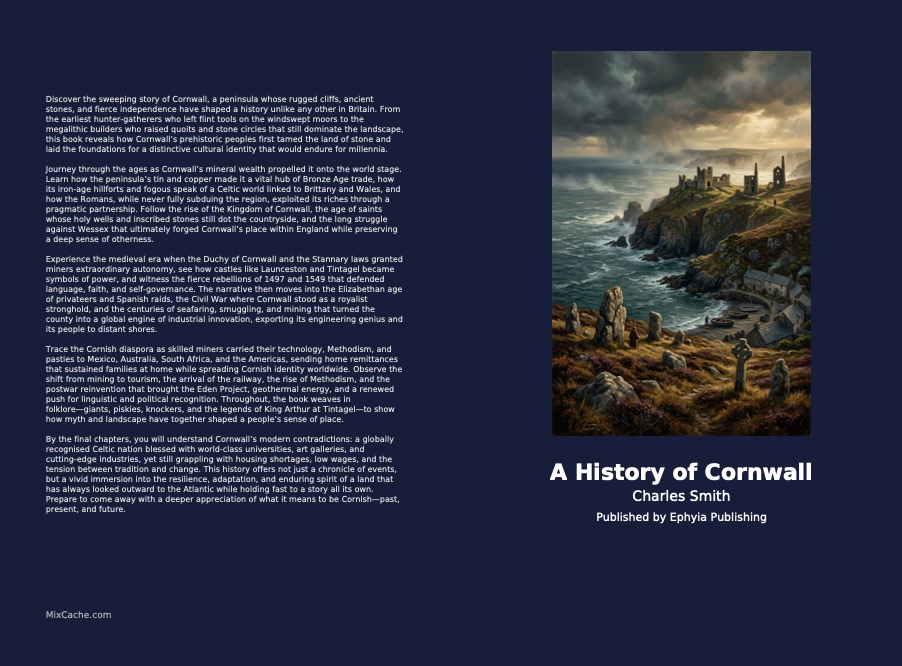
Discover the sweeping story of Cornwall, a peninsula whose rugged cliffs, ancient stones, and fierce independence have shaped a history unlike any other in Britain. From the earliest hunter‑gatherers who left flint tools on the windswept moors to the megalithic builders who raised quoits and stone circles that still dominate the landscape, this book reveals how Cornwall’s prehistoric peoples first tamed the land of stone and laid the foundations for a distinctive cultural identity that would endure for millennia.
Journey through the ages as Cornwall’s mineral wealth propelled it onto the world stage. Learn how the peninsula’s tin and copper made it a vital hub of Bronze Age trade, how its iron‑age hillforts and fogous speak of a Celtic world linked to Brittany and Wales, and how the Romans, while never fully subduing the region, exploited its riches through a pragmatic partnership. Follow the rise of the Kingdom of Cornwall, the age of saints whose holy wells and inscribed stones still dot the countryside, and the long struggle against Wessex that ultimately forged Cornwall’s place within England while preserving a deep sense of otherness.
Experience the medieval era when the Duchy of Cornwall and the Stannary laws granted miners extraordinary autonomy, see how castles like Launceston and Tintagel became symbols of power, and witness the fierce rebellions of 1497 and 1549 that defended language, faith, and self‑governance. The narrative then moves into the Elizabethan age of privateers and Spanish raids, the Civil War where Cornwall stood as a royalist stronghold, and the centuries of seafaring, smuggling, and mining that turned the county into a global engine of industrial innovation, exporting its engineering genius and its people to distant shores.
Trace the Cornish diaspora as skilled miners carried their technology, Methodism, and pasties to Mexico, Australia, South Africa, and the Americas, sending home remittances that sustained families at home while spreading Cornish identity worldwide. Observe the shift from mining to tourism, the arrival of the railway, the rise of Methodism, and the postwar reinvention that brought the Eden Project, geothermal energy, and a renewed push for linguistic and political recognition. Throughout, the book weaves in folklore—giants, piskies, knockers, and the legends of King Arthur at Tintagel—to show how myth and landscape have together shaped a people’s sense of place.
By the final chapters, you will understand Cornwall’s modern contradictions: a globally recognised Celtic nation blessed with world‑class universities, art galleries, and cutting‑edge industries, yet still grappling with housing shortages, low wages, and the tension between tradition and change. This history offers not just a chronicle of events, but a vivid immersion into the resilience, adaptation, and enduring spirit of a land that has always looked outward to the Atlantic while holding fast to a story all its own. Prepare to come away with a deeper appreciation of what it means to be Cornish—past, present, and future.
What You'll Find Inside:
- Cornwall's enduring Celtic identity has persisted for millennia despite political incorporation into England, maintained through language, saints, traditions, and ongoing cultural revival against Anglicizing pressures.
- The tin mining industry shaped Cornwall's global influence from the Bronze Age through the Industrial Revolution, driving technological innovation and ultimately triggering the Great Migration of skilled Cornish miners worldwide.
- Medieval institutions like the Stannaries and Duchy of Cornwall granted unique legal and administrative autonomy, recognizing tin's strategic importance and reinforcing Cornwall's distinctiveness within England.
- Cultural and religious transformations - from Celtic Christianity and the Age of Saints to Methodist revival and modern language preservation - have continually strengthened Cornish identity and resistance to assimilation.
- Modern Cornwall balances industrial heritage decline with new opportunities in tourism, renewable energy, and technology while securing official recognition as a national minority and preserving its Celtic heritage.
Who's It For:
This book is ideal for readers interested in British regional history, particularly Celtic nations and minority cultures; those studying industrial history, mining communities, and economic transformation; people with Cornish heritage or connections to the global Cornish diaspora; students of cultural identity, language preservation, and regional nationalism; and anyone fascinated by how geography shapes distinct cultural identities over time. It serves both general readers seeking an engaging narrative and those with specific academic interests in Cornwall's unique historical trajectory.
Table of Contents:
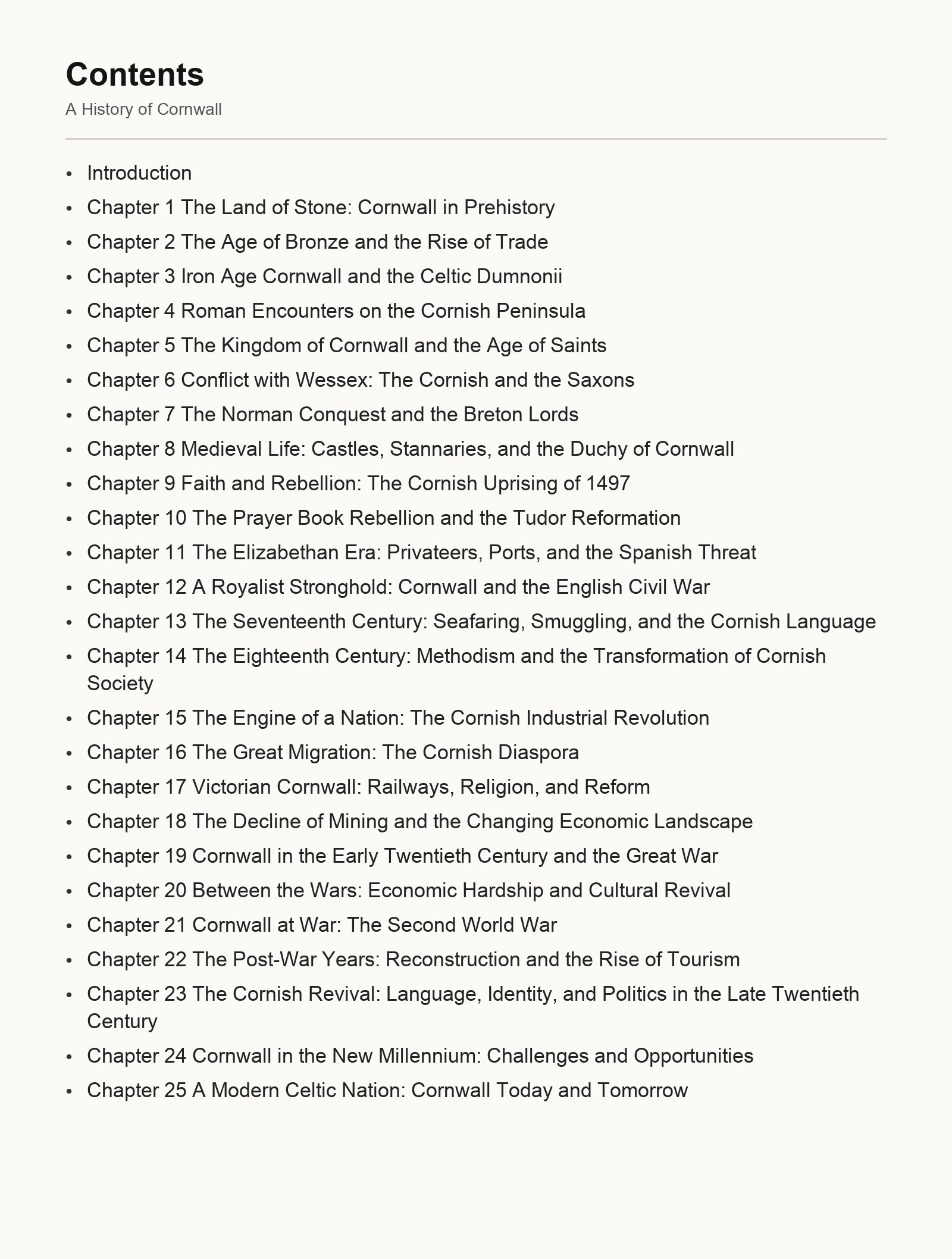
- Introduction
- Chapter 1 The Land of Stone: Cornwall in Prehistory
- Chapter 2 The Age of Bronze and the Rise of Trade
- Chapter 3 Iron Age Cornwall and the Celtic Dumnonii
- Chapter 4 Roman Encounters on the Cornish Peninsula
- Chapter 5 The Kingdom of Cornwall and the Age of Saints
- Chapter 6 Conflict with Wessex: The Cornish and the Saxons
- Chapter 7 The Norman Conquest and the Breton Lords
- Chapter 8 Medieval Life: Castles, Stannaries, and the Duchy of Cornwall
- Chapter 9 Faith and Rebellion: The Cornish Uprising of 1497
- Chapter 10 The Prayer Book Rebellion and the Tudor Reformation
- Chapter 11 The Elizabethan Era: Privateers, Ports, and the Spanish Threat
- Chapter 12 A Royalist Stronghold: Cornwall and the English Civil War
- Chapter 13 The Seventeenth Century: Seafaring, Smuggling, and the Cornish Language
- Chapter 14 The Eighteenth Century: Methodism and the Transformation of Cornish Society
- Chapter 15 The Engine of a Nation: The Cornish Industrial Revolution
- Chapter 16 The Great Migration: The Cornish Diaspora
- Chapter 17 Victorian Cornwall: Railways, Religion, and Reform
- Chapter 18 The Decline of Mining and the Changing Economic Landscape
- Chapter 19 Cornwall in the Early Twentieth Century and the Great War
- Chapter 20 Between the Wars: Economic Hardship and Cultural Revival
- Chapter 21 Cornwall at War: The Second World War
- Chapter 22 The Post-War Years: Reconstruction and the Rise of Tourism
- Chapter 23 The Cornish Revival: Language, Identity, and Politics in the Late Twentieth Century
- Chapter 24 Cornwall in the New Millennium: Challenges and Opportunities
- Chapter 25 A Modern Celtic Nation: Cornwall Today and Tomorrow
Author:
Published By:
Date Published:
May 23, 2026
Type:
Nonfiction
Language:
English
Also Available In:
Word Count:
45,615 words
Reading Time:
3 hours 12 minutes
Sample:
Order:
Order A History of Cornwall (Hardcover) on MixCache.com:
Buy NowPrint copy is made to order and ships worldwide. Includes the ebook free, ready to read instantly.
$5 account credit for all new MixCache.com accounts, usable toward any ebook purchase!*


