Browse by Category
Fiction
- Action & Adventure
- African American
- Anthologies
- Children's Fiction
- Classics
- Comics & Graphic Novels
- Coming of Age
- Contemporary
- Cultural & Regional
- Drama
- Erotica
- Fantasy
- General
- Historical Fiction
- Horror
- Humor & Satire
- Literary Fiction
- Mystery, Thriller & Suspense
- Poetry
- Religious & Inspirational
- Romance
- Science Fiction
- Short Stories
- War & Military
- Westerns
- Women's Fiction
- Young Adult
Non-Fiction
- Antiques & Collectibles
- Arts & Photography
- Biographies & Memoirs
- Business & Money
- Children's Non-Fiction
-
Computers & Technology
- Artificial Intelligence
- Computer Science
- Cybersecurity & Cryptography
- Data Science & Analytics
- Databases & Big Data
- Game Development & Design
- General
- Hardware & DIY
- Mobile App Development
- Networking & Cloud Computing
- Operating Systems
- Programming
- Robotics
- Software
- Software Engineering
- User Experience (UX) & Design
- Web Development & Design
- Cooking, Food & Wine
- Crafts, Hobbies & Home
- Education & Teaching
- Engineering
- General
- Health, Fitness & Dieting
-
History
- African History
- African History - North Africa
- African History - Sub-Saharan Africa
- American History
- American History - 20th Century
- American History - Civil War
- American History - Colonial Period
- Ancient History
- Asian History
- Asian History - China
- Asian History - India
- Asian History - Japan
- Asian History - Southeast Asia
- European History
- European History - Ancient Greece
- European History - Ancient Rome
- European History - Medieval
- European History - Modern
- European History - Renaissance
- General
- Middle Eastern History
- Military History
- Military History - Aviation
- Military History - Naval
- Social & Cultural History
- World History
- Humor & Entertainment
- Industrial Technology
- Language Learning
- Law
- LGBTQ+ Non-Fiction
- Literary Criticism
- Medical Books
- Parenting & Relationships
- Philosophy
- Politics & Social Sciences
- Reference
- Religion & Spirituality
-
Science & Math
- Agricultural Sciences
- Astronomy & Space Science
- Behavioral Sciences
- Biological Sciences
- Botany & Plant Science
- Chemistry
- Earth Sciences
- Engineering - Chemical
- Engineering - Civil
- Engineering - Electrical
- Engineering - Mechanical
- Environment
- General
- Geology
- Mathematics
- Nature & Ecology
- Oceanography
- Paleontology
- Physics
- Statistics
- Self-Help
- Sports & Outdoors
- Study Aids
- Sustainability & Green Living
- Textbooks
- Transportation
- Travel
- True Crime
- Urban Planning & Development
- Veterinary Medicine
- Writing & Publishing
Jump to Section
MixCache.com Total Access
Unlimited reading and audiobooks for every book published by MixCache.com.
Included titles carry the MTA badge.
Learn more →A History of Ivory Coast
About this book:
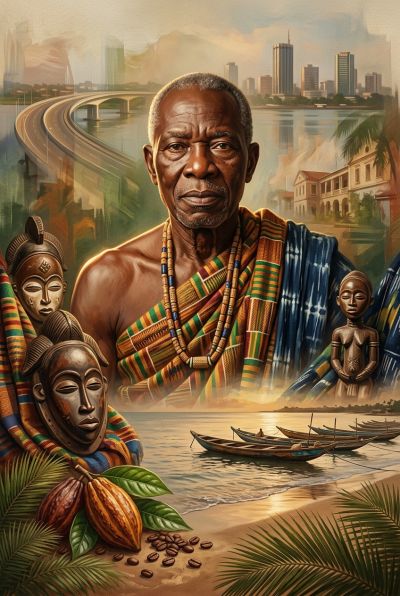
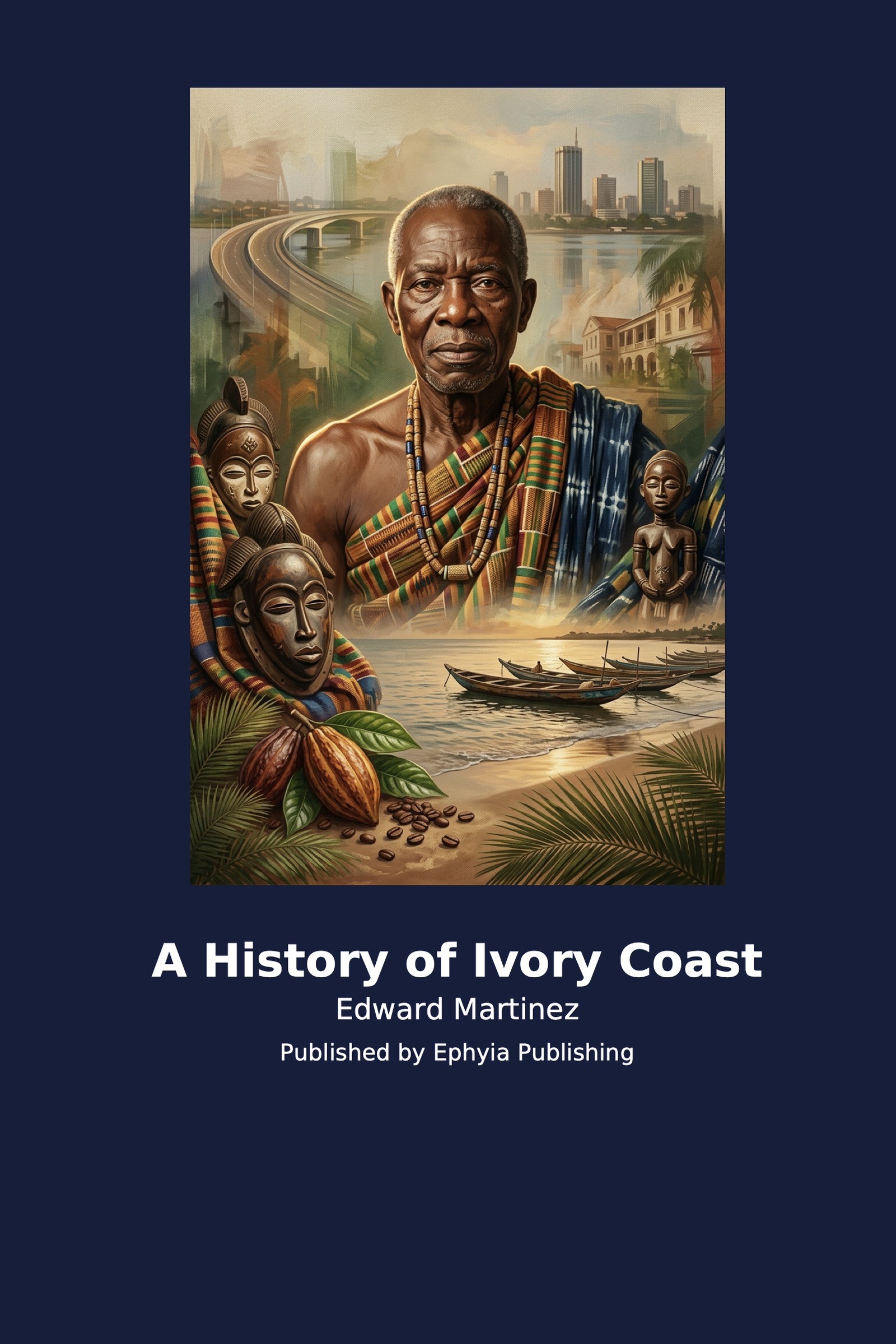
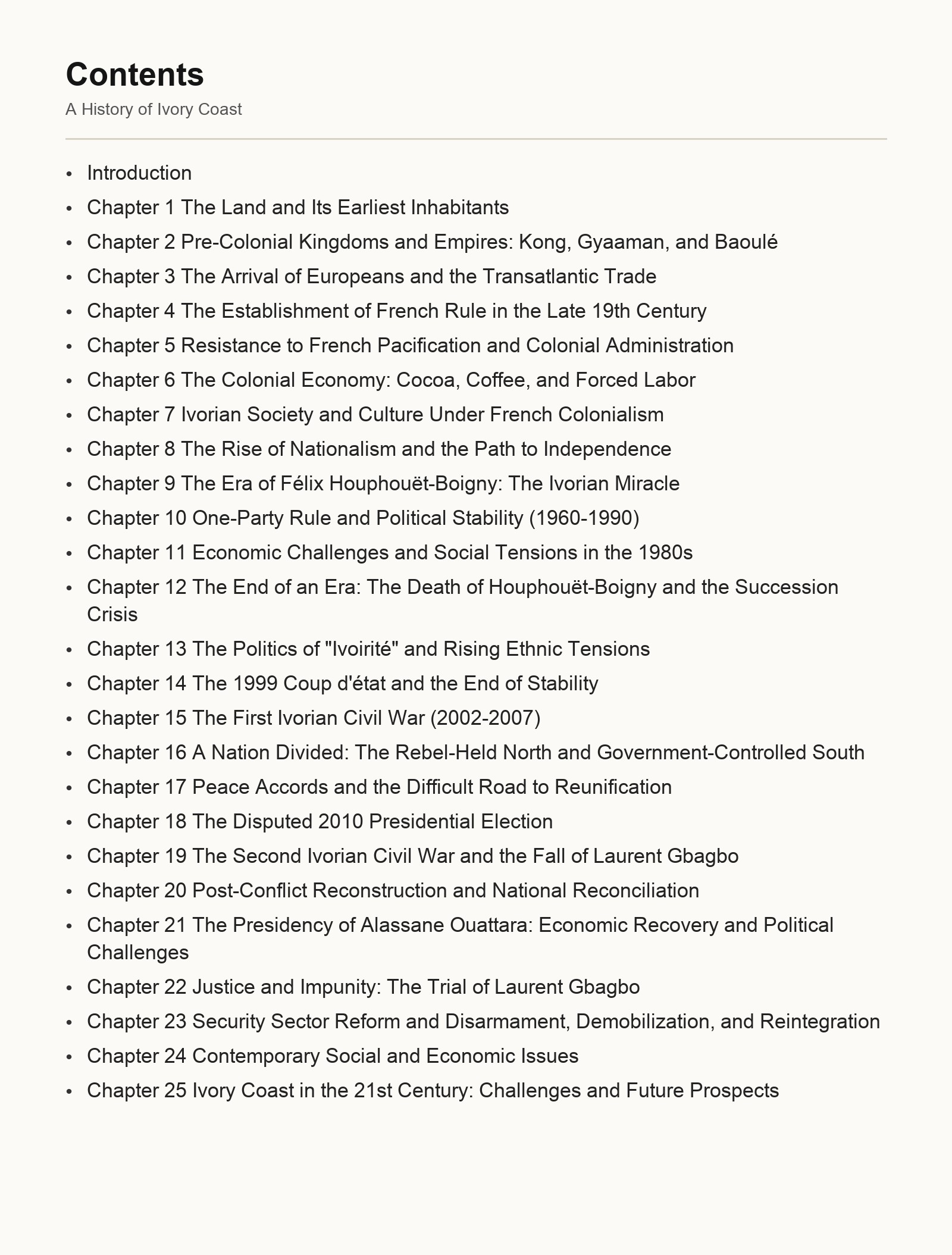
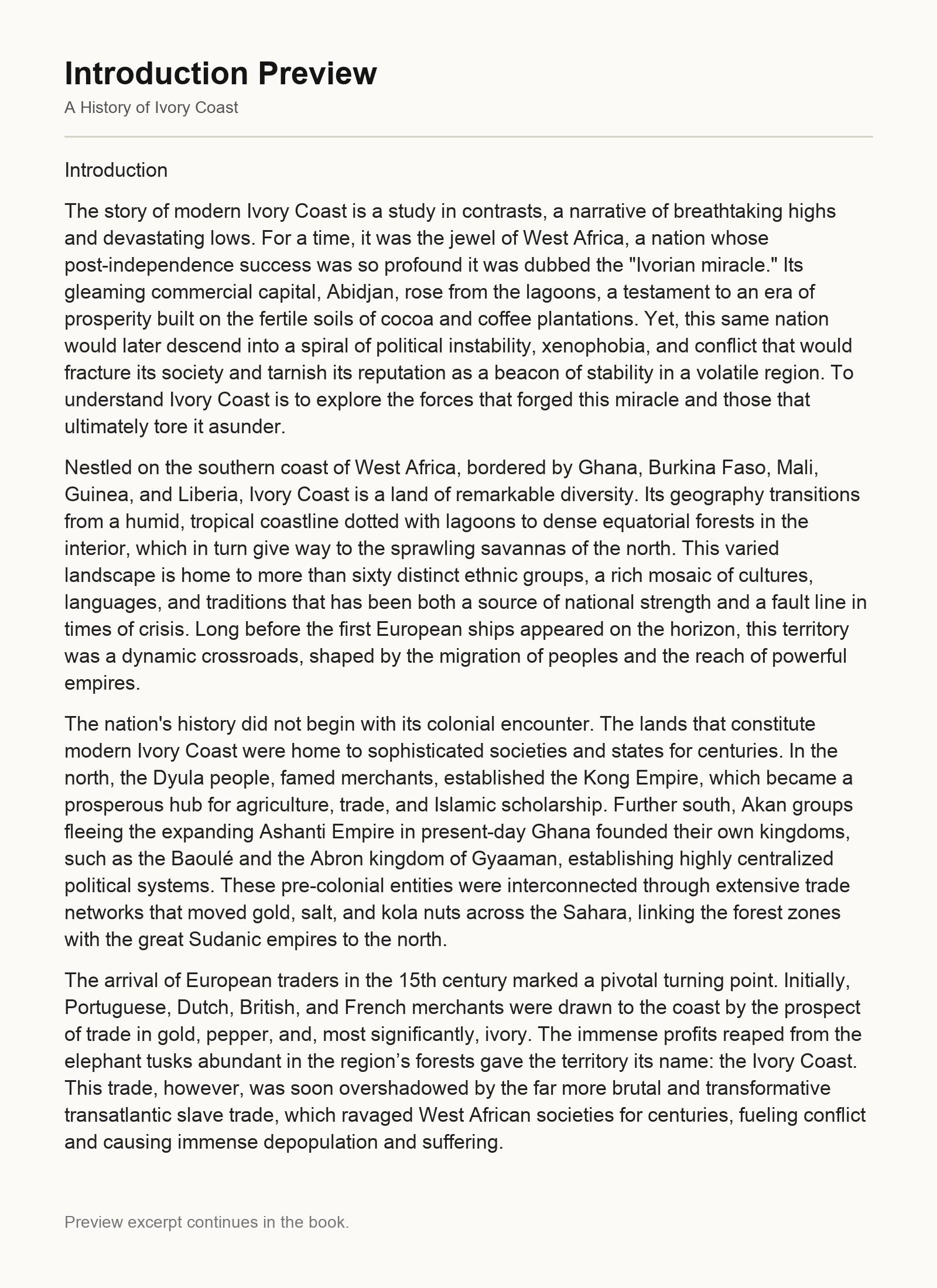
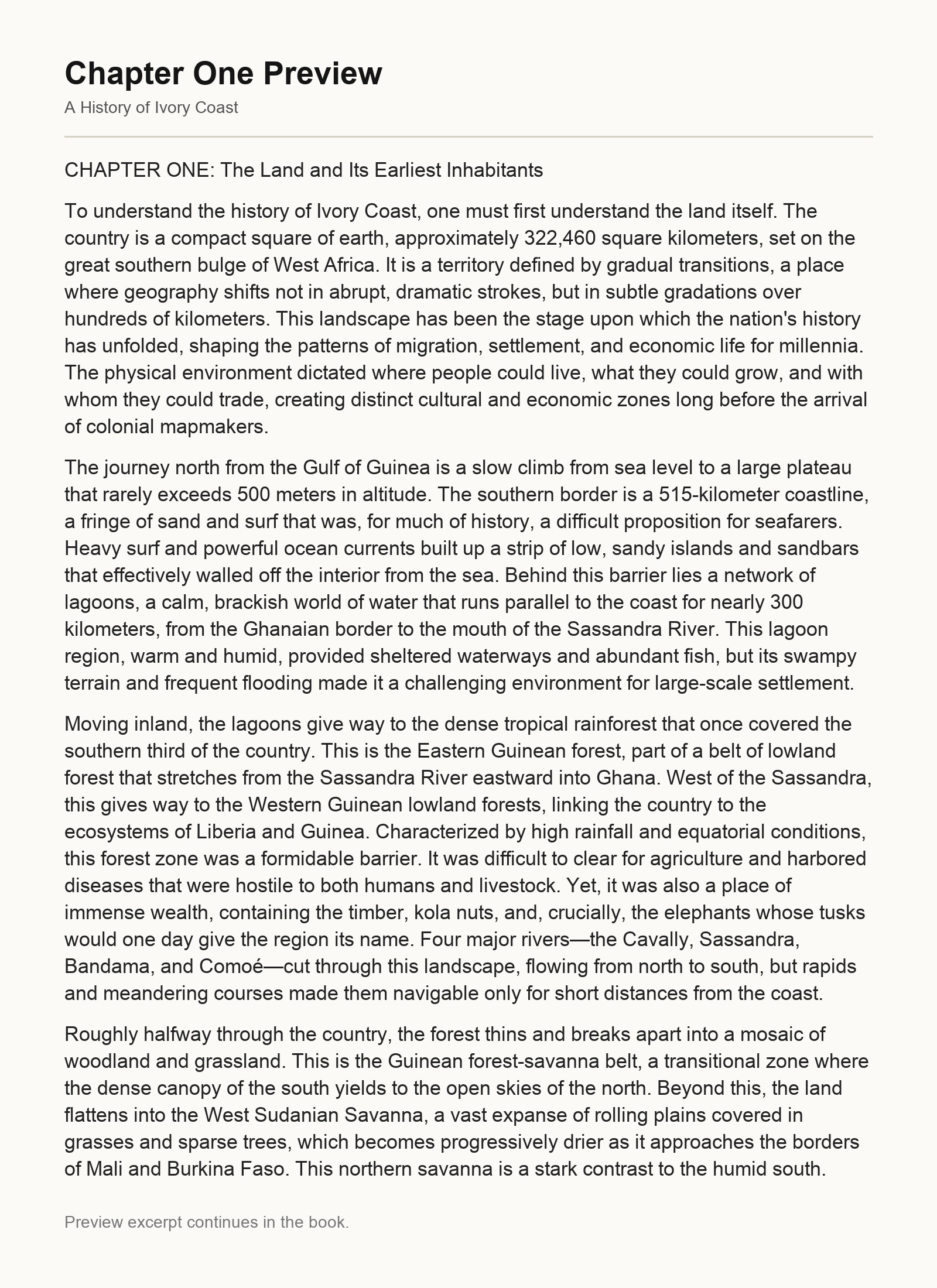
This comprehensive history takes readers on a journey through Ivory Coast's remarkable transformation from a land of diverse pre-colonial kingdoms to a modern nation grappling with the complexities of post-colonial Africa. Edward Martinez meticulously traces the country's evolution, revealing how its unique geography - from lagoon coastlines to dense forests and northern savannas - shaped the migration patterns and cultural foundations of over sixty distinct ethnic groups long before European arrival.
Readers will discover the fascinating origins of the nation's name in the 15th-century ivory trade, and how this early European contact set the stage for centuries of exploitation. The book details the sophisticated pre-colonial societies that existed, including the merchant empire of Kong, the Akan kingdom of Gyaaman, and the decentralized Baoulé confederation, showing how these polities created intricate trade networks across the region. It then examines the devastating impact of the transatlantic slave trade and the eventual establishment of French colonial rule, highlighting the resistance movements led by figures like Samori Touré and the Baoulé people's prolonged guerrilla resistance.
The narrative shifts to independence and the extraordinary era of Félix Houphouët-Boigny, whose leadership produced what became known as the "Ivorian miracle." Readers will learn how close ties with France, strategic immigration policies, and state-led agricultural development transformed Ivory Coast into the world's leading cocoa producer and turned Abidjan into a cosmopolitan metropolis dubbed the "Paris of West Africa." The book explains the mechanisms behind this success - from the Caistab price stabilization system to the delicate ethnic balancing act that maintained three decades of stability and prosperity.
However, Martinez doesn't shy away from analyzing the fragility beneath this success story. Readers will understand how dependence on volatile commodity prices, economic austerity measures in the 1980s, and the toxic politics of "Ivoirité" unraveled the nation's cohesion. The book provides deep insight into the succession crisis after Houphouët-Boigny's death, the rise of ethnic exclusionism, the devastating coups and civil wars that fractured the country, and the painful peace processes that followed - including the disputed 2010 election that plunged Ivory Coast back into violence and the subsequent international interventions.
Finally, readers will gain a nuanced understanding of contemporary Ivory Coast - its impressive economic recovery under Alassane Ouattara, persistent challenges like deforestation and child labor in the cocoa sector, ongoing security threats from Sahelian jihadist spillover, and the enduring struggle for true national reconciliation. This history reveals Ivory Coast not just as a case study of African development, but as a profound parable about the promises and pitfalls of the post-colonial experience, offering valuable lessons about how natural wealth, colonial legacies, ethnic politics, and institutional fragility interact to shape a nation's destiny.
What You'll Find Inside:
- The pre‑colonial kingdoms of Kong, Gyaaman, and Baoulé established Ivory Coast’s early trade networks and political structures.
- French colonial rule created an export‑oriented economy centered on cocoa and coffee, built on forced labor and European settler plantations.
- Félix Houphouët-Boigny’s leadership after independence produced the 'Ivorian miracle' through close ties with France, state‑led capitalism, and mass immigration.
- The politicization of 'Ivoirité' after Houphouët-Boigny’s death fueled ethnic tensions, leading to coups, civil wars, and prolonged instability from the 1990s to 2011.
- Post‑conflict reconstruction under Alassane Ouattara spurred rapid economic growth but left unresolved challenges of reconciliation, justice, youth unemployment, and environmental degradation.
Who's It For:
This book is ideal for undergraduate and graduate students of African history, political science, and development studies who seek a comprehensive overview of Ivory Coast’s trajectory from pre‑colonial societies to the present. It also serves policymakers, journalists, and general readers interested in understanding the roots of the country’s economic booms and busts, the role of ethnic politics, and the challenges of post‑conflict reconstruction in West Africa.
Table of Contents:
- Introduction
- Chapter 1 The Land and Its Earliest Inhabitants
- Chapter 2 Pre-Colonial Kingdoms and Empires: Kong, Gyaaman, and Baoulé
- Chapter 3 The Arrival of Europeans and the Transatlantic Trade
- Chapter 4 The Establishment of French Rule in the Late 19th Century
- Chapter 5 Resistance to French Pacification and Colonial Administration
- Chapter 6 The Colonial Economy: Cocoa, Coffee, and Forced Labor
- Chapter 7 Ivorian Society and Culture Under French Colonialism
- Chapter 8 The Rise of Nationalism and the Path to Independence
- Chapter 9 The Era of Félix Houphouët-Boigny: The Ivorian Miracle
- Chapter 10 One-Party Rule and Political Stability (1960-1990)
- Chapter 11 Economic Challenges and Social Tensions in the 1980s
- Chapter 12 The End of an Era: The Death of Houphouët-Boigny and the Succession Crisis
- Chapter 13 The Politics of "Ivoirité" and Rising Ethnic Tensions
- Chapter 14 The 1999 Coup d'état and the End of Stability
- Chapter 15 The First Ivorian Civil War (2002-2007)
- Chapter 16 A Nation Divided: The Rebel-Held North and Government-Controlled South
- Chapter 17 Peace Accords and the Difficult Road to Reunification
- Chapter 18 The Disputed 2010 Presidential Election
- Chapter 19 The Second Ivorian Civil War and the Fall of Laurent Gbagbo
- Chapter 20 Post-Conflict Reconstruction and National Reconciliation
- Chapter 21 The Presidency of Alassane Ouattara: Economic Recovery and Political Challenges
- Chapter 22 Justice and Impunity: The Trial of Laurent Gbagbo
- Chapter 23 Security Sector Reform and Disarmament, Demobilization, and Reintegration
- Chapter 24 Contemporary Social and Economic Issues
- Chapter 25 Ivory Coast in the 21st Century: Challenges and Future Prospects
Author:
Published By:
Date Published:
May 22, 2026
Type:
Nonfiction
Language:
English
Also Available In:
Word Count:
45,598 words
Reading Time:
3 hours 12 minutes
Sample:
Order:
Order A History of Ivory Coast (Paperback) on MixCache.com:
Buy NowPrint copy is made to order and ships worldwide. Includes the ebook free, ready to read instantly.
$5 account credit for all new MixCache.com accounts, usable toward any ebook purchase!*