Browse by Category
Fiction
- Action & Adventure
- African American
- Anthologies
- Children's Fiction
- Classics
- Comics & Graphic Novels
- Coming of Age
- Contemporary
- Cultural & Regional
- Drama
- Erotica
- Fantasy
- General
- Historical Fiction
- Horror
- Humor & Satire
- Literary Fiction
- Mystery, Thriller & Suspense
- Poetry
- Religious & Inspirational
- Romance
- Science Fiction
- Short Stories
- War & Military
- Westerns
- Women's Fiction
- Young Adult
Non-Fiction
- Antiques & Collectibles
- Arts & Photography
- Biographies & Memoirs
- Business & Money
- Children's Non-Fiction
-
Computers & Technology
- Artificial Intelligence
- Computer Science
- Cybersecurity & Cryptography
- Data Science & Analytics
- Databases & Big Data
- Game Development & Design
- General
- Hardware & DIY
- Mobile App Development
- Networking & Cloud Computing
- Operating Systems
- Programming
- Robotics
- Software
- Software Engineering
- User Experience (UX) & Design
- Web Development & Design
- Cooking, Food & Wine
- Crafts, Hobbies & Home
- Education & Teaching
- Engineering
- General
- Health, Fitness & Dieting
-
History
- African History
- African History - North Africa
- African History - Sub-Saharan Africa
- American History
- American History - 20th Century
- American History - Civil War
- American History - Colonial Period
- Ancient History
- Asian History
- Asian History - China
- Asian History - India
- Asian History - Japan
- Asian History - Southeast Asia
- European History
- European History - Ancient Greece
- European History - Ancient Rome
- European History - Medieval
- European History - Modern
- European History - Renaissance
- General
- Middle Eastern History
- Military History
- Military History - Aviation
- Military History - Naval
- Social & Cultural History
- World History
- Humor & Entertainment
- Industrial Technology
- Language Learning
- Law
- LGBTQ+ Non-Fiction
- Literary Criticism
- Medical Books
- Parenting & Relationships
- Philosophy
- Politics & Social Sciences
- Reference
- Religion & Spirituality
-
Science & Math
- Agricultural Sciences
- Astronomy & Space Science
- Behavioral Sciences
- Biological Sciences
- Botany & Plant Science
- Chemistry
- Earth Sciences
- Engineering - Chemical
- Engineering - Civil
- Engineering - Electrical
- Engineering - Mechanical
- Environment
- General
- Geology
- Mathematics
- Nature & Ecology
- Oceanography
- Paleontology
- Physics
- Statistics
- Self-Help
- Sports & Outdoors
- Study Aids
- Sustainability & Green Living
- Textbooks
- Transportation
- Travel
- True Crime
- Urban Planning & Development
- Veterinary Medicine
- Writing & Publishing
Jump to Section

Want unlimited access to all books published by MixCache.com (plus their audiobooks)? Try MixCache.com Total Access. Look for the MTA badge on book covers to identify included titles.
Access to infinite ebooks: Don't see the book you want? Suggest it and we'll create it (free!) for you from scratch with our powerful AI book writer. Then read it with MTA - besides profiting from any sales it makes!
Muslim Women Across Cultures: Rights, Roles, and Realities
MTA
An evidence-based look at women's experiences in Islamic communities worldwide
About this book:
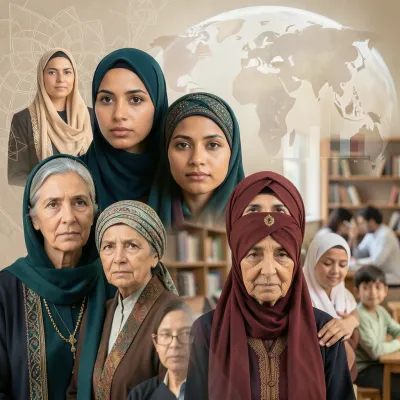
This book offers an evidence‑based, multidisciplinary examination of Muslim women’s lives across the globe, challenging monolithic portrayals by showing how theology, law, and local culture interact to produce diverse realities. It begins by deconstructing pervasive myths—both the victim and the “superwoman” tropes—and argues that understanding women’s experiences requires attention to the Qur’an, Hadith, jurisprudence, state statutes, and customary practices, recognizing that these sources are interpreted and applied differently over time and place.
The work then traces how these norms shape concrete domains: family law (marriage, divorce, custody), inheritance and economic rights, education and knowledge traditions, labor market participation, dress and modesty, mobility and citizenship, health and reproductive rights, and protection from violence. Each chapter illustrates the gap between prescriptive ideals and lived practice, highlighting reforms—such as Tunisia’s early abolition of polygyny, Morocco’s 2004 Moudawana changes, and India’s criminalization of instant triple talaq—as well as persistent obstacles like customary barriers, enforcement gaps, and sociocultural resistance.
Further chapters explore Muslim women’s agency in public and religious life, detailing their growing presence in political leadership, religious scholarship, judicial roles, and grassroots activism, as well as the ways they negotiate piety, ethical choices, and identity in everyday life. The book also examines media representation, migration and diaspora experiences, the impact of conflict and displacement, and the rise of digital activism and networked feminisms that enable transnational solidarity and self‑representation. Case studies from North and West Africa, the Middle East and Gulf, South and Southeast Asia, and Europe and North America provide grounded illustrations of these dynamics.
Finally, the book outlines pathways to reform—court‑driven judicial activism, legislative change, community‑based education and advocacy, and the empowerment of female religious authorities—and looks to the future, emphasizing the role of youth, technology, and evolving norms in reshaping rights, roles, and realities. Throughout, it maintains a commitment to intellectual honesty, documenting both constraints and the vibrant agency of Muslim women as they reinterpret Islamic traditions, contest injustice, and imagine more just and equitable futures.
What You'll Find Inside:
- Muslim women's experiences are diverse and dynamic, shaped by the interaction of theology, legal systems, and local culture rather than being a monolithic group defined by stereotypes of oppression or superwoman narratives
- The book examines how Islamic sources (Qur'an, Hadith, jurisprudence) are interpreted and applied differently across contexts, affecting women's rights in marriage, divorce, inheritance, education, and public participation
- Through evidence-based analysis, the book debunks pervasive myths such as universal barriers to education, immutability of family law, and reform only coming from outside Islamic traditions, while acknowledging real challenges
- Muslim women exercise agency in multiple ways—pursuing religious and secular education, engaging in digital activism, challenging discriminatory practices, and shaping religious discourse from within Islamic traditions
- The book explores multiple pathways to reform including legal strategies (court cases, legislative reform), community activism, reinterpretation of religious texts (gender hermeneutics), and coalition-building, showing how change happens in practice
Who's It For:
This book is designed for scholars, practitioners, and general audiences seeking a nuanced, evidence-based understanding of Muslim women's lives. It will be particularly valuable for academics in gender studies, Islamic studies, law, sociology, or anthropology; policymakers and human rights advocates working on issues affecting Muslim women; journalists aiming to move beyond stereotypes; and general readers interested in cross-cultural understanding and women's rights. Muslim women themselves will find their diverse experiences reflected and validated in this scholarship.
Author:
Published By:
Date Published:
May 20, 2026
Type:
Nonfiction
Language:
English
Word Count:
44,637 words
Reading Time:
3 hours 8 minutes
Sample:
Order:
Order Muslim Women Across Cultures: Rights, Roles, and Realities (Hardcover) on MixCache.com:
Buy NowPrint copy is made to order and ships worldwide. Includes the ebook free, ready to read instantly.
$5 account credit for all new MixCache.com accounts, usable toward any ebook purchase!*