Browse by Category
Fiction
- Action & Adventure
- African American
- Anthologies
- Children's Fiction
- Classics
- Comics & Graphic Novels
- Coming of Age
- Contemporary
- Cultural & Regional
- Drama
- Erotica
- Fantasy
- General
- Historical Fiction
- Horror
- Humor & Satire
- Literary Fiction
- Mystery, Thriller & Suspense
- Poetry
- Religious & Inspirational
- Romance
- Science Fiction
- Short Stories
- War & Military
- Westerns
- Women's Fiction
- Young Adult
Non-Fiction
- Antiques & Collectibles
- Arts & Photography
- Biographies & Memoirs
- Business & Money
- Children's Non-Fiction
-
Computers & Technology
- Artificial Intelligence
- Computer Science
- Cybersecurity & Cryptography
- Data Science & Analytics
- Databases & Big Data
- Game Development & Design
- General
- Hardware & DIY
- Mobile App Development
- Networking & Cloud Computing
- Operating Systems
- Programming
- Robotics
- Software
- Software Engineering
- User Experience (UX) & Design
- Web Development & Design
- Cooking, Food & Wine
- Crafts, Hobbies & Home
- Education & Teaching
- Engineering
- General
- Health, Fitness & Dieting
-
History
- African History
- African History - North Africa
- African History - Sub-Saharan Africa
- American History
- American History - 20th Century
- American History - Civil War
- American History - Colonial Period
- Ancient History
- Asian History
- Asian History - China
- Asian History - India
- Asian History - Japan
- Asian History - Southeast Asia
- European History
- European History - Ancient Greece
- European History - Ancient Rome
- European History - Medieval
- European History - Modern
- European History - Renaissance
- General
- Middle Eastern History
- Military History
- Military History - Aviation
- Military History - Naval
- Social & Cultural History
- World History
- Humor & Entertainment
- Industrial Technology
- Language Learning
- Law
- LGBTQ+ Non-Fiction
- Literary Criticism
- Medical Books
- Parenting & Relationships
- Philosophy
- Politics & Social Sciences
- Reference
- Religion & Spirituality
-
Science & Math
- Agricultural Sciences
- Astronomy & Space Science
- Behavioral Sciences
- Biological Sciences
- Botany & Plant Science
- Chemistry
- Earth Sciences
- Engineering - Chemical
- Engineering - Civil
- Engineering - Electrical
- Engineering - Mechanical
- Environment
- General
- Geology
- Mathematics
- Nature & Ecology
- Oceanography
- Paleontology
- Physics
- Statistics
- Self-Help
- Sports & Outdoors
- Study Aids
- Sustainability & Green Living
- Textbooks
- Transportation
- Travel
- True Crime
- Urban Planning & Development
- Veterinary Medicine
- Writing & Publishing
Jump to Section
MixCache.com Total Access
Unlimited reading and audiobooks for every book published by MixCache.com.
Included titles carry the MTA badge.
Learn more →
Subaru
Portrait of a Japanese Automobile Company
About this book:


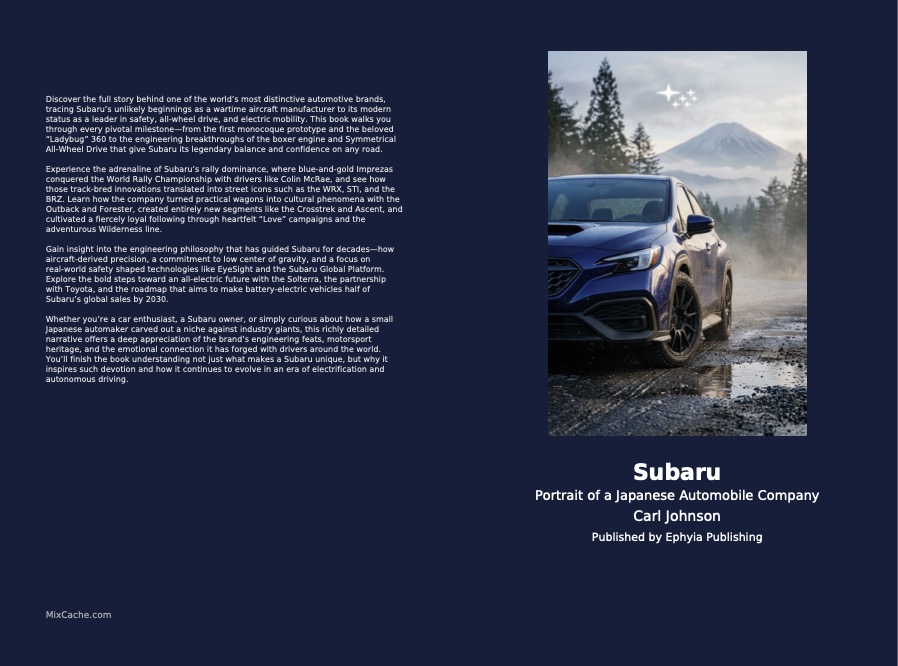
Discover the full story behind one of the world’s most distinctive automotive brands, tracing Subaru’s unlikely beginnings as a wartime aircraft manufacturer to its modern status as a leader in safety, all‑wheel drive, and electric mobility. This book walks you through every pivotal milestone—from the first monocoque prototype and the beloved “Ladybug” 360 to the engineering breakthroughs of the boxer engine and Symmetrical All‑Wheel Drive that give Subaru its legendary balance and confidence on any road.
Experience the adrenaline of Subaru’s rally dominance, where blue‑and‑gold Imprezas conquered the World Rally Championship with drivers like Colin McRae, and see how those track‑bred innovations translated into street icons such as the WRX, STI, and the BRZ. Learn how the company turned practical wagons into cultural phenomena with the Outback and Forester, created entirely new segments like the Crosstrek and Ascent, and cultivated a fiercely loyal following through heartfelt “Love” campaigns and the adventurous Wilderness line.
Gain insight into the engineering philosophy that has guided Subaru for decades—how aircraft‑derived precision, a commitment to low center of gravity, and a focus on real‑world safety shaped technologies like EyeSight and the Subaru Global Platform. Explore the bold steps toward an all‑electric future with the Solterra, the partnership with Toyota, and the roadmap that aims to make battery‑electric vehicles half of Subaru’s global sales by 2030.
Whether you’re a car enthusiast, a Subaru owner, or simply curious about how a small Japanese automaker carved out a niche against industry giants, this richly detailed narrative offers a deep appreciation of the brand’s engineering feats, motorsport heritage, and the emotional connection it has forged with drivers around the world. You’ll finish the book understanding not just what makes a Subaru unique, but why it inspires such devotion and how it continues to evolve in an era of electrification and autonomous driving.
What You'll Find Inside:
- The transformation from Nakajima Aircraft Company to Subaru, revealing how aviation engineering principles shaped the brand's core technologies like the boxer engine and symmetrical all-wheel drive
- Subaru's motorsport dominance in the World Rally Championship, featuring legendary drivers like Colin McRae and the creation of performance icons including the Impreza WRX and STI
- The innovation behind vehicle categories such as the world's first Sport Utility Wagon (Outback) and the Forester, which blended car-like handling with SUV versatility
- How Subaru built intense brand loyalty through emotional marketing ('Love' campaign), safety leadership (EyeSight), and authentic connections with outdoor lifestyles
- The company's strategic transition toward an electrified future with the Solterra, while preserving its core values of safety, capability, and driver engagement through new technologies
Who's It For:
This book is ideal for automotive enthusiasts, particularly fans of Japanese cars and Subaru owners who want to understand the engineering and cultural foundations behind their vehicles. It will also appeal to readers interested in corporate history, motorsport (especially rally racing), and how brands cultivate loyal followings through authentic storytelling and innovation. Anyone fascinated by the intersection of engineering excellence, marketing strategy, and evolving automotive technology will find valuable insights in Subaru's unique journey from aircraft manufacturer to global automotive icon.
Table of Contents:
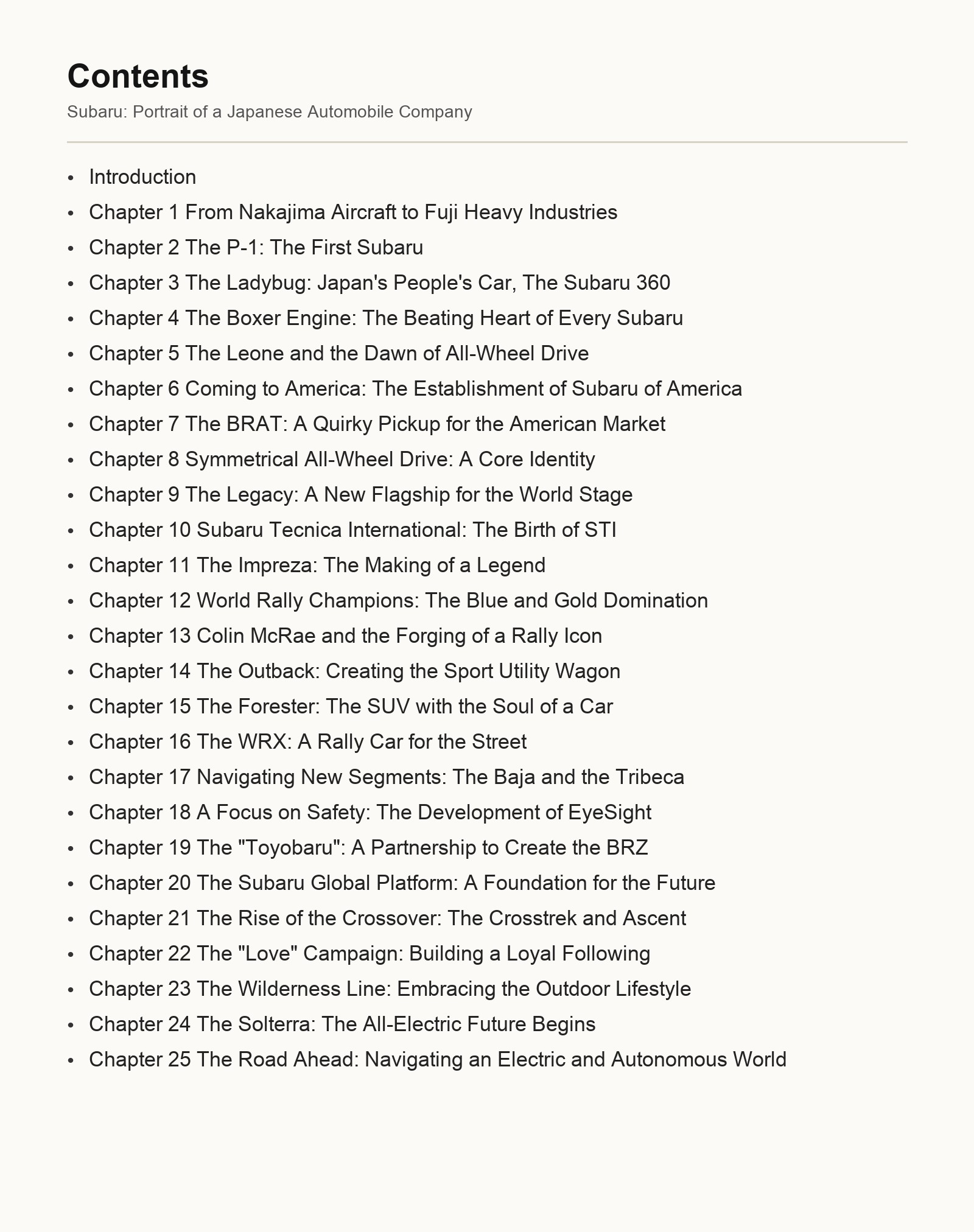
- Introduction
- Chapter 1 From Nakajima Aircraft to Fuji Heavy Industries
- Chapter 2 The P-1: The First Subaru
- Chapter 3 The Ladybug: Japan's People's Car, The Subaru 360
- Chapter 4 The Boxer Engine: The Beating Heart of Every Subaru
- Chapter 5 The Leone and the Dawn of All-Wheel Drive
- Chapter 6 Coming to America: The Establishment of Subaru of America
- Chapter 7 The BRAT: A Quirky Pickup for the American Market
- Chapter 8 Symmetrical All-Wheel Drive: A Core Identity
- Chapter 9 The Legacy: A New Flagship for the World Stage
- Chapter 10 Subaru Tecnica International: The Birth of STI
- Chapter 11 The Impreza: The Making of a Legend
- Chapter 12 World Rally Champions: The Blue and Gold Domination
- Chapter 13 Colin McRae and the Forging of a Rally Icon
- Chapter 14 The Outback: Creating the Sport Utility Wagon
- Chapter 15 The Forester: The SUV with the Soul of a Car
- Chapter 16 The WRX: A Rally Car for the Street
- Chapter 17 Navigating New Segments: The Baja and the Tribeca
- Chapter 18 A Focus on Safety: The Development of EyeSight
- Chapter 19 The "Toyobaru": A Partnership to Create the BRZ
- Chapter 20 The Subaru Global Platform: A Foundation for the Future
- Chapter 21 The Rise of the Crossover: The Crosstrek and Ascent
- Chapter 22 The "Love" Campaign: Building a Loyal Following
- Chapter 23 The Wilderness Line: Embracing the Outdoor Lifestyle
- Chapter 24 The Solterra: The All-Electric Future Begins
- Chapter 25 The Road Ahead: Navigating an Electric and Autonomous World
In the vast and fiercely competitive world of the global automotive industry, a landscape dominated by colossal conglomerates and household names, there exists a smaller, somewhat unconventional Japanese automaker that has cultivated an outsized reputation and one of the most intensely loyal followings in the business. This company doesn't typically lead the sales charts, nor does it strive to produce a car for every conceivable niche. Instead, it has forged its own path, often defying convention and doubling down on a handful of core engineering principles that set it apart. This company is Subaru, and its story is one of innovation born of necessity, identity forged in the crucible of motorsport, and a brand image built not merely on steel and rubber, but on a deep, almost familial connection with its customers.
What is it about Subaru that inspires such devotion? Ask a dozen owners and you might get a dozen different answers, yet common themes quickly emerge. For some, it is the distinctive, rhythmic thrum of the horizontally-opposed "boxer" engine, a design shared with Porsche but applied by Subaru across its entire lineup. This flat engine configuration allows for a lower center of gravity, contributing to the exceptional stability and handling that drivers feel, whether on a winding mountain road or a snow-covered highway. For others, the answer lies in the unwavering commitment to all-wheel drive. Long before it became a popular option on crossovers and SUVs, Subaru made Symmetrical All-Wheel Drive a cornerstone of its identity, offering sure-footed confidence in all weather conditions as a standard feature on nearly every vehicle it sells. This dedication has made the brand synonymous with capability and safety, particularly in regions with harsh winters or rugged terrain.
Yet, the foundations of Subaru's unique identity run deeper than its signature technologies. The company's very name, the Japanese word for the Pleiades star cluster, symbolizes the unification of five companies that emerged from the remnants of a corporate giant. The six stars in its celestial logo represent this merger, a constant reminder of a history forged in collaboration and reinvention. This book will chart the course of that history, from its origins as the Nakajima Aircraft Company, a primary supplier of warplanes for Japan in World War II, through its postwar rebirth as Fuji Heavy Industries, a producer of everything from scooters and buses to the tiny car that would put it on the automotive map.
This journey from military aviation to civilian transportation is not merely a historical footnote; it is fundamental to understanding the engineering-first culture that permeates Subaru to this day. The same meticulous attention to balance, durability, and performance required for aircraft design would become the bedrock of its automotive philosophy. We will explore the company's tentative first steps into car manufacturing with the P-1 prototype and the revolutionary Subaru 360, a diminutive "people's car" affectionately nicknamed the "Ladybug" that helped mobilize postwar Japan and became a cultural icon in its own right.
The narrative will then follow Subaru's expansion beyond its island home, particularly its arrival in the United States and the formation of Subaru of America. This was a challenging new frontier, and the company’s early offerings were often seen as quirky and unusual. Vehicles like the diminutive BRAT, a car-based pickup truck with rear-facing jump seats in the cargo bed, were certainly unconventional. Yet, these quirky beginnings laid the groundwork for a brand that was never afraid to be different, a trait that would ultimately become one of its greatest strengths. The introduction of the Leone wagon with four-wheel drive in the 1970s was a pivotal moment, introducing the safety and performance benefits of 4WD to a mainstream audience for the first time and setting the stage for the company's future focus.
No portrait of Subaru would be complete without a deep dive into the mud, snow, and gravel of the World Rally Championship (WRC). It was here, in the grueling arena of international rally racing, that Subaru transformed its image from a purveyor of quirky-but-dependable wagons into a global performance icon. The iconic blue and gold livery of the Subaru World Rally Team became instantly recognizable to motorsport fans around the globe. This book will recount the thrilling era of the 1990s and early 2000s, when legendary drivers like Colin McRae, Richard Burns, and Petter Solberg piloted the Subaru Impreza to multiple driver's and manufacturer's championships. McRae's "win-or-crash" driving style and the fierce rivalry with Mitsubishi's Lancer Evolution defined an entire generation of motorsport and cemented the Impreza WRX and its more potent STI variant as legends, rally cars for the street that brought world-beating performance to the masses.
But even as its rally cars were flying through the forests of Finland and the deserts of Australia, Subaru was simultaneously carving out a completely different, yet equally powerful, identity back in the civilian world. Facing an American market clamoring for SUVs in the 1990s, Subaru, lacking a traditional truck-based platform, created a new genre of vehicle altogether. By adding a raised suspension and rugged body cladding to its Legacy wagon, it created the Outback, the world's first sport-utility wagon. Marketed with a charmingly adventurous spirit by Australian actor Paul Hogan, the Outback was a massive success, offering the go-anywhere capability of an SUV with the comfort and efficiency of a car. It was a formula Subaru would replicate with the Forester, a vehicle with the soul of a car but the utility of an SUV, and later with the compact Crosstrek, which would become a runaway success with a new generation of buyers.
This dual identity—the adrenaline of the rally stage and the practicality of the open road—is central to the Subaru story. It's a brand trusted by families for its industry-leading safety ratings and its advanced EyeSight driver-assist technology, yet also adored by performance enthusiasts for its turbocharged, all-wheel-drive sedans. This unique appeal is the result of a deliberate and carefully cultivated brand ethos. Through its celebrated "Love" campaign, Subaru moved beyond simply advertising its features and began telling stories about the lives of its owners. The campaigns focused on themes of love, family, adventure, and even pets, fostering an emotional connection and building a community around the brand. This strategy recognized that Subaru owners didn't just drive their cars; they integrated them into their lives, their passions, and their families, leading to extraordinary levels of brand loyalty.
This book will trace this entire, multifaceted journey. It will delve into the engineering marvel of the boxer engine and the elegant simplicity of Symmetrical All-Wheel Drive. It will relive the glory days of rally domination and explore the clever marketing that turned a niche Japanese automaker into a beloved American brand. We will examine both the successes, like the creation of the crossover segment, and the missteps, such as the curiously styled Baja and the upscale Tribeca. The story will continue into the modern era, covering partnerships like the one with Toyota to create the BRZ sports car, the development of the Subaru Global Platform, and the company’s first steps into an all-electric future with the Solterra. From the roar of a WRC car to the quiet confidence of a family wagon in a snowstorm, this is the portrait of Subaru: a company that proved you don't have to be the biggest to be one of the best, and that the surest path to success is often the one you carve yourself.
Author:
Published By:
Date Published:
May 20, 2026
Type:
Nonfiction
Language:
English
Word Count:
34,602 words
Reading Time:
2 hours 25 minutes
Sample:
Order:
Order Subaru (Paperback) on MixCache.com:
Buy NowPrint copy is made to order and ships worldwide. Includes the ebook free, ready to read instantly.
$5 account credit for all new MixCache.com accounts, usable toward any ebook purchase!*