
Browse by Category
Fiction
- Action & Adventure
- African American
- Anthologies
- Children's Fiction
- Classics
- Comics & Graphic Novels
- Coming of Age
- Contemporary
- Cultural & Regional
- Drama
- Erotica
- Fantasy
- General
- Historical Fiction
- Horror
- Humor & Satire
- Literary Fiction
- Mystery, Thriller & Suspense
- Poetry
- Religious & Inspirational
- Romance
- Science Fiction
- Short Stories
- War & Military
- Westerns
- Women's Fiction
- Young Adult
Non-Fiction
- Antiques & Collectibles
- Arts & Photography
- Biographies & Memoirs
- Business & Money
- Children's Non-Fiction
-
Computers & Technology
- Artificial Intelligence
- Computer Science
- Cybersecurity & Cryptography
- Data Science & Analytics
- Databases & Big Data
- Game Development & Design
- General
- Hardware & DIY
- Mobile App Development
- Networking & Cloud Computing
- Operating Systems
- Programming
- Robotics
- Software
- Software Engineering
- User Experience (UX) & Design
- Web Development & Design
- Cooking, Food & Wine
- Crafts, Hobbies & Home
- Education & Teaching
- Engineering
- General
- Health, Fitness & Dieting
-
History
- African History
- African History - North Africa
- African History - Sub-Saharan Africa
- American History
- American History - 20th Century
- American History - Civil War
- American History - Colonial Period
- Ancient History
- Asian History
- Asian History - China
- Asian History - India
- Asian History - Japan
- Asian History - Southeast Asia
- European History
- European History - Ancient Greece
- European History - Ancient Rome
- European History - Medieval
- European History - Modern
- European History - Renaissance
- General
- Middle Eastern History
- Military History
- Military History - Aviation
- Military History - Naval
- Social & Cultural History
- World History
- Humor & Entertainment
- Industrial Technology
- Language Learning
- Law
- LGBTQ+ Non-Fiction
- Literary Criticism
- Medical Books
- Parenting & Relationships
- Philosophy
- Politics & Social Sciences
- Reference
- Religion & Spirituality
-
Science & Math
- Agricultural Sciences
- Astronomy & Space Science
- Behavioral Sciences
- Biological Sciences
- Botany & Plant Science
- Chemistry
- Earth Sciences
- Engineering - Chemical
- Engineering - Civil
- Engineering - Electrical
- Engineering - Mechanical
- Environment
- General
- Geology
- Mathematics
- Nature & Ecology
- Oceanography
- Paleontology
- Physics
- Statistics
- Self-Help
- Sports & Outdoors
- Study Aids
- Sustainability & Green Living
- Textbooks
- Transportation
- Travel
- True Crime
- Urban Planning & Development
- Veterinary Medicine
- Writing & Publishing
Jump to Section
MixCache.com Total Access
Unlimited reading and audiobooks for every book published by MixCache.com.
Included titles carry the MTA badge.
Learn more →
Sacred Geometry and Sacred Space: Islamic Art and Architecture Explained
MTA
Visual language, symbolism, and the meaning behind mosques, calligraphy, and ornament
About this book:
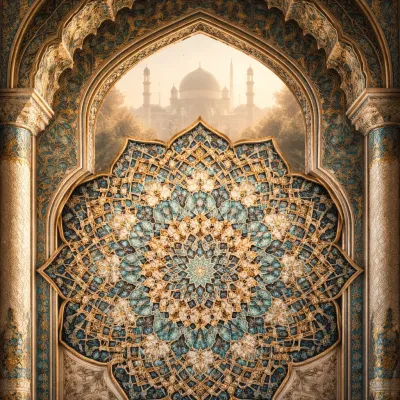
This book presents Islamic art and architecture as a visual language grounded in the Qur’anic worldview, where geometry, proportion, calligraphy, materiality, light, and ornament together express the oneness of God (tawhid) and make sacred space legible. It traces how simple geometric elements—a point, line, and circle—generate complex patterns that embody divine unity, how numerical ratios and proportional systems reflect cosmic order, and how archetypal forms such as the circle and square articulate the relationship between the earthly and the celestial. Chapters explore the construction of stars, girih strapwork, tessellations, muqarnas vaults, arabesques, and calligraphy, showing each as a disciplined act of devotion that transforms abstract mathematical and spiritual principles into tangible surfaces and volumes.
Beyond ornament, the work examines how these elements organize architectural experience: the mosque’s typology (hypostyle, iwan, domed), its orienting features (mihrab, minbar, minaret), and spatial grammars of courtyards, iwans, and domes that guide movement and contemplation. It extends to gardens and water as sensory memories of paradise, Sufi aesthetics that emphasize presence and rhythm, acoustic design that shapes the soundscape of devotion, and urban morphologies where souks, streets, and sacred precincts interweave daily life with spiritual practice. The semiotic depth of surface ornament is unpacked as a language of unity within multiplicity, material choice, and layered meaning, while chapters on patronage, workshops, and transmission reveal the collaborative, craft‑based processes that sustained these traditions across regions and centuries.
The book also addresses the dynamics of cultural exchange—how motifs traveled from Al‑Andalus to Central and Southeast Asia—and the ethical challenges of conserving living heritage amid modern development, tourism, and climate change. It concludes with contemporary practice, showing how digital design, new materials, and sustainable approaches reinterpret traditional principles without losing their spiritual resonance, and provides practical frameworks for “reading” buildings through context, typology, spatial grammar, orientation, materials, patterns, calligraphy, light, color, water, and human scale. Throughout, the emphasis remains on the interplay of beauty, order, and devotion that makes Islamic art and architecture a profound expression of faith and a guide to contemplative experience.
What You'll Find Inside:
- Islamic geometry embodies Tawhid, turning points, lines, and circles into patterns that reflect divine unity and cosmic order.
- Calligraphy, arabesque, and geometric ornament function as a visual language that conveys theological meaning and guides contemplation.
- Material choices—stone, brick, timber, plaster, and glaze—are imbued with symbolic and sensory significance, shaping the experience of sacred space.
- Architectural typologies such as mosques, courtyards, iwans, and domes employ spatial grammars that orient worshippers and facilitate communal devotion.
- The book traces the transmission of craft, regional adaptations, conservation ethics, and contemporary digital practice, linking tradition to innovation.
Who's It For:
This book is ideal for architects, architectural historians, art historians, and designers seeking to understand and apply Islamic design principles in contemporary practice. It also serves students and scholars of Islamic studies, conservation professionals, and culturally curious readers who wish to decode the visual language of mosques, ornament, and sacred spaces. By combining historical insight with practical tools, it equips anyone interested in the intersection of faith, geometry, and material culture to read and create meaningful built environments.
Table of Contents:
- Introduction
- Chapter 1 Unity and Beauty in the Qur’anic Worldview
- Chapter 2 Geometry as Devotion: From Point to Pattern
- Chapter 3 Number, Proportion, and Cosmic Order
- Chapter 4 The Circle and the Square: Archetypes of Space
- Chapter 5 Stars and Girih: Designing with Grids
- Chapter 6 Tessellations and Symmetry: Mathematics of Ornament
- Chapter 7 Muqarnas: Stalactite Vaults and the Play of Light
- Chapter 8 Arabesque: The Infinite Vine
- Chapter 9 Calligraphy: Writing the Word in Space
- Chapter 10 Materials and Making: Stone, Brick, Timber, Plaster, and Glaze
- Chapter 11 Color and Light: Optics, Pigments, and Illumination
- Chapter 12 The Mosque: Typologies and Congregational Space
- Chapter 13 Mihrab, Minbar, and Minaret: Orientation and Proclamation
- Chapter 14 Courtyards, Iwans, and Domes: Spatial Grammars
- Chapter 15 Gardens and Water: Paradise Enclosed
- Chapter 16 Sufi Aesthetics: Presence, Rhythm, and the Heart
- Chapter 17 Sound and Silence: Acoustics of Devotion
- Chapter 18 Urban Morphologies: Souk, Street, and Sacred Precinct
- Chapter 19 Ornament and Meaning: Semiotics of Surface
- Chapter 20 Patronage, Workshops, and Transmission of Craft
- Chapter 21 Circulation of Motifs: From Al-Andalus to Central and Southeast Asia
- Chapter 22 Conservation and Ethics: Preserving Living Heritage
- Chapter 23 Modernism and Revival: Negotiating Tradition
- Chapter 24 Contemporary Practice: Digital Design and New Materials
- Chapter 25 Reading a Building: Frameworks, Diagrams, and Case Studies
Author:
Published By:
Date Published:
May 20, 2026
Type:
Nonfiction
Language:
English
Word Count:
44,243 words
Reading Time:
3 hours 6 minutes
Sample:
Order:
Order Sacred Geometry and Sacred Space: Islamic Art and Architecture Explained (Hardcover) on MixCache.com:
Buy NowPrint copy is made to order and ships worldwide. Includes the ebook free, ready to read instantly.
$5 account credit for all new MixCache.com accounts, usable toward any ebook purchase!*


