Browse by Category
Fiction
- Action & Adventure
- African American
- Anthologies
- Children's Fiction
- Classics
- Comics & Graphic Novels
- Coming of Age
- Contemporary
- Cultural & Regional
- Drama
- Erotica
- Fantasy
- General
- Historical Fiction
- Horror
- Humor & Satire
- Literary Fiction
- Mystery, Thriller & Suspense
- Poetry
- Religious & Inspirational
- Romance
- Science Fiction
- Short Stories
- War & Military
- Westerns
- Women's Fiction
- Young Adult
Non-Fiction
- Antiques & Collectibles
- Arts & Photography
- Biographies & Memoirs
- Business & Money
- Children's Non-Fiction
-
Computers & Technology
- Artificial Intelligence
- Computer Science
- Cybersecurity & Cryptography
- Data Science & Analytics
- Databases & Big Data
- Game Development & Design
- General
- Hardware & DIY
- Mobile App Development
- Networking & Cloud Computing
- Operating Systems
- Programming
- Robotics
- Software
- Software Engineering
- User Experience (UX) & Design
- Web Development & Design
- Cooking, Food & Wine
- Crafts, Hobbies & Home
- Education & Teaching
- Engineering
- General
- Health, Fitness & Dieting
-
History
- African History
- African History - North Africa
- African History - Sub-Saharan Africa
- American History
- American History - 20th Century
- American History - Civil War
- American History - Colonial Period
- Ancient History
- Asian History
- Asian History - China
- Asian History - India
- Asian History - Japan
- Asian History - Southeast Asia
- European History
- European History - Ancient Greece
- European History - Ancient Rome
- European History - Medieval
- European History - Modern
- European History - Renaissance
- General
- Middle Eastern History
- Military History
- Military History - Aviation
- Military History - Naval
- Social & Cultural History
- World History
- Humor & Entertainment
- Industrial Technology
- Language Learning
- Law
- LGBTQ+ Non-Fiction
- Literary Criticism
- Medical Books
- Parenting & Relationships
- Philosophy
- Politics & Social Sciences
- Reference
- Religion & Spirituality
-
Science & Math
- Agricultural Sciences
- Astronomy & Space Science
- Behavioral Sciences
- Biological Sciences
- Botany & Plant Science
- Chemistry
- Earth Sciences
- Engineering - Chemical
- Engineering - Civil
- Engineering - Electrical
- Engineering - Mechanical
- Environment
- General
- Geology
- Mathematics
- Nature & Ecology
- Oceanography
- Paleontology
- Physics
- Statistics
- Self-Help
- Sports & Outdoors
- Study Aids
- Sustainability & Green Living
- Textbooks
- Transportation
- Travel
- True Crime
- Urban Planning & Development
- Veterinary Medicine
- Writing & Publishing
Jump to Section
MixCache.com Total Access
Unlimited reading and audiobooks for every book published by MixCache.com.
Included titles carry the MTA badge.
Learn more →
Greenland
A History
About this book:
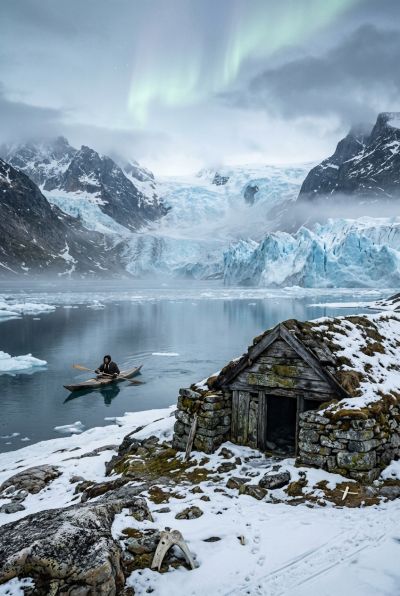
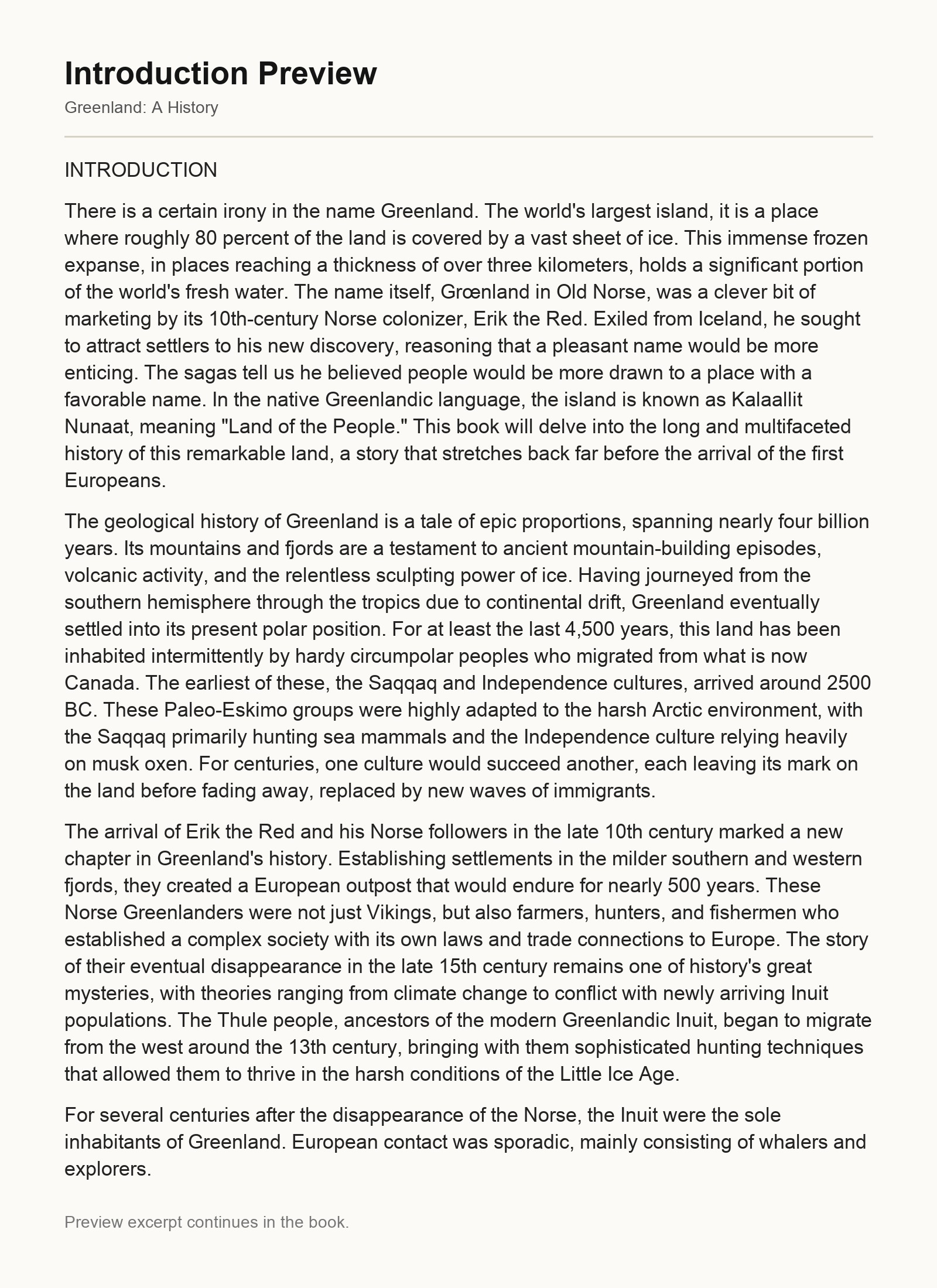
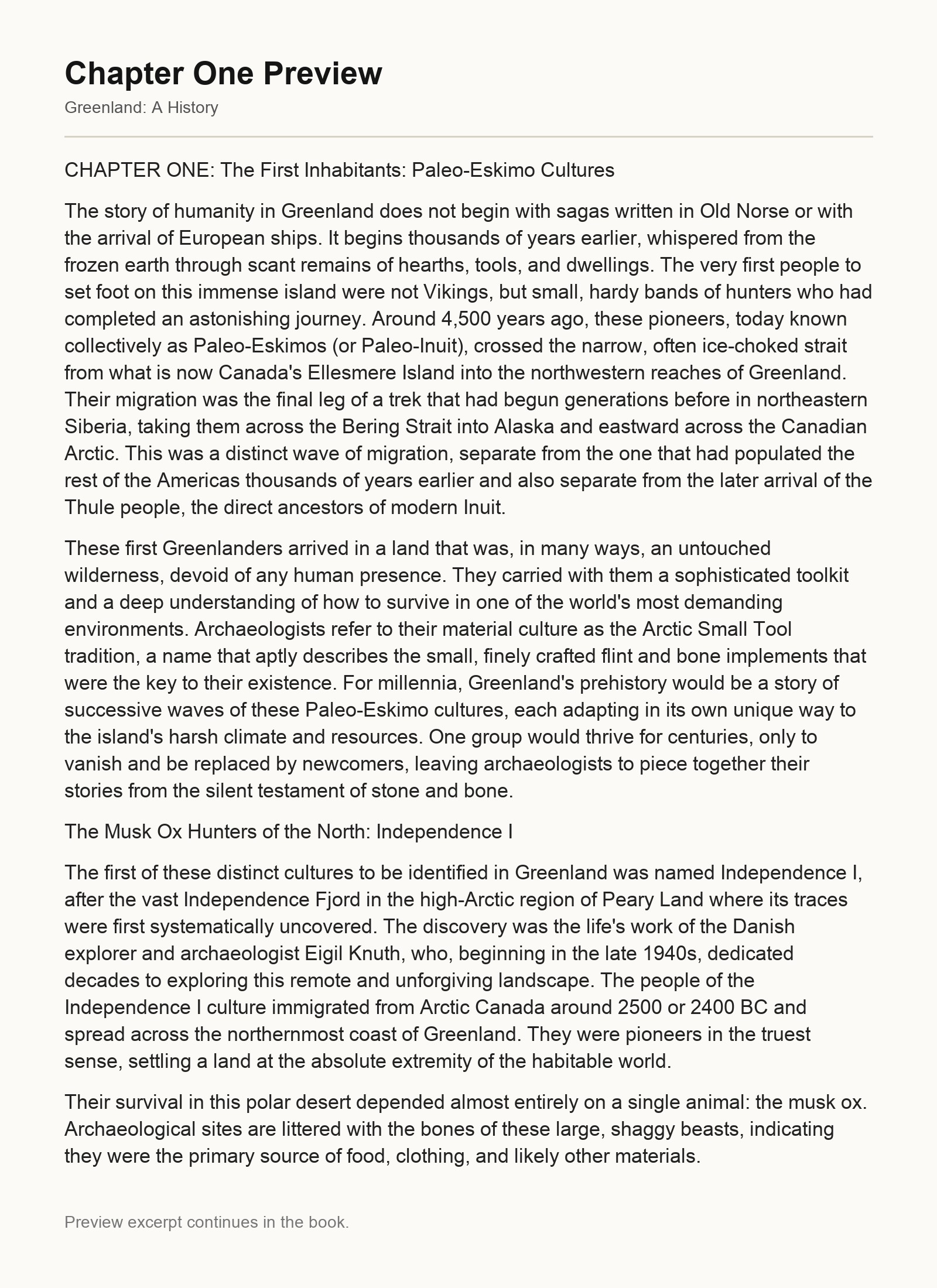
Greenland: A History invites readers on a sweeping journey through the island’s deep past, beginning with the first Paleo‑Eskimo hunters who crossed from Canada millennia ago and tracing the rise and fall of the Saqqaq, Dorset, and Thule cultures. You will discover how the pioneering musk‑ox hunters of Independence I clung to the northern fringes, how the sea‑savvy Saqqaq built enduring coastal communities, and how the technologically advanced Thule people, ancestors of today’s Inuit, spread across Greenland with their umiaks, toggling harpoons, and dog sleds, laying the cultural foundation that survives to the present.
The narrative then turns to the Norse adventure sparked by Erik the Red’s clever branding of “Greenland,” detailing the establishment of the Eastern and Western Settlements, their farming economy, the rise of a Christian diocese, and the intricate trade in walrus ivory and narwhal tusks that tied the colony to Europe. You will explore the competing theories behind the Norse disappearance—climate cooling, severed trade links, competition with the Thule, and cultural reluctance to adopt Arctic hunting techniques—and see how the Little Age transformed the island, turning a once‑promising pastoral outpost into a frozen landscape where the Thule’s ice‑adapted lifestyle thrived while the Norse world faded.
Next, the book follows the intermittent return of Europeans: the rapacious whalers who exchanged metal tools for Inuit furs and spread disease, the determined explorers like Martin Frobisher, John Davis, and Fridtjof Nansen who charted coasts and crossed the inland ice, and the missionary efforts of Hans Egede and the Moravian Brethren that began a long‑lasting colonial presence. You will learn how the Royal Greenland Trading Company imposed a state‑run monopoly that shaped everyday life for centuries, how 19th‑century scientific expeditions revealed Greenland’s interior, and how Knud Rasmussen’s immersive Thule Expeditions preserved the oral histories and myths of the Inuit peoples across the Arctic.
Moving into the 20th century, the text recounts Greenland’s sudden strategic importance during World War II as a source of cryolite and a weather‑watch hub, the construction of Thule Air Base and its Cold War role in early‑warning radar and nuclear deterrence, and the political awakening that led to Home Rule in 1979 and self‑governance in 2009. You will see how the post‑war fishing boom—first cod, then shrimp and halibut—built a modern economy, how state‑driven urbanization and Danish‑led education reshaped society, and how the resulting social tensions fueled the push for greater autonomy.
Finally, the book brings you to contemporary Greenland, where the accelerating melt of the ice sheet is reshaping coastlines, threatening traditional hunting, and opening new shipping routes and mineral prospects that attract global powers. You will experience the vibrant revival of the Greenlandic language, the dynamic music scene from Sumé to modern hip‑hop, the flourishing visual arts and literature that grapple with post‑colonial identity, and the ongoing debates over independence, resource development, and climate adaptation. By the end, readers will have gained a comprehensive understanding of how a remote Arctic island has become a focal point of environmental change, geopolitical strategy, and cultural resilience, and what choices lie ahead for its people in the 21st century.
What You'll Find Inside:
- The book chronicles Greenland's human history from Paleo-Eskimo cultures like the Saqqaq and Independence I through Norse settlement to the Thule Inuit ancestors, highlighting how each group uniquely adapted to the Arctic environment.
- It details the 500-year Norwegian Greenland colony, exploring theories for its disappearance including climate change, economic isolation from Europe, and cultural factors that hindered adaptation to Inuit survival techniques.
- The work examines Greenland's strategic 20th-century role, from its WWII cryolite mining importance to the Cold War Thule Air Base, including the forced relocation of the Inughuit and nuclear accidents that shaped local resentment.
- It traces Greenland's political evolution from Danish colony to integrated county, through the Home Rule movement of the 1970s, to the 2009 Self-Governance Act that transferred resource control and paved the way for potential independence.
- The book addresses contemporary challenges including climate change's threat to traditional hunting culture alongside its potential to unlock mineral resources, and Greenland's emerging role in 21st-century Arctic geopolitics involving global powers.
Who's It For:
This book is ideal for students and scholars of Arctic history, anthropology, colonial studies, and climate change impacts on human societies. It will also appeal to general readers interested in indigenous cultures, North Atlantic history, and Greenland's unique position in global affairs, providing a comprehensive yet accessible account of the island's 4,500-year human story.
Table of Contents:
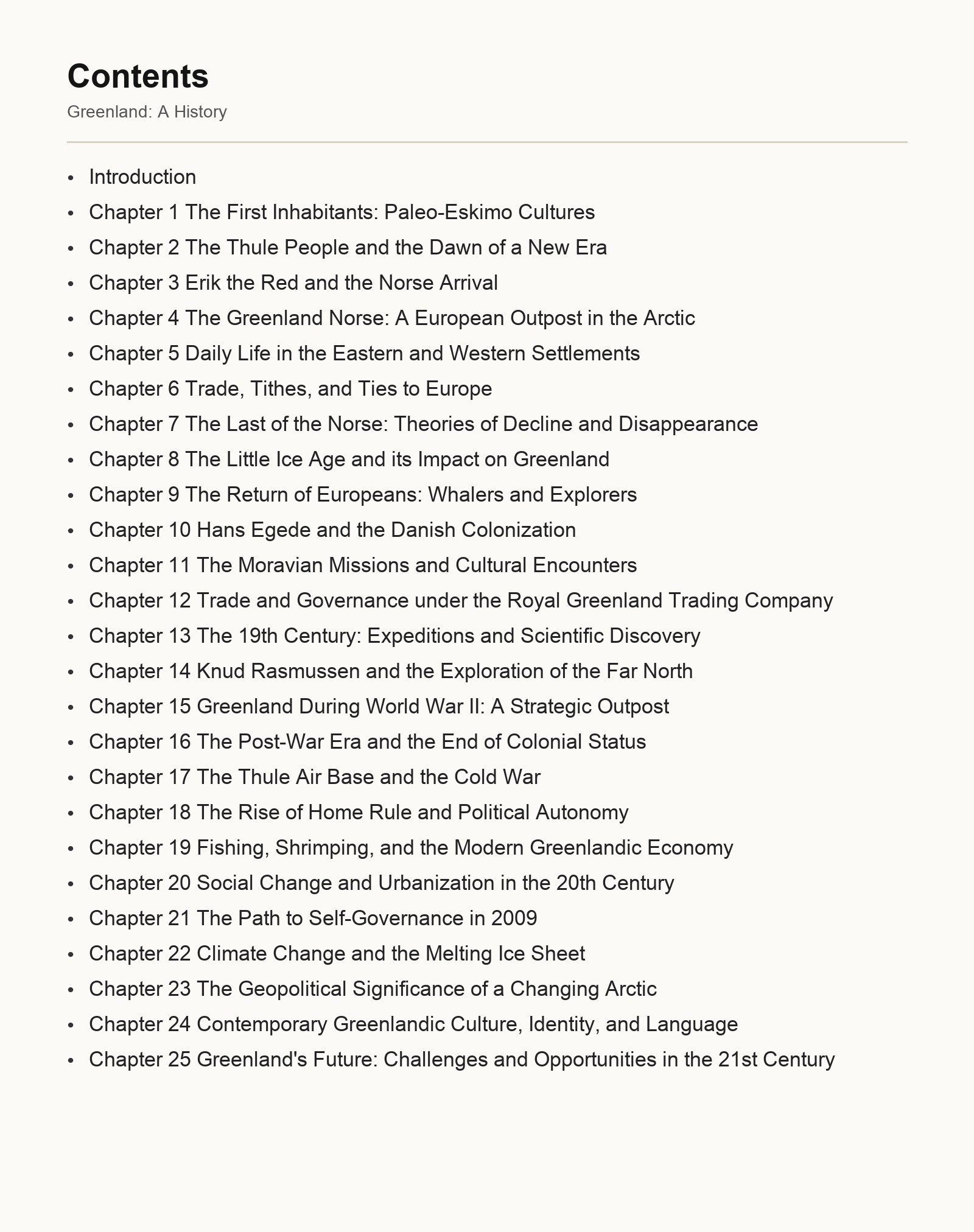
- Introduction
- Chapter 1 The First Inhabitants: Paleo-Eskimo Cultures
- Chapter 2 The Thule People and the Dawn of a New Era
- Chapter 3 Erik the Red and the Norse Arrival
- Chapter 4 The Greenland Norse: A European Outpost in the Arctic
- Chapter 5 Daily Life in the Eastern and Western Settlements
- Chapter 6 Trade, Tithes, and Ties to Europe
- Chapter 7 The Last of the Norse: Theories of Decline and Disappearance
- Chapter 8 The Little Ice Age and its Impact on Greenland
- Chapter 9 The Return of Europeans: Whalers and Explorers
- Chapter 10 Hans Egede and the Danish Colonization
- Chapter 11 The Moravian Missions and Cultural Encounters
- Chapter 12 Trade and Governance under the Royal Greenland Trading Company
- Chapter 13 The 19th Century: Expeditions and Scientific Discovery
- Chapter 14 Knud Rasmussen and the Exploration of the Far North
- Chapter 15 Greenland During World War II: A Strategic Outpost
- Chapter 16 The Post-War Era and the End of Colonial Status
- Chapter 17 The Thule Air Base and the Cold War
- Chapter 18 The Rise of Home Rule and Political Autonomy
- Chapter 19 Fishing, Shrimping, and the Modern Greenlandic Economy
- Chapter 20 Social Change and Urbanization in the 20th Century
- Chapter 21 The Path to Self-Governance in 2009
- Chapter 22 Climate Change and the Melting Ice Sheet
- Chapter 23 The Geopolitical Significance of a Changing Arctic
- Chapter 24 Contemporary Greenlandic Culture, Identity, and Language
- Chapter 25 Greenland's Future: Challenges and Opportunities in the 21st Century
Author:
Published By:
Date Published:
May 19, 2026
Type:
Nonfiction
Language:
English
Word Count:
47,156 words
Reading Time:
3 hours 18 minutes
Sample:
Order:
Order Greenland (Hardcover) on MixCache.com:
Buy NowPrint copy is made to order and ships worldwide. Includes the ebook free, ready to read instantly.
$5 account credit for all new MixCache.com accounts, usable toward any ebook purchase!*