Browse by Category
Fiction
- Action & Adventure
- African American
- Anthologies
- Children's Fiction
- Classics
- Comics & Graphic Novels
- Coming of Age
- Contemporary
- Cultural & Regional
- Drama
- Erotica
- Fantasy
- General
- Historical Fiction
- Horror
- Humor & Satire
- Literary Fiction
- Mystery, Thriller & Suspense
- Poetry
- Religious & Inspirational
- Romance
- Science Fiction
- Short Stories
- War & Military
- Westerns
- Women's Fiction
- Young Adult
Non-Fiction
- Antiques & Collectibles
- Arts & Photography
- Biographies & Memoirs
- Business & Money
- Children's Non-Fiction
-
Computers & Technology
- Artificial Intelligence
- Computer Science
- Cybersecurity & Cryptography
- Data Science & Analytics
- Databases & Big Data
- Game Development & Design
- General
- Hardware & DIY
- Mobile App Development
- Networking & Cloud Computing
- Operating Systems
- Programming
- Robotics
- Software
- Software Engineering
- User Experience (UX) & Design
- Web Development & Design
- Cooking, Food & Wine
- Crafts, Hobbies & Home
- Education & Teaching
- Engineering
- General
- Health, Fitness & Dieting
-
History
- African History
- African History - North Africa
- African History - Sub-Saharan Africa
- American History
- American History - 20th Century
- American History - Civil War
- American History - Colonial Period
- Ancient History
- Asian History
- Asian History - China
- Asian History - India
- Asian History - Japan
- Asian History - Southeast Asia
- European History
- European History - Ancient Greece
- European History - Ancient Rome
- European History - Medieval
- European History - Modern
- European History - Renaissance
- General
- Middle Eastern History
- Military History
- Military History - Aviation
- Military History - Naval
- Social & Cultural History
- World History
- Humor & Entertainment
- Industrial Technology
- Language Learning
- Law
- LGBTQ+ Non-Fiction
- Literary Criticism
- Medical Books
- Parenting & Relationships
- Philosophy
- Politics & Social Sciences
- Reference
- Religion & Spirituality
-
Science & Math
- Agricultural Sciences
- Astronomy & Space Science
- Behavioral Sciences
- Biological Sciences
- Botany & Plant Science
- Chemistry
- Earth Sciences
- Engineering - Chemical
- Engineering - Civil
- Engineering - Electrical
- Engineering - Mechanical
- Environment
- General
- Geology
- Mathematics
- Nature & Ecology
- Oceanography
- Paleontology
- Physics
- Statistics
- Self-Help
- Sports & Outdoors
- Study Aids
- Sustainability & Green Living
- Textbooks
- Transportation
- Travel
- True Crime
- Urban Planning & Development
- Veterinary Medicine
- Writing & Publishing
Jump to Section
MixCache.com Total Access
Unlimited reading and audiobooks for every book published by MixCache.com.
Included titles carry the MTA badge.
Learn more →A History of Niger
About this book:
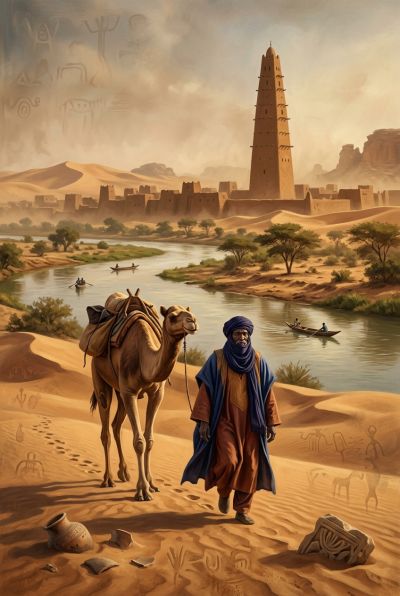
A History of Niger invites readers on an expansive journey through one of Africa’s most pivotal yet often overlooked nations, revealing how its vast desert landscapes have shaped empires, cultures, and modern struggles. From the verdant savannas of the Green Sahara, where prehistoric rock art and ancient burial sites whisper of a world teeming with wildlife, to the rise of the Songhai, Mali, and Kanem‑Bornu empires that controlled the fabled trans‑Saharan trade routes, the book illuminates the deep roots of Niger’s political and economic life. Readers will walk alongside Tuareg caravans, Hausa merchants, and Songhai scholars, witnessing how salt, gold, and ideas moved across the desert and forged the foundations of statehood in the Sahel.
The narrative then turns to the turbulent encounter with European colonialism, detailing the French conquest, the brutal Voulet‑Chanoine mission, and the establishment of a colony built on forced labor, head taxes, and the extraction of groundnuts and uranium. Chapters on life under the tricolor reveal how colonial administration reshaped social structures, introduced Western education and medicine only to a privileged few, and left a legacy of inequality that persisted long after independence. Readers will grasp the contradictions of a “civilizing mission” that brought railways and hospitals to a minority while the majority remained tied to subsistence farming and pastoralism.
Independence arrived in 1960, but the book shows how the promise of a new republic was quickly tested by drought, coups, and recurring cycles of military rule and fleeting democratic experiments. From Hamani Diori’s pro‑Western First Republic through Seyni Kountché’s uranium‑fueled development surge, the tumultuous 1990s National Conference, and the fragile transitions of the 2000s and 2010s, the text traces the patterns of political instability, economic boom‑and‑bust, and the persistent struggle to forge a unified national identity amid a mosaic of ethnic groups—Hausa, Zarma‑Songhai, Tuareg, Fulani, Kanuri, and many others. Readers will experience the hopes and disappointments of each era, seeing how external pressures and internal rivalries have repeatedly reshaped Niger’s destiny.
Beyond politics, the book immerses readers in Niger’s rich cultural tapestry: the enduring presence of Islam intertwined with traditional Bori spirit possession, the vibrant festivals like the Cure Salée and Gerewol, the timeless art of griots, Tuareg silverwork, and Sudano‑Sahelian architecture. Chapters on the economy reveal the stark duality of a nation where over eighty percent depend on rain‑fed agriculture and pastoralism, yet whose state fortunes rise and fall with the price of uranium, oil, and foreign aid. Readers will understand how climate change, demographic explosion, and regional jihadist insurgencies intertwine to create today’s profound challenges.
Finally, A History of Niger brings the story up to the present, examining the 2023 coup, the collapse of Western security partnerships, and the nation’s realignment toward new allies amid ongoing violence and humanitarian crises. By the end, readers will have a comprehensive grasp of how Niger’s past—its prehistoric green sands, imperial glory, colonial scars, democratic aspirations, and cultural resilience—continues to inform its uncertain future. This is not merely a chronicle of dates and events; it is an invitation to comprehend a country at the heart of the Sahel, whose struggles and strengths are essential to understanding the broader story of West Africa.
What You'll Find Inside:
- Explores Niger's prehistoric Green Sahara era, highlighting rock art like the Dabous Giraffes and the Gobero cemetery to show early human adaptation to dramatic climate shifts.
- Examines the trans-Saharan trade routes and the rise of medieval empires—Mali, Songhai, and Kanem-Bornu—that brought wealth, Islam, and political transformation to the region.
- Details French colonial conquest, resistance movements such as the Kaocen Revolt, and the lasting administrative and economic legacy of colonial rule in Niger.
- Traces Niger's post-independence political turbulence, including repeated coups, democratic experiments, and the ongoing struggle between civilian and military rule.
- Highlights Niger's rich ethnic mosaic, cultural traditions, and contemporary challenges like uranium dependence, climate vulnerability, and regional security crises.
Who's It For:
This book is ideal for university students and researchers of African history, postcolonial studies, and development studies, as well as general readers interested in understanding the complex trajectory of a Sahelian nation. It will also benefit policymakers, NGO workers, and journalists seeking context on Niger's current political and humanitarian crises. Anyone looking for a comprehensive, accessible narrative that connects ancient heritage to modern challenges will find value in this work.
Table of Contents:
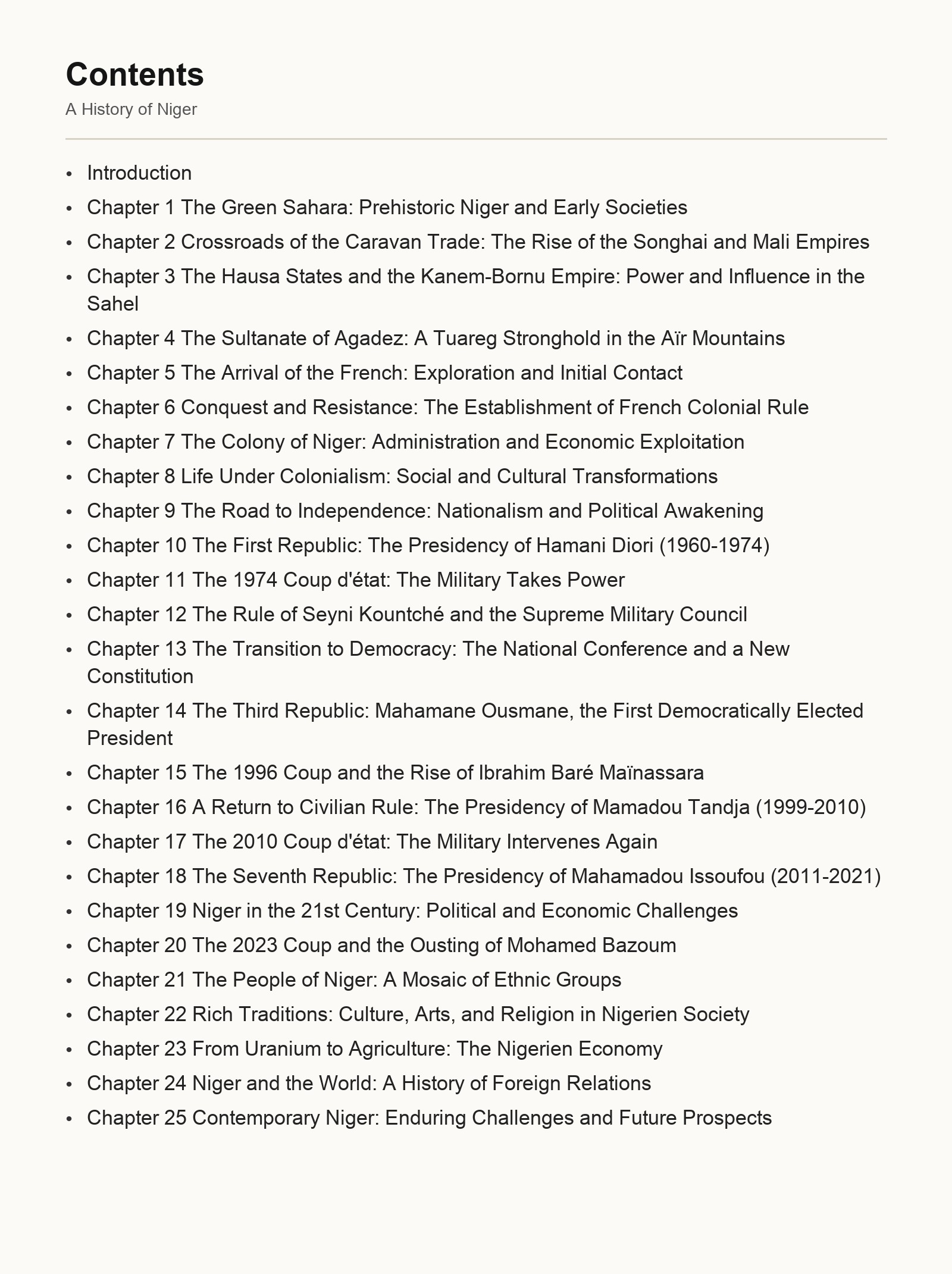
- Introduction
- Chapter 1 The Green Sahara: Prehistoric Niger and Early Societies
- Chapter 2 Crossroads of the Caravan Trade: The Rise of the Songhai and Mali Empires
- Chapter 3 The Hausa States and the Kanem-Bornu Empire: Power and Influence in the Sahel
- Chapter 4 The Sultanate of Agadez: A Tuareg Stronghold in the Aïr Mountains
- Chapter 5 The Arrival of the French: Exploration and Initial Contact
- Chapter 6 Conquest and Resistance: The Establishment of French Colonial Rule.
- Chapter 7 The Colony of Niger: Administration and Economic Exploitation.
- Chapter 8 Life Under Colonialism: Social and Cultural Transformations
- Chapter 9 The Road to Independence: Nationalism and Political Awakening.
- Chapter 10 The First Republic: The Presidency of Hamani Diori (1960-1974).
- Chapter 11 The 1974 Coup d'état: The Military Takes Power.
- Chapter 12 The Rule of Seyni Kountché and the Supreme Military Council
- Chapter 13 The Transition to Democracy: The National Conference and a New Constitution
- Chapter 14 The Third Republic: Mahamane Ousmane, the First Democratically Elected President.
- Chapter 15 The 1996 Coup and the Rise of Ibrahim Baré Maïnassara
- Chapter 16 A Return to Civilian Rule: The Presidency of Mamadou Tandja (1999-2010).
- Chapter 17 The 2010 Coup d'état: The Military Intervenes Again.
- Chapter 18 The Seventh Republic: The Presidency of Mahamadou Issoufou (2011-2021).
- Chapter 19 Niger in the 21st Century: Political and Economic Challenges
- Chapter 20 The 2023 Coup and the Ousting of Mohamed Bazoum.
- Chapter 21 The People of Niger: A Mosaic of Ethnic Groups.
- Chapter 22 Rich Traditions: Culture, Arts, and Religion in Nigerien Society.
- Chapter 23 From Uranium to Agriculture: The Nigerien Economy
- Chapter 24 Niger and the World: A History of Foreign Relations
- Chapter 25 Contemporary Niger: Enduring Challenges and Future Prospects
Author:
Published By:
Date Published:
May 18, 2026
Type:
Nonfiction
Language:
English
Also Available In:
Word Count:
49,802 words
Reading Time:
3 hours 29 minutes
Sample:
Order:
Order A History of Niger (Hardcover) on MixCache.com:
Buy NowPrint copy is made to order and ships worldwide. Includes the ebook free, ready to read instantly.
$5 account credit for all new MixCache.com accounts, usable toward any ebook purchase!*