Browse by Category
Fiction
- Action & Adventure
- African American
- Anthologies
- Children's Fiction
- Classics
- Comics & Graphic Novels
- Coming of Age
- Contemporary
- Cultural & Regional
- Drama
- Erotica
- Fantasy
- General
- Historical Fiction
- Horror
- Humor & Satire
- Literary Fiction
- Mystery, Thriller & Suspense
- Poetry
- Religious & Inspirational
- Romance
- Science Fiction
- Short Stories
- War & Military
- Westerns
- Women's Fiction
- Young Adult
Non-Fiction
- Antiques & Collectibles
- Arts & Photography
- Biographies & Memoirs
- Business & Money
- Children's Non-Fiction
-
Computers & Technology
- Artificial Intelligence
- Computer Science
- Cybersecurity & Cryptography
- Data Science & Analytics
- Databases & Big Data
- Game Development & Design
- General
- Hardware & DIY
- Mobile App Development
- Networking & Cloud Computing
- Operating Systems
- Programming
- Robotics
- Software
- Software Engineering
- User Experience (UX) & Design
- Web Development & Design
- Cooking, Food & Wine
- Crafts, Hobbies & Home
- Education & Teaching
- Engineering
- General
- Health, Fitness & Dieting
-
History
- African History
- African History - North Africa
- African History - Sub-Saharan Africa
- American History
- American History - 20th Century
- American History - Civil War
- American History - Colonial Period
- Ancient History
- Asian History
- Asian History - China
- Asian History - India
- Asian History - Japan
- Asian History - Southeast Asia
- European History
- European History - Ancient Greece
- European History - Ancient Rome
- European History - Medieval
- European History - Modern
- European History - Renaissance
- General
- Middle Eastern History
- Military History
- Military History - Aviation
- Military History - Naval
- Social & Cultural History
- World History
- Humor & Entertainment
- Industrial Technology
- Language Learning
- Law
- LGBTQ+ Non-Fiction
- Literary Criticism
- Medical Books
- Parenting & Relationships
- Philosophy
- Politics & Social Sciences
- Reference
- Religion & Spirituality
-
Science & Math
- Agricultural Sciences
- Astronomy & Space Science
- Behavioral Sciences
- Biological Sciences
- Botany & Plant Science
- Chemistry
- Earth Sciences
- Engineering - Chemical
- Engineering - Civil
- Engineering - Electrical
- Engineering - Mechanical
- Environment
- General
- Geology
- Mathematics
- Nature & Ecology
- Oceanography
- Paleontology
- Physics
- Statistics
- Self-Help
- Sports & Outdoors
- Study Aids
- Sustainability & Green Living
- Textbooks
- Transportation
- Travel
- True Crime
- Urban Planning & Development
- Veterinary Medicine
- Writing & Publishing
Jump to Section
MixCache.com Total Access
Unlimited reading and audiobooks for every book published by MixCache.com.
Included titles carry the MTA badge.
Learn more →A History of Taxes and Taxation
About this book:



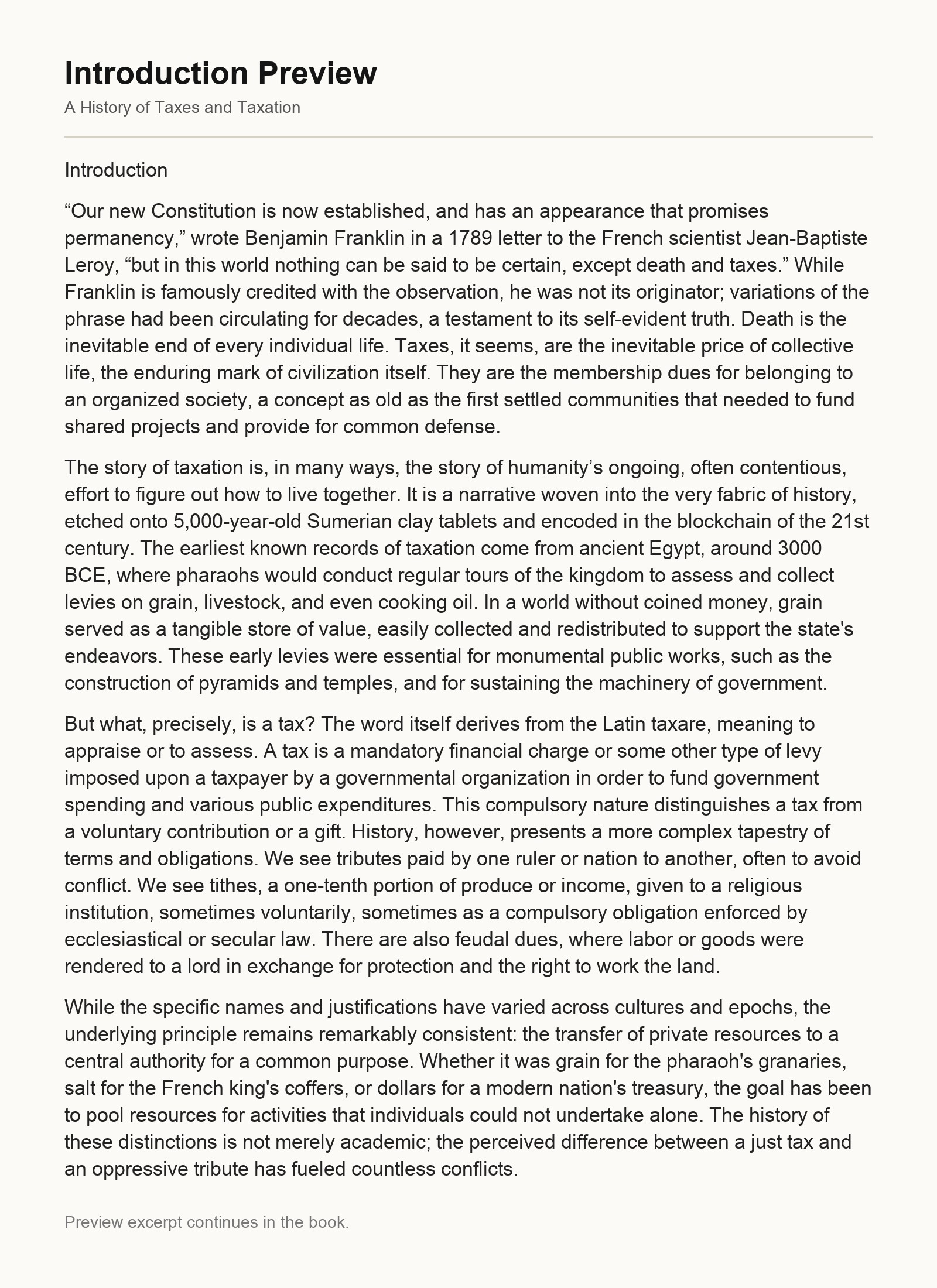
Throughout human history, one constant has remained as inevitable as death itself: the need for societies to collect resources from their members to fund collective endeavors. This fundamental truth forms the backbone of "A History of Taxes and Taxation," a comprehensive exploration of how the act of taxation has shaped civilizations, sparked revolutions, and defined the relationship between governed and government across five millennia. From the clay tablets of ancient Sumer to the blockchain ledgers of the 21st century, this book reveals taxation not merely as a financial mechanism but as a driving force of human progress and conflict.
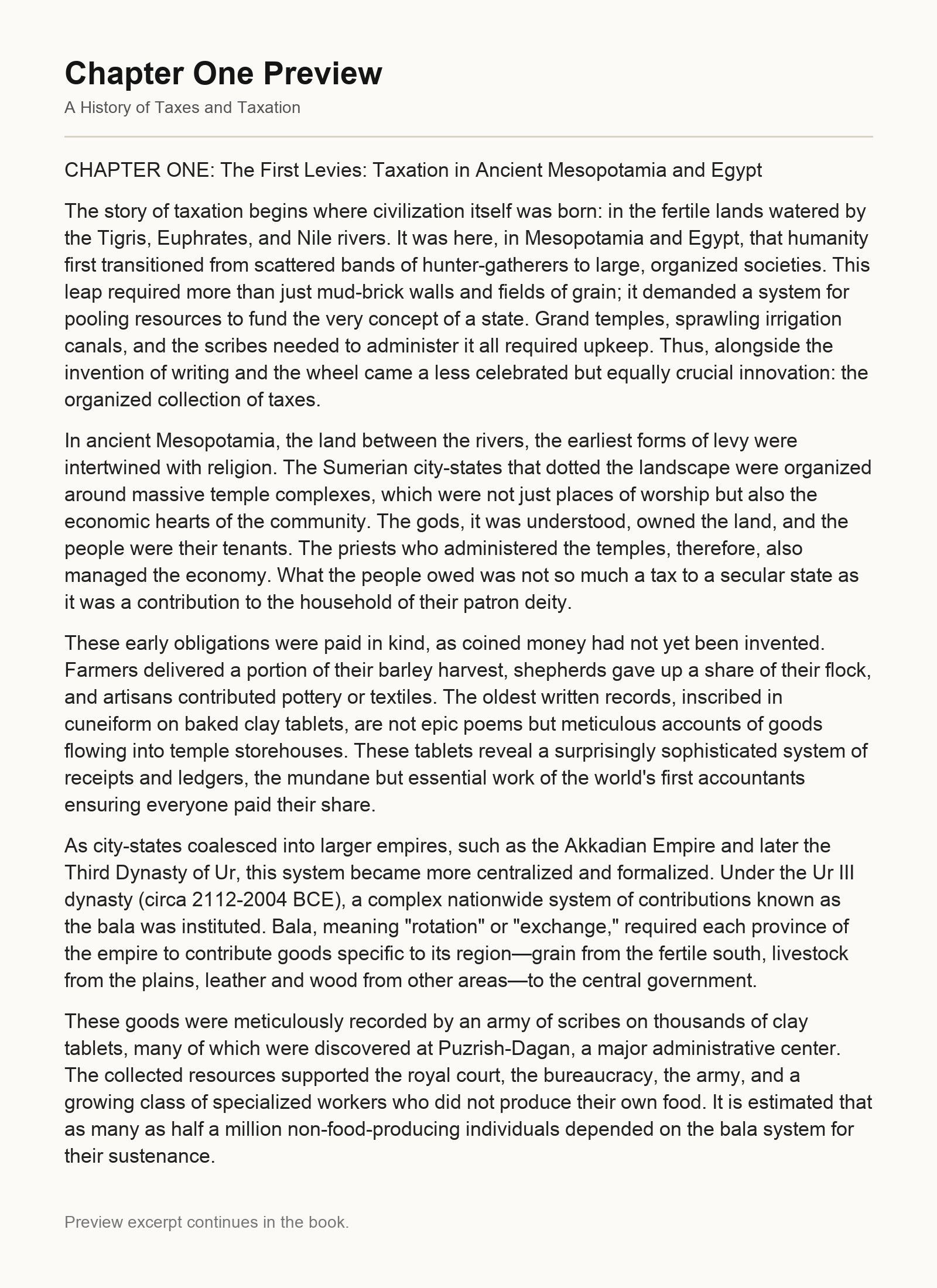
Readers will embark on a chronological journey beginning with the earliest known tax systems in Mesopotamia and Egypt, where grain and livestock payments funded pyramids and temples. The narrative progresses through the innovative liturgies of ancient Greece, the sophisticated tax farming of Rome, the feudal dues of medieval Europe, and the unique labor-based systems of the Inca and Aztec empires. Each chapter builds upon the last, showing how economic necessities, technological advances, and shifting philosophies continually transformed how societies raised revenue—from tangible goods and labor services to monetized taxes, income levies, and today's digital transactions.
This historical sweep reveals taxation's profound role as a catalyst for some of history's most pivotal moments. Discover how resentment over arbitrary levies inspired the Magna Carta's assertion that rulers require consent to tax. Trace how the American Revolution's "no taxation without representation" cry and the French Revolution's uprising against privileged exemptions reshaped political landscapes. Understand how the immense costs of total war birthed modern income tax systems and payroll withholding, forever altering the citizen-state relationship. The book illustrates time and again that tax policy isn't just about money—it's about power, fairness, and the very structure of society.
The examination continues into the modern era, where readers will confront today's most pressing tax challenges. Learn how globalization and the digital economy have complicated traditional taxation, prompting international efforts to tax e-commerce and curb profit shifting by tech giants. Explore the ongoing battle against tax havens and the international push for transparency through automatic information exchange. Engage with contemporary debates surrounding flat taxes versus wealth taxes, the mechanics of value-added taxes that fund European welfare states, and radical proposals like universal basic income that would require fundamental restructuring of tax systems.
More than a historical account, this book equips readers with the knowledge to understand taxation as a living social contract—a concept as relevant today as in ancient times. You'll gain insight into why tax debates consistently return to core questions of equity, efficiency, and the proper role of government. Whether considering the environmental taxes designed to combat climate change, the challenges of taxing automation and cryptocurrency, or the timeless tension between individual liberty and collective need, you'll see how historical patterns inform current dilemmas. Ultimately, this work reveals that understanding taxation is essential to understanding ourselves—the values we prioritize, the societies we build, and the price we willingly pay for civilization itself.
What You'll Find Inside:
- The book traces taxation's evolution from ancient Mesopotamian grain levies and Egyptian corvée labor through medieval feudal systems to modern income tax and VAT developments
- It examines how taxation disputes ignited pivotal historical events including the Magna Carta, American Revolution ('no taxation without representation'), and French Revolution
- It analyzes diverse civilizational approaches from Roman tax farming and Byzantine collective responsibility to Inca mita labor systems and Ottoman timar-iltizam arrangements
- It explores the philosophical evolution of tax fairness from Adam Smith's maxims through Progressive Era reforms to contemporary debates on wealth taxes, flat taxes, and universal basic income
- It addresses 21st-century challenges including digital economy taxation, cryptocurrency complications, tax haven proliferation, and environmental taxation responses
Who's It For:
This book is ideal for students and scholars of economics, history, and political science seeking a comprehensive understanding of taxation's role in shaping civilizations. It will particularly benefit policy makers, tax professionals, and informed citizens interested in how historical tax systems inform contemporary fiscal debates. Readers interested in the intersection of economic policy, social justice, and governmental development will find valuable insights into taxation as both an economic mechanism and a reflection of societal values throughout human history.
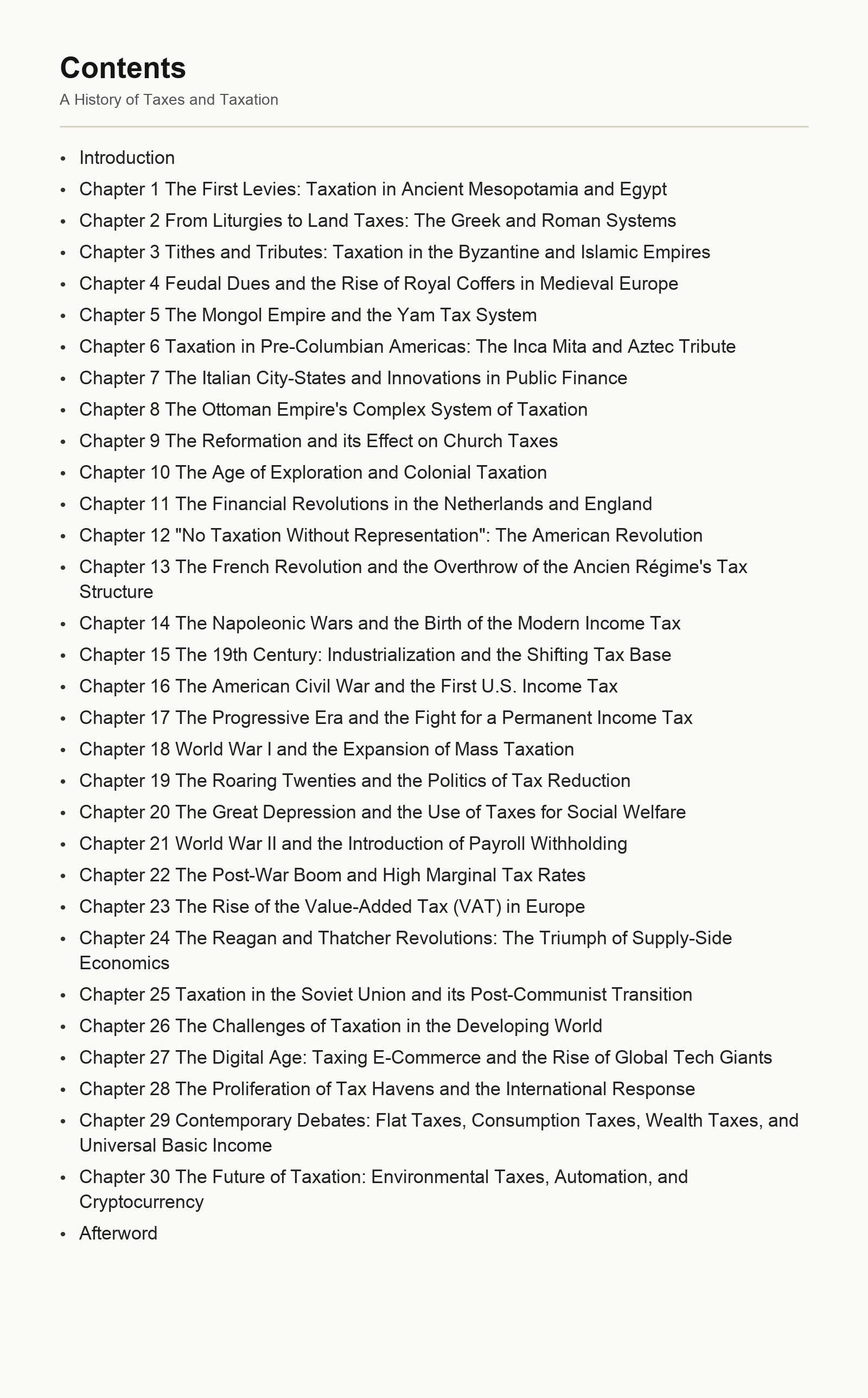
Table of Contents:
- Introduction
- Chapter 1 The First Levies: Taxation in Ancient Mesopotamia and Egypt
- Chapter 2 From Liturgies to Land Taxes: The Greek and Roman Systems
- Chapter 3 Tithes and Tributes: Taxation in the Byzantine and Islamic Empires
- Chapter 4 Feudal Dues and the Rise of Royal Coffers in Medieval Europe
- Chapter 5 The Mongol Empire and the Yam Tax System
- Chapter 6 Taxation in Pre-Columbian Americas: The Inca Mita and Aztec Tribute
- Chapter 7 The Italian City-States and Innovations in Public Finance
- Chapter 8 The Ottoman Empire's Complex System of Taxation
- Chapter 9 The Reformation and its Effect on Church Taxes
- Chapter 10 The Age of Exploration and Colonial Taxation
- Chapter 11 The Financial Revolutions in the Netherlands and England
- Chapter 12 "No Taxation Without Representation": The American Revolution
- Chapter 13 The French Revolution and the Overthrow of the Ancien Régime's Tax Structure
- Chapter 14 The Napoleonic Wars and the Birth of the Modern Income Tax
- Chapter 15 The 19th Century: Industrialization and the Shifting Tax Base
- Chapter 16 The American Civil War and the First U.S. Income Tax
- Chapter 17 The Progressive Era and the Fight for a Permanent Income Tax
- Chapter 18 World War I and the Expansion of Mass Taxation
- Chapter 19 The Roaring Twenties and the Politics of Tax Reduction
- Chapter 20 The Great Depression and the Use of Taxes for Social Welfare
- Chapter 21 World War II and the Introduction of Payroll Withholding
- Chapter 22 The Post-War Boom and High Marginal Tax Rates
- Chapter 23 The Rise of the Value-Added Tax (VAT) in Europe
- Chapter 24 The Reagan and Thatcher Revolutions: The Triumph of Supply-Side Economics
- Chapter 25 Taxation in the Soviet Union and its Post-Communist Transition
- Chapter 26 The Challenges of Taxation in the Developing World
- Chapter 27 The Digital Age: Taxing E-Commerce and the Rise of Global Tech Giants
- Chapter 28 The Proliferation of Tax Havens and the International Response
- Chapter 29 Contemporary Debates: Flat Taxes, Consumption Taxes, Wealth Taxes, and Universal Basic Income
- Chapter 30 The Future of Taxation: Environmental Taxes, Automation, and Cryptocurrency
- Afterword
Author:
Published By:
Date Published:
May 18, 2026
Type:
Nonfiction
Language:
English
Also Available In:
Word Count:
60,843 words
Reading Time:
4 hours 16 minutes
Sample:
Order:
Order A History of Taxes and Taxation (Hardcover) on MixCache.com:
Buy NowPrint copy is made to order and ships worldwide. Includes the ebook free, ready to read instantly.
$5 account credit for all new MixCache.com accounts, usable toward any ebook purchase!*