
Browse by Category
Fiction
- Action & Adventure
- African American
- Anthologies
- Children's Fiction
- Classics
- Comics & Graphic Novels
- Coming of Age
- Contemporary
- Cultural & Regional
- Drama
- Erotica
- Fantasy
- General
- Historical Fiction
- Horror
- Humor & Satire
- Literary Fiction
- Mystery, Thriller & Suspense
- Poetry
- Religious & Inspirational
- Romance
- Science Fiction
- Short Stories
- War & Military
- Westerns
- Women's Fiction
- Young Adult
Non-Fiction
- Antiques & Collectibles
- Arts & Photography
- Biographies & Memoirs
- Business & Money
- Children's Non-Fiction
-
Computers & Technology
- Artificial Intelligence
- Computer Science
- Cybersecurity & Cryptography
- Data Science & Analytics
- Databases & Big Data
- Game Development & Design
- General
- Hardware & DIY
- Mobile App Development
- Networking & Cloud Computing
- Operating Systems
- Programming
- Robotics
- Software
- Software Engineering
- User Experience (UX) & Design
- Web Development & Design
- Cooking, Food & Wine
- Crafts, Hobbies & Home
- Education & Teaching
- Engineering
- General
- Health, Fitness & Dieting
-
History
- African History
- African History - North Africa
- African History - Sub-Saharan Africa
- American History
- American History - 20th Century
- American History - Civil War
- American History - Colonial Period
- Ancient History
- Asian History
- Asian History - China
- Asian History - India
- Asian History - Japan
- Asian History - Southeast Asia
- European History
- European History - Ancient Greece
- European History - Ancient Rome
- European History - Medieval
- European History - Modern
- European History - Renaissance
- General
- Middle Eastern History
- Military History
- Military History - Aviation
- Military History - Naval
- Social & Cultural History
- World History
- Humor & Entertainment
- Industrial Technology
- Language Learning
- Law
- LGBTQ+ Non-Fiction
- Literary Criticism
- Medical Books
- Parenting & Relationships
- Philosophy
- Politics & Social Sciences
- Reference
- Religion & Spirituality
-
Science & Math
- Agricultural Sciences
- Astronomy & Space Science
- Behavioral Sciences
- Biological Sciences
- Botany & Plant Science
- Chemistry
- Earth Sciences
- Engineering - Chemical
- Engineering - Civil
- Engineering - Electrical
- Engineering - Mechanical
- Environment
- General
- Geology
- Mathematics
- Nature & Ecology
- Oceanography
- Paleontology
- Physics
- Statistics
- Self-Help
- Sports & Outdoors
- Study Aids
- Sustainability & Green Living
- Textbooks
- Transportation
- Travel
- True Crime
- Urban Planning & Development
- Veterinary Medicine
- Writing & Publishing
Jump to Section
MixCache.com Total Access
Unlimited reading and audiobooks for every book published by MixCache.com.
Included titles carry the MTA badge.
Learn more →
Linguistics
The Science of Language, Meaning, and Communication
About this book:

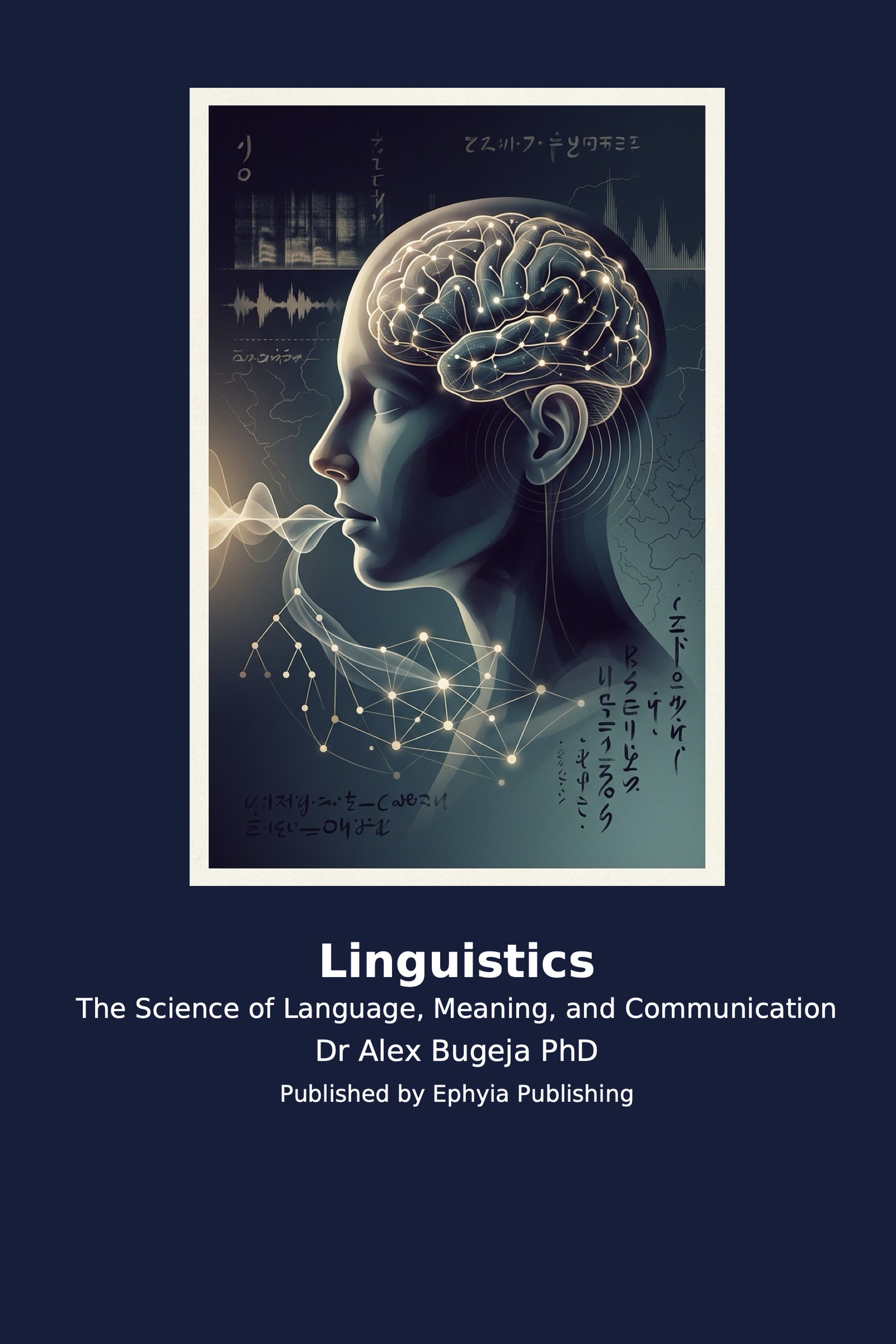
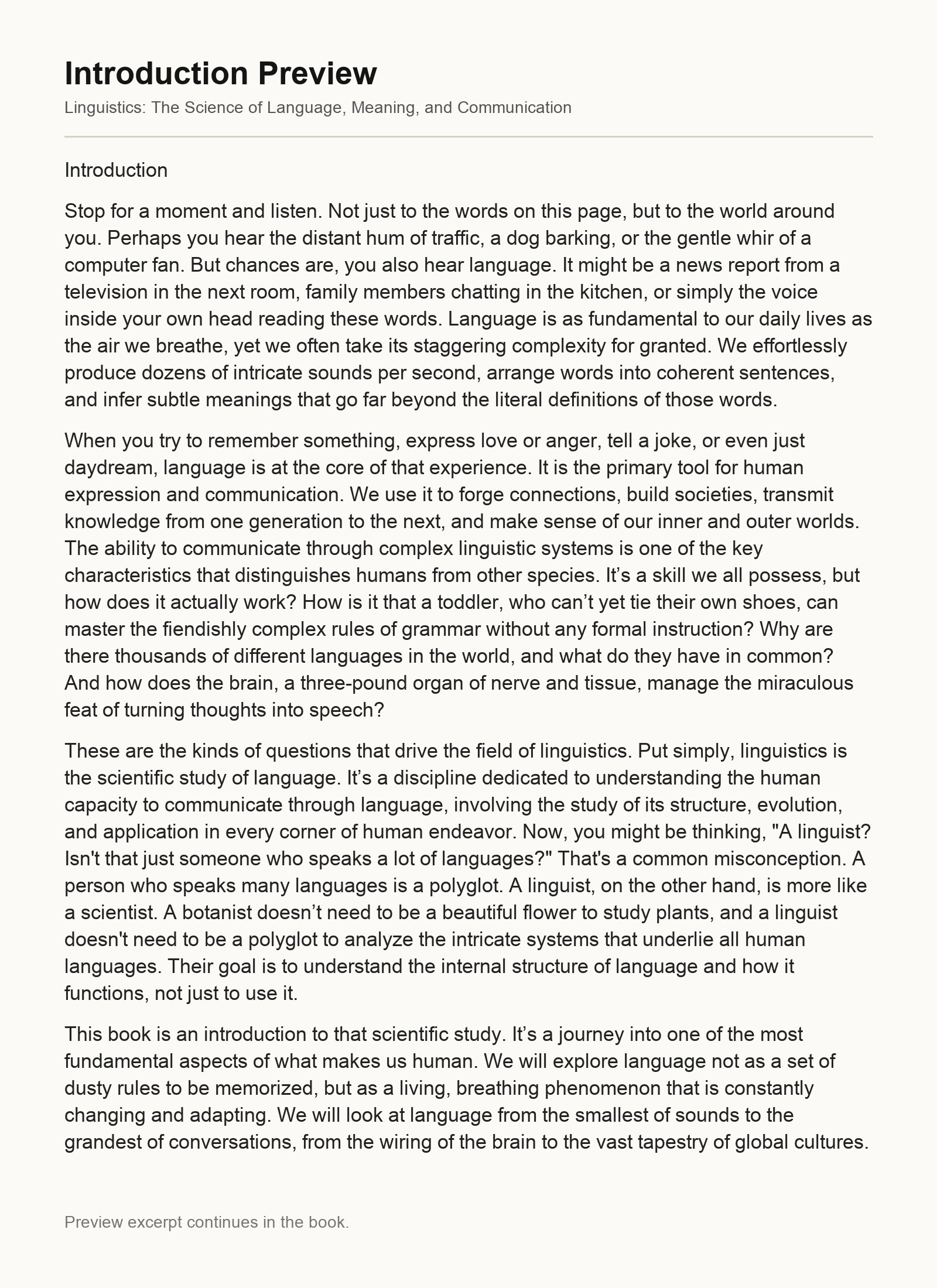
Step into the fascinating world of language as a living, breathing system that shapes every facet of human experience. This book invites you to explore linguistics not as a set of dry rules but as a scientific discipline that uncovers how sounds become meaning, how words are built, and how sentences acquire structure. From the minute vibrations of the vocal folds to the sweeping patterns of global language families, each chapter guides you through the inner workings of speech, revealing the invisible architecture that makes communication possible.
You will begin by mastering the building blocks of sound, learning how phonetics and phonology explain why certain combinations feel natural while others sound impossible. Next, you’ll see how morphemes combine to form words, and how syntax arranges those words into infinitely creative sentences. The journey continues into semantics and pragmatics, where you’ll discover how literal meaning interacts with context to produce jokes, requests, and subtle social cues. Along the way, you’ll confront common myths—such as the idea that some languages are primitive or that language is decaying—and see how linguistic research dismantles these misconceptions with evidence.
Beyond the sentence, the book expands your view to language in society, the mind, and the brain. You’ll explore how accents and dialects signal identity, how children acquire language effortlessly, and how adults learn a second tongue. Neurolinguistic insights show where language lives in the brain, while psycholinguistics uncovers the lightning‑fast processes of comprehension and production. Historical linguistics lets you trace language change over millennia, and sociolinguistics reveals the powerful links between speech, power, and culture.
Finally, you’ll look outward to the diversity of the world’s languages, the challenges of endangered tongues, and the rise of sign languages as full linguistic systems. You’ll see how computational tools are transforming translation, speech recognition, and our understanding of meaning itself. By the end, you’ll not only know how language works but also appreciate its role in shaping thought, culture, and what it means to be human—equipped with a deeper awareness of the complex system you use every day without a second thought.
What You'll Find Inside:
- Linguistics is a descriptive science that investigates language structure, meaning, and use without imposing prescriptive rules.
- Core subfields—phonetics, phonology, morphology, syntax, semantics, and pragmatics—explain how sounds become words, sentences, and meaningful communication.
- Language acquisition reveals children’s innate ability to master complex grammar, while second language learning depends on motivation, interaction, and cognitive factors.
- Language varies systematically across regions, social groups, and historical periods, reflecting identity, contact, and ongoing change.
- Modern linguistics integrates computational methods, neuroscience, and technology to model language processing, preserve endangered languages, and explore future frontiers.
Who's It For:
This book is ideal for undergraduate students beginning their study of linguistics, language educators seeking a scientific foundation for teaching, and anyone curious about how language works—from speech therapists and AI developers to polyglots and social scientists. It provides a comprehensive yet accessible overview of linguistic subfields, language acquisition, variation, and the interplay between language, mind, and society. Readers will gain both theoretical insight and practical appreciation of language as a dynamic human phenomenon.
Table of Contents:
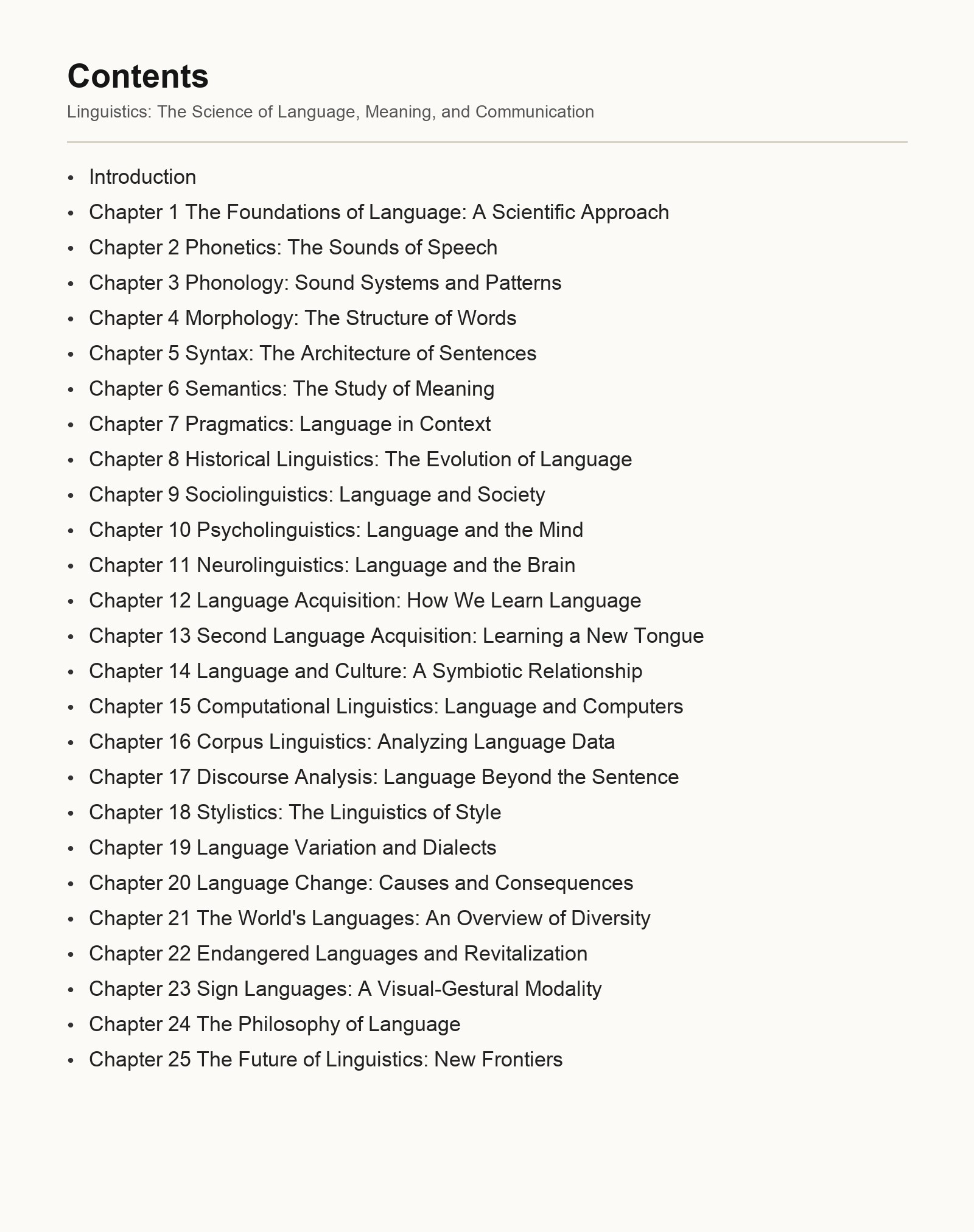
- Introduction
- Chapter 1 The Foundations of Language: A Scientific Approach
- Chapter 2 Phonetics: The Sounds of Speech
- Chapter 3 Phonology: Sound Systems and Patterns
- Chapter 4 Morphology: The Structure of Words
- Chapter 5 Syntax: The Architecture of Sentences
- Chapter 6 Semantics: The Study of Meaning
- Chapter 7 Pragmatics: Language in Context
- Chapter 8 Historical Linguistics: The Evolution of Language
- Chapter 9 Sociolinguistics: Language and Society
- Chapter 10 Psycholinguistics: Language and the Mind
- Chapter 11 Neurolinguistics: Language and the Brain
- Chapter 12 Language Acquisition: How We Learn Language
- Chapter 13 Second Language Acquisition: Learning a New Tongue
- Chapter 14 Language and Culture: A Symbiotic Relationship
- Chapter 15 Computational Linguistics: Language and Computers
- Chapter 16 Corpus Linguistics: Analyzing Language Data
- Chapter 17 Discourse Analysis: Language Beyond the Sentence
- Chapter 18 Stylistics: The Linguistics of Style
- Chapter 19 Language Variation and Dialects
- Chapter 20 Language Change: Causes and Consequences
- Chapter 21 The World's Languages: An Overview of Diversity
- Chapter 22 Endangered Languages and Revitalization
- Chapter 23 Sign Languages: A Visual-Gestural Modality
- Chapter 24 The Philosophy of Language
- Chapter 25 The Future of Linguistics: New Frontiers
Author:
Published By:
Date Published:
May 17, 2026
Type:
Nonfiction
Language:
English
Also Available In:
Word Count:
61,991 words
Reading Time:
4 hours 20 minutes
Sample:
Order:
Buy the Linguistics ebook on MixCache.com:
Buy NowThe full ebook will be available immediately to read instantly on any device.
$5 account credit for all new MixCache.com accounts, usable toward any ebook purchase!*


Ratings & Reviews
Ask Questions About This Book
Have a question about the content? Ask our AI assistant!
Start by asking a question about "Linguistics"
Example: "Does this book mention William Shakespeare?"
Thinking...