
Browse by Category
Fiction
- Action & Adventure
- African American
- Anthologies
- Children's Fiction
- Classics
- Comics & Graphic Novels
- Coming of Age
- Contemporary
- Cultural & Regional
- Drama
- Erotica
- Fantasy
- General
- Historical Fiction
- Horror
- Humor & Satire
- Literary Fiction
- Mystery, Thriller & Suspense
- Poetry
- Religious & Inspirational
- Romance
- Science Fiction
- Short Stories
- War & Military
- Westerns
- Women's Fiction
- Young Adult
Non-Fiction
- Antiques & Collectibles
- Arts & Photography
- Biographies & Memoirs
- Business & Money
- Children's Non-Fiction
-
Computers & Technology
- Artificial Intelligence
- Computer Science
- Cybersecurity & Cryptography
- Data Science & Analytics
- Databases & Big Data
- Game Development & Design
- General
- Hardware & DIY
- Mobile App Development
- Networking & Cloud Computing
- Operating Systems
- Programming
- Robotics
- Software
- Software Engineering
- User Experience (UX) & Design
- Web Development & Design
- Cooking, Food & Wine
- Crafts, Hobbies & Home
- Education & Teaching
- Engineering
- General
- Health, Fitness & Dieting
-
History
- African History
- African History - North Africa
- African History - Sub-Saharan Africa
- American History
- American History - 20th Century
- American History - Civil War
- American History - Colonial Period
- Ancient History
- Asian History
- Asian History - China
- Asian History - India
- Asian History - Japan
- Asian History - Southeast Asia
- European History
- European History - Ancient Greece
- European History - Ancient Rome
- European History - Medieval
- European History - Modern
- European History - Renaissance
- General
- Middle Eastern History
- Military History
- Military History - Aviation
- Military History - Naval
- Social & Cultural History
- World History
- Humor & Entertainment
- Industrial Technology
- Language Learning
- Law
- LGBTQ+ Non-Fiction
- Literary Criticism
- Medical Books
- Parenting & Relationships
- Philosophy
- Politics & Social Sciences
- Reference
- Religion & Spirituality
-
Science & Math
- Agricultural Sciences
- Astronomy & Space Science
- Behavioral Sciences
- Biological Sciences
- Botany & Plant Science
- Chemistry
- Earth Sciences
- Engineering - Chemical
- Engineering - Civil
- Engineering - Electrical
- Engineering - Mechanical
- Environment
- General
- Geology
- Mathematics
- Nature & Ecology
- Oceanography
- Paleontology
- Physics
- Statistics
- Self-Help
- Sports & Outdoors
- Study Aids
- Sustainability & Green Living
- Textbooks
- Transportation
- Travel
- True Crime
- Urban Planning & Development
- Veterinary Medicine
- Writing & Publishing
Jump to Section
MixCache.com Total Access
Unlimited reading and audiobooks for every book published by MixCache.com.
Included titles carry the MTA badge.
Learn more →
A History of Trade
How the Exchange of Goods Built Empires and Created the Modern World
About this book:
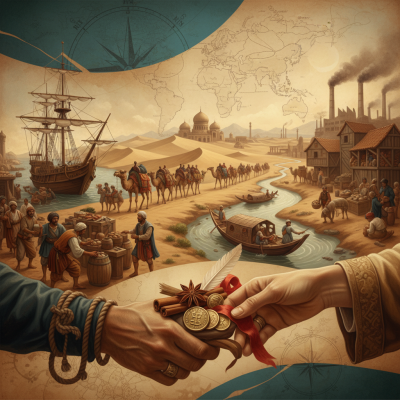
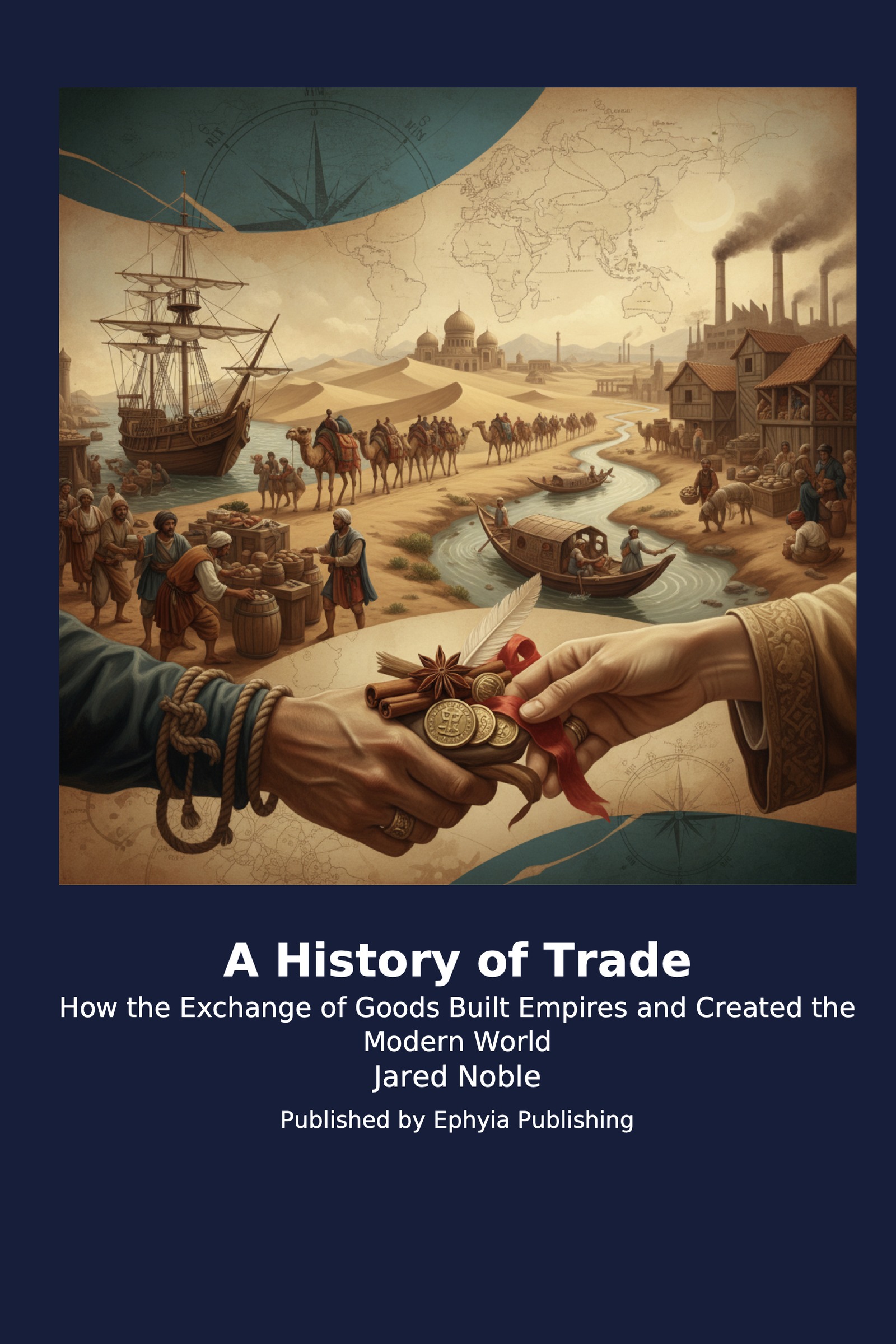
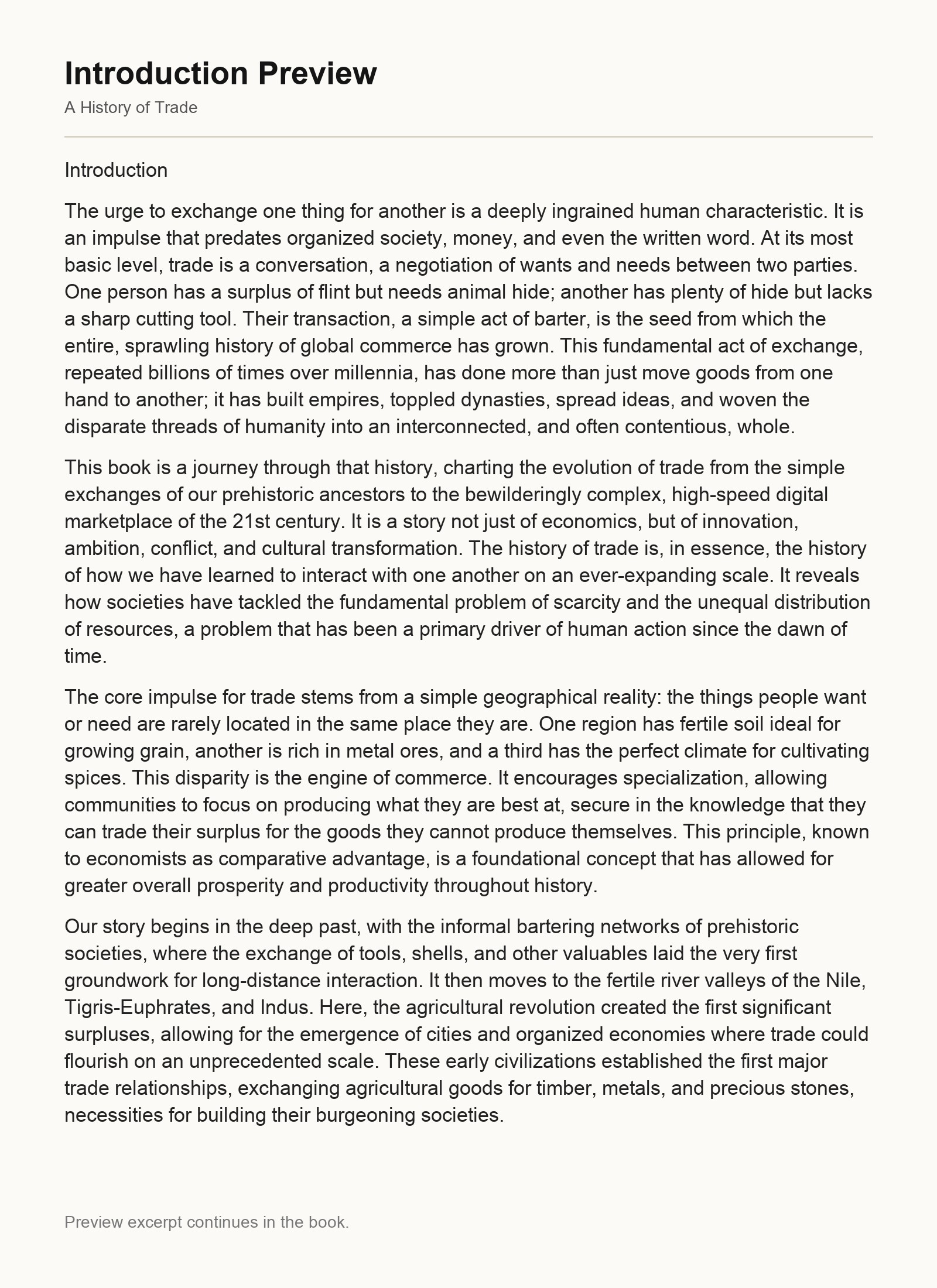
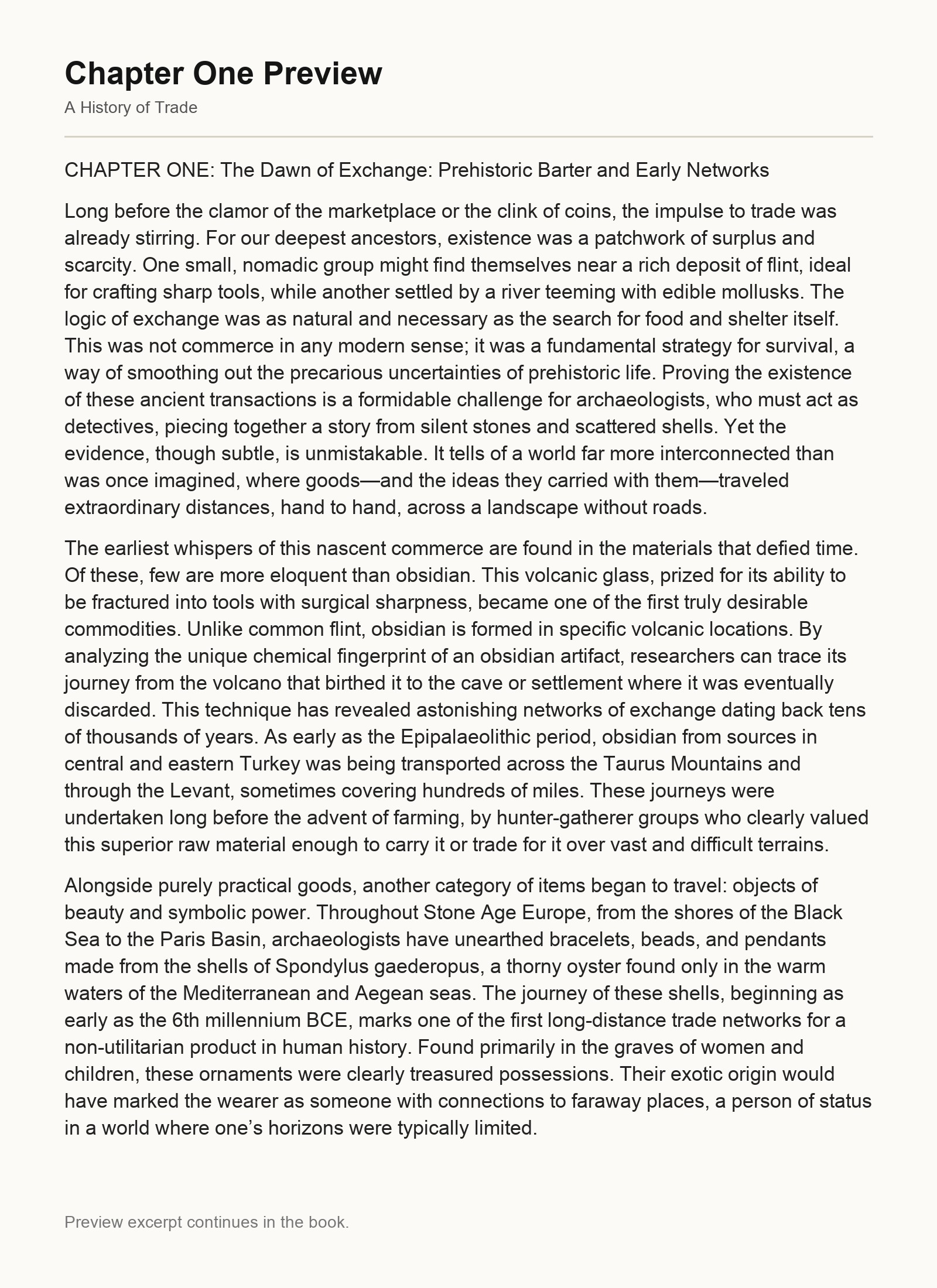
A History of Trade invites readers on an epic voyage through millennia of human exchange, revealing how the simple act of swapping goods has shaped empires, sparked revolutions, and woven the modern world together. From the first obsidian flakes carried across prehistoric landscapes to the digital clicks that now move billions of dollars in an instant, each chapter uncovers the motivations, innovations, and consequences that turned barter into a global engine of prosperity and conflict. Readers will discover how geographic scarcity drove early societies to specialize, how the rise of money and writing emerged from the need to keep accounts, and how powerful maritime traders like the Phoenicians and Vikings turned the seas into highways of culture and technology.
The narrative follows the great arteries of commerce that defined ages: the Silk Road’s caravans that carried silk, ideas, and disease between East and West; the monsoon‑driven fleets of the Indian Ocean that linked Rome with distant spice markets; the trans‑Saharan caravans that exchanged gold for salt and forged wealthy African empires; and the Hanseatic League’s network that dominated Northern Europe’s trade. Alongside these routes, the book examines the rise of powerful commercial entities—from the chartered Dutch and British East India Companies to the mercantile republics of Venice and Genoa—showing how state‑backed monopolies, financial ingenuity, and ruthless competition transformed trade into an instrument of statecraft and empire.
Readers will also witness the seismic shifts brought by the Age of Discovery, when new sea routes rewired the world’s economy, triggering the Columbian Exchange that reshaped diets, populations, and ecosystems across continents. The story continues through the age of mercantilism, the birth of free‑trade ideals sparked by Adam Smith and David Ricardo, and the Industrial Revolution that turned Britain into the “workshop of the world.” Each era is illuminated with vivid details—from the clatter of power looms in Manchester to the roar of steamships crossing newly opened canals—demonstrating how technology, politics, and human ambition continually reinvented the ways goods move and value is created.
The latter half of the book traces the tumultuous twentieth century, from the collapse of global trade during two world wars and the Great Depression to the Bretton Woods framework that sought stability through institutions like the IMF and the World Bank. It explores how containerization and supertankers revolutionized logistics, how the Asian Tigers emerged as new manufacturing powerhouses, and how the GATT evolved into the WTO, establishing a rules‑based system for modern commerce. Finally, readers confront the complexities of twenty‑first‑century trade—digital commerce, sprawling supply chains, trade wars, pandemics, and the growing tension between efficiency and resilience—offering a clear lens through which to understand today’s headlines and tomorrow’s challenges.
By the end of this journey, readers will not only have absorbed a comprehensive chronicle of trade but will also grasp the enduring patterns that underlie economic exchange: the drive to overcome scarcity, the power of networks to spread ideas and innovation, and the recurring tension between cooperation and competition. Whether you are a student of history, a business professional, or simply curious about the forces that shape our interconnected world, this book equips you with the knowledge to see trade not as a mere background activity, but as the central story of human progress.
What You'll Find Inside:
- The origins of trade in prehistoric barter and how early exchange networks spread goods, ideas, and social stratification.
- How major trade routes like the Silk Road, Trans-Saharan, and Indian Ocean monsoon trade connected civilizations and facilitated cultural and technological diffusion.
- The transformative impact of maritime exploration, chartered companies, and mercantilist policies on creating the first global economy and the tragic consequences of the Triangular Trade.
- How industrialization, steam power, railroads, telegraph, and later containerization reduced trade costs and integrated world markets into a single system.
- The evolution of international trade governance from Bretton Woods and GATT to the WTO, and contemporary challenges including trade wars, digital commerce, and supply‑chain vulnerabilities.
Who's It For:
This book is ideal for undergraduate students of history, economics, or international relations who seek a comprehensive narrative of how trade shaped human civilization. It also appeals to policymakers, business professionals, and globally minded readers interested in understanding the historical roots of today’s globalized economy and the forces driving current trade debates.
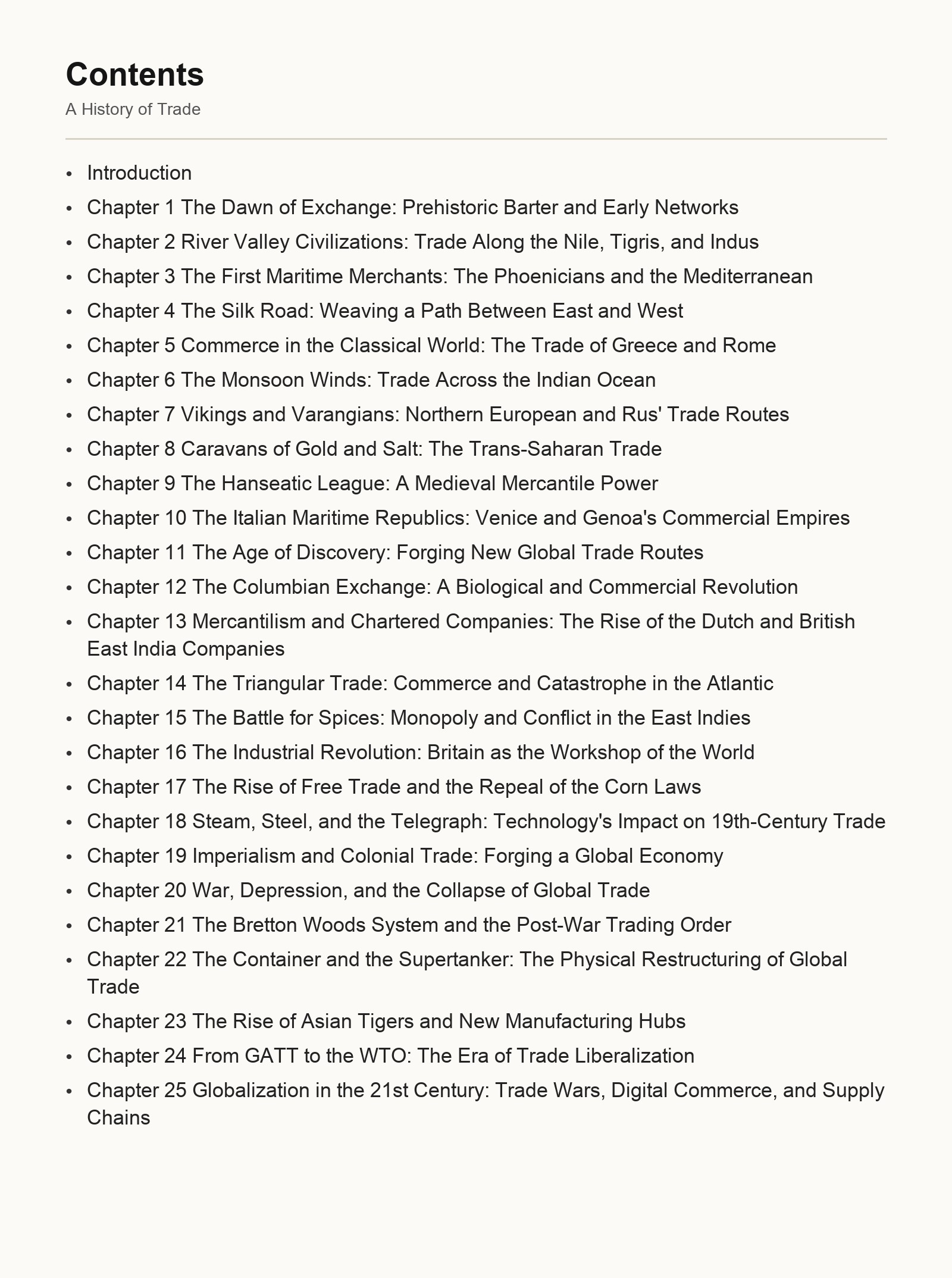
Table of Contents:
- Introduction
- Chapter 1 The Dawn of Exchange: Prehistoric Barter and Early Networks
- Chapter 2 River Valley Civilizations: Trade Along the Nile, Tigris, and Indus
- Chapter 3 The First Maritime Merchants: The Phoenicians and the Mediterranean
- Chapter 4 The Silk Road: Weaving a Path Between East and West
- Chapter 5 Commerce in the Classical World: The Trade of Greece and Rome
- Chapter 6 The Monsoon Winds: Trade Across the Indian Ocean
- Chapter 7 Vikings and Varangians: Northern European and Rus' Trade Routes
- Chapter 8 Caravans of Gold and Salt: The Trans-Saharan Trade
- Chapter 9 The Hanseatic League: A Medieval Mercantile Power
- Chapter 10 The Italian Maritime Republics: Venice and Genoa's Commercial Empires
- Chapter 11 The Age of Discovery: Forging New Global Trade Routes
- Chapter 12 The Columbian Exchange: A Biological and Commercial Revolution
- Chapter 13 Mercantilism and Chartered Companies: The Rise of the Dutch and British East India Companies
- Chapter 14 The Triangular Trade: Commerce and Catastrophe in the Atlantic
- Chapter 15 The Battle for Spices: Monopoly and Conflict in the East Indies
- Chapter 16 The Industrial Revolution: Britain as the Workshop of the World
- Chapter 17 The Rise of Free Trade and the Repeal of the Corn Laws
- Chapter 18 Steam, Steel, and the Telegraph: Technology's Impact on 19th-Century Trade
- Chapter 19 Imperialism and Colonial Trade: Forging a Global Economy
- Chapter 20 War, Depression, and the Collapse of Global Trade
- Chapter 21 The Bretton Woods System and the Post-War Trading Order
- Chapter 22 The Container and the Supertanker: The Physical Restructuring of Global Trade
- Chapter 23 The Rise of Asian Tigers and New Manufacturing Hubs
- Chapter 24 From GATT to the WTO: The Era of Trade Liberalization
- Chapter 25 Globalization in the 21st Century: Trade Wars, Digital Commerce, and Supply Chains
Author:
Published By:
Date Published:
May 17, 2026
Type:
Nonfiction
Language:
English
Also Available In:
Word Count:
52,323 words
Reading Time:
3 hours 40 minutes
Sample:
Order:
Buy the A History of Trade ebook on MixCache.com:
Buy NowThe full ebook will be available immediately to read instantly on any device.
$5 account credit for all new MixCache.com accounts, usable toward any ebook purchase!*




Ratings & Reviews
Ask Questions About This Book
Have a question about the content? Ask our AI assistant!
Start by asking a question about "A History of Trade"
Example: "Does this book mention William Shakespeare?"
Thinking...