
Browse by Category
Fiction
- Action & Adventure
- African American
- Anthologies
- Children's Fiction
- Classics
- Comics & Graphic Novels
- Coming of Age
- Contemporary
- Cultural & Regional
- Drama
- Erotica
- Fantasy
- General
- Historical Fiction
- Horror
- Humor & Satire
- Literary Fiction
- Mystery, Thriller & Suspense
- Poetry
- Religious & Inspirational
- Romance
- Science Fiction
- Short Stories
- War & Military
- Westerns
- Women's Fiction
- Young Adult
Non-Fiction
- Antiques & Collectibles
- Arts & Photography
- Biographies & Memoirs
- Business & Money
- Children's Non-Fiction
-
Computers & Technology
- Artificial Intelligence
- Computer Science
- Cybersecurity & Cryptography
- Data Science & Analytics
- Databases & Big Data
- Game Development & Design
- General
- Hardware & DIY
- Mobile App Development
- Networking & Cloud Computing
- Operating Systems
- Programming
- Robotics
- Software
- Software Engineering
- User Experience (UX) & Design
- Web Development & Design
- Cooking, Food & Wine
- Crafts, Hobbies & Home
- Education & Teaching
- Engineering
- General
- Health, Fitness & Dieting
-
History
- African History
- African History - North Africa
- African History - Sub-Saharan Africa
- American History
- American History - 20th Century
- American History - Civil War
- American History - Colonial Period
- Ancient History
- Asian History
- Asian History - China
- Asian History - India
- Asian History - Japan
- Asian History - Southeast Asia
- European History
- European History - Ancient Greece
- European History - Ancient Rome
- European History - Medieval
- European History - Modern
- European History - Renaissance
- General
- Middle Eastern History
- Military History
- Military History - Aviation
- Military History - Naval
- Social & Cultural History
- World History
- Humor & Entertainment
- Industrial Technology
- Language Learning
- Law
- LGBTQ+ Non-Fiction
- Literary Criticism
- Medical Books
- Parenting & Relationships
- Philosophy
- Politics & Social Sciences
- Reference
- Religion & Spirituality
-
Science & Math
- Agricultural Sciences
- Astronomy & Space Science
- Behavioral Sciences
- Biological Sciences
- Botany & Plant Science
- Chemistry
- Earth Sciences
- Engineering - Chemical
- Engineering - Civil
- Engineering - Electrical
- Engineering - Mechanical
- Environment
- General
- Geology
- Mathematics
- Nature & Ecology
- Oceanography
- Paleontology
- Physics
- Statistics
- Self-Help
- Sports & Outdoors
- Study Aids
- Sustainability & Green Living
- Textbooks
- Transportation
- Travel
- True Crime
- Urban Planning & Development
- Veterinary Medicine
- Writing & Publishing
Jump to Section
MixCache.com Total Access
Unlimited reading and audiobooks for every book published by MixCache.com.
Included titles carry the MTA badge.
Learn more →A History of Yukon
About this book:

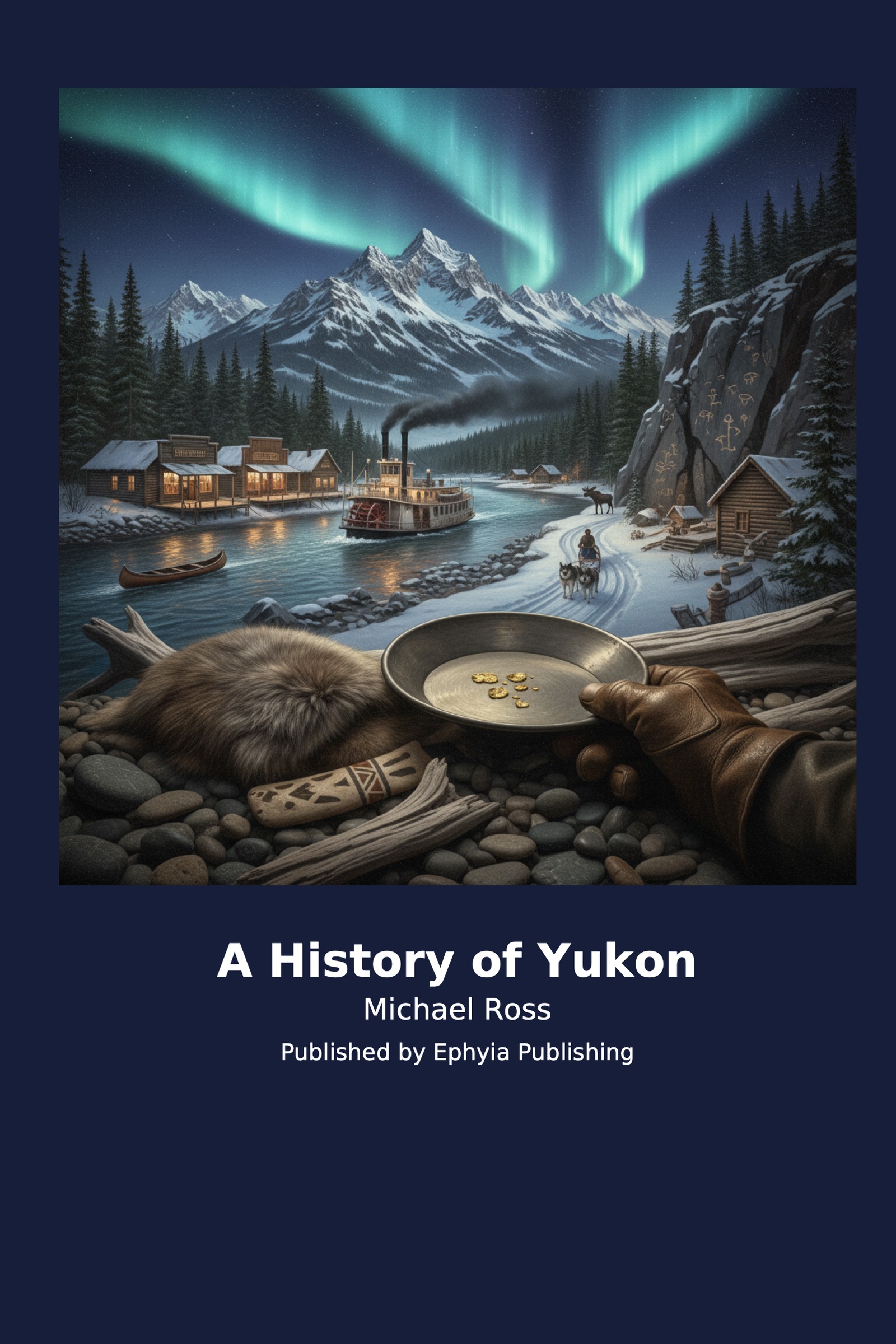
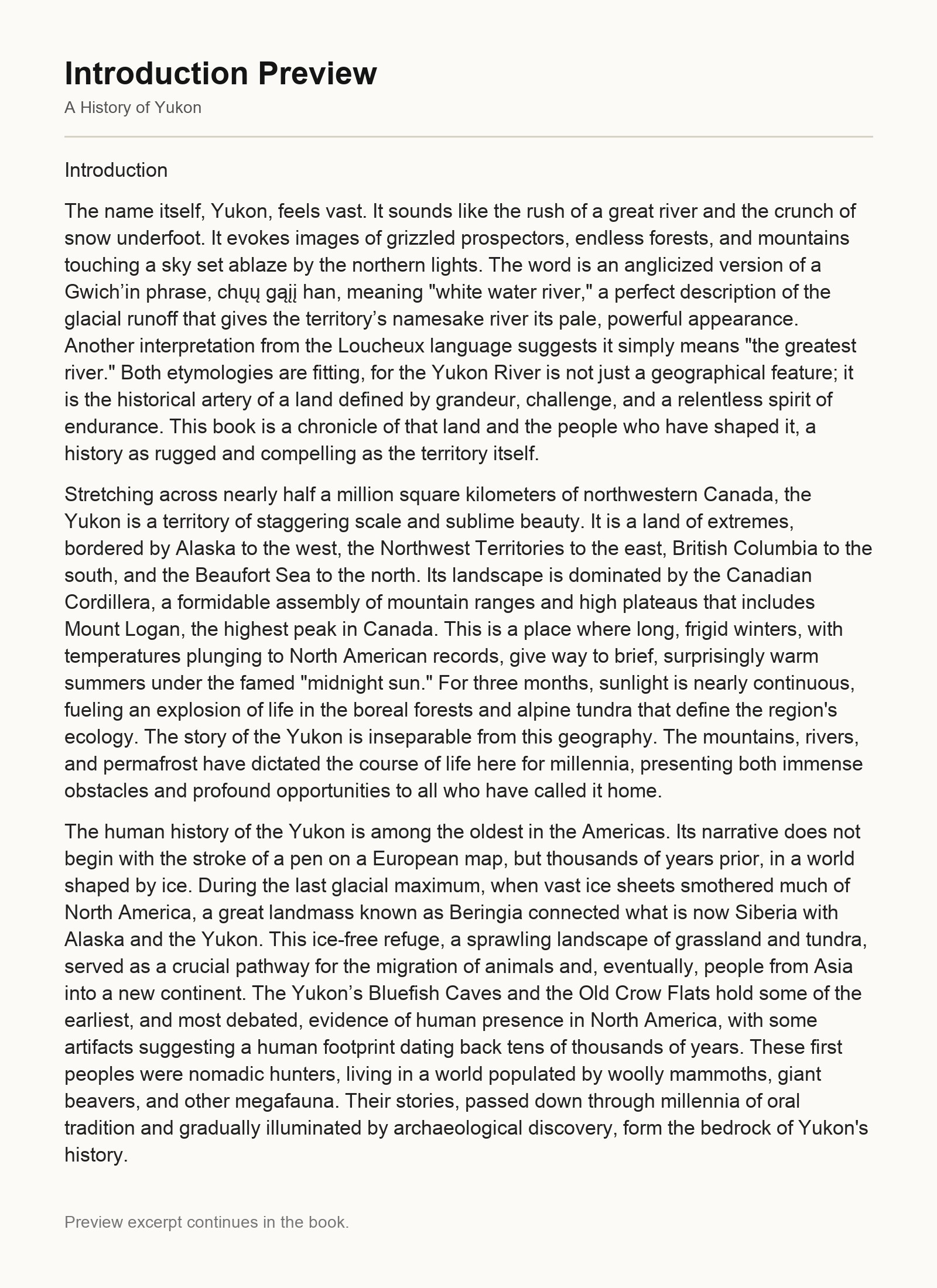
A History of Yukon invites readers on an expansive journey through one of North America’s most striking landscapes, tracing the forces that have shaped the territory from deep geological time to the present day. Beginning with the billion‑year story of mountain building, ancient seas, and the relentless advance and retreat of glaciers, the book reveals how the Yukon’s dramatic topography—its towering peaks, vast river systems, and pervasive permafrost—has dictated the movements of animals, the paths of peoples, and the location of riches hidden in the earth. Readers will come to understand how the land itself is not a passive backdrop but an active participant in every chapter of human experience here.
From the earliest arrivals during the Last Glacial Maximum, evidenced by the remarkable cut marks on bones in the Bluefish Caves, to the vibrant, enduring cultures of the Yukon First Nations, the narrative illuminates a deep, uninterrupted connection to the land that stretches back tens of thousands of years. Detailed chapters explore traditional lifeways—seasonal rounds of hunting, fishing, and gathering; sophisticated clan systems; spiritual relationships with animals and landscape; and the ingenious tools and technologies that allowed thriving in one of the world’s harshest climates. This foundation sets the stage for understanding how external forces would later intersect with, challenge, and transform these societies.
The book then follows the tide of change brought by European traders, from the early Russian fur hunters and the British explorers who first mapped the Yukon’s coast, to the Hudson’s Bay Company’s establishment of forts that reoriented trade routes and introduced new goods, dependencies, and devastating diseases. Readers will experience the dramatic shift as the fur trade altered traditional economies, created new centers of power, and set the stage for the monumental Klondike Gold Rush. The rush itself is rendered in vivid detail: the grueling Chilkoot and White Pass trails, the chaotic boomtown of Dawson City, the role of the North‑West Mounted Police in imposing order, and the fleeting nature of the stampede that left a lasting imprint on the territory’s identity.
Beyond the gold rush, the narrative continues through the quiet consolidation of the early twentieth century, the World War II construction of the Alaska Highway, the postwar mining boom that shifted economic gravity to Whitehorse, and the modern era of land claims and self‑government. Chapters devoted to the Umbrella Final Agreement and the rise of self‑governing First Nations show how Indigenous peoples negotiated a new political order, reclaiming rights to land, resources, and self‑determination while building contemporary governance structures and economic enterprises. The final sections bring the story into the twenty‑first century, examining today’s diversified economy, the enduring challenges of climate change, housing, and reconciliation, and the vibrant cultural life that persists across the territory.
By the end of A History of Yukon, readers will have gained a comprehensive understanding of how ice, gold, railroads, highways, treaties, and resilience have intertwined to shape a land and its people. They will experience the territory not merely as a place on a map but as a living story of adaptation, survival, and ongoing negotiation between humanity and a magnificent, demanding north—a story that continues to unfold.
What You'll Find Inside:
- The Yukon's ancient human history, featuring evidence from the Bluefish Caves dating back 24,000 years that challenges traditional narratives of peopling the Americas.
- The transformative Klondike Gold Rush of 1896-1899 that drew 100,000 prospectors, created Dawson City, and permanently altered the territory's economic and political landscape.
- The construction of the Alaska Highway during WWII as a military project that shattered the Yukon's isolation and shifted its economic center from Dawson City to Whitehorse.
- The landmark Umbrella Final Agreement of 1993 that established a framework for First Nations land claims and self-government, fundamentally reshaping Yukon's political landscape.
- The modern Yukon's diversified economy balancing mining, tourism, and government sectors while addressing contemporary challenges like climate change and reconciliation.
Who's It For:
This comprehensive history is ideal for readers interested in Canadian northern history, Indigenous studies, and resource development. It will particularly benefit Yukon residents seeking to understand their territorial heritage, students of geography or Canadian studies, and travelers planning to explore the region. The book's accessible narrative makes it suitable for both academic audiences and general readers fascinated by gold rush history, Indigenous land claims, and the evolution of northern communities.
Table of Contents:
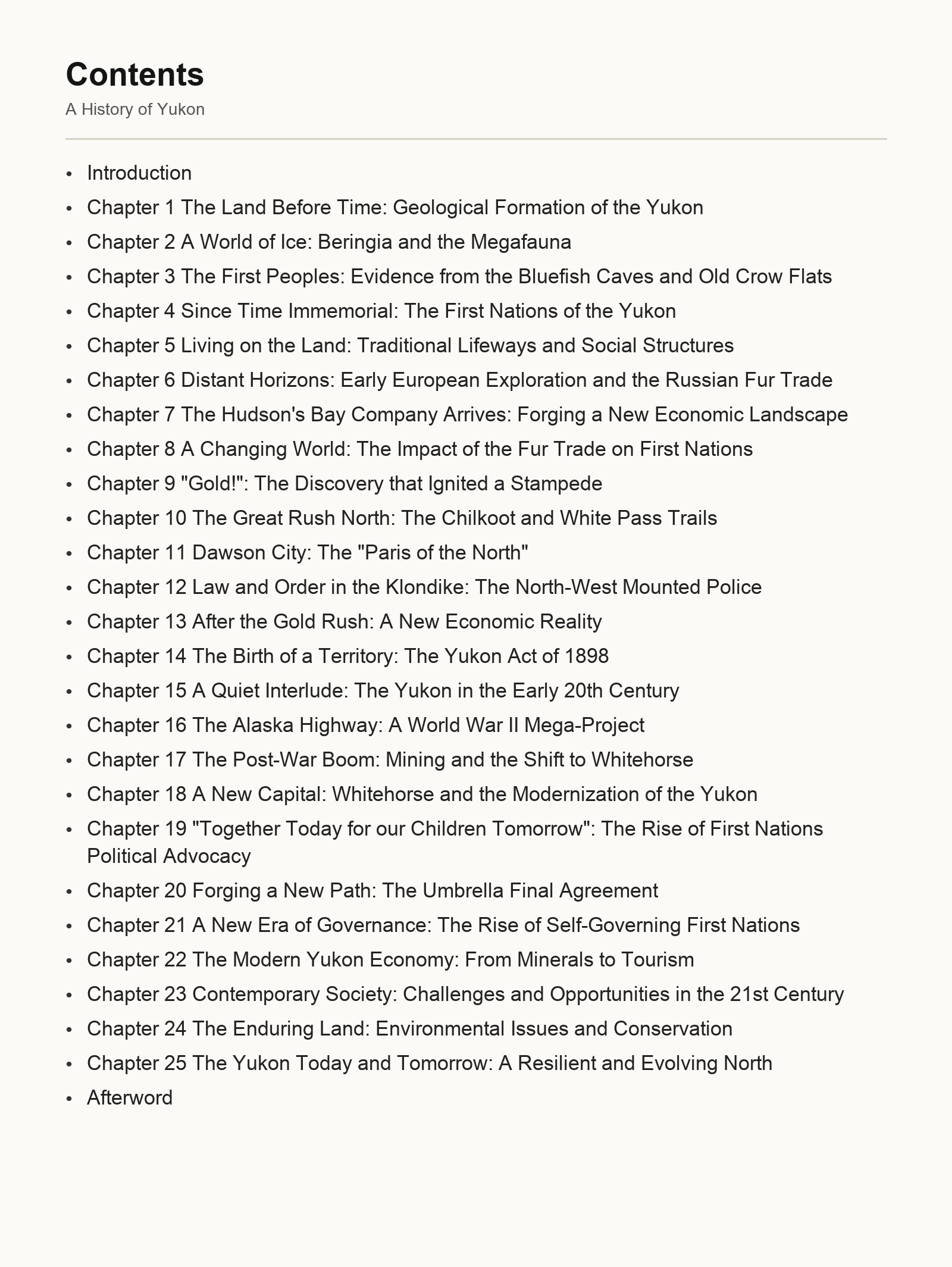
- Introduction
- Chapter 1 The Land Before Time: Geological Formation of the Yukon
- Chapter 2 A World of Ice: Beringia and the Megafauna
- Chapter 3 The First Peoples: Evidence from the Bluefish Caves and Old Crow Flats
- Chapter 4 Since Time Immemorial: The First Nations of the Yukon
- Chapter 5 Living on the Land: Traditional Lifeways and Social Structures
- Chapter 6 Distant Horizons: Early European Exploration and the Russian Fur Trade
- Chapter 7 The Hudson's Bay Company Arrives: Forging a New Economic Landscape
- Chapter 8 A Changing World: The Impact of the Fur Trade on First Nations
- Chapter 9 "Gold!": The Discovery that Ignited a Stampede
- Chapter 10 The Great Rush North: The Chilkoot and White Pass Trails
- Chapter 11 Dawson City: The "Paris of the North"
- Chapter 12 Law and Order in the Klondike: The North-West Mounted Police
- Chapter 13 After the Gold Rush: A New Economic Reality
- Chapter 14 The Birth of a Territory: The Yukon Act of 1898
- Chapter 15 A Quiet Interlude: The Yukon in the Early 20th Century
- Chapter 16 The Alaska Highway: A World War II Mega-Project
- Chapter 17 The Post-War Boom: Mining and the Shift to Whitehorse
- Chapter 18 A New Capital: Whitehorse and the Modernization of the Yukon
- Chapter 19 "Together Today for our Children Tomorrow": The Rise of First Nations Political Advocacy
- Chapter 20 Forging a New Path: The Umbrella Final Agreement
- Chapter 21 A New Era of Governance: The Rise of Self-Governing First Nations
- Chapter 22 The Modern Yukon Economy: From Minerals to Tourism
- Chapter 23 Contemporary Society: Challenges and Opportunities in the 21st Century
- Chapter 24 The Enduring Land: Environmental Issues and Conservation
- Chapter 25 The Yukon Today and Tomorrow: A Resilient and Evolving North
- Afterword
Author:
Published By:
Date Published:
May 17, 2026
Type:
Nonfiction
Language:
English
Also Available In:
Word Count:
52,917 words
Reading Time:
3 hours 42 minutes
Sample:
Order:
Buy the A History of Yukon ebook on MixCache.com:
Buy NowThe full ebook will be available immediately to read instantly on any device.
$5 account credit for all new MixCache.com accounts, usable toward any ebook purchase!*


Ratings & Reviews
Ask Questions About This Book
Have a question about the content? Ask our AI assistant!
Start by asking a question about "A History of Yukon"
Example: "Does this book mention William Shakespeare?"
Thinking...