Browse by Category
Fiction
- Action & Adventure
- African American
- Anthologies
- Children's Fiction
- Classics
- Comics & Graphic Novels
- Coming of Age
- Contemporary
- Cultural & Regional
- Drama
- Erotica
- Fantasy
- General
- Historical Fiction
- Horror
- Humor & Satire
- Literary Fiction
- Mystery, Thriller & Suspense
- Poetry
- Religious & Inspirational
- Romance
- Science Fiction
- Short Stories
- War & Military
- Westerns
- Women's Fiction
- Young Adult
Non-Fiction
- Antiques & Collectibles
- Arts & Photography
- Biographies & Memoirs
- Business & Money
- Children's Non-Fiction
-
Computers & Technology
- Artificial Intelligence
- Computer Science
- Cybersecurity & Cryptography
- Data Science & Analytics
- Databases & Big Data
- Game Development & Design
- General
- Hardware & DIY
- Mobile App Development
- Networking & Cloud Computing
- Operating Systems
- Programming
- Robotics
- Software
- Software Engineering
- User Experience (UX) & Design
- Web Development & Design
- Cooking, Food & Wine
- Crafts, Hobbies & Home
- Education & Teaching
- Engineering
- General
- Health, Fitness & Dieting
-
History
- African History
- African History - North Africa
- African History - Sub-Saharan Africa
- American History
- American History - 20th Century
- American History - Civil War
- American History - Colonial Period
- Ancient History
- Asian History
- Asian History - China
- Asian History - India
- Asian History - Japan
- Asian History - Southeast Asia
- European History
- European History - Ancient Greece
- European History - Ancient Rome
- European History - Medieval
- European History - Modern
- European History - Renaissance
- General
- Middle Eastern History
- Military History
- Military History - Aviation
- Military History - Naval
- Social & Cultural History
- World History
- Humor & Entertainment
- Industrial Technology
- Language Learning
- Law
- LGBTQ+ Non-Fiction
- Literary Criticism
- Medical Books
- Parenting & Relationships
- Philosophy
- Politics & Social Sciences
- Reference
- Religion & Spirituality
-
Science & Math
- Agricultural Sciences
- Astronomy & Space Science
- Behavioral Sciences
- Biological Sciences
- Botany & Plant Science
- Chemistry
- Earth Sciences
- Engineering - Chemical
- Engineering - Civil
- Engineering - Electrical
- Engineering - Mechanical
- Environment
- General
- Geology
- Mathematics
- Nature & Ecology
- Oceanography
- Paleontology
- Physics
- Statistics
- Self-Help
- Sports & Outdoors
- Study Aids
- Sustainability & Green Living
- Textbooks
- Transportation
- Travel
- True Crime
- Urban Planning & Development
- Veterinary Medicine
- Writing & Publishing
Jump to Section
MixCache.com Total Access
Unlimited reading and audiobooks for every book published by MixCache.com.
Included titles carry the MTA badge.
Learn more →A History of Food Preservation
About this book:

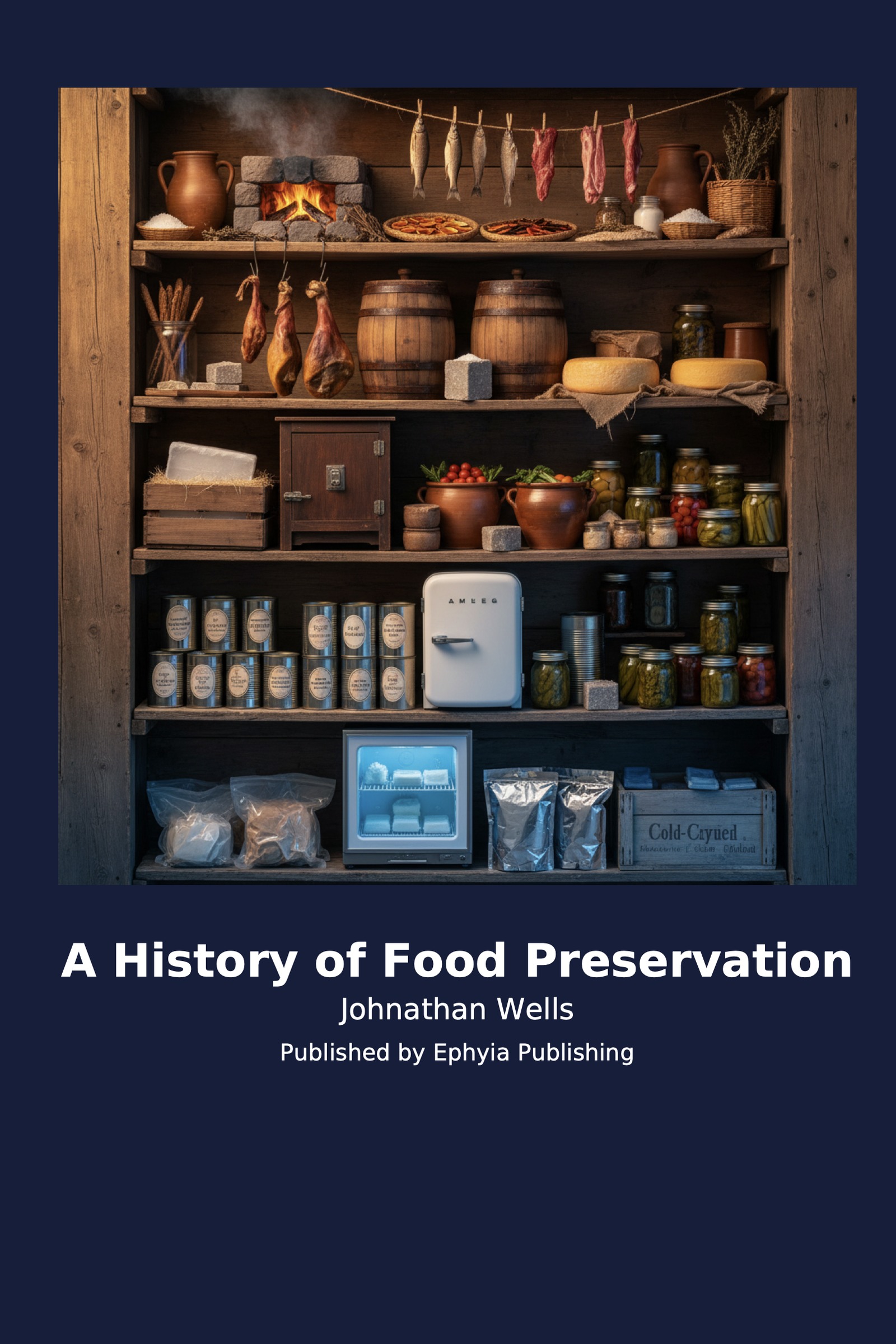
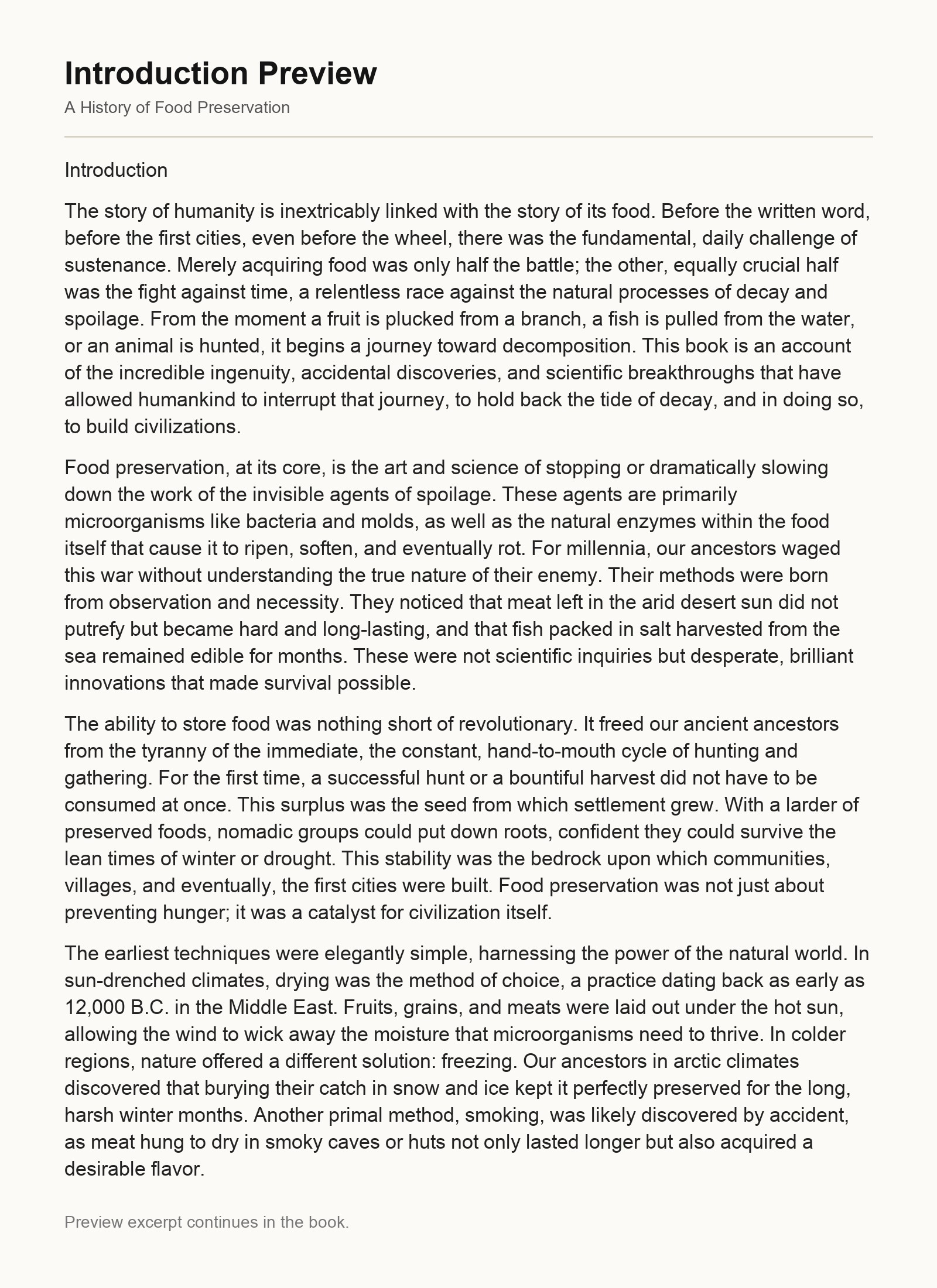
A History of Food Preservation takes readers on an expansive journey through the ingenious ways humanity has learned to defy spoilage and extend the life of its nourishment. Beginning with the earliest observations of drying meat on sun‑baked rocks, smoking fish in smoky caves, and freezing game in Arctic ice, the book reveals how these simple, nature‑based tricks allowed nomadic bands to store surplus, settle down, and lay the foundations for the first villages and cities. Each chapter uncovers the accidental discoveries and cultural adaptations that turned preservation from a desperate survival tactic into a driving force behind civilization itself.
As societies grew, the narrative follows the rise of salting and fermentation in ancient Egypt and Mesopotamia, the sweet allure of honey and sugar, and the acidic power of vinegar that gave birth to pickling. Readers will see how salt became a form of currency, how fermentation produced staple foods like beer, wine, cheese, and bread, and how the spice trade wove exotic flavors into preservation practices while silently boosting their effectiveness. The book also explores the quiet mastery of earth‑based storage—root cellars, caves, and buried caches—that kept harvests fresh through long winters without any processing at all.
The story then accelerates into the modern era with the breakthroughs of Nicolas Appert’s sealed glass bottles, Peter Durand’s tin can, and Louis Pasteur’s germ theory that transformed preservation from art to science. Readers will trace the evolution from labor‑intensive, hand‑soldered cans to the sanitary, pressure‑retort processes that made mass‑produced, shelf‑safe foods a reality. The narrative continues through the age of ice harvesting, the advent of mechanical refrigeration, Clarence Birdseye’s quick‑freezing revolution, and the industrialization of dehydration, showing how each innovation responded to war, exploration, and the changing demands of daily life.
Later chapters delve into the controversies and triumphs of chemical preservatives, the cultural shift brought by the home refrigerator, wartime innovations like the K‑ration and Spam, and the space‑age precision of freeze‑drying that fed astronauts. The book also examines emerging technologies such as high‑pressure processing, biotech starter cultures, vacuum and modified‑atmosphere packaging, and the latest frontiers of smart packaging, nanotechnology, and sustainable practices aimed at cutting food waste. By the end, readers will not only understand the scientific principles behind each method but also appreciate how preservation has shaped diets, economies, and the very structure of human societies across millennia.
What You'll Find Inside:
- Traces the development of food preservation from prehistoric drying, smoking, and freezing to modern techniques like high-pressure processing and nanotechnology.
- Highlights pivotal inventions and figures such as Nicolas Appert's canning, Louis Pasteur's germ theory, Clarence Birdseye's quick-freezing, and Peter Durand's tin can.
- Explains how preservation enabled surplus storage, leading to settled communities, trade networks, and the growth of cities and armies.
- Details scientific breakthroughs like pasteurization, pressure canning, and the understanding of microbes that transformed preservation from art to science.
- Examines contemporary issues including chemical preservative controversies, food irradiation perception, sustainability efforts, and future smart packaging innovations.
Who's It For:
This book is ideal for students and professionals in food science, nutrition, history, or culinary arts who seek a comprehensive understanding of how preservation methods have shaped human civilization. It also appeals to curious general readers interested in the technology behind everyday food and the societal impacts of food safety innovations. Anyone looking to grasp the past, present, and future of keeping food safe and nutritious will find valuable insights.
Table of Contents:
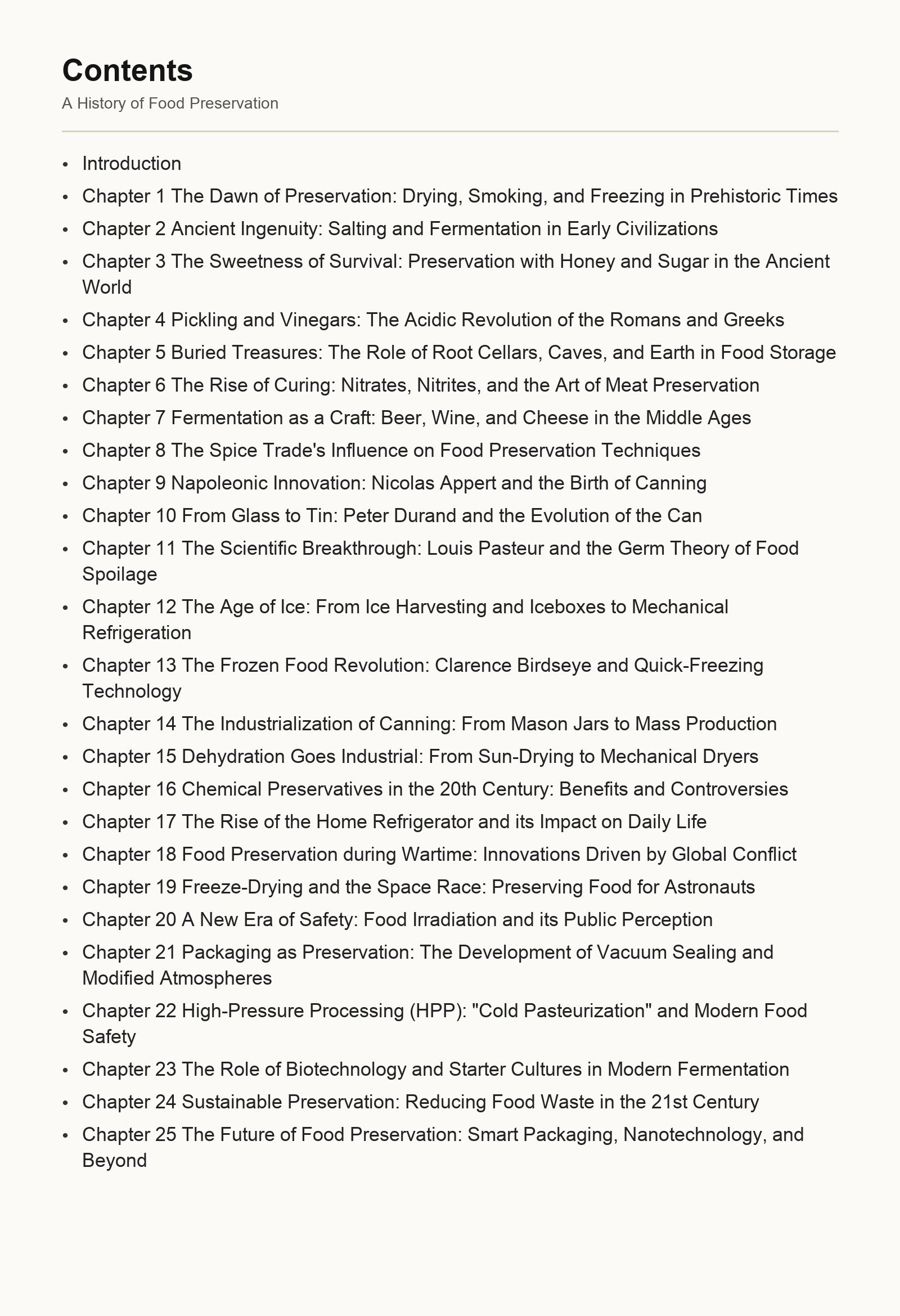
- Introduction
- Chapter 1 The Dawn of Preservation: Drying, Smoking, and Freezing in Prehistoric Times
- Chapter 2 Ancient Ingenuity: Salting and Fermentation in Early Civilizations
- Chapter 3 The Sweetness of Survival: Preservation with Honey and Sugar in the Ancient World
- Chapter 4 Pickling and Vinegars: The Acidic Revolution of the Romans and Greeks
- Chapter 5 Buried Treasures: The Role of Root Cellars, Caves, and Earth in Food Storage
- Chapter 6 The Rise of Curing: Nitrates, Nitrites, and the Art of Meat Preservation
- Chapter 7 Fermentation as a Craft: Beer, Wine, and Cheese in the Middle Ages
- Chapter 8 The Spice Trade's Influence on Food Preservation Techniques
- Chapter 9 Napoleonic Innovation: Nicolas Appert and the Birth of Canning
- Chapter 10 From Glass to Tin: Peter Durand and the Evolution of the Can
- Chapter 11 The Scientific Breakthrough: Louis Pasteur and the Germ Theory of Food Spoilage
- Chapter 12 The Age of Ice: From Ice Harvesting and Iceboxes to Mechanical Refrigeration
- Chapter 13 The Frozen Food Revolution: Clarence Birdseye and Quick-Freezing Technology
- Chapter 14 The Industrialization of Canning: From Mason Jars to Mass Production
- Chapter 15 Dehydration Goes Industrial: From Sun-Drying to Mechanical Dryers
- Chapter 16 Chemical Preservatives in the 20th Century: Benefits and Controversies
- Chapter 17 The Rise of the Home Refrigerator and its Impact on Daily Life
- Chapter 18 Food Preservation during Wartime: Innovations Driven by Global Conflict
- Chapter 19 Freeze-Drying and the Space Race: Preserving Food for Astronauts
- Chapter 20 A New Era of Safety: Food Irradiation and its Public Perception
- Chapter 21 Packaging as Preservation: The Development of Vacuum Sealing and Modified Atmospheres
- Chapter 22 High-Pressure Processing (HPP): "Cold Pasteurization" and Modern Food Safety
- Chapter 23 The Role of Biotechnology and Starter Cultures in Modern Fermentation
- Chapter 24 Sustainable Preservation: Reducing Food Waste in the 21st Century
- Chapter 25 The Future of Food Preservation: Smart Packaging, Nanotechnology, and Beyond
Author:
Published By:
Date Published:
May 17, 2026
Type:
Nonfiction
Language:
English
Also Available In:
Word Count:
43,828 words
Reading Time:
3 hours 4 minutes
Sample:
Order:
Order A History of Food Preservation (Hardcover) on MixCache.com:
Buy NowPrint copy is made to order and ships worldwide. Includes the ebook free, ready to read instantly.
$5 account credit for all new MixCache.com accounts, usable toward any ebook purchase!*