Browse by Category
Fiction
- Action & Adventure
- African American
- Anthologies
- Children's Fiction
- Classics
- Comics & Graphic Novels
- Coming of Age
- Contemporary
- Cultural & Regional
- Drama
- Erotica
- Fantasy
- General
- Historical Fiction
- Horror
- Humor & Satire
- Literary Fiction
- Mystery, Thriller & Suspense
- Poetry
- Religious & Inspirational
- Romance
- Science Fiction
- Short Stories
- War & Military
- Westerns
- Women's Fiction
- Young Adult
Non-Fiction
- Antiques & Collectibles
- Arts & Photography
- Biographies & Memoirs
- Business & Money
- Children's Non-Fiction
-
Computers & Technology
- Artificial Intelligence
- Computer Science
- Cybersecurity & Cryptography
- Data Science & Analytics
- Databases & Big Data
- Game Development & Design
- General
- Hardware & DIY
- Mobile App Development
- Networking & Cloud Computing
- Operating Systems
- Programming
- Robotics
- Software
- Software Engineering
- User Experience (UX) & Design
- Web Development & Design
- Cooking, Food & Wine
- Crafts, Hobbies & Home
- Education & Teaching
- Engineering
- General
- Health, Fitness & Dieting
-
History
- African History
- African History - North Africa
- African History - Sub-Saharan Africa
- American History
- American History - 20th Century
- American History - Civil War
- American History - Colonial Period
- Ancient History
- Asian History
- Asian History - China
- Asian History - India
- Asian History - Japan
- Asian History - Southeast Asia
- European History
- European History - Ancient Greece
- European History - Ancient Rome
- European History - Medieval
- European History - Modern
- European History - Renaissance
- General
- Middle Eastern History
- Military History
- Military History - Aviation
- Military History - Naval
- Social & Cultural History
- World History
- Humor & Entertainment
- Industrial Technology
- Language Learning
- Law
- LGBTQ+ Non-Fiction
- Literary Criticism
- Medical Books
- Parenting & Relationships
- Philosophy
- Politics & Social Sciences
- Reference
- Religion & Spirituality
-
Science & Math
- Agricultural Sciences
- Astronomy & Space Science
- Behavioral Sciences
- Biological Sciences
- Botany & Plant Science
- Chemistry
- Earth Sciences
- Engineering - Chemical
- Engineering - Civil
- Engineering - Electrical
- Engineering - Mechanical
- Environment
- General
- Geology
- Mathematics
- Nature & Ecology
- Oceanography
- Paleontology
- Physics
- Statistics
- Self-Help
- Sports & Outdoors
- Study Aids
- Sustainability & Green Living
- Textbooks
- Transportation
- Travel
- True Crime
- Urban Planning & Development
- Veterinary Medicine
- Writing & Publishing
Jump to Section
MixCache.com Total Access
Unlimited reading and audiobooks for every book published by MixCache.com.
Included titles carry the MTA badge.
Learn more →
Life behind the Iron Curtain
Daily Life in the Warsaw Pact
About this book:



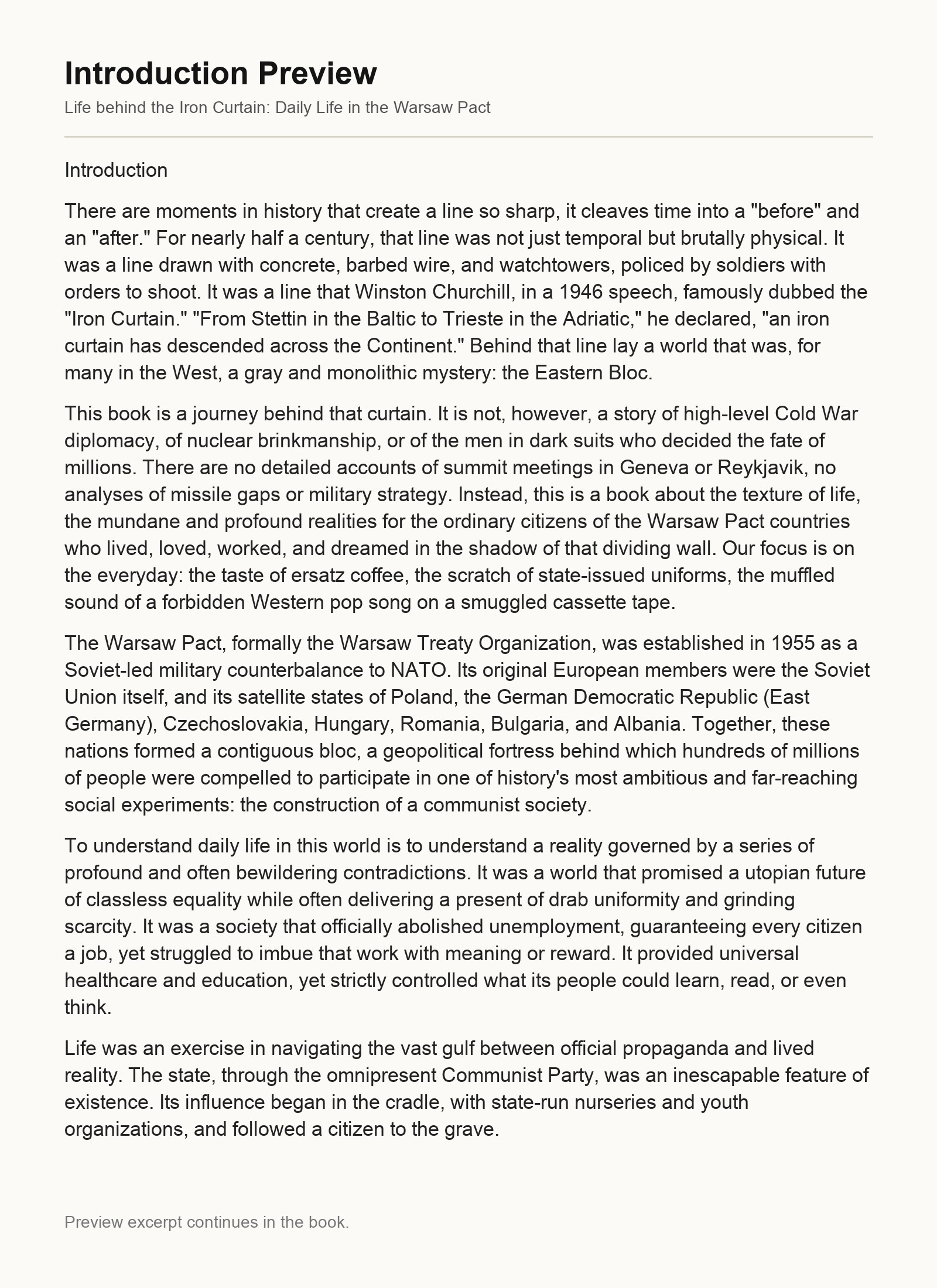
Life behind the Iron Curtain offers a vivid, intimate portrait of everyday existence in the Warsaw Pact countries, moving far beyond the familiar headlines of summits and spy games to reveal what it truly felt like to live under a system that promised equality while delivering scarcity, surveillance, and stark contradictions. Through twenty‑five carefully researched chapters, readers will walk the streets of panelák housing estates, stand in endless queues for basic goods, and hear the muffled crack of a forbidden Western song on a smuggled cassette, gaining a deep appreciation for the texture of daily life that shaped millions of ordinary people.
The book explores the pervasive reach of the secret police and the ways citizens learned to self‑censor, the relentless pressures of a centrally planned economy that produced both absurd shortages and a thriving black market, and the paradox of universal healthcare and education that coexisted with privileged elite services and widespread shortages of medicine. It delves into the design of mass‑produced housing, the indoctrination of youth through Pioneers and Komsomol, the grueling realities of factory work where “they pretended to pay us and we pretended to work,” and the creative coping strategies families devised in the kitchen, from home gardens to elaborate holiday feasts that defied state‑imposed austerity.
Readers will also discover how people carved out private spheres of freedom—weekend dachas, smuggled rock tapes, whispered jokes, and samizdat literature—while navigating state‑sanctioned leisure, strict travel bans, and the ever‑present tension between official propaganda and personal belief. The narrative covers the complex roles of women burdened by a “second shift,” the varied experiences of religious faith under state atheism, the environmental toll of unchecked industry, and the quiet persistence of ethnic minorities striving to preserve their identities amid assimilation campaigns. Each chapter reveals both the oppressive mechanisms of the regime and the remarkable resilience, ingenuity, and humor that allowed ordinary citizens to sustain their humanity.
By presenting a balanced, evidence‑based account that avoids both romanticization and condemnation, the book equips readers with a nuanced understanding of why the socialist experiment ultimately faltered and how its legacy continues to influence contemporary attitudes toward authority, community, and personal freedom. It is an essential resource for students, historians, and anyone curious about the social mechanics of the Cold War era, offering insights that resonate with modern discussions about surveillance, economic planning, and the balance between state control and individual liberty.
Step into the shoes of those who lived behind the Iron Curtain and experience the sights, sounds, and struggles of a world that once divided a continent. This book invites you to feel the weight of a queue, the thrill of a smuggled record, the quiet defiance of a joke told in a kitchen, and the hope that flickered in the margins of a tightly controlled society—providing a compelling, human‑centered perspective on a chapter of history that still echoes today.
What You'll Find Inside:
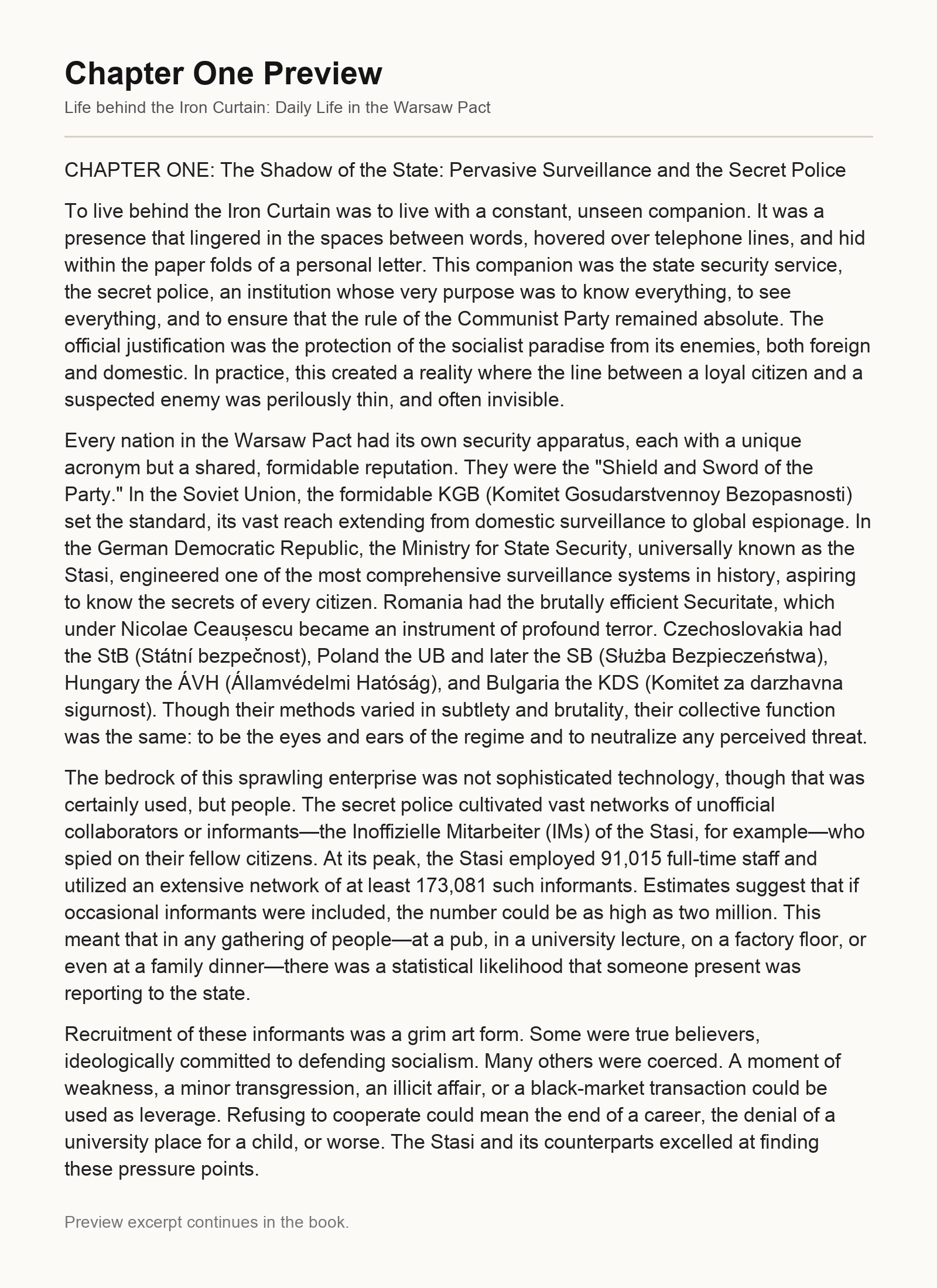
- The pervasive surveillance state and secret police apparatus that monitored citizens through informants, wiretapping, and psychological warfare tactics like Zersetzung
- The realities of the planned economy including chronic shortages, endless queues for basic goods, and the essential black market that kept daily life functioning
- Housing conditions from the standardized Panelák apartments to communal living arrangements, revealing both improvements in living standards and enforced uniformity
- Education and youth indoctrination systems that sought to mold the 'New Socialist Man' from cradle through university, blending academics with political conformity
- The duality of official state-sanctioned leisure versus private escapes like dachas, pubs, and nature outings where citizens cultivated authentic lives away from state scrutiny
Who's It For:
This book is ideal for readers interested in social history and the everyday experiences of ordinary people behind the Iron Curtain. It will particularly appeal to students of Cold War history, European studies, sociology, and anyone seeking to understand life under communist regimes beyond political diplomacy and military conflicts. Those curious about how ideological systems shaped daily routines, relationships, and personal struggles will find rich insights into the texture of life in the Warsaw Pact countries.
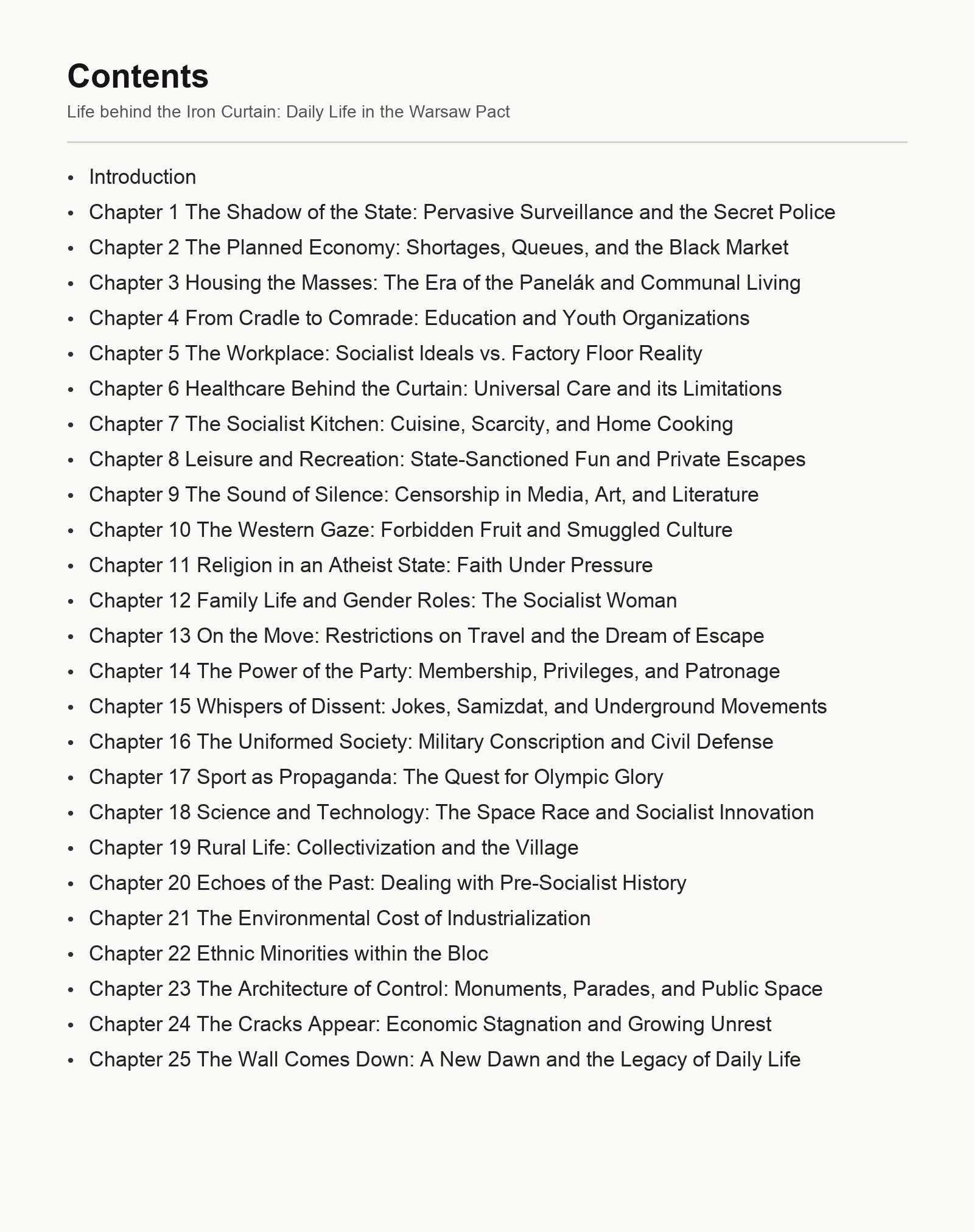
Table of Contents:
- Introduction
- Chapter 1 The Shadow of the State: Pervasive Surveillance and the Secret Police
- Chapter 2 The Planned Economy: Shortages, Queues, and the Black Market
- Chapter 3 Housing the Masses: The Era of the Panelák and Communal Living
- Chapter 4 From Cradle to Comrade: Education and Youth Organizations
- Chapter 5 The Workplace: Socialist Ideals vs. Factory Floor Reality
- Chapter 6 Healthcare Behind the Curtain: Universal Care and its Limitations
- Chapter 7 The Socialist Kitchen: Cuisine, Scarcity, and Home Cooking
- Chapter 8 Leisure and Recreation: State-Sanctioned Fun and Private Escapes
- Chapter 9 The Sound of Silence: Censorship in Media, Art, and Literature
- Chapter 10 The Western Gaze: Forbidden Fruit and Smuggled Culture
- Chapter 11 Religion in an Atheist State: Faith Under Pressure
- Chapter 12 Family Life and Gender Roles: The Socialist Woman
- Chapter 13 On the Move: Restrictions on Travel and the Dream of Escape
- Chapter 14 The Power of the Party: Membership, Privileges, and Patronage
- Chapter 15 Whispers of Dissent: Jokes, Samizdat, and Underground Movements
- Chapter 16 The Uniformed Society: Military Conscription and Civil Defense
- Chapter 17 Sport as Propaganda: The Quest for Olympic Glory
- Chapter 18 Science and Technology: The Space Race and Socialist Innovation
- Chapter 19 Rural Life: Collectivization and the Village
- Chapter 20 Echoes of the Past: Dealing with Pre-Socialist History
- Chapter 21 The Environmental Cost of Industrialization
- Chapter 22 Ethnic Minorities within the Bloc
- Chapter 23 The Architecture of Control: Monuments, Parades, and Public Space
- Chapter 24 The Cracks Appear: Economic Stagnation and Growing Unrest
- Chapter 25 The Wall Comes Down: A New Dawn and the Legacy of Daily Life
Author:
Published By:
Date Published:
May 16, 2026
Type:
Nonfiction
Language:
English
Also Available In:
Word Count:
47,720 words
Reading Time:
3 hours 21 minutes
Sample:
Order:
Order Life behind the Iron Curtain (Paperback) on MixCache.com:
Buy NowPrint copy is made to order and ships worldwide. Includes the ebook free, ready to read instantly.
$5 account credit for all new MixCache.com accounts, usable toward any ebook purchase!*